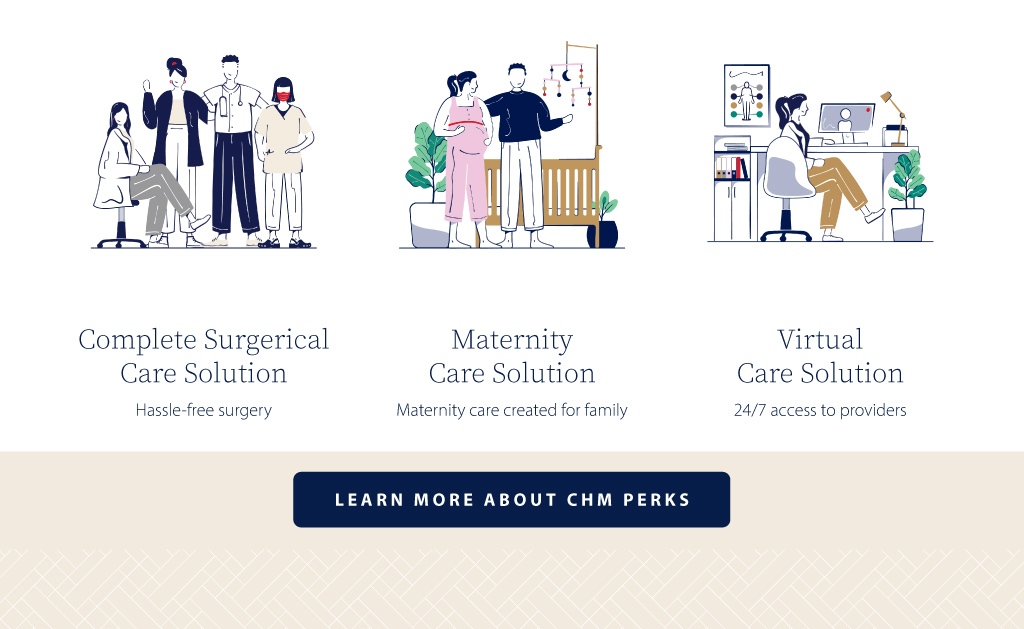
CHM members are free to choose their own healthcare providers, take advantage of our preferred CHM providers (who give unique discounts to CHM members), or use a provider we’ve helped you select for certain medical events (maternity or non-emergency surgical procedures). Our CHM Care Solutions offer specialized care components to help you navigate your healthcare journey, often leading to savings, superior treatment and peace of mind. For example, you can also use HealthTap providers through our Virtual Care Solution for your primary or urgent care needs.

Whether you choose to use a provider CHM recommends or another provider, we can give you the tools to effectively communicate with your provider about your medical bills.

3 tips for talking to your doctor

These principles can go a long way when communicating with your healthcare provider and establishing a relationship with them.

  1. Open communication: Be clear and upfront about your billing status and how you intend to pay your bills.
  2. Proactive approach: Ask upfront for itemized bills and about discounts that are available to you. Ask questions to aid your understanding of their billing process.
  3. Owning the “stewardship” responsibility that all Christians share: Be diligent to negotiate fair pricing with your providers and be quick to pay them fully for services they’ve rendered.

Healthcare providers: steps for successful interactions

We’ve worked with more than 100,000 healthcare providers nationwide, and we’re sharing our best tips from personal experience and from what CHM members have shared with us.

Tell your provider that you’re eager to pay your bills: Build rapport with your provider; when they know you want to pay your bills, the conversation will go more smoothly. Plus, it’s a testimony to others when we, as Christians, are determined to “do right” by them.

Communicate your billing status: Tell your healthcare providers that you’re uninsured and should be billed as a self-pay patient. We recommend telling your provider: “I don’t have insurance. I have something better: Christian Healthcare Ministries, which is a health cost sharing organization. Please apply any available uninsured or self-pay discounts to my bill.”

Your CHM card is not an insurance card. However, if your provider has a prearranged discount with CHM (see the “CHM friendly-providers” lookup tool on your Member Portal), show your card to your provider to identify yourself as a CHM member to take advantage of the discounts.

Self-pay versus uninsured:

  • What is self-pay? It means you are paying your medical bills yourself rather than the provider billing insurance. A self-pay patient may or may not have traditional insurance. Most providers offer discounts for self-pay patients.
  • “Uninsured” refers to people without health insurance. CHM isn’t insurance, and, if you don’t have a primary health insurance, you’re considered uninsured; however, CHM is an exemption to the Affordable Care Act and as such is an eligible option under the national healthcare law. Providers often offer discounts or options for people without insurance.

Ask for three things: 1) to be billed directly, 2) that bills are itemized, and 3) that any available self-pay or uninsured discounts are listed. As you submit bills to CHM, be sure to reference the CHM Guidelines for sharing eligibility. An itemized bill contains:

  • Patient’s name
  • Date of service
  • Place of service
  • Procedural (CPT) code or description of service
  • Charge for each service

Avoid aggressive prepayment practices by calling CHM first: Please don’t pay upfront (unless the bill is less than $1,000).

A provider may require upfront payment or offer a discount only when services are paid upfront. However, the cost may have been marked up and still be over fair market value after the discount applies.

That’s why we recommend, prior to paying bills totaling $1,000 or more from an individual healthcare provider, contacting Member Advocate by calling 800-791-6225 when the following circumstances apply:

  • You’re unable to obtain a self-pay discount
  • You obtain a discount, but the provider requires payment upfront or has a deadline for payment

If required to pay upfront for a surgery: Contact CHM’s Complete Surgical Care Solution (CSCS) team if you’ve been recommended surgery and have a diagnosis. CSCS matches you with a quality provider offering services at a fair-market price. You get the care you need and CHM takes care of the rest, by paying your provider directly for eligible bills. From January-April 2025, CHM members through CSCS saved $2.5 million in medical costs!

Ask about other financial assistance available: Apply for any financial assistance available to you, even if you don’t think you qualify.

 As you ask, know that most hospitals are required to provide certain types of medical care at a reduced cost, so don’t be afraid to advocate for yourself. As self-pay, uninsured patients, CHM members may qualify for financial assistance programs which are offered by the hospital. Likewise, state and federal governments also allocate money toward healthcare for individuals whose incomes fall within a defined economic level.

Work together to create a strategy: Work with your provider to set up a monthly payment plan until your eligible medical costs have been processed and reimbursed in accordance with the CHM Guidelines.

Promptly pay your providers with your CHM sharing funds: Every membership unit must satisfy an annual Personal Responsibility; this is considered your out-of-pocket expense. Once this amount is met, you will receive reimbursement for the remaining eligible medical costs. It is your responsibility to use funds received from CHM to pay the appropriate healthcare providers.

Maternity only: If you have a maternity event, learn more about specific steps to take when communicating with your providers and how CHM can support you.

Communication in healthcare

As you follow these steps, you’ll be on your way to building an effective, professional relationship with your healthcare provider.

Being a self-pay, uninsured patient gives you the perks, flexibility, and opportunity to make the best decisions for your medical care. It’s another great advantage of being a part of the CHM family.

Being engaged in your healthcare decisions makes all the difference. The more you talk with your providers, the more you’ll be equipped to navigate the marketplace with ease. Plus, remember that the CHM staff is standing by, ready and willing to help along the way!

What is an itemized bill?

Save this pocket-sized explanation of the five elements that are included on an itemized bill. Bringing this handy tool will enable you to explain what you need so CHM can process your sharing request.

Ready to grow your family?

We want this experience to be full of joy and excitement as you welcome a new life into the world! Ready to dive into our maternity solution?

If you’re a member, call us within the first 16 weeks of pregnancy so we can:

  • Take $500 off your Personal Responsibility
  • Connect you to the best care in your area
  • Offer prayer, spiritual support, and Christian community

Please note: You must have joined CHM at least 300 days before the estimated delivery date. Please see the CHM Guidelines for more information.

Please call 1-800-791-6225 and select the maternity line to get started! Or learn more about the maternity sharing process here.

You are not alone

Preparing for pregnancy

Planning to grow your family is an exciting and often stressful time. Regardless of whether you’re currently just pondering the idea or actively trying to conceive, now’s the time to start preparing your heart, body, and budget.


Read more
Doula vs. midwife: understanding the difference

Doulas and midwives are trained to be “Mom’s helpers.” Both are involved in the birthing process, but their qualifications, training, and duties differ. Professional requirements for doulas and midwives vary with individuals, training or certification, and changing laws or standards of care. Ask local health officials for current regulations.


Read more
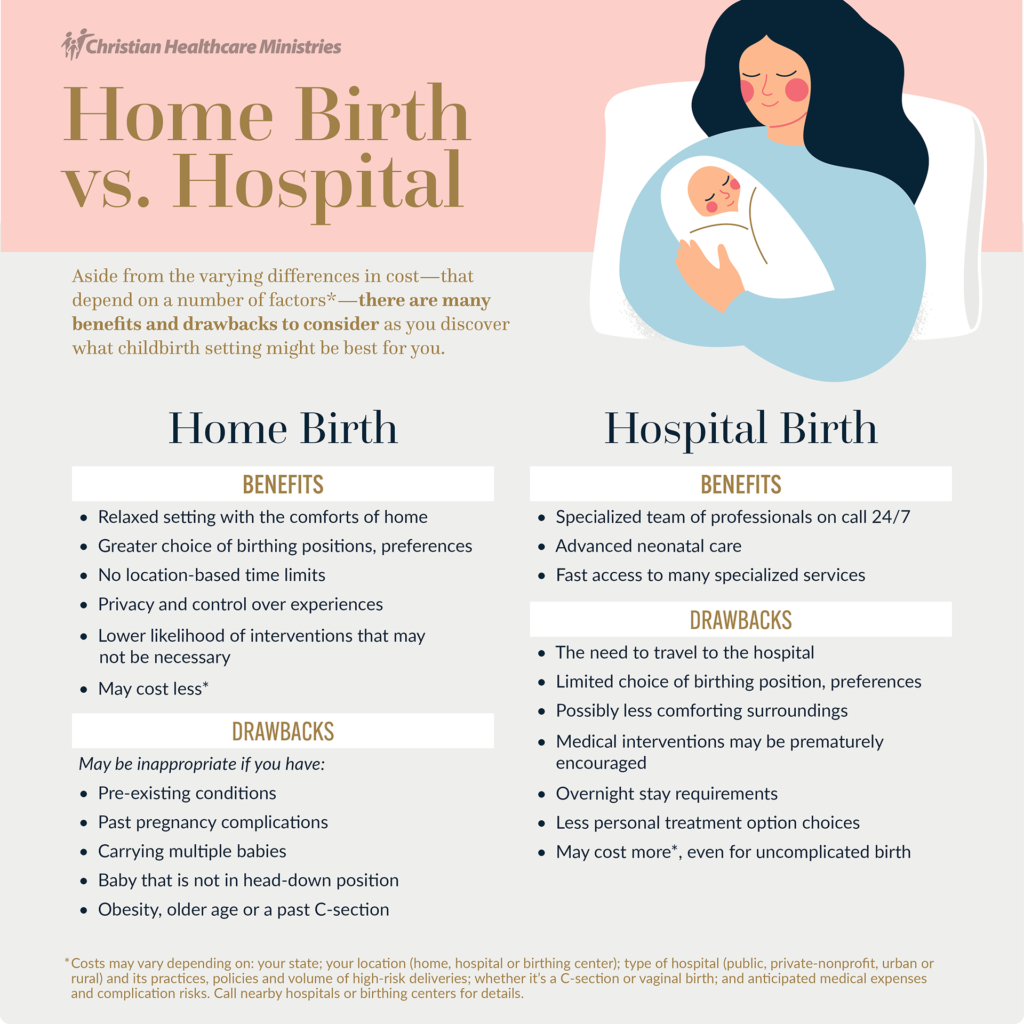
Home birth vs. hospital birth

When you’re expecting, each day brings you closer to the moment you see your newborn face-to-face. You’re sure to have countless questions about childbirth and adding to your family. How much does it cost to give birth? What labor and delivery bills can I expect? How does home birth compare to hospital birth?


Read more

We’re right here with you during this journey. Download our free Maternity Guide to learn more about how CHM supports you during this exciting stage of life.

We also want to provide you with helpful maternity resources. If you sign up for our maternity email journey, you can receive:

  • Information you should know about our maternity solution and how we process your bills
  • Facts about our nurse navigator and how she can be a blessing to you
  • Helpful information about choosing a maternity provider and healthcare team
  • Devotionals about pregnancy and motherhood
  • Budgeting and baby preparation tools
  • Answers to common medical questions you might have about your pregnancy
  • Catered emails with information that’s specific to where you are in your maternity journey
  • Call our Maternity Care Team

    As soon as you learn you’re pregnant, call our Maternity Care Team!

    CHM members who call within the first 16 weeks of pregnancy can receive a $500 Personal Responsibility reduction. Call
    1-800-791-6225 and select the maternity line to connect with the Maternity Care Team and our maternity nurse navigator.

  • Ask for a prepayment agreement

    Ask for a prepayment agreement on your clinic/hospital/doctor’s letterhead.

    Your prepayment agreement should have the patient information, list of services included (or CPT codes), total charges, and due date the prepayment agreement needs to be paid by.

  • Submit prepayment agreement

    Immediately submit Sharing Request forms, the prepayment agreement, and any additional itemized bills

    Your Sharing Request forms can be filled out digitally through the Member Portal. Notify the CHM office immediately if your healthcare provider sets a time limit for reduced charges on your prepayment agreement (seven months is common).

More about our maternity solution

Below is additional information about our maternity solution. Download our free Maternity Guide to learn more about how CHM supports you during this exciting stage of life.

Is CHM’s Maternity Care Solution available on all programs?

Yes. The maternity event will be shared according to the member’s program participation 300 days prior to their expected due date, as verified by a medical professional.

Eligible maternity events must satisfy the following maternity Personal Responsibility amounts before any reimbursement funds can be distributed:

  • CHM Gold—$2,500
  • CHM Silver—$5,000
  • CHM Bronze—$9,000

For more information about maternity Personal Responsibility and switching programs with respect to your maternity event, see the CHM Guidelines.

What’s eligible under the maternity solution?

CHM shares qualifying medical bills for prenatal care, delivery (including cesarean and multiple births), home births, midwives, postnatal care, and complications that arise for mother and baby.

For prenatal care, CHM shares:

  • routine office visits
  • lab tests
  • maternity-related prescriptions and immunizations
  • three ultrasounds

For delivery, CHM shares costs associated with:

  • facility labor and delivery
  • physician labor and delivery
  • anesthesiology services
  • complications that arise for mother and baby

Note: CHM shares expenses from either a midwife or a physician, not both. (For an exception, see CHM’s maternity Guidelines.) We cannot share expenses from more than one midwife.

For postnatal care, CHM shares:

  • mother’s postpartum check-ups
  • lactation consultations
  • postpartum depression treatment
  • wellness visits, circumcision, and tongue tie for baby*

For a list of ineligible maternity expenses, please refer to CHM’s maternity Guidelines

*See maternity Guidelines for more information on baby’s eligibility under mother’s membership unit.

What can I expect after submitting my maternity incident?

Once CHM receives all the necessary paperwork and invoices, we’ll review the bills to make sure they’re properly itemized and eligible according to CHM Guidelines. Once CHM issues your reimbursement check, you’re responsible to promptly pay your healthcare provider.

Documents required for sharing include:

  • your prepayment agreement/global fee
  • Medical Information Release and Patient Delegation Form
  • Maternity Verification Form
  • itemized bills for services not included in your prepayment agreement

Failure to submit the necessary documents can result in sharing delays. We recommend uploading via the Member Portal, as all the necessary forms are fillable directly from the Portal.

Please note: CHM will process your prepayment agreement near the 30th week of pregnancy. We ask that you plan on checks going out around that time.

A prepayment agreement for facility charges must include the length of the hospital stay and whether or not the baby’s facility charges are included.


What is a prepayment agreement/global fee?

Your physician or midwife may provide you with a prepayment agreement/ global fee. This usually includes:

  • prenatal appointment
  • physician/midwife delivery charges
  • postpartum appointments (for mom)

In order to process your prepayment agreement, it must include:

  • provider information
  • patient name
  • a list of all services included in the fee
  • total fee for services
  • the payment due date or payment plan details

You’ll need to obtain itemized bills for any medical services performed outside of the global fee. Charges outside of the global fee typically include:

  • lab work
  • ultrasounds
  • additional appointments
  • hospital/ER visits

Note: Some prepayment agreements/global fees include lab work and ultrasounds. Please review your agreement before sending in itemized bills.

What’s the difference between a prepayment and an estimate?

An estimate is a ballpark figure that’s subject to change.

prepayment agreement is an agreed-upon price that stays the same as long as the conditions of the agreement are met.

While prepayment agreements are preferable, if you receive an estimate, please submit it so our team can work with you and your provider to receive additional information.

If you need assistance obtaining a prepayment agreement, please contact the Maternity Care Team at 1-800-791-6225.

Does CHM reimburse facility/hospital prepayment agreements?

Our Maternity Care Team (MCT) wants to help our members receive bundled facility flat rates. Please contact the MST at 1-800-791-6225 for assistance finding flat rates available in your area.

Facility/hospital prepayment agreements (or flat rates) must include:

  • the patient’s name
  • provider or place of service
  • CPT codes or descriptions of services
  • the total charge for each service
  • length of your hospital stay
  • whether newborn charges are included
  • due date of the prepayment agreement

Anesthesiology charges are eligible for sharing, but CHM cannot share these expenses prior to the birth. You’ll need to pay these charges out of pocket if your provider requires payment before delivery. You can upload the estimated bill into the CHM Member Portal prior to delivery, then submit the actual bill after the birth. Following this suggestion will significantly shorten sharing time.

Note: You may receive additional medical bills for your baby’s after-delivery hospital care, such as lab work, hearing tests, pediatrician visits, etc. You can submit the itemized bills as “maternity add-on” bills.

Is genetic testing eligible for sharing?

Genetic testing may be eligible for sharing if:

  1. It’s non-invasive and required to determine treatment for a current medical condition.
  2. Medical records or healthcare provider notes are provided for verification.

Note: An amniocentesis may be considered for sharing when medical records confirm that the procedure is necessary to determine life-preserving medical care for the baby and/or mother.

Are medical bills for congenital conditions eligible for sharing?

For members whose birth was shared through CHM’s maternity program, CHM shares up to $200,000 for medical bills related to their congenital condition if the following conditions are met:

  1. For a dependent child, the child’s mother must be a CHM Gold member with an account in good standing and must remain a CHM Gold member until $200,000 is shared.
  2. The individual who incurred the bills has continuously been a CHM Gold member (no interruptions in membership) since birth or adoption.

For CHM Silver and CHM Bronze members, or CHM Gold members who don’t meet the above requirements, you can submit expenses for congenital conditions for sharing with a maximum total of $25,000 per illness.

Note: Babies with a congenital birth defect must transition immediately from their mother’s membership unit to their own unit.

For more information, please reference the CHM Guidelines.

How does CHM spiritually support members?

We believe supporting each other spiritually is as important as the financial support members receive. Our Maternity Care Team will pray for you, provide you with spiritual resources, and encourage you to participate in a community with each other.

CHM members lift each other up in prayer through the Prayer Wall, located on the Member Portal. See prayer requests submitted by your fellow CHM members, and submit prayer requests of your own so your CHM family can pray for you, too.

Through Prayers Unceasing, included in your Monthly Contribution Form, members have the opportunity to reach out to each other through prayer, cards, and notes of encouragement. By visiting us every Wednesday on social media, you can join members across the country in praying for one another.

CHM staff also pray daily for members, especially those who have submitted prayer requests by mail, email, or phone. Staff members are dedicated prayer warriors available to pray with you over the phone at your request.

As a CHM member, you’re not bound to any provider network. Instead, as long as the expenses are eligible for sharing according to the CHM Guidelines, you have flexibility in choosing which provider you want to trust with your care.

This is a fantastic advantage—but it does mean that sometimes your provider won’t know about CHM. What should you do then?

Here are five tips to guide you through this interaction.

Your care is handled by you. 

As you’re talking with your provider, it’s important to emphasize medical decisions are handled by you and your provider. They don’t need to get approval or permission from CHM for different treatments. If you have questions about the eligibility of your treatments, check the CHM Guidelines or call us first at 800-791-6225.

Explain that you’re a self-pay patient. 

This means you need itemized bills sent directly to you, and that you would like self-pay or uninsured discounts. Most doctor’s offices and hospitals already have pre-established discounts for self-pay and uninsured patients that will be easily applied to your bill.

Remember, an itemized bill contains: 1) the patient’s name; 2) the date of service; 3) the place of service; 4) the procedural (CPT) codes (or description of services rendered); and 5) an itemized list of charges.

Assure your provider of payment. 

While you are a self-pay patient, you have your fellow CHM members to help you carry the burden of health cost sharing! You can assure your providers that they will get paid in a timely fashion. If needed, set up a payment plan with them; usually even small payments will do. When you receive CHM’s check, you can reimburse yourself for your payments and pay your provider.

Know that CHM is here to help. 

We have resources online written specifically for interacting with providers to help them understand who CHM is, what we do, and how we work. If you’re having difficulties with a discount or have questions about interacting with your providers, our Member Advocate and Provider Relations teams are standing by to help.

Pay your providers quickly by utilizing the Member Portal. 

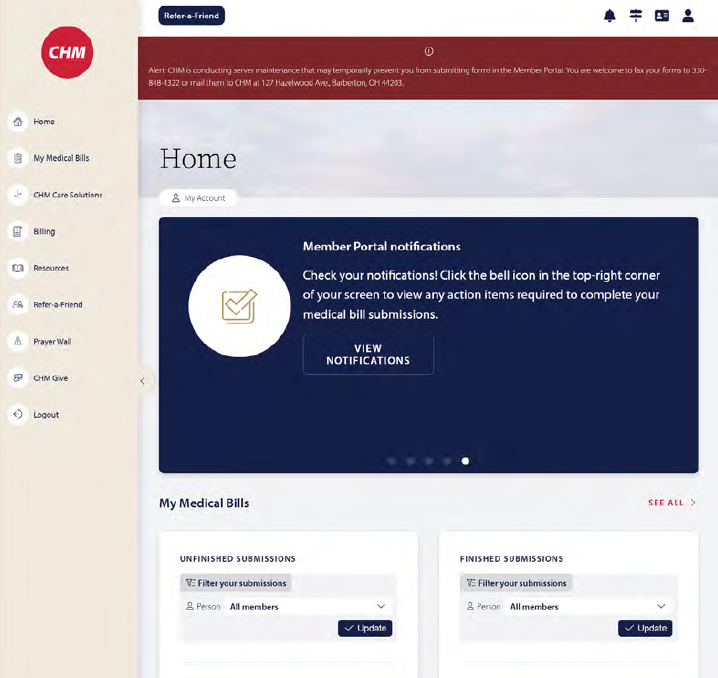
Submitting your Sharing Request Packet on the secure Member Portal is the most secure and easiest way to submit your medical bills. This helps us process your reimbursement efficiently so that you can pay your providers.

Medical costs are stressful enough without having to navigate a complicated system. Christian Healthcare Ministries (CHM) offers a different approach.

Health cost sharing is not a new idea. Christians have been bearing one another’s burdens for generations [Galatians 6:2]. Christian Healthcare Ministries was founded on that principle, bringing believers together to share one another’s eligible medical expenses.

Members support one another through a simple, transparent process. This guide provides a quick overview of how CHM works and what members can expect.

How health cost sharing works at CHM

The process follows three simple steps:

  1. You choose the program that best fits your needs and send your monthly contribution. These contributions help meet eligible medical bills for fellow members.
  2. When you have an eligible medical need, you submit your bills to CHM for review.
  3. Eligible medical bills are shared based on the program you selected.

All sharing follows the CHM Guidelines, which are accessible to all members, so you always know what to expect.

Picking your CHM Program

CHM offers four main programs, each designed to meet you where you are: CHM Gold, CHM Silver, CHM Bronze, and CHM SeniorShare. CHM also offers additional solutions and perks to support members beyond the core programs.

Why CHM programs are easy to use:

  • Every program follows the same process, so sharing works consistently no matter which option you choose.
  • You choose your own healthcare provider. There are no networks to navigate, and you can often negotiate self-pay discounts directly with your provider.
  • Monthly contributions stay the same each month, so you always know what to expect.

Ready to choose? Keep these tips in mind:

  • Consider how frequently your family requires medical care. Households with higher usage often benefit from a more comprehensive program like CHM Gold.
  • Consider your budget. CHM offers programs at various contribution levels, from the affordable CHM Bronze to the comprehensive sharing of CHM Gold.
  • If you are 65 or older and on Medicare, CHM SeniorShare is designed specifically for you. It works alongside Medicare to help fill coverage gaps.

Still not sure? Use CHM’s Find Your Program tool to pick your perfect fit.

Types of eligible medical needs members typically share

Soul care is the intentional practice of nurturing your relationship with God. It CHM members share a wide range of medical needs. Some of the most common include:

  • Cancer care: Support for members facing a cancer diagnosis, including treatment-related expenses such as chemotherapy, radiation, and surgery.
  • Maternity care: Sharing for prenatal visits, labor and delivery, and postnatal care for growing families. Having a baby is one of life’s greatest blessings, and CHM helps keep the focus on that joy rather than on medical bills.
  • Surgical care: Support for a broad range of surgical procedures, from planned operations to urgent interventions. Members can choose their own surgeon and facility without network restrictions.
  • Prescription care: Help with eligible prescription costs so members do not have to carry those expenses alone.

These shared needs reflect the everyday realities members face and the practical support CHM provides. With a few simple steps, the sharing process can stay smooth from start to finish.

3 tips to make sharing simple

Getting the most out of CHM starts with a few simple habits:

  1. Ask your provider to bill you directly instead of paying up front at the time of treatment. If needed, you can request a payment plan to allow CHM time to complete the sharing process.
  2. Mention your CHM membership at every appointment. Many providers will work with you on pricing when they know you’re a self-pay patient. Building that relationship early makes the process smooth.
  3. Submit bills promptly through the CHM Member Portal. It is your main hub for uploading bills, tracking sharing requests, and staying up to date. Submit an itemized bill as soon as you receive it to keep everything moving.

Understanding the CHM Guidelines

The CHM Guidelines form the foundation for how health cost sharing works at CHM. They outline eligibility requirements, how to submit medical needs, and what members receive through sharing.

CHM makes the Guidelines available to both current and prospective members. Reviewing them before joining helps you understand the process and what to expect.

Health cost sharing made simple

Christian Healthcare Ministries provides a practical, faith-based approach to managing medical costs. Once you understand the basics, the process is clear and easy to follow.

Learn more about Christian Healthcare Ministries and explore the available programs by clicking here.

In my virtual primary care practice, I often see patients who come in with a variety of complaints—insomnia, chronic headaches, digestive issues, or just a general sense of being “unwell.” While we always investigate physical causes, more often than not, the trail leads back to a silent, pervasive orchestrator: stress.

Understanding stress isn’t just about “relaxing more.” It’s about understanding the biological machinery of your body and learning how to operate the controls.

What exactly is stress?

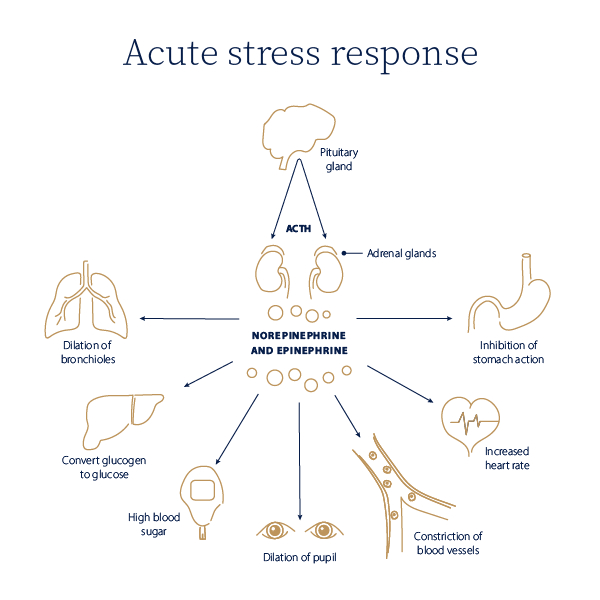
At its core, stress is a survival mechanism. It’s the body’s reaction to any change that requires an adjustment or response. When you perceive a threat—whether it’s a car swerving into your lane or an aggressive email from your boss—your body initiates the “fight-or-flight” response.

This process starts in the brain’s hypothalamus, which signals your adrenal glands to release a surge of hormones, primarily adrenaline and cortisol.

  • Adrenaline: Increases your heart rate, elevates your blood pressure, and boosts energy supplies.
  • Cortisol: The primary stress hormone, which increases sugars (glucose) in the bloodstream and enhances your brain’s use of glucose.

This system is magnificent for protection. However, the modern world triggers this high-intensity response for non-life-threatening situations, and many of us never “turn it off.”

How stress manifests: The body’s alarm system

Stress doesn’t just stay in your head; it speaks through your body. Because the stress response affects almost every biological system, the symptoms are incredibly diverse:

  • Physical: Tension headaches, muscle pain (especially in the neck and shoulders), chest pain, rapid heartbeat, and frequent colds due to a suppressed immune system.
  • Emotional: Irritability, anxiety, feeling overwhelmed, or a lack of motivation.
  • Cognitive: Racing thoughts, constant worrying, “brain fog,” and poor judgment.
  • Behavioral: Changes in appetite (eating too much or too little), procrastinating, or using negative coping mechanisms.

The domino effect: What chronic stress leads to

When the “fight-or-flight” system stays activated for days or months, it leads to chronic stress, which is a primary underlying driver for several serious health conditions:

  1. Cardiovascular disease: Constant high blood pressure and heart rate can damage arteries.
  2. Metabolic issues: Cortisol increases cravings for “comfort foods,” leading to weight gain and potentially Type 2 diabetes.
  3. Gastrointestinal disorders: Stress can exacerbate GERD (acid reflux), IBS, and stomach ulcers.
  4. Mental health disorders: Long-term exposure to stress hormones is a major risk factor for clinical depression and anxiety disorders.

Managing the storm: Daily habits and routines

To manage stress, we must focus on down-regulating the nervous system. Think of it as bleeding off the pressure from a steam engine.

1. The power of “micro-rest”

You don’t need a week in the tropics to reset. Implementing “micro-rests” throughout the day can prevent stress from compounding.

  • The 90-Minute Rule: Our brains work in ultradian rhythms. Every 90 minutes, take 5 minutes to step away from your screen, stretch, or simply stare out a window.
2. Nutritional resilience

Stress depletes B vitamins and magnesium. Focus on a “stress-busting” diet:

  • Complex carbohydrates: Oatmeal and whole grains prompt the brain to produce serotonin.
  • Fatty fish: Omega-3s can prevent surges in stress hormones.
  • Hydration: Even mild dehydration increases cortisol levels.
3. Sleep hygiene

Sleep is when your brain “cleans” itself of metabolic waste. High cortisol makes it hard to fall asleep, and lack of sleep raises cortisol—it’s a vicious cycle. Aim for a “cool, dark, and tech-free” bedroom.

Inventive ways to cope and prevent

Beyond the standard advice, I encourage my patients to try “system interrupts”:

  • The “temperature reset”: If you feel a panic spike, splash ice-cold water on your face or hold an ice cube. This triggers the mammalian dive reflex, which naturally slows the heart rate.
  • Box breathing: Breathe in for 4 seconds, hold for 4, exhale for 4, and hold for 4. This is a manual override for your autonomic nervous system.
  • Cognitive reframing: Instead of saying “I am stressed,” try saying “I am experiencing a high-energy state.” Reframing the physiological arousal as “readiness” rather than “fear” can change how your body processes the hormones.

When to reach out to your doctor

Self-management is vital, but it has its limits. You should schedule an appointment with your primary care physician if:

  • Stress is interfering with your ability to work or maintain relationships.
  • You are experiencing physical symptoms like chest pain or chronic digestive issues.
  • You feel a sense of hopelessness or are using negative behaviors to cope.

How we can help

A doctor is your partner in your journey to well-being. When you come to us for stress, we don’t just “hand out pills.” We provide:

  • Diagnostic screening: To ensure your symptoms aren’t caused by something else, like a thyroid imbalance or vitamin deficiency.
  • Referrals: We can connect you with specialized therapists or nutritional counselors.
  • Pharmacotherapy: If lifestyle changes aren’t enough, we can discuss short-term or long-term medications to help balance your brain chemistry while you work on other management strategies.
  • Actionable monitoring: We can track your blood pressure and markers of inflammation to see how your stress management is physically improving your health.

Stress is an inevitable part of being alive, but it does not have to be the pilot of your life. By understanding that stress is a physical process, you can use physical and mental tools to manage it. You are not “weak” for feeling stressed; you are simply human, reacting to a high-pressure world. Start small. Choose one habit—perhaps just five minutes of breathing or a consistent bedtime—and build from there. If you’re ready to take the first step, schedule an appointment with your HealthTap primary care physician for an evaluation. Virtual visits are included as part of CHM membership! Start today by clicking here, or visit www.healthtap.com/for/chm/.

Editor’s note: It’s important to note that any associated lab, testing, or treatment costs with HealthTap are not included, however, eligible bills can be submitted to CHM for sharing per your program as outlined in the CHM Guidelines. Please refer to the CHM Guidelines and applicable web pages for the most up-to-date information regarding sharing eligibility, CHM membership, and ministry news.

Despair. Depression. Doubt. Defeat. Darkness.

These are the “dragons” we face.

When these attacks of the enemy strike, we’re naturally equipped for battle, right? We always brandish our “swords” with fervent hearts and Christ-centered spirits, never frightened or shaken by the enemy.

If only this were true.

Instead, we often find ourselves struggling to stand—let alone fight back—against the lies of the enemy. It might be one small pesky dragon that continually nips at our heels and wears us down. Or perhaps there are many gigantic dragons, rearing their heads and filling our minds with fire and fog so thick we can’t find a path forward.

Either way, fighting a “dragon” requires confidence, courage, and tenacity. After all, there’s a reason why “Slay a Dragon Day” falls within the National Month of Hope. For without hope, we find ourselves stressed, worn, and weary:

Hope deferred makes the heart sick, but a longing fulfilled is a tree of life.” [Proverbs 13:12, NIV]

Hope is what our soul craves.

Definition of hope

Finding hope in a world so void of faith often feels futile. It’s not a quest for the fainthearted, it’s true.

But here’s the good news: hope in the Bible isn’t about “making wishes” and expecting them to magically appear. It isn’t about putting our faith in fanciful dreams or living in a state of constant yearning for our “maybe someday” moment to finally show up.

Biblical hope is based on something far greater.

May the God of hope fill you with all joy and peace as you trust in him, so that you may overflow with hope by the power of the Holy Spirit.” [Romans 15:13, NIV]

We have this hope as an anchor for the soul, firm and secure. It enters the inner sanctuary behind the curtain, where our forerunner, Jesus, has entered on our behalf. He has become a high priest forever, in the order of Melchizedek.” [Hebrews 6:19-20, NIV]

As defined in scripture, hope is found in the person of Christ. He is our high priest, seated at the right hand of the Father, working out goodness in our lives on our behalf:

Who then is the one who condemns? No one. Christ Jesus who died—more than that, who was raised to life—is at the right hand of God and is also interceding for us.” [Romans 8:24, NIV]

Hope means having a confident expectation of good. It means putting our hope in Christ, and His goodness, despite the times when the dragon of despair rears its ugly head.

It’s easier said than done, but when we redefine what hope means to our hearts, we can trade feeling hopeless for feeling hopeful.  We can tread upon the dragons out to defeat us [Psalm 91:13].

George and the dragon

There are many “dragon legends” across history and culture, but one of the most prominent is that of “George and the dragon” from medieval literature.

So the tale is told, George, a brave knight, sets out to save a kingdom from a terrible fire-breathing dragon. This dragon has been terrorizing the kingdom, demanding sacrifices and killing the villagers. In fact, the situation eventually reaches such a heightened state of evil that the dragon decides to capture the princess herself! However, just when all seems lost, George arrives and slays the dragon with his spear. By doing so, he frees the village from the bondage of the dragon’s darkness.

This legend highlights the battle of good versus evil, reminding us that light and hope will always win in the end. However, as believers, we have more power than George’s skills, spear, and steadfast heart combined.

We can fight our dragons with the hope of Christ, pushing back the darkness of despair and “slaying” the enemy forces that suffocate our souls.

Words of hope

Even when we’re feeling hopeless, we can take heart and root our spirits in God’s promises.

Here’s what’s true – we never go into battle alone. Jesus walks through the valleys with us, guiding us and shepherding our souls [Psalm 23]. What’s more, we’re armed with the “sword of the Spirit”, which is the Word of God [Ephesians 6:17]. When we speak words of hope into the darkness, we reflect the light of the Lord. When we call on His name, we can set our confidence on things above, knowing that His name is above every other name [Philippians 2:9-11]. He reigns above it all – hallelujah!

This doesn’t mean that we won’t face deep despair, discouragement, or depression. It doesn’t mean that we won’t fall short or take the wrong path. It doesn’t mean we won’t stumble and fall, bruising our hearts in the process. It doesn’t mean that we won’t give up sometimes, letting the dragons gain more ground over our minds.

This is okay, because even then, especially then, Bible verses about hope remind us that despair doesn’t win. God reminds us that we are still His beloved children.

The dragons may roar. The flames of fear may burn bright. The smoke of shame may seem stifling. But God will fight for you – you only need to be still [Exodus 14:14].

What if hope’s not a rope you hold onto.
What if it’s the arms that have always held you.
On the edge when it feels like you’re not gonna pull through
Is the place you discover that hope’s gonna find you.”
-Ellie Holcomb, Hope’s Gonna Find You

Embracing the adventure of living with Christ means embracing all the parts of our lives. Yes, that includes the dragons, too.

Despair. Depression. Doubt. Defeat. Darkness.

These are the “dragons” we face.

But what is life, if to not to confront and slay our dragons with Christ so we can serve His kingdom?

After all, as author J.R.R. Tolkien writes:

It simply isn’t an adventure worth telling if there aren’t any dragons.”

As followers of God, it can be disconcerting when we struggle with mental health. After all, if we know Jesus, why should we struggle with depression or anxiety? Maybe you, like so many others, were led to believe that struggling mental health reflects a failed spiritual life.

While mental health is too often ignored or stigmatized in Christian settings, it’s essential. First, it’s important to acknowledge that struggles with mental health are not caused by personal failing; mental health issues are often passed down from generation to generation, are a result from past trauma, or are based in current, unchangeable circumstances. Second, it’s important to know how to improve mental health. It’s not always possible to simply “pray away” our issues; sometimes God’s answer to our prayers is right in front of us—to utilize resources He’s provided to us.

Counseling is an essential resource for mental health because it provides practical tools to help people understand their emotions and behaviors. While prayer, Scripture, and even medication are powerful sources of strength, God also provides wisdom through community and trained counselors who can help individuals navigate life’s challenges. This counsel can look like talking to trusted friends, biblical counseling with a leader in your church, or even scheduling appointments with a licensed therapist.

Counseling can support you in a myriad of ways, including the following:

It provides a safe space to process emotions

Counseling offers a confidential environment where people can talk openly about struggles such as stress, grief, anxiety, or relationship difficulties. A counselor helps individuals explore these feelings in a healthy and constructive way.

Many people carry emotions for a long time without processing them. Instead of carrying these burdens alone, individuals can talk openly and receive compassionate guidance.

“Anxiety in a man’s heart weighs him down, but a good word makes him glad” [Proverbs 12:25, NIV].

It helps people understand themselves better

Through counseling, individuals can identify issues in their thoughts, behaviors, and relationships. This increased self-awareness can help people understand unhealthy patterns in their thinking, why they react in certain ways, and how past experiences may influence current challenges.

Rooting out unhealthy habits is a starting point for important change, allowing room for God to work in our hearts. “For the word of God is living and active…discerning the thoughts and intentions of the heart” [Hebrews 4:12, ESV].

It teaches coping skills

Counselors help people develop practical strategies for managing stress, regulating emotions, and responding to difficult situations. Developing skills can improve resilience and make it easier to handle life’s challenges. These coping strategies can also be integrated into faith practices, like prayer journaling, mediating on Scripture, and formative prayer.

This is part of the reason believers need to seek wise counsel: “Plans fail for lack of counsel, but with many advisers they succeed” [Proverbs 15:22, ESV]. A counselor can help individuals apply biblical principles to real-life struggles while developing practical coping skills.

It heals in more way than one

Counseling can be an important step in addressing issues like depression, trauma, anxiety, or burnout, and from a faith perspective, it can be one way God brings healing and restoration.

But it does more than just heal emotions—mental health and physical health are closely connected. What happens in the mind often affects the body, and vice versa. When mental health struggles go unaddressed, they can influence everything from sleep and energy levels to heart health and immune function.

Peace I leave with you; my peace I give you. I do not give to you as the world gives. Do not let your hearts be troubled and do not be afraid” [John 14:27, NIV].

It improves relationships

Have you ever struggled to make friends? Or maybe you’ve had friendships struggle or end because of conflict? Perhaps anxiety has made it difficult to be vulnerable with others?

Mental health issues often affect communication and relationships. Counseling can help people learn healthier communication patterns, establish boundaries, and build stronger connections with others.

We were not created to live in isolation. God designed people for community and support, and seeking help is not a sign of weak faith—it’s an act of humility and wisdom. Through counseling, many people experience emotional healing, renewed hope, and a deeper reliance on God’s grace.

Mental health influences every part of life—work, family, physical health, spiritual life—and helps people grow emotionally and mentally, leading to greater balance, purpose, and well-being.

In short, counseling isn’t just for moments of crisis. It’s a valuable tool for growth, healing, and maintaining healthy mental and emotional lives. And yes, it IS for everyone.

Every year on World Health Day (April 7), people around the globe pause to reflect on a simple but powerful idea: healthcare should be accessible.

For millions of families, however, that ideal still feels far out of reach. In the United States, the cost of healthcare has become a source of fear, stress, and uncertainty. During the most recent presidential cycle, surveys consistently showed that catastrophic healthcare costs ranked as the number one concern on the minds of American voters.

We understand this concern is not theoretical—it’s deeply personal. CHM is designed to help Christians gain access to the healthcare they need without being crushed by financial burdens. Over the years, CHM has helped hundreds of thousands of Christians receive care that might otherwise have been delayed, denied, or financially devastating.

By bringing Christians together, we create a community where members help carry one another through times of medical need. Scripture calls us to fulfill the law of Christ through carrying each other’s burdens [Galatians 6:2]. CHM is a living expression of that calling.

Access to care, however, is about more than paying medical bills. It also means being able to get care when it’s needed. One of the most important ways CHM supports members is by providing virtual primary care and urgent care visits through HealthTap—CHM’s Virtual Care Solution. For many members, this has been a gamechanger. Instead of waiting weeks for an appointment or hesitating because of cost or inconvenience, members can connect quickly with a qualified clinician for common medical concerns, guidance, and reassurance. Early access often prevents small problems from becoming larger, more expensive ones—and it gives members peace of mind knowing help is just a tap away.

A third and equally critical way CHM improves access to high-quality care is through our other medical support teams, also known as our Care Solutions. These include Maternity Care Solution, Complete Surgical Care Solution, and Cancer Care Solution. Each of these solutions are designed and staffed with a clear goal: to help members receive excellent, accessible medical care while avoiding unnecessary cost, confusion, and delay.

Our Care Solutions have already saved CHM members millions of dollars in aggregate healthcare costs, but the financial impact tells only part of the story. Through these solutions, members are connected with high-quality physicians, surgeons, hospitals, and treatment centers—often leaders in their fields. Good outcomes are not accidental; they are the result of thoughtful coordination and informed decision-making.

Central to the success of these Care Solutions are our contract nurse navigators. These dedicated professionals work closely with members and care teams, helping guide individuals through complex medical situations. A cancer diagnosis, a planned surgery, or a complicated pregnancy can feel overwhelming. Nurse navigators help members understand treatment options, coordinate care, gather medical records, and stay focused on the best path forward.

On World Health Day, it’s worth reflecting on what access to care truly means. It means care without fear. Care without financial ruin. Care that respects both the dignity of the patient and the wisdom of stewardship. CHM exists to make that vision real— not through government mandates or insurance bureaucracy, but through a community of believers choosing to care for one another.

In a world where healthcare often feels broken and impersonal, CHM stands as a reminder that there is another way. When Christians come together in faith, responsibility, and compassion, access to meaningful healthcare without hardship is not just possible—it is already happening.

References


World Health Organization
https://www.who.int/campaigns/world-health-day


“And let us consider how to stir up one another to love and good works, not neglecting to meet together, as is the habit of some, but encouraging one another, and all the more as you see the Day drawing near.” – Hebrews 10:24-25 [ESV]

After celebrating the resurrected King, our hearts may grow weary as the wonder of the season begins to fade. However, Hebrews 10:24-25 spurs us forward, encouraging us as the Body of Christ to resist stagnation. With every decision and discussion, we’re meant to live out a higher calling of care, community, and Christlike love.

Here’s the exciting part: CHM members serve as a tangible testimony to the rest of the world as you “stir up one another to love.” Biblical love brings God’s light into the broken places we (and our family and friends) may sometimes hide.

Caring for others: Within your CHM family

Opportunities to demonstrate care and build up other believers abound within our unique health cost sharing model.

Here are a few ways to get started:

Prayer Wall: Easily engage in the power of prayer for your brothers and sisters in Christ when you visit your Member Portal. Read through the latest prayer requests, pray for fellow members, and let them know they’re not alone in their struggles. In time of personal need, please submit your own requests.

Prayers Unceasing: CHM members are uplifted in dark days when they receive cards and notes expressing support and encouragement. Prayers
Unceasing is a monthly list of urgent prayer requests from fellow members. Find them under the “Billing” tab of your Member Portal and send
an uplifting note to those in need!

Downloadable resources: Make sure you’re opted-in to receive our emails with resources created just for you. From thank-you cards and devotionals to e-books and digital challenges, you’ll be empowered with tools to enrich your faith journey and share the love of Christ.

Digital community: Follow CHM on social media to pray for fellow members’ requests and stay up-to-date on the latest ministry information!

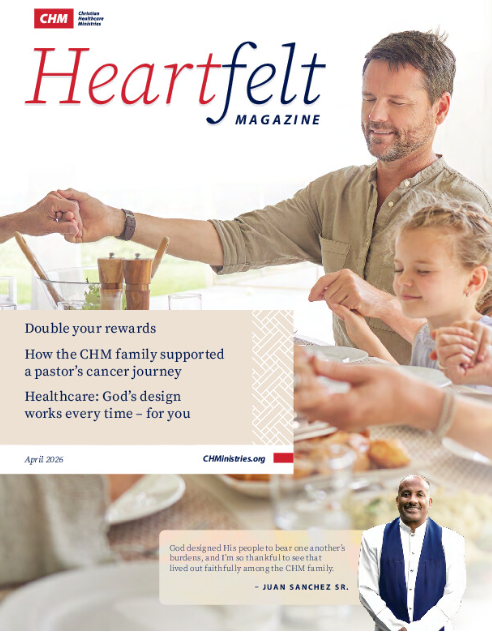
Member stories: With Heartfelt Magazine, all members have the opportunity to hear directly from fellow believers who
have faced (and overcome) challenges, while also lifting them in prayer.

Encourage one another:

In the hurting world Spiritual words of encouragement and strength are necessary in our hurting world.

These tips will help you to show care in your community beyond CHM:

Put together a care package: Collect cozy, inexpensive items to share with a friend or neighbor in need.

Nourish one another: Make meals and help plan dietary options to nurture bodies and minds.

Write out an encouraging prayer: God’s Word soothes hurting souls. Write a prayer or word of encouragement infused with Scripture and have it
on hand to share.

Lend a listening ear: Sometimes people undergoing hardship want someone else to talk to, or just to listen to them. Offer to sit with a friend, church member, or neighbor.

Get involved in service: Notice a need in your church or community? Ask about ways to get started and dedicate time to serve.

When we encourage each other and build bridges of community, we follow in the footsteps of Christ.

Through His death and resurrection, Jesus mediated a new covenant with God, established on better promises [Hebrews 8:6]. Because of this, we who believe in Him are made right with God. That’s a better convenant for us!

Just as the Bible differentiates between an old and new covenant, CHM offers you health cost sharing, a “new,” and biblically-based way to pay your healthcare costs.

Reflecting God’s design, CHM is built on biblical principles found in Acts 2 and 4, and Galatians 6:2. Galatians 6:2 says, “Share each other’s burdens, and in this way obey the law of Christ.” [NLT]

The early Church models practical and tangible care

CHM is a 21st-century model of the first-century church. In Acts 2 and 4, believers who were led by the Spirit, “shared everything they had” [Acts 4:32, NLT]. Likewise, we, who have had our hearts transformed by the Holy Spirit, experience joy in sharing with others.

Health cost sharing supports lives and carries others’ burdens. Practically, CHM members take care of the financial burden of eligible medical bills. Tangibly, members give of themselves to one another in prayer and in encouragement. When you’ve experienced this care firsthand, you know that a ministry-first approach stands apart.

Relationships are the focus, not contracts

CHM’s biblical community is a beautiful and powerful reflection of the body of Christ in action. Members meet each other’s needs voluntarily, not out of obligation. This means participation doesn’t require a contract—instead it’s a biblical covenant. The “old” way—traditional insurance—is contract-based and reflects a “what’s in it for me” mindset.

By design, health cost sharing shifts our perspective from ourselves to others, making it more personal. It’s the body of Christ serving the body of Christ. Many CHM members are pastors, teachers, missionaries, and evangelists. Your membership directly uplifts members like Juan Sanchez, pastor at King’s Chapel Assembly, as well as other believers who champion the spreading of the Gospel.

Transparency and stewardship are the norm

Acts 4:32 [NLT] says, “All the believers were united in heart and mind.” When caring for one another is our shared goal, trust and accountability naturally grow between members. Our health cost sharing model represents the values of individual and collective financial stewardship. The CHM Guidelines outline which expenses are eligible for sharing and which expenses are the members’ responsibility. Each member has a Personal Responsibility which is theirs to pay for as well. Members help share the “burden” of eligible medical bills—burdens that would be too heavy to bear alone.

Together our impact is beyond what any one of us could accomplish on our own. It’s our joy to report those accomplishments through member testimonies, CHM by the numbers, and more. Last year members shared over $609 million in eligible medical bills. Additionally, through the combined efforts of members and our Member Advocate Team, over $693 million was saved due to medical bill discounts—which make member contributions go farther.

Integrity and transparency are markers of stewardship. CHM achieves this in several ways, including by conducting an annual independent audit, as well as by earning independent accreditation from Demotech, a respected financial analysis firm.

Freedom supports empowerment

CHM offers you and your family more freedom in your healthcare. Under CHM’s Guidelines, you’re free to pick your provider—no network restrictions. You’re free to make your own healthcare decisions—no pre-approval required. Your eligible medical bills can be submitted and shared within the ministry.

You, the patient, are empowered through health cost sharing. Making your own healthcare decisions helps you better understand the true cost of medical bills and how to choose a quality provider. Being fully informed leads to more informed healthcare decisions. Additionally, because medical bills are shared within the ministry’s Guidelines, you can be confident knowing that your membership contributions aren’t going towards expenses that conflict with your faith-based values.

CHM also has solutions set up for such medical conditions as surgery, maternity, cancer, and provides members the option of virtual care. Through CHM Care Solutions, we connect you with a quality provider, offer a simplified process, and provide cost-saving opportunities. Last year CHM’s Complete Surgical Care Solutions (CSCS) saved members a collective $9.9 million on their healthcare costs.

Returning to people-centered care

When Jesus came, He re-centered faith on loving God and your neighbor. In the health cost sharing model, people are the priority. As the body of Christ, we’re called to serve and care for one another.

At CHM, with people-centered care in mind, we developed a Member Care Liaison Team with their mission being: “to extend Christ’s love through personalized, compassionate care for our members, offering prayerful support, thoughtful connection, and a source of encouragement and hope.” They’re available to help members submitting bills for the first time, to explain CHM programs and what we offer, to walk alongside grieving families, to pray with you, and to provide you with resources. We are not made to walk alone, and that’s exactly why the Member Care Liaison Team exists.

1 Corinthians 12:12 and 26 [NLT] remind us that the body of Christ is one: “The human body has many parts, but the many parts make up one whole body. So it is with the body of Christ. If one part suffers, all the parts suffer with it, and if one part is honored, all the parts are glad.” This is the heart of CHM’s ministry, and it is what the ministry’s members and staff have the privilege of living out every day.

In 2020, after my wife and I lost our jobs, God led us to CHM. As the pastor of King’s Chapel Assembly, I wanted a way for us to be good stewards while being surrounded by a community of believers, and CHM offered that opportunity. I had no idea that just a few years later, in April 2023, I would be diagnosed with prostate cancer.

One of my first steps was contacting CHM to share my prognosis and treatment plan.

As a senior pastor, I often preach to our congregation about having faith. Suddenly, it was my turn to live out what I had been teaching. Would God heal me? Would He deliver? I believed the answer was yes—and so did everyone who supported me.

Cancer and its treatment can be frightening, but trusting God and leaning on CHM reminded me that I wasn’t alone.

In August 2023, I underwent surgery to remove my prostate. CHM shared over $65,000 in eligible hospital and doctor bills. It was a tremendous relief to know that my CHM family was praying for me and helping carry my burden. We all want to be the good Samaritan who helps someone who has fallen, but sometimes we are the ones who need to be lifted up.

God designed His people to bear one another’s burdens, and I’m so thankful to see that lived out faithfully among the CHM family.

-Juan Sanchez Sr.

If you’re unsure about anything, don’t hesitate to talk with the CHM staff. They will provide peace of mind as you submit your medical bills.

I want to personally thank the CHM staff and members who prayed for me and supported me throughout this journey. I’m grateful for this Christian community that understands the power of praying for one another. God designed His people to bear one another’s burdens, and I’m so thankful to see that lived out faithfully among the CHM family.

It has now been three years since God healed me from prostate cancer. Please continue to pray that He gives me the physical, spiritual, and emotional strength to serve my family and church as a husband, father, and pastor.

The alarm goes off. The exhaustion lingers. Your soul is tired in ways you didn’t know were possible. Your mind races through everything that needs to be done, so you drag yourself out of bed to begin a day you aren’t ready for.

Maybe this isn’t how you imagined motherhood would feel—moving through your days on autopilot and struggling to find joy in an ordinary morning. Yet even in seasons that feel heavy, your days still hold meaning.

I found myself in a season that took everything I had. The deep weariness wouldn’t lift. I felt lost and without purpose. I tried to push through and manage it on my own, but nothing worked. One day, I finally understood: I had lost my joy.

In the busyness of motherhood, I forgot to care for my soul. It wasn’t that God had left me, but somewhere along the way I had drifted from Him. In trying to carry everything myself, I had overlooked what I needed most: a reconnection with Jesus.

If you are a Christian mom feeling this deeply, you are not alone. Maternal burnout is real and well documented. Mothers consistently report higher rates of burnout than fathers, even when duties are shared. This is not a personal failure. It may be a sign that your soul needs care.

Jesus speaks directly to this moment:

“Come to me, all you who are weary and burdened, and I will give you rest. Take my yoke upon you and learn from me, for I am gentle and humble in heart, and you will find rest for your souls.” — Matthew 11:28–29 (NIV)

He is not asking you to fix yourself first. He is asking you to come to him.

What is soul care for a Christian mom?

Soul care is the intentional practice of nurturing your relationship with God. It creates time and space for connection, renewal, and reflection, especially when life feels busy or hard.

This does not have to be complicated or perfect. For Christian moms, soul care could look like:

  • Whispering a prayer while washing dishes
  • Playing worship music during the drive to and from school
  • Listening to your Bible app read Scripture while folding laundry
  • Sitting quietly for a few minutes before the chaos begins

It is not about perfection. It is about intention. Soul care meets you where you are, not where you think you should be.

“Be still, and know that I am God.” — Psalm 46:10 (NIV)

Daily devotions and spiritual life: where soul care begins

You carry a lot. Motherhood adds more. You’re used to multitasking, tending to everyone else’s needs, and keeping things moving. But your soul also needs attention. When you slow down long enough to rest with Jesus, it shapes how you carry the rest of your day.

Daily devotions don’t have to be long. Even brief moments with God can quiet the noise inside you. Research suggests that regular spiritual practices—such as prayer, Scripture reading, and worship—are associated with lower anxiety and improved overall well-being. Studies on spirituality and mental health also show that a steady faith life is linked to emotional resilience.

Some practical starting points:

  • Choose one psalm or proverb to read each morning
  • Keep a small journal for one-sentence prayers
  • Use a daily devotion on your Bible app so you can listen on the go
  • Set a daily reminder to pause and pray

Christ-centered motherhood and God’s goodness

Scripture reminds us that strength in motherhood isn’t about doing more or doing it flawlessly. Proverbs 31:25–26 reveals a steady assurance—strength that grows from trusting God, not from controlling every outcome. Soul care gently shifts the focus back to faith instead of performance.

“She is clothed with strength and dignity; she can laugh at the days to come. She speaks with wisdom, and faithful instruction is on her tongue.” — Proverbs 31:25–26 (NIV)

This kind of strength isn’t built overnight. It grows as you return to God in everyday life.

If you’ve ever wondered what living that kind of faith looks like in everyday motherhood, you may find encouragement in The Proverbs 31 Woman.  For many women, this passage can feel intimidating at first. But it isn’t a standard to measure yourself against. It’s a picture of what God forms in a life that turns to Him.

And when you fall short, as every mother does, God’s goodness does not disappear. Jesus reminds us:

“My grace is sufficient for you, for my power is made perfect in weakness.” — 2 Corinthians 12:9 (NIV)

Peace doesn’t come from having everything under control. It comes from trusting the One who does.

You were never meant to walk through motherhood alone

God created us for connection, and that need becomes clear in the beautiful, exhausting seasons of raising children.

Whether you’re an overwhelmed working mom and wife trying to hold everything together at the end of a long day or a stay-at-home mom who feels unseen in a busy house, you were not meant to carry this quietly by yourself. You need other Christian mothers, not to compete with, but to be honest with. To be seen and encouraged, even on the hard days.

A simple text from a friend who says she’s praying for you. Coffee with a mom who understands the chaos. A small group where no one pretends to have it all together. These aren’t extras. They are part of God’s love expressed through the people around you.

Research suggests that belonging to a faith-centered community is associated with lower feelings of isolation and greater resilience during stressful seasons. Scripture affirms this truth:

“And let us consider how we may spur one another on toward love and good deeds, not giving up meeting together… but encouraging one another.” — Hebrews 10:24–25 (NIV)

Other Christian moms feel what you feel—the exhaustion, the questions, the quiet longing for deeper peace. Allow someone to sit beside you in it, to pray with you, to remind you that you are seen and loved.

Returning to Joy

Joy isn’t found in your circumstances. It grows out of your relationship with Jesus. When you neglect your spiritual rhythms, joy can feel distant. The good news is you don’t have to change everything to find it again. It begins with small, consistent steps as you turn back toward Him.

Soul care and community are not luxuries. They are part of how God sustains you through every season. You have a God who walks with you and a biblical community that stands beside you.

Start with one thing. A whispered prayer. A single verse. A five-minute walk where you talk with God. Let that be enough for today. Then do it again tomorrow.

For Christian moms, caring for your soul isn’t selfish. It is part of staying rooted and present in everyday life.

References

Koenig, H.G. (2012). Religion, spirituality, and health: The research and clinical implications. ISRN Psychiatry. https://pmc.ncbi.nlm.nih.gov/articles/PMC3671693/

Lucchetti, G., Koenig, H.G., & Lucchetti, A.L.G. (2021). Spirituality, religiousness, and mental health: A review of the current scientific evidence. World Journal of Clinical Cases, 9(26), 7620–7631. https://pmc.ncbi.nlm.nih.gov/articles/PMC8462234/

Ren, X., Cai, Y., Wang, J., & Chen, O. (2024). A systematic review of parental burnout and related factors among parents. BMC Public Health, 24, 376. https://pmc.ncbi.nlm.nih.gov/articles/PMC10840230/

Health cost sharing has grown in popularity over the last few decades, especially among Christians looking for an alternative to traditional health insurance. Because of this, there are often misunderstandings about what it is and how it works.

At Christian Healthcare Ministries (CHM), we prioritize transparency about who we are and how we operate. Below, we’re tackling some of the most common myths we hear about health cost sharing to set the record straight.

Myth 1: “There’s no assurance that health cost sharing ministries will reimburse you”

Many don’t really know how health cost sharing works—creating suspicion about the approach in general. Anyone enrolling in CHM needs to fully understand our sharing process and requirements so they’re empowered throughout any bill submissions.

Since 1981, Christian Healthcare Ministries has satisfied 100% of all eligible medical bills. CHM follows clear, written Guidelines that define what kind of medical bills are qualified for sharing. Any bill that meets these requirements will be shared after a member’s Personal Responsibility (PR) amount has been met.

Our Guidelines are available before joining so you can determine if CHM is the right fit for your needs. These rules exist to protect our members and steward the ministry’s resources responsibly. Members can also reach out to CHM directly with questions regarding their bill submissions.

Every month, members contribute a fixed amount to the ministry that is used to satisfy the health expenses of fellow Christians. Reimbursing eligible bills has been and continues to be a time-honored tradition for over 40 years at CHM.

Myth 2: “Health cost sharing ministries are unreliable”

This myth is often spread by people who have been misled or hurt by disreputable health cost sharing organizations. Before joining any health insurance alternative, it’s always best to research the company thoroughly to make a wise decision.

CHM is the nation’s first and longest-serving health cost sharing ministry. Below are some of the ways we’ve established accountability and transparency as a ministry:

  • Third-party independent accreditation through Demotech
  • Better Business accredited charity since 2013
  • Nationally endorsed by The Ramsey Show
  • Yearly audits through an independent accounting firm

Likewise, our CHM Gold, CHM Silver, CHM Bronze, and CHM SeniorShare™ programs are also designed to be transparent and understandable. Things like monthly contributions, PR amounts, and sharing limits are all disclosed up front before joining.

Myth 3: “Health cost sharing ministries are overly strict”

Because many health cost sharing organizations abide by faith-based rules and ethics, they’ve often been misjudged by skeptics and critics alike. While thoroughly Christian, CHM does not belong to a specific denomination, church, or tradition that informs our rules for sharing.

As a non-profit ministry, our only spiritual requirements at enrollment are that members affirm their faith in Christ and commit to living a biblical lifestyle as outlined in our Statement of Beliefs. Our ministry honors the call of Galatians 6:2 to help Christians “bear one another’s burdens” through sharing medical bills.

Every defining rule from our Guidelines aims at providing the best experience for all Christians. Members retain full ability to choose their certified healthcare providers, make medical decisions with their doctors, and manage their own healthcare journey. Having a shared foundation of faith allows the ministry to establish what medical care we will and won’t share for.

Myth 4: “Health cost sharing only works for the young and healthy”

CHM welcomes members of all ages and health histories. While pre-existing conditions are handled differently than new medical issues, CHM offers helpful options for those in need. CHM Gold includes a scheduled sharing option for maintained pre-existing conditions, and CHM Give provides a way for members to receive support for eligible needs through voluntary donations from fellow members.

Programs like CHM SeniorShare™ are specifically designed for members age 65 and older to work alongside Medicare. Because Medicare only pays for 80% of medical bill costs, SeniorShare™ takes care of the remaining 20%; saving retirees lots of money in the long run.

For larger or more complex medical needs, CHM has a Complete Surgical Care Solution which helps members find quality surgeons, secure major discounts, and arrange any needed travel accommodations.

CHM also offers a Cancer Care Solution. It’s designed to simplify the treatment process, offer spiritual encouragement, save money, and get you the right care with the right provider. This makes health cost sharing an option not just for the young or those with a clean bill of health.

Myth 5: “Health cost sharing ministries can’t help you with prescriptions”

CHM shares eligible, incident-related prescription medications according to program Guidelines. While the initial eligible 90-day prescription supply can be shared for, members also have access to CHM’s Prescription Care Solution after the first 90 days. This connects members to different tools to help find coupons, generic brands, and the cheapest prices near you.

Additionally, members have access to our Virtual Care Solution through HealthTap, making it easier to receive primary care and get a prescription for many common needs without an in-person appointment.

CHM’s financial and spiritual support isn’t a myth

While lots of misinformation about health cost sharing exists, there are real reasons why so many Christians trust it as a viable solution. For singles, families, and retirees, CHM’s affordable programs are a great alternative to health insurance. If you want to see how our ministry works practically for believers like you, check out our member stories or join CHM today!

Between World Wildlife Day (March 3), International Day of Forests (March 21), and World Water Day (March 22), there are plenty of reasons to honor and celebrate God’s creation. But can we truly honor His creation if we are not also caring for it?

For Christians, caring for the earth is not a peripheral issue or a passing cultural trend—it flows directly from foundational biblical truths about God, humanity, and redemption. Stewardship is an expression of obedience to God, love for our neighbors, and reverence for all He has made.

Stewardship does not mean ownership

In Genesis, God entrusts His creation to humanity, calling us to “work” and “take care” of the garden [Genesis 2:15]. These words imply cultivation and protection. It means using the resources God has given us with responsibility.

Stewardship in the Bible means managing something that belongs to God, and Scripture repeatedly affirms that “the earth is the Lord’s” [Psalm 24:1], created by Him and deemed good. When Christians care for the environment, they acknowledge and respect God’s ownership and resist the temptation to abuse it for human consumption and profit.

Caring for the earth is an act of faithfulness, respects what ultimately belongs to God, and honors His trust.

Creation reflects God’s character and glory

The natural world reveals God’s power, creativity, and order [Psalm 19:1; Romans 1:20]. Swaying fields of wildflowers, a rainbow at the bottom of a waterfall, a self-sustaining ecosystem, sweet and loving house pets—all these things are expressions of God’s vast creativity and intentionality.

Damaging creation distorts God’s witness; preserving it allows future generations to experience wonder, gratitude, and reverence toward the Creator.

Environmental care is a matter of loving our neighbor

Environmental harm often affects the poor and vulnerable first—through polluted water, unhealthy air, food scarcity, or climate instability. Jesus’ command to love our neighbor includes protecting the conditions that allow people to live healthy, dignified lives. As such, Stewardship is an act of compassion.

Stewardship shapes Christian witness

We reflect God in how we care for the earth and those around us. Thoughtful care demonstrates humility, self-restraint, and gratitude—virtues that reflect Christ. Neglect or exploitation can undermine Christian witness by suggesting indifference to God’s creation and human suffering.

Caring for the earth anticipates God’s future restoration

As Christians, our hope shouldn’t be in escape from the world but the renewal of it. Scripture teaches that humanity subjects creations to destruction, but it will be redeemed [Romans 8:19–21].

However, while God promises to renew creation, believers are called to live in ways that anticipate that renewal [Luke 12:40-44]. When Christians care for the earth now, they live in alignment with God’s promised future, offering a foretaste of restoration.

Gratitude leads to responsibility

Creation is a gift meant to be received with thanksgiving. Gratitude naturally leads to care, restraint, and wise use of resources. Christians honor God when they treat His gifts with reverence and care rather than selfishness and wastefulness [Matthew 25:14-30].

Taken together, caring for the earth is a beautiful expression of Christian faith—one that combines worship, obedience, justice, and hope. It’s not about elevating creation above God, but about honoring God by faithfully tending what He has made.

What does the Bible say about women? It’s the question we ask when faced with trials and triumphs both great and small. It’s what we ponder when we try to make friends but still feel so out of place. It’s the echo in the back of our minds when we see Nancy bring her famous pie to the church potluck, and we’re left wondering if we’d be admired if we were just more like her.

Our culture has a lot to say about women, who they should be, what they should prioritize, and which things they should strive to achieve. In fact, there’s even an International Women’s Day each March, dedicated to women everywhere.

However, only one voice truly matters when we consider biblical womanhood, and that’s the voice of Christ. God has a lot to say about women, their importance, and their critical role in biblical community.

Great women of the Bible

God intentionally included examples of women in the Bible to help us learn what it means to live as one of His daughters. By considering snapshots of some of their lives, we can discover practical takeaways and put them into action in our own homes and hearts.

Use this list as a jumping-off point for further in-depth study on your own, in your church small group, or in your daily devotional time with God. As you take the time to look up each woman’s story and dive deeper, your faith will grow:

Ruth

Ruth’s story, recorded in the book of the same name, gives us a peek behind the scenes of a woman struggling with heartache. We often incorporate her statements on wall art, plaques, mugs, and even purses. However, upon further evaluation, the value of her story echoes much deeper.

“‘Look,’ said Naomi, ‘your sister-in-law is going back to her people and her gods. Go back with her.’ But Ruth replied, ‘Don’t urge me to leave you or to turn back from you. Where you go I will go, and where you stay I will stay. Your people will be my people and your God my God. Where you die I will die, and there I will be buried. May the Lord deal with me, be it ever so severely, if even death separates you and me.’ When Naomi realized that Ruth was determined to go with her, she stopped urging her.” – Ruth 1:15-18 [NIV]

Upon the death of her husband, Ruth intentionally decided to stay with Naomi, her mother-in-law. Not many women would make such a choice, let alone what Ruth decided to do: take a journey and settle in a foreign land. Ruth would live as a stranger, an immigrant, with no community, no support, no family connections, and no hope of a future. However, she decided to put her trust in the hope of the Lord, and what a turn her story took!

Practical takeaways: As women, we’re important to the Kingdom of God. Our choices make a difference in the lives of those around us – but it can also change the course of history. We can take chances when God is calling us to move forward in faith. When we obey His voice, He is faithful to lead us and build community around us.

Esther

The story of Esther, also found in the biblical book of the same name, demonstrates to us that God cares for His people and is faithful to rescue us even when hope seems lost.

When Esther’s words were reported to Mordecai, he sent back this answer: ‘Do not think that because you are in the king’s house you alone of all the Jews will escape. For if you remain silent at this time, relief and deliverance for the Jews will arise from another place, but you and your father’s family will perish. And who knows but that you have come to your royal position for such a time as this?’” – Esther 4:12-14 [NIV]

Esther didn’t want to approach the king on behalf of her people. She was full of fear and doubt, concerned that her position, and even her life itself, would be taken from her. She’d already been through a lot of pain, having been orphaned at a young age. Later, she was also taken from the only family she knew to see if she’d be worthy enough to become the king’s wife. Now, with a stable position in life, she was faced with an impossible choice: approach the king to save her people’s lives or try to keep her stable position. At the urging of Mordecai, she decided to take the risk.

Practical takeaways: As women, we’re intentionally placed in our roles: wife, mother, sister, daughter, friend, co-worker, teacher, leader, and many more. If we let Him into those roles, God transforms heartache into healing. He meets us in each calling and uses our unique gifts to bring about His glory.

Abigail

Abigail’s story is found in 1 Samuel 25, showing us what it means to be a strong woman in the face of difficult decisions and delicate situations.

One of the servants told Abigail, Nabal’s wife, ‘David sent messengers from the wilderness to give our master his greetings, but he hurled insults at them. Yet these men were very good to us. They did not mistreat us, and the whole time we were out in the fields near them nothing was missing. Night and day they were a wall around us the whole time we were herding our sheep near them. Now think it over and see what you can do, because disaster is hanging over our master and his whole household. He is such a wicked man that no one can talk to him.’ Abigail acted quickly…” – 1 Samuel 25:14-18

Abigail was faced with a tricky situation, as her husband (who was said to be wicked) made a grave mistake in insulting the future king – David. David intended to destroy not only Nabal, but his whole household. However, Abigail didn’t hesitate. She knew what needed to be done to restore the relationship and prevent disaster. She stood in the gap, approached David herself, and asked for mercy. As a result of her bold choice, David decided to marry her upon the death of her husband Nabal. This secured Abigail’s position and status in life, giving her a bright future.

Practical takeaways: As women, we’re gifted with wisdom and grace from God, and we’re called to use those gifts to seek mercy and unity. We can step out in boldness when God calls us forward.

Strong women: You have a place in biblical community

What if there was one thing that each of these women have in common? In fact, what if it’s something all the biblical women have in common?

Spoiler alert: they do! It’s their flaws.

Not one woman listed in the Bible reacted perfectly, lived flawlessly, or had every aspect of their heart and home in order. Far from it.

In fact, we see many examples of women who tried their best, but sinned. We see examples of women who were misguided or intentionally chose harder paths. We see examples of women who faced trauma, abuse, anxiety, brokenness, homelessness, and heartache. We also see snapshots of women’s lives where it seemed like they made good choices, however, it’s important to remember that we truly only see one story out of the entire tapestry of their existence.

We know there are no human beings without sin. No one, except Jesus, was perfect. This fills our hearts with hope, because we can approach God’s throne of grace through the blood of Christ. We’re not perfect, and we’ll never be on this side of heaven. This means that we’re not disqualified, nor should we be discouraged. Rather, God calls His imperfect daughters to important roles in biblical community. From homemakers and homeschool moms, to teachers, lawyers, missionaries, writers, artists, leaders and so many more, women have crucial skills to offer our world.

God wants His daughters to know how valuable they truly are. He says that we are fearfully and wonderfully made [Psalm 139:14], beautiful and beloved [Song of Songs 4:7], and that He has good plans for our lives [Jeremiah 29:11]. He calls us to be women of valor and virtue, stepping out in faith to allow God to work through our lives and hearts. As we do, we can be sure that we’ll be living out God’s call to biblical womanhood.
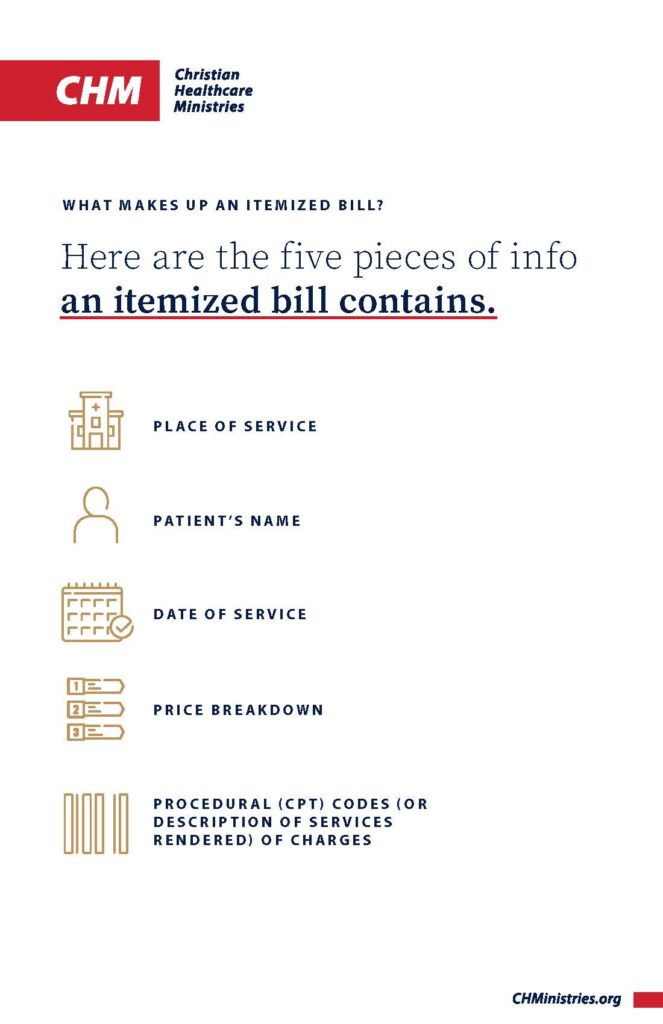
Living out our faith is less about perfection and more about daily commitment—allowing Christ to shape how we think, love, and act. Here are five creative, practical ways to embrace faith in everyday life:

1. Turn ordinary moments sacred
Worship isn’t confined to Sunday mornings—it exists in the day-to-day. Practices such as praying while commuting, reflecting on Scripture during a walk, or practicing gratitude while doing chores, can positively impact your spiritual walk. Seeing daily routines as holy moments reshapes how you live [1 Corinthians 10:31]. In fact, it gives us the opportunity to honor God in everything—our words, work ethic, finances, and relationships.

Bring prayer, Scripture, and Christlike character into work, parenting, friendships, and rest. When faith is expressed authentically, it often invites curiosity and conversation. Spend regular time in prayer and Scripture, even if it’s brief. Make God the focal point of your decisions, struggles, and gratitude throughout the day [Psalm 119:105].

Let your faith guide your choices, even when no one is watching [Colossians 3:23].

2. Serve in unexpected ways
Active participation in biblical community means looking for and meeting the needs of your family, church, or workplace. However, serving doesn’t have to be a grand gesture. Something as simple as paying for someone’s coffee, cooking someone a meal, finding a creative way to support a local ministry, or using professional skills to bless others carries eternal impact [Matthew 25:40].

For CHM members, a creative way of serving is going to the Prayer Wall on your Member Portal and offering prayers for your CHM family. Additionally, you can write encouraging notes through Prayers Unceasing, which can be found with your monthly contribution letter. Small acts make a big difference.

3. Creatively share your testimony
Be ready to speak about your hope in Christ in all circumstances. Let your actions support your words. Offer personal testimonies through journaling, social media, letters, or conversations. This is a crucial step, because stories help others see how God moves in our lives [Psalm 107:2]. Additionally, writing or verbalizing how God is working helps keep these moments at the forefront of our minds. As we internalize God’s goodness and provision, our spiritual walk is strengthened.

4. Practice love and hospitality with intention
Jesus said love would mark His followers [John 13:34–35]. This type of all-encompassing love also includes patience, forgiveness, generosity, and compassion, especially when it’s inconvenient or undeserved. Invite neighbors, coworkers, or church members into your home—no perfection required. A shared meal can become a powerful expression of Christ’s love [Romans 12:13].

Everyone needs community for encouragement, accountability, and prayer. If you don’t have capacity for heavy emotional investment, you can also love others by listening well, sitting with someone in grief, or being fully present in support [Job 2:13].

5. Create habits and rhythms
Intentional habits create consistency in your relationship with God. When we find ourselves struggling to form good habits in our prayer lives or Bible readings, one idea is to try adding a new creative flair. Light a candle during prayer, observe Sabbath rest, mark seasons such as Advent or Lent, or start family prayer traditions.

These practices anchor faith in daily life [Deuteronomy 6:6–9]. When you find yourself in difficult seasons, you can use these habits to posture your heart towards gratitude and remind yourself of God’s blessings, giving thanks in all circumstances [1Thessalonians 5:18].

Creative faith doesn’t require grand gestures—it’s about letting God’s love flow through who you are and how you live, in ways that are natural and sincere.

On March 30, communities across the U.S. will honor the service of physicians—not just as medical professionals, but as stewards of healing and compassion in a broken world. National Doctors’ Day was first observed in 1933 in Winder, Georgia, when Eudora Brown Almond and fellow members of the Barrow County Alliance wrote cards, sent flowers, and placed memorial blossoms on the graves of physicians who had passed. This tradition eventually grew into a national observance, officially recognized in 1991 by Congress. 

As a physician myself, I appreciate this day. And as believers, we recognize that healing is both a physical art and a divine calling. As it is written in James 5:14 [NIV], “Is anyone among you sick? Let them call the elders of the church to pray over them and anoint them with oil in the name of the Lord.”

Doctors have a principal role in a sacred ministry of care and restoration—one that often reflects God’s heart for the suffering.

The journey to medicine: Commitment, cost, and calling

Becoming a physician isn’t a casual decision, but a long and demanding pilgrimage requiring:

  • 4 years of undergraduate study,
  • 4 years of medical school, and
  • 3–7+ years of residency training (with additional fellowship years for some specialties)

From the first pre-med course to independent practice, it often takes 11–15 years or more of rigorous study and clinical training before a young doctor truly begins to serve patients on their own.

The financial cost is significant, with graduates carrying an average educational debt of $200,000–$250,000. Many physicians spend their first decade after college paying down loans while working long hours for modest residency salaries.

Rewards of the calling

Despite the challenges, the work is deeply rewarding. Every day offers moments to use skills and compassion.

Some of the most meaningful rewards include:

  • The privilege of bearing witness to life’s most tender moments such as birth, healing, forgiveness, and reconciliation.
  • Easing suffering and restoring function so people can return to family, work, and purpose.
  • The trust placed in physicians by patients and families—a human echo of God’s own invitation to care for one another.
  • The daily reminder that healing, even when imperfect, brings hope and dignity.

Like the good Samaritan who “binds up wounds” [Luke 10:34, NIV], physicians act as agents of comfort and care in the brokenness of our world.

Challenges of physicians today

Modern medicine often feels like a marathon, and physician burnout is a growing concern. Recent surveys indicate that nearly half of U.S. physicians report symptoms of burnout, including emotional exhaustion, depersonalization, and reduced sense of accomplishment.

  • Despite improvement after the pandemic, the burnout rate remains significantly higher for physicians than many other professions.
  • Primary care doctors (who often serve as the front line of community health) have especially high stress levels compared with other specialties. 

Burnout correlates with decreased job satisfaction and diminished well-being for clinicians and patients alike. As a physician myself, I’ve found that this burnout is rarely rooted in caring for patients, but rather in working within healthcare systems that reduce physicians to data-entry clerks or productivity units rather than honoring the relational and vocational heart of medicine.

Yet, many physicians still find joy and meaning in their vocation. Recent data suggests that many doctors still report overall job satisfaction, particularly when their work allows them to practice medicine in ways that preserve meaningful patient relationships and professional integrity. Many doctors express enduring pride in their role and a sustained sense of calling, even as they navigate challenging healthcare systems.

Gratitude heals doctors, too

This Doctors’ Day, consider saying thanks to your personal physician. A simple, heartfelt “thank you for helping me” matters more than we often realize—especially to physicians who work long hours and carry heavy burdens.

Here are ways to express gratitude to your physician:

  • Write a handwritten note sharing how a doctor’s care changed your life.
  • Pause to say “thank you” during visits—genuine encouragement sticks with caregivers.
  • Mention specific qualities (kindness, attentiveness, clarity of explanation) you noticed during your visit.
  • Pray for your doctor privately or as part of your church prayer time. Ask God to give them wisdom, strength, and rest.
  • Encourage others to share thanks! A culture of gratitude strengthens communities and reinforces a doctor’s calling.

A simple “thank you” is a small seed, but with faith and care, it grows to make a lasting impact.

A culture of care

On National Doctors’ Day, we honor my physician colleagues for what they do, and for what they give—long nights, listening ears, steady hands, and compassionate hearts.

As a community of faith, we celebrate the gift of healing, and pray God sustains doctors with wisdom, resilience, and peace. Jesus reminds us in Matthew 25:40 [NIV], “Whatever you did for one of the least of these brothers and sisters of mine, you did for me.”

If you need a physician who prioritizes your care, explore CHM’s Virtual Care Solution through HealthTap for convenient access to caring, licensed doctors. Learn more by visiting www.healthtap.com/for/chm/.

With every compassionate diagnosis and restorative treatment, God’s love is reflected through the doctors He calls to serve.

References

Wikipedia – National Doctor’s Day https://en.wikipedia.org/wiki/National_Doctors%27_Day?utm_source=chatgpt.com

AMA Measuring Physician Burnout May 15, 2025. https://www.ama-assn.org/practice-management/physician-health/measuring-and-addressing-physician-burnout?utm_source=chatgpt.com

AMA National Physician Burnout Survey, May 15, 2025 https://www.ama-assn.org/practice-management/physician-health/national-physician-burnout-survey?utm_source=chatgpt.com.

Mohr DC, Elnahal S, Marks ML, Derickson R, Osatuke K. Burnout Trends Among US Health Care Workers. JAMA Netw Open. 2025 Apr 1;8(4):e255954. doi: 10.1001/jamanetworkopen.2025.5954. PMID: 40257797; PMCID: PMC12013355.

AAFP. Family Physician Burnout, Well-Being, and Professional Satisfaction (Position Paper). 2023.

My cancer journey came out of nowhere, with no warning. I experienced shoulder pain, and when I went to the doctor, he told me there was nothing wrong with my shoulder. However, they decided to do an MRI to check everything out. That’s when they found cancer in my left lung, which meant I needed to begin chemotherapy.

Prior to my cancer diagnosis, we never submitted any medical bills for sharing with CHM, so we didn’t know what the process would look like or how it would unfold.

However, when we started submitting medical bills, we discovered a level of support that went beyond our expectations. Every time we reached out, we spoke with real people who listened to us. When my husband, Danny, needed to review bills or ask questions, everything was handled smoothly. The conversations would end with encouragement, reassurance, and prayer.

In fact, one of the very first things my husband and I noticed about CHM, and one of the things we are most grateful for, is CHM’s staff. From the start of our experience, every staff member we’ve encountered has been incredibly kind, supportive, and full of faith. I can see and feel the Holy Spirit at work in the way they serve.

We live in Tennessee, but I was being treated in Ohio for my needs. It was difficult to be away from home. However, further into my treatment, we found out about CHM’s Cancer Care Solution. I contacted them and they embraced me with support. They helped with finding an oncologist for immunotherapy in Tennessee and answered any questions. CHM’s Cancer Care Solution team became advocates for my treatment.

The whole process has reminded me of how the early church gathered and shared one another’s burdens in Acts. Similarly, CHM and its members are living by faith. We are connecting as brothers and sisters in Christ, and I’d like to say thank you to the members who faithfully contribute towards each other’s eligible medical bills.

Please continue to pray for my healing on this side of heaven, as well as for our family as we continue to be examples for the Lord and share God’s love. My journey isn’t over yet!

Throughout the year, CHM members share stories about the financial and spiritual support they receive from fellow believers. The impact of participating in the CHM family is invaluable! Here’s a look back at the numbers from 2025 and what you, our CHM members, made possible.

2025 by the numbers

CHM members submitted $1,557,807,000 worth of eligible medical bills in 2025. Discounts and financial assistance received amounted to $693,469,000 which was an average of 45%—allowing member dollars to go even further. That’s over 54,000 individual members who were helped through sharing support in 2025.

Members received medical bill reimbursement for eligible illnesses, including pre-existing conditions, surgeries, maternity, cancer, and more.

  • CHM Plus: Over $83,000,000 was shared in medical bills for catastrophic medical illnesses exceeding $125,000.
  • Pre-existing conditions: $14,707,000 was shared in medical bills for maintained pre-existing conditions. This included $11,540,000 shared through the Maintained Pre-existing Schedule and $3,167,000 which was shared through CHM Give donations.

CHM Care Solutions

In 2025, CHM developed CHM Care Solutions—specialized components that allow members to save on costs and receive quality healthcare.

  • Complete Surgical Care Solution (CSCS): CHM members who use a CSCS medical provider can receive a $1,250 membership credit.
  • Maternity Care Solution: CHM members who call within the first 16 weeks of pregnancy receive $500 off their Personal Responsibility.
  • Cancer Care Solution: CHM members who use a CCS provider receive a $1,250 membership credit.
  • Virtual Care Solution: With CHM’s Virtual Care Solution, members can utilize HealthTap for urgent care and primary care needs.
  • Prescription Care Solution: CHM members can save on prescription costs by taking advantage of CHM’s prescription discount resources.

Referral rewards

Members can save on monthly contributions and Personal Responsibility costs by referring their friends and family to CHM. Last year, thousands of members earned reward credits in the enhanced Refer-a-Friend program. Additionally, 8,799 new members received a 50% welcome credit when a friend referred them. Thank you for spreading the word about CHM!

When we reflect on all that was made possible in 2025, we glorify God for His goodness and thank you for your faithful support.

Looking ahead

As a CHM member, you can be confident knowing that 90 cents of every dollar you send to CHM goes directly to help another member in need. Our commitment to transparency and accountability led CHM to become the nation’s first health cost sharing ministry to earn independent accreditation. Demotech, a firm that conducts independent, certified financial stability ratings, gave CHM a score of 97 out of 100.

In 2026, CHM is positioned to share more eligible medical bills than ever before—helping members access quality care and meaningful savings. Thank you for being part of this ministry.

Raising a family with a lot of kids comes with plenty of joy and major expenses—healthcare being one of them. Many parents wonder why family health insurance has to be so pricey and if there are any viable alternatives out there.

For Christian families who want to steward God’s money wisely, Christian Healthcare Ministries (CHM) offers a unique approach compared to the traditional insurance model. As a nonprofit ministry, CHM allows Christians to share each other’s eligible health expenses.

Instead of paying premiums to an insurance company, members send monthly contributions that directly help fellow believers. Let’s explore how CHM can help bigger families save money while allowing access to high-quality, flexible care.

Why health insurance is so expensive for big families

Marketplace health insurance is already expensive for just one person, let alone a whole family. Add a spouse and multiple kids and things start to add up quickly. Traditional family health insurance is often priced per person, which means costs increase with every additional child—stretching an already tight budget.

For households with low to modest income, financial planning and family planning can turn into a complex juggling act. Many health insurance plans for families present the following challenges:

  • High monthly premiums plus added costs for each dependent
  • Large deductibles that must be met before coverage starts
  • Limited networks of private practices and hospitals

Parents wanting affordable family health insurance often feel financially constrained or priced out altogether, but it doesn’t have to be that way. CHM exists to help Christians live out God’s calling without worrying about the price of medical care.

How CHM supports big families with a three-unit structure

Because CHM isn’t health insurance, members aren’t burdened by excessive costs and restrictions. This allows Christian families to get affordable support that accommodates their needs.

CHM respects the biblical command to “be fruitful and multiply” [Genesis 1:28, ESV]. That’s why we believe parents shouldn’t be penalized with extra costs for having more children through birth or adoption. An important thing to know is how CHM defines family membership through our unit-based system:

  • Married couple + any number of dependent children = three units
  • Parent or legal guardian + any number of dependent children = two units
  • Married couple = two units

What’s great about CHM’s family membership is the three-unit maximum. This structure sets us apart from traditional insurance family plans. Whether you and your spouse have one child or ten, your monthly contribution will never exceed paying for three units. For many families, this frees up more of the budget for everyday expenses.

CHM offers flexibility for your family budget

When managing a family budget with a lot of kids, having some wiggle room goes a long way. CHM’s monthly contributions are designed to be affordable and adaptable.

As your family’s needs change, your membership can be updated at any time. If you need to upgrade or downgrade your family’s program, you can do so within the Member Portal or by calling CHM’s member support team (1-800-791-6225) to assist you. This flexibility is helpful for parents who might need to adjust their spending during different seasons of life.

Just note that any bills submitted with your previous program will be shared under the rules of that program. Any new bills submitted after you change your membership will then be shared under the rules of the new program.

Compared to traditional insurance, CHM doesn’t lock you into a fixed year-long contract; allowing you to switch your program at any time. While health insurance plans can only be adjusted during an enrollment period or after a qualifying life event. CHM makes it easier for families to pivot so they can get the pricing and support they need when they need it.

Because CHM isn’t insurance, members also can benefit from self-pay discounts, adding even more to their savings. Many private practices and hospitals are eager to work with patients who can pay upfront instead of dealing with insurance.

CHM’s robust maternity support for growing families

Having a family is one of God’s greatest earthly blessings. For that reason, CHM is committed to supporting growing families as much as possible—and maternity care is one of the ways we do that. Our generous Maternity Care Solution shares many expenses related to prenatal care, delivery, and postnatal needs according to CHM Guidelines.

Members can also receive a reduction of $500 to their maternity Personal Responsibility if they call and speak with the Maternity Care Team within the first 16 weeks of pregnancy. This kind of discount is rare under traditional family health insurance plans. Not only that, but CHM fully reimburses mothers for eligible physical therapy sessions during pregnancy and postpartum treatment up to 90 days after delivery.

The Maternity Care solution also allows our members access to a nurse navigator to help with various things related to pregnancy like:

  • Finding reputable healthcare providers nearby
  • Clarifying your options for childbirth
  • Explaining lab test results and possible health risks
  • Answering questions and providing helpful resources

Because CHM doesn’t use a provider network, that means mothers can go to the certified OBGYNs and hospitals they prefer without worrying about extra fees or hidden charges. Or, you can share eligible costs for legally practicing midwives and birthing centers. Being able to choose your provider allows families to find the best care they need without unnecessary limitations.

CHM’s commitment to help Christian families

If God has blessed your home with many children, there’s no need to worry about unexpected medical debt or exorbitant health insurance fees. CHM serves families big or small by providing financial flexibility, greater provider options, robust maternity care, and compassionate member service. Check out our free cost comparison tool or join CHM today and feel the difference of a biblical alternative to traditional health insurance.

Hospitals often present self-pay as straightforward. You get care, you receive a bill, and you pay it. But if you’ve ever opened a hospital bill and felt that overwhelm set in, you know it’s rarely that simple.

For many families—especially moms already juggling what seems like a million things—self-pay can feel confusing and overwhelming. Prices aren’t clear. Discounts aren’t advertised. And no one explains your options unless you know exactly who and what to ask. That confusion can turn a stressful health moment into a long season of financial strain.

Here’s what hospitals often don’t explain—and what you should know before assuming that first bill is final.

What “self-pay” really means

Many people assume self-pay only applies if you don’t have insurance. In reality, self-pay simply means you are responsible for the bill.

That can include people who:

  • Don’t have insurance
  • Are getting care that isn’t covered
  • Choose to pay cash or pay out of pocket instead of submitting a claim

Hospitals typically start with a chargemaster price. This is the internal list of charges for services ranging from lab work to imaging and procedures. These prices are often much higher than what most people end up paying, but they’re frequently the first numbers self-pay patients see.

It’s important to understand that those prices are usually a starting point, not the final amount you can expect to pay.

Why are hospital bills so expensive?

If you’ve ever wondered why hospital bills are so expensive, you’re not alone.

Healthcare pricing can vary widely depending on where you receive care, how services are billed, and how you pay. Research shows that the same test or medical procedure can cost very different amounts—even within the same community.

Although hospitals are now required to post pricing information, it can be challenging to find. You may still need to call or ask for a written estimate to get a clearer picture of what you may owe.

Financial assistance and charity care

Many hospitals often don’t specifically promote that financial assistance is available, even though it usually is.

Nonprofit hospitals are required to offer financial assistance programs—sometimes called charity care—as part of their tax-exempt status. These programs can help reduce medical bills for patients who meet specific income guidelines.

Hospitals must have written policies explaining:

  • Who qualifies
  • What help is available
  • How to apply

While these programs aren’t always offered initially, you certainly have the right to ask about them—especially when a bill feels unmanageable.

Good Faith Estimates: what self-pay patients can expect  

Another important protection for self-pay patients is the Good Faith Estimate.

When you schedule non-emergency care in advance, providers are generally required to provide self-pay patients with a written estimate of expected charges. This estimate should reflect the planned care and include related services when possible.

If the final bill is much higher than the estimate, you may have the right to question or dispute those charges. Simply knowing you can request an estimate puts you in a stronger position before care begins.

Start with these five questions

When you’re dealing with a medical bill—or better yet, before you schedule an appointment—having a few questions ready can help clarify your options. Consider asking:

  • Are payment plans available?
  • What is your self-pay rate?
  • Do you offer a discount for prompt payment or cash pay discounts?
  • Can I get an itemized bill?
  • Do you offer financial assistance or charity care?

These questions don’t make you difficult. They help you understand your options and take an active role in managing healthcare costs.

Always request an itemized bill

One of the simplest ways to review a hospital bill is to ask for an itemized statement.

Itemized bills break down charges line by line, making it easier to spot errors such as duplicate charges, services you didn’t receive, or charges that don’t match your care. If something doesn’t look right, asking questions can often lead to corrections.

You can compare prices for non-emergency care

For non-emergency services, you may have more choices than you realize.

Imaging, lab work, physical therapy, and some outpatient procedures can vary widely in cost. Calling ahead to ask about self-pay pricing or cash pay discounts can help you make more informed decisions.

A few phone calls won’t take much time, but they can save hundreds—or even thousands—of dollars.

What happens if you can’t pay a hospital bill?

If you’re worried about what happens if you can’t pay a hospital bill, here’s some reassurance: most hospitals would rather work with patients than send bills to collections.

Many facilities offer payment plans, prompt-payment options, or financial assistance. Reaching out early and asking questions often leads to a better outcome.

A different way to handle healthcare costs

For those seeking an alternative to traditional insurance, Christian Healthcare Ministries (CHM) offers a different approach.

CHM is a faith-based health cost sharing ministry where members voluntarily share one another’s eligible medical bills. Members are considered self-pay patients, which may allow them to ask about self-pay pricing and available options when receiving care.

CHM also has staff available to help members understand medical bills, explore options, and navigate next steps. Since 1981, CHM members have shared nearly $13 billion in eligible medical bills.

When support and discounts make a difference

One couple joined Christian Healthcare Ministries (CHM) shortly before learning they were expecting triplets. Their pregnancy, delivery, and extended NICU stay resulted in nearly $1 million in hospital charges. By securing self-pay pricing and provider discounts, the total eligible bills were reduced to $600,000—a savings of roughly $400,000 before bill sharing even began.

With guidance and support from CHM throughout the billing process, the family saw firsthand that asking questions and pursuing available discounts can significantly reduce even the largest hospital bills.

A more hopeful way to look at the bill

What hospitals often don’t explain is that the first bill you receive isn’t always the final bill.

Prices can vary. Financial assistance may be available. Self-pay patients have the right to estimates and clearer information. Knowing this can turn that next medical bill in the mail into a starting point instead of a dead end.

Asking questions isn’t being difficult. It’s being informed. Informed patients are better equipped to manage both their health and their finances.

If you’re exploring ways to manage healthcare costs while staying rooted in faith and community, learning more about Christian Healthcare Ministries may be a helpful next step. CHM exists to support members with clarity, compassion, and shared responsibility.

References

Do you ever look back on your school days and marvel at how easy it was to make new friends? Sometimes it was as simple as complimenting someone’s outfit or sharing your lunch. When did it get so complicated?

Let’s be honest, making friends as an adult isn’t always easy. Without an organized, daily community—like school—forming strong connections can feel daunting. Friendship takes time and intentionality, and adults who work full time or care for families often feel they have little of either to spare.

And yet, community and friendship are vitally important. They’re biblical and essential for spiritual formation and mental health. “Two are better than one … if either of them falls down, one can help the other up” [Ecclesiastes 4:9–10, NIV]. With that in mind, here are six practical tips for building friendships in adulthood:

1. Be open and approachable

For task-oriented people, small talk can feel more like a chore than a bridge to connection. But deep friendships rarely begin in the deep end—they start with small, simple steps.

Smiling, making eye contact, and saying hello signal that you’re open to conversation. These brief interactions may feel insignificant, but they often pave the way for something meaningful.

2. Show genuine interest

When someone expresses sincere curiosity and interest in your life, admit it—it makes you feel valued. Now it’s your turn to offer that same care. Be the friend you hope to have.

Scripture encourages us to “let each of you look not only to his own interests, but also to the interests of others [Philippians 2:4, ESV]. Ask thoughtful questions, listen attentively, and remember details. The next time you see that person, ask how their interview went, how their dad is recovering from that surgery, or whether they tried that restaurant they mentioned. People feel seen when they’re truly heard.

If you say you’ll pray for someone, follow through. You might even jot notes on your phone to remember important details. Sending a text on the day of an important event or offering to show up for support when appropriate can go a long way. Consistent check-ins help relationships deepen.

3. Start where you already are

Friendships in school are often formed through forced proximity, and the same principle applies in adulthood. Look for connection within your existing routines—church, work, volunteer opportunities, fitness classes, or hobbies you enjoy.

Join that small group you’ve been considering. Strike up a conversation with a coworker you admire. Start a book club with others who love to read. Shared experiences naturally create opportunities for connection.

If weekly commitments aren’t realistic because of family or work responsibilities, build friendships around the rhythms you already have. Parents of young children can plan playdates. Caregivers can find community with others who understand the weight of that role. Even in isolating seasons, meaningful connection is possible.

4. Be the initiator

If you’re waiting for someone else to take a leap of faith toward friendship, you may end up waiting a while. Chances are, others feel just as nervous as you do. Take the risk—invite someone for coffee, sit with someone new, or follow up after a good conversation.

If the first attempt doesn’t work out, don’t be discouraged. Suggest an alternative date or a different activity. Following up doesn’t make you needy; it shows genuine interest.

5. Be authentic and vulnerable

If you’ve ever wondered whether you’re too much, too awkward, or don’t quite belong, you’re not alone. Many people carry the same insecurities. Sometimes all it takes is one person willing to be fully themselves to break down those walls—and that person could be you.

Authenticity invites trust and gives others permission to be real in return. Not everyone will connect with you, and that’s okay. The right people will. You don’t need to impress—kindness and sincerity go a long way.

6. Get out of your head

We’re often far more critical of ourselves than others are. Fear of seeming awkward or rejection can keep us from reaching out. However, most people are too focused on how they’re coming across to dwell on something weird you said hours ago.

Instead, your attention likely made them feel noticed and valued. Let go of assumptions about how others perceive you and take the step toward connection. Meaningful friendships are often found on the other side of that risk.

Toward the end of 2025, I had hip replacement surgery at an orthopedic surgery center. Everything went smoothly, the surgery costs were extremely reasonable, and I was soon back at work.

However, before surgery I had to receive health clearance. While my primary care doctor is through CHM’s Virtual Care Solution (HealthTap), for this specific surgery-related appointment, I went in person to see a doctor.

I used a physician service set up specifically to clear patients for surgery through the surgery center. For 29 minutes and 30 seconds of that appointment, an orthopedic nurse from the surgery center asked health history questions and recorded my vital signs. For the last 30 seconds, the subcontracted doctor came in, listened to my heart, asked a couple questions, pushed a button on the computer keyboard, and was finished. Upon his exit, I jokingly said to the nurse, “There’s an $800 bill.”

However, the bill was no joke; it was $1,250 just for the physician portion of the bill. I called the company and said the cost was unreasonable. The representative spoke with her manager and indicated they would accept $400 if I paid it that day.

I told her that wasn’t good enough. “My credit score is great,” I said, “so it won’t be a problem if this bill goes to collections, and you’ll only receive 20 cents on the dollar. I’m willing to pay you $200 today.” Once again, she talked to her manager, came back, and told me they would accept the $200 as payment in full.

I saved $1,050 with a short phone call to politely challenge exorbitant charges. You can, too.

Here are three tips for negotiating discounts with healthcare providers:

  1. Always ask for an itemized or “super” bill and check for errors. That way you can ensure that you are only paying for services that were performed or items that were used.
  2. If your provider is a nonprofit, review their financial assistance policy. They are required to give back to the community in exchange for their tax-exempt status and this could help you reduce your costs.
  3. Always ask for a self-pay or uninsured discount.
  4. If you’re able, pay in cash if it will increase the discounted amount.

After I retired from the Air Force, I contemplated how I might best use the final season of my professional life. In a meeting with a coach, he—out of nowhere—asked, “Where did you lose your heart?”

The question caught me off guard, but it stirred my curiosity. Instead of explaining, he gave me an assignment: go to a park, watch children play—notice their laughter, joy, and freedom from worry, and then ask myself, “When was the last time I felt that alive?”

Interestingly, the medical term for a heart attack is “myocardial infarction.” Infarct is Latin for “stuff it” and that’s exactly what I’d learned to do with my emotions.

His question became my quest to answer.

Emotional health is physical health

In my quest, I learned about a physical health measurement for the heart called Heart Rate Variability (HRV). HRV refers to the variation that occurs between each of your heart beats. If your heart rate is 60 beats per minute, that’s your average—your heart is not actually beating at a fixed rate of 60.  Instead, the heart beats a little faster for a few beats, then slows for a few, then speeds up again, and so on. This variation represents a normal, healthy autonomic nervous system, alternating between accelerating and decelerating the heart in a smooth pattern.

The heart can also beat in abnormal, unhealthy patterns, in which the HRV is chaotic and dysregulated. A negative HRV pattern is the single best predictor of sudden cardiac death.

Positive emotions are associated with a healthy, smooth-beating HRV. Conversely, negative emotions create an unstable, chaotic pattern. By improving your emotional state, you improve your HRV pattern, lowering your cardiac risk.

Further, the heart is the most powerful oscillating (rhythmic) organ—far more powerful than the brain. From a neurobiological perspective, this explains why people who are calm make better decisions than those who are upset. As the heart goes, so goes the rest of your body.

Heart and mind

As a child, I was taught through our family’s dynamics that emotions were irrelevant, opposed sound thinking, reflected weakness and instability, and that I should ignore them. Yet, as an adult, it was clear that science was telling me that emotions were of paramount importance. I was shocked.

Additionally, the Bible suggests that the heart and mind are connected. For example, Proverbs 23:7 [NKJV] says, “As he thinks in his heart, so is he…” Through this, I learned:

  • The heart “thinks”
  • The heart’s thoughts are shaped by our emotions
  • Our feelings tell us what we believe to be true

Our hearts can influence the way we think. However, Jeremiah 17:9 [ESV] warns that “The heart is deceitful above all things, and desperately sick….”  We can’t trust our hearts; we need a fixed point of reference—the Bible.

Hebrews 4:12 [ESV] says, “For the word of God is living and active, sharper than any two-edged sword, piercing to the division of soul and of spirit, of joints and of marrow, and discerning the thoughts and intentions of the heart.”

Emotional intelligence

I came across a helpful book called “Running On Empty: Overcome Your Childhood Emotional Neglect” by Jonice Webb. The book explains how a child develops emotional intelligence. She advises that, when a child is upset, a parent needs to attune to that child’s heart by doing three things:

  • Feel an emotional connection with the child,
  • Empathize with and validate the child’s emotions (in other words, don’t condemn feelings or tell a child that they shouldn’t feel that way), and
  • Respond competently to the child’s emotional need.

When we do that for another person, they no longer feel alone, their distress typically dissipates, and we can help them back to a place of joy.

That was where my upbringing fell short. When my siblings or I were in emotional distress, we dealt with it alone. Neuroscientist Curt Thompson said, “We can grow up in homes in which the food finds the table, the money finds the college fund, and the family even finds the church on Sunday, but somehow our hearts remain undiscovered by the two people we most need to know us, our parents.”

King David gives us an example of what such attunement looks like. In Psalms 13:1-6, David was very upset. He felt like God had abandoned him. However, David knew the secret of what to do when his soul was cast down—he expressed raw emotion to God and found comfort in his time of need.

One of the greatest gifts I’ve ever received is that coach who asked me where I’d lost my heart. Through my quest, I discovered that I had not actually lost my heart—my problem was that no one had ever listened to it or the feelings I experienced as life happened, so neither did I. I had never learned its language. And I’d ask you: Where is your heart? Have you ignored it or shoved it away? Has anyone ever bothered to listen to it? Have you learned its language?

Once you find your heart, “guard your heart, for everything you do flows from it” [Proverbs 4:23, NIV].

References

  1. Webb, J., & Musello, C. (2019). Running on empty: Overcome your childhood emotional neglect. Morgan James Publishing. p. 6.

Todd and Emilee Henry: A surprise heart attack

My husband Todd had a heart attack in November 2022. Up until that point, he had no heart issues of which we were aware. He was in good health and on no medications.

Todd’s initial heart attack sent us to the ER: at the hospital, he had an additional heart attack. After the second heart attack, he was put on a nitroglycerin drip, and surgery was scheduled the day after Thanksgiving.

His recovery went well, but I thought about how we would pay his medical bills. I called CHM; the woman that answered the phone was truly a blessing to me. She prayed with me, encouraged me, and told me step by step exactly what to do. Most importantly, she said, “Just take your time and do what you need to do with your husband first.” I was blown away by God’s goodness.

His recovery went so well that we were eager to start an exercise regimen, but two weeks after his quadruple bypass, he suffered another heart attack. That was quite a blow as his recovery had gone so well.

Today, Todd is doing well since his surgery and the heart attack afterwards. We eat healthily and feel great.

CHM made it an easy process and reimbursed us quickly. The provision of other believers sharing our costs with us through CHM was far more than we had hoped or imagined. When I called shortly after we got home from the hospital to find out exactly how much would be shared, they let me know that since we had CHM Plus, we had additional sharing for our medical costs (ultimately totaling $279,748.95). Another kindness from the Lord.

We’ve been eager to share our experience with everyone. It’s our belief that, if all Christians joined a health cost sharing ministry like this, no Christian would have to use insurance and the medical costs of God’s family would decrease substantially.

God is showing us to trust Him more. God is Sovereign and God is good. When we can stand on those truths, it helps us have great peace when the world could be falling around us.

Mary Solomon: An “accidental” diagnosis

Right before Mother’s Day, I felt pain and numbness in my left hand that spread up my arm. Thinking it wasn’t serious, I drove myself to the hospital. Halfway there, things worsened and I fervently prayed to our Heavenly Father for help.

When I finally reached the ER, I had lost depth perception, and my speech was not clear. A nurse called a code, and I realized this was serious. I needed an MRI which terrified me because of claustrophobia. I prayed for peace, and the techs were kind, giving me headphones to calm my nerves. My favorite hymn “Be Still My Soul” was playing. I knew this was no coincidence.

The neurologist came and told me that I did not have a stroke, but they found something unexpected: a brain aneurysm.

When my husband arrived at the hospital and learned of my diagnosis, he asked if all the symptoms I had were related to my aneurysm. The doctor said no. She then explained that all my symptoms were on the left side of my body, and my aneurysm was also located on the left side. She proceeded to explain that the left side of the brain oversees the right side of the body. It was all an accidental medical find. I told the doctor that it was not an accidental find; it was guided by God.

After surgery, I stayed in the ICU overnight due to risks of stroke or stent rejection. Recovery was slow, but I felt incredible love from family, friends, CHM members, and my church. Their prayers carried me.

I’ve had two procedures—making the total cost eligible for sharing through CHM Plus—and my aneurysm has since shrunk.

Through this trial, I’ve been told many times that it was an accidental find. I have repeated that it never was. I had to feel exactly how I felt for the medical personnel to look exactly where they did. The kind techs that did my MRI had to be Christians playing the beautiful music that calmed my soul. I was sent to a neurosurgeon that not only did the surgery I needed, but also did research on it.  

For God, there are no coincidences. My testimony and faith have increased because I know He loves me. He loves each one of us. He is with us. It does not matter who we are or what we have done. For Him, we are His Children; and He will always be there. We need to see the beautiful miracles we are given day by day and trust Him with all our hearts. I am so grateful each day to be here and to enjoy my family, His creation, and be His hands.

The Lord gave me a miracle, and I intend to share it with anyone that I can.

No one goes through life unscathed by pain or hardship. In fact, we’re guaranteed to face them. In John 16:33 [NIV], Jesus says, “…In this world you will have trouble. But take heart! I have overcome the world.”

Too often, when trials come, we push down the negative emotions that surface. We think that, because Jesus overcame the world, we shouldn’t feel troubled. But we were created to feel, and even Jesus experienced deep emotion [John 11:35]. Ignoring what our hearts and bodies are communicating has consequences because suppressed emotions linger, affecting our relationships, habits, and even physical health.

Here are five scriptural principles to pursue healing for your heart:

1. Bring your pain before God

Genuine healing begins when we come honestly before God with our hurt. Crying out, writing down your prayers, and lamenting before Him releases emotional weight. The Psalms are full of raw, honest expression—they remind us that God already knows our hearts, so we can freely bring Him every emotion.

Reflect on these passages as you come before God:

  • Psalm 62:8 [NIV] — “Trust in him at all times, you people; pour out your hearts to him, for God is our refuge.”
  • Psalm 34:18 [NIV] — “The Lord is close to the brokenhearted and saves those who are crushed in spirit.”
  • 1 Peter 5:7 [NIV] — “Cast all your anxiety on him because he cares for you.”
  • Psalm 23:4 [NIV] — “Even though I walk through the darkest valley, I will fear no evil, for you are with me…”

2. Facing rejection? Rest in God’s love

If you’ve faced rejection, your heart may say, “I’m not enough… nobody will stay.” But Scripture speaks truth: “You are deeply, unconditionally loved.” No matter how others treat you or how many times you’ve been rejected, your Heavenly Father—who knows you completely—chooses you and will never leave you.

Consider these verses:

  • Jeremiah 31:3 [NIV] — “I have loved you with an everlasting love; I have drawn you with unfailing kindness.”
  • Romans 8:38–39 [NIV] — “For I am convinced that neither death nor life, neither angels nor demons, neither the present nor the future, nor any powers, neither height nor depth, nor anything else in all creation, will be able to separate us from the love of God that is in Christ Jesus our Lord.”

3. Forgive and release

Forgiveness doesn’t excuse the offense; it frees your heart from bitterness and bondage. Healing truly takes root when we let go of the desire for retaliation and entrust justice to God.

Scriptures on forgiveness:

  • Ephesians 4:32 [NIV] — “Be kind and compassionate to one another, forgiving each other, just as in Christ God forgave you.”
  • Romans 12:19 [NIV] — “Do not take revenge, my dear friends, but leave room for God’s wrath… ‘It is mine to avenge; I will repay,’ says the Lord.”

4. Surround yourself with Godly community

Isolation doesn’t produce healing—you’re not meant to walk through heartbreak alone. Biblical community offers support, wise counsel, and an environment that encourages growth and restoration.

Scriptures that highlight the importance of community:

  • Galatians 6:2 [NIV] — “Carry each other’s burdens, and in this way you will fulfill the law of Christ.”
  • Ecclesiastes 4:9–10 [NIV] — “Two are better than one… If either of them falls down, one can help the other up…”

5. Trust God’s timing for healing

Healing isn’t instantaneous. Setbacks don’t mean you’ll feel this pain forever—they’re simply part of the healing journey. Ecclesiastes 3:1, 4 [NIV] says, “There is a time for everything… a time to weep and a time to laugh, a time to mourn and a time to dance.”

Your time to laugh and dance will come again.

Medical expenses for catastrophic or chronic illness can easily surpass $125,000—the standard sharing limit per illness on CHM’s main programs (CHM Bronze, CHM Silver, CHM Gold). Furthermore, medical bill expenses for both short-term and long-term medical needs are projected to keep rising. For example, annual U.S. spending for cancer treatment is expected to increase from $183 billion in 2015 to $246 billion in 2030 according to the American Cancer Society. The need for CHM Plus, CHM’s optional program for medical bills exceeding $125,000 per illness, has never been greater.

The price tag for medical care

Medical conditions that easily—and regularly—exceed $125,000 include heart disease, stroke, cancer, serious motor vehicle accidents, and even maternity events involving complications or multiple births.

Medical costs can vary widely by state, level of care needed, length of care, and other factors, making it difficult to assess the specific costs. However, we’ve compiled some general statistics that show the magnitude of today’s healthcare costs:

Cancer: On average cancer treatment is estimated to be $150,000, with chemotherapy costs ranging from $1,000 to more than $12,000 per month.

Motor vehicle accident: Medical bills for severe injuries from a car accident can easily be $50,000 or more, and may include emergency room visits, hospitalization, medical treatment, and even life-saving medical transportation.

Maternity: Maternity expenses, which are $20,416 on average, can exceed $125,000 when there are multiple births or complications. The average cost for giving birth to twins is $104,831, and for triplets—or more—is $407,199. If complications or a premature birth require a Neonatal Intensive Care Unit (NICU) stay, the average cost in 2021 was $71,158, not including prenatal or delivery costs, or postpartum care for mothers.

How CHM Plus safeguards you

For a monthly cost of $42 per unit, CHM Plus, an add-on to CHM Bronze, CHM Silver, or CHM Gold*, increases the $125,000 per illness sharing limit, so you’re protected even when costs go above $125,000. With CHM Gold and CHM Plus, you get the highest level of support—unlimited sharing for eligible medical bills.

Don’t be caught unprepared. For CHM Plus sharing to be active, CHM Plus must be added before any signs, symptoms, or testing occur and prior to becoming pregnant (the due date must be at least 300 days from the CHM Plus start date). The best time to add CHM Plus is now! In 2025, CHM members shared more than $64 million through CHM Plus, which is 3.11% of the total dollars shared. This includes 956 individual members who were helped through CHM Plus sharing, relieving the burden and stress of expensive medical costs. You can have the peace of mind that comes from knowing if expensive medical bills arise, you have support from your fellow CHM members through CHM Plus.

*Editor’s note: CHM SeniorShare™ members don’t have a sharing limit, meaning the perks of CHM Plus are already included with the program.

CHM has an exciting savings opportunity for 2026! You can save 3% on your monthly contributions (effective the month after you sign up) by setting up recurring automatic bank withdrawal, downloading the CHM Member Portal App, and opting in to email and text messages*.

Update your payment information to make automatic bank withdrawals through your Member Portal or on the CHM Member Portal App by following these steps:

  • Log in to the Member Portal 
  • Select “Billing” in the navigation 
  • Select “Manage monthly contributions” 
  • Select “Payment Methods” to update, edit or add your payment methods, and choose “ACH”
  • Select “Manage Auto Pay Preference
  • Select “Yes” beneath “Auto Payment Consent

Haven’t downloaded the CHM Member Portal app yet?

By downloading the app, you can easily stay connected with all the Member Portal features right at your fingertips—anytime, anywhere. Plus, you can upload photos of your medical bills directly from your phone.

Stretch your healthcare dollars even further

Choose your provider:

With CHM, you can choose your own healthcare providers, take advantage of preferred CHM providers who offer exclusive discounts to CHM members, or work with providers we recommend for specific medical events like maternity care or non-emergency surgeries. These options prioritize quality while keeping expenses low.

CHM Care Solutions:

Our CHM Care Solutions provide specialized support to guide you through your healthcare journey, often resulting in significant savings, better treatment, and peace of mind. For example, using HealthTap providers through our Virtual Care Solution for primary or urgent care needs can help you avoid costly in-person visits. These virtual visits are already included with your CHM membership.

Refer-a-Friend:

Another way to save is through CHM’s Refer-a-Friend program. By referring friends and family, you’ll earn a one-time $200 reward credit toward your monthly contribution or Personal Responsibility. Plus, your friend will get a welcome credit of 50% off one monthly contribution.

No matter where you are in your healthcare journey, CHM gives you the tools to save money, simplify your experience, and stay connected.

*Editor’s note: Automatic bank withdrawal is not available for Maryland members because giving is member-to-member.

Being a parent in a world overrun with screens, apps, and notifications is no easy job. Many want to protect their kids from the pitfalls of digital media but have no idea where or how to start.

With smart phones, tablets, television, video games, streaming, and social media—it’s natural to feel overwhelmed. But no need to worry! Applying simple lessons from Scripture can help your family’s tech habits honor the Lord.

How much screen time is too much?

A big question for parents today is the amount of screen time appropriate for kids. This is challenging as most of us use tech for almost every part of life. And for teenagers, social pressure to be always online and reachable continues to rise.

While every child is different, studies show that a limited and gradual introduction to tech proves better in the long run. Too much screen time creates harmful side effects—negatively impacting a child’s sleep, focus, and emotional development.

According to the Canadian Paediatric Society, “High exposure to background TV has been found to negatively affect language use and acquisition, attention, cognitive development and executive function in children younger than 5 years.”

It’s no surprise that companies design videos, apps, and games to hold a user’s attention as long as possible. As you make decisions about your family’s screen time, be mindful of how vulnerable kids are to digital media. This is especially true for younger children whose brains are still developing.

Screen time recommendations by age

Portioning screen time based on your child’s age and maturity is key here. Children’s Hospital Los Angeles (CHLA) suggests the following limits:

  • For children under 2, no screentime at all except for video calls with friends and family.
  • For 2–5-year-olds, 1 hour a day of high-quality kid’s media (watching with them is encouraged).
  • For 5–12-year-olds, set clear screen time rules and make sure 9-12 hours of sleep and over an hour of exercise are a priority.
  • For kids 13 and older, monitor online activity and limit social media use. Ensure they get 8-10 hours of sleep and over an hour of exercise.

Because of the unpredictable nature of parenthood, this standard isn’t always realistic. So don’t feel bad if you’re struggling to maintain this every day. Long weekends, vacations, and sick days can be exceptions to the rule!

Setting Christ-honoring boundaries to limit screen time

Ideas of a balanced technology diet for kids will differ for every family. That being said, here are a few effective ways to set boundaries:

  • Put “offline” things first. Prioritize church, family worship, chores, school, outdoor play, and reading before screen time.
  • Use software as support. Parental controls for screen time can be very helpful in blocking inappropriate sites and limiting app use.
  • Set family rhythms. Small, daily habits set a powerful example:
    • Put away all devices for meals together
    • Have regular worship time where kids can join in
    • Make Sundays a “Sabbath” from screens

Parents can reinforce this by modeling self-control, moderation, and being fully present with their kids. Now is a good time to audit your own tech habits and see where you and your spouse might need to make changes.

It’s also important to remember that screen time controls only go so far (kids can often find ways around app restrictions). That’s why building positive habits together will encourage them away from obsessive tech use.

Discernment in media: guarding your child’s heart

Healthy boundaries matter, but it’s also crucial to decide what kind of content your kids will consume. This is even more important than the amount of time they spend on it!

Thankfully, there are great online resources for Christian parents to find quality movies, shows, games, and videos for kids. While no piece of media is perfect, asking the questions below can also help you decide what’s best for your family:

  • Does this media celebrate sin or normalize it?
  • Does it promote good morals and life lessons?
  • Are the themes and visuals appropriate for my child’s age?
  • Does it encourage compulsive or addictive behavior?

Christian parents play a vital role in teaching children not just what to consume, but how to discern if something is spiritually healthy. Helping your kids ask these questions on their own can nourish spiritual growth and critical thinking.

Bible verses for parents on discernment  

With many helpful tools for parents out there, God’s word should still be at the heart of any decision. In fact, the Bible sheds meaningful light on all the issues we’ve covered. Below are a few helpful verses to meditate on and memorize:

  • “Turn my eyes from looking at worthless things; and give me life in your ways.” —Psalm 119:37, ESV
  • “Finally, brothers, whatever is true, whatever is honorable, whatever is just, whatever is pure, whatever is lovely, whatever is commendable, if there is any excellence, if there is anything worthy of praise, think about these things.” —Philippians 4:8, ESV
  • “Look carefully then how you walk, not as unwise but as wise, making the best use of the time, because the days are evil.” —Ephesians 5:15-16, ESV
  • “But the fruit of the Spirit is love, joy, peace, patience, kindness, goodness, faithfulness, gentleness, self-control; against such things there is no law.” —Galatians 5:22-23

As these verses engage your mind and spirit, use that wisdom to make informed media guidelines for your family. Remember, you’re not alone either! If you’re ever unsure about what to do, reach out to your pastor or fellow Christian parents for advice.

Parenting as a Christian in a digital landscape 

Raising godly children is a big challenge—and the stakes have never been higher for their attention. But with biblical wisdom, they can swim upstream in a world of endless distractions.

When setting boundaries, the goal isn’t perfection. Focus on building healthy habits as a family every day. Over time, you’ll enable your kids to glorify God while having a balanced relationship with technology.

Resources/References

Biblical community is a central theme in the Christian faith, but it involves far more than simply gathering together. While fellowship protects us from isolation and loneliness, it also serves as a powerful means of encouraging one another toward love and good deeds [Hebrews 10:24]. One of the primary ways this happens is through discipleship and mentorship.

Biblical mentorship is when believers help one another grow in faith, character, and obedience to Scripture. This isn’t just a helpful suggestion—it’s a command given directly by Jesus. In Matthew 28:19–20 [NIV], Jesus’ Great Commission instructs us to “go and make disciples of all nations… teaching them to obey everything I have commanded you.”

This call extends beyond simply sharing the good news; it involves teaching, guiding, and walking alongside others as they mature in their faith. Throughout Scripture, we see that faith grows best in relationship, not in isolation. Discipleship is hands-on and requires intentional investment from those who are spiritually mature.

The goals of discipleship and mentorship are:

  • To become more like Christ: “For those God foreknew he also predestined to be conformed to the image of his Son, that he might be the firstborn among many brothers and sisters.” – Romans 8:29, NIV
  • To help others mature in faith: “He is the one we proclaim, admonishing and teaching everyone with all wisdom, so that we may present everyone fully mature in Christ.” – Colossians 1:28, NIV
  • To pass the faith to future generations: “And the things you have heard me say in the presence of many witnesses entrust to reliable people who will also be qualified to teach others.” – 2 Timothy 2:2, NIV

Benefits of mentorship

Engaging in mentorship—whether by being mentored or mentoring someone else—allows you to experience deeper relationship and richer biblical fellowship. Some key benefits include:

Spiritual guidance rooted in Scripture

A biblical mentor helps you understand and apply God’s Word. They can assist with interpreting difficult passages, discerning God’s will, and avoiding misinterpretations. Through this relationship, both mentor and mentee gain clarity about their spiritual gifts and encourage one another to serve in ways that honor God.

Encouragement and accountability

Mentors often have more experience walking with God, and much of Christian growth happens through imitation. They model Christlike virtues such as patience, forgiveness, humility, and integrity in everyday situations. A mentor also offers loving accountability—someone who recognizes your growth, supports you through struggles, and helps you develop godly habits. This consistency strengthens your walk with God.

Support during difficult seasons

A mentor walks with you through all stages of life. When challenges arise, they offer prayer, biblical wisdom, comfort, and a steady presence. They help you process emotions while staying grounded in truth.

How to be a mentor

Biblical mentorship is relational, intentional, and transformative. It involves doing life together, modeling godliness, and equipping others to eventually lead and disciple others. Scripture shows this multi-generational chain of faithfulness repeatedly:

  • Moses preparing Joshua to lead Israel
  • Elijah training Elisha as his successor
  • Paul mentoring Timothy in ministry
  • Jesus teaching His disciples to carry the Gospel to the world

The goal of mentorship is to “pass the torch”—to help others grow confident and capable of discipling someone else. However, this calling should not be taken lightly. Before stepping into a mentoring role, it’s important to examine your own spiritual maturity.

A biblical mentor should be:

  • Faithful: “And the things you have heard me say in the presence of many witnesses entrust to reliable people who will also be qualified to teach others.” – 2 Timothy 2:2, NIV
  • An example worth imitating: “Follow my example, as I follow the example of Christ.” – 1 Corinthians 11:1, NIV
  • Wise and spiritually mature: “Walk with the wise and become wise, for a companion of fools suffers harm.” – Proverbs 13:20, NIV
  • Gentle and patient: “And the Lord’s servant must not be quarrelsome but must be kind to everyone, able to teach, not resentful. Opponents must be gently instructed.” – 2 Timothy 2:24–25, NIV
  • Accountable to God: “Have confidence in your leaders and submit to their authority, because they keep watch over you as those who must give an account.” – Hebrews 13:17, NIV

Spiritual maturity is not a destination but a lifelong journey with God. Even when you are ready to mentor others, you must continue nurturing your own spiritual health. Proverbs 9:9 [NIV] says, “Instruct the wise and they will be wiser still; teach the righteous and they will add to their learning.”

No one ever “outgrows” the need for guidance and biblical community. It’s essential to have people who pour into you even as you pour into others.

He has filled them with skill to do all kinds of work as engravers, designers, embroiderers in blue, purple and scarlet yarn and fine linen, and weavers—all of them skilled workers and designers.” – Exodus 35:35 [NIV]

God has a unique design for each of our lives, and that includes how he created us to engage with the world. Hobbies can help us lean into those gifts and areas – both to serve others and take care of the mind, body, and spirit God’s given us.

According to an article by University Hospitals, when we engage in creative activities (like hobbies), we improve our overall health. Creative hobbies release stress, increase mental wellbeing, strengthen problem-solving skills and memory function, boost physical health, and more. That’s why having hobbies is important – it makes a positive impact on our lives!

How to find a hobby

God gave us our minds and our imagination to spark new innovations, ideas, and service opportunities. When we engage with our gifts and passions through finding hobbies, we ultimately reflect parts of His character to our biblical community. When picking or trying a new hobby, it’s important to decide what matters most, and what we hope to achieve.

What is a hobby?

A hobby is a pastime or activity that we pursue for enjoyment, relaxation, or out of the interests God’s placed in our hearts. It can be creative, artistic, physical, intellectual, social, or based in the natural world. Oftentimes, hobbies are part of obtaining a solid work-life balance, creating quality family time, or cultivating restorative soul care.

Evaluate where God is calling you

What lights you up with creativity and imagination? When you dive into those activities or passions that make your soul come alive, those are the hobbies you’d want to focus on. It’s always important to evaluate our desires against God’s will and purpose. As we do, remember that God is the ultimate source of all goodness, joy, and creativity.

Discover what you want to achieve

Are you hoping to spend time in solitude, gathering with community, or somewhere in-between? Do you prefer an activity that engages your body, your mind, or your soul? What is your ultimate goal? Jot down your answers to these questions, and you’ll uncover a corresponding hobby!

List of hobbies

If you’re feeling stuck, examples of hobbies can help us identify new ideas or areas we haven’t tried before. Take a peek at this quick-reference hobby list as a jumping-off point to get started:

  • Painting
  • Drawing
  • Playing a musical instrument
  • Paper crafting
  • Solving puzzles
  • Reading
  • Scrapbooking
  • Woodworking
  • Running
  • Collecting
  • Hiking
  • Sculpting/pottery
  • Cooking
  • Photography
  • Building models or other projects
  • Gardening
  • Glassblowing
  • Web design
  • Camping
  • Crocheting
  • Paddleboarding
  • Volunteering
  • Baking
  • Kite-flying
  • Letter writing/pen palling
  • Embroidery
  • Calligraphy
  • Thrifting
  • Fishing
  • Leatherworking
  • Upcycling
  • Graphic design
  • Flower arranging or pressing
  • Stargazing
  • Bird watching

I joined Christian Healthcare Ministries because I liked the idea of sharing medical costs with other believers in a biblical way, rather than paying into traditional insurance that I didn’t fully trust. Though the monthly cost was less than health insurance, I was nervous. However, I knew if I was following God’s ways, I could trust Him to provide.

I’d been a member for a few years before needing to use CHM but, as a new empty nester, I was approaching the age where I needed to be more consistent with annual doctor visits. During my annual visit, it was determined that I needed to have some medical and blood tests done as preventative care.

Praise God that all my medical tests came back great!

When filling out my online forms, I had questions, and whenever I called CHM for help, I was always greeted by someone who was cheerful. I filled out the paperwork online and was delighted with how easy it was. I received cash-pay discounts from my providers and was able to get on low payment plans while CHM processed my sharing request.

One thing I’d like to tell fellow members: don’t hesitate to ask for self-pay discounts at your doctor’s office. To make sure you’re given the promised discounts, keep track of all the bills you’re submitting.

After a couple months, the CHM sharing checks began arriving in the mail, and I paid off my bills.

“I love being a part of this ministry and giving toward other believers who have medical needs. “

When I looked at my online health chart to verify the amount of my final payment to my provider, it was over $500 less than what my own records showed. I called the medical facility and explained the situation. The voice on the other end of the line said, “It looks like someone came back to your account and gave you a 40% discount. I don’t know who did it. This doesn’t usually happen.” I knew exactly who had done that—our generous and miracle-working God.

I called CHM to pay back my overshare and thanked Jesus for providing for our needs in the little things and in creative ways that we could never dream up. I told the young lady on the phone the story of why my bill was less, and she shared with me that she hears stories of how God provides for people daily. How encouraging!

Through Christian Healthcare Ministries, God has shown me His faithfulness and how He uses His children to provide for each other. He has also made me more aware of the “Big C” church all over the world that I am part of with CHM.

God knows exactly what we need. He is our provider. I love being a part of this ministry and giving toward other believers who have medical needs. Sharing monthly with a ministry that is honest and follows God’s Word gives me great joy. I also love praying over the prayer requests that I receive each month with my billing statement, and the opportunity to email that member with a word of encouragement.

I’ve gladly shared the good news about CHM with others. This ministry provides for believers’ medical costs in a biblical way and gives us the opportunity to give, pray for, and encourage those going through difficult times.

As I pray for fellow members, I ask that you pray for me to continue to have discipline in my life as I endeavor to eat healthier, exercise more, and manage my time wisely.

Thank you, CHM family, for your generous, faithful, and consistent giving. I look forward to meeting you in Heaven and sharing the amazing stories of how God provided for each one of us. God has, once again, shown me that He is always faithful.

We want to be loved, and, more importantly, God wants us to love, too [John 13:34]. One way to pour out God’s love to others is to build each other up in faith. Hebrews 10:24–25 [NIV] reminds us to “consider how we may spur one another on toward love and good deeds, not giving up meeting together, as some are in the habit of doing, but encouraging one another.”

Here are some meaningful ways to encourage one another:

  • Pray for and with each other
  • Speak life-giving words
  • Show acts of kindness
  • Celebrate victories and support through struggles

One way CHM members deliver this expression of love is through the notes of prayer and encouragement they send to fellow CHM members as they face seasons of difficult health issues. Through options like Prayers Unceasing, CHM Give, and the Prayer Wall, CHM members embrace the heart of the ministry by uplifting each other.

See how your prayers and encouragement strengthen your CHM family:

  • Terri M., Brielle, NJ: I have received so many cards; I cried reading most of them. So much of God’s love is reflected in them.
  • Tim H., Fremont, OH: As soon as I started my health journey with CHM, I was flooded with cards, letters, and prayers from my CHM family. The support and encouragement was immeasurable in its effect on my recovery.
  • Colleen J., Cincinnati, OH: After the first appointment with the surgeon, we came home to multiple cards from CHM members who were praying for me! I received more cards with scripture verses over the coming weeks and was comforted knowing people whom I had never met were praying for me and trusting God with my health.
  • Jerome B., Mansura, LA: For months after the surgery, I received cards from so many members. They all touched my heart.
  • Nancy U., Brunswick, OH: During my illness, so many CHM members sent cards and prayers to help give me strength. I was overwhelmed with the caring and heartfelt messages, and they carried me through my illness.

We thank you, CHM family, for the love and generosity you pour out to your fellow members.

Download free encouragement cards that you can use to continue to show God’s love to fellow CHM members, friends, family, and more. You’ll find timeless truths tucked inside each card, along with space to personalize each note you share. It’s biblical community, lived out.

Imagine this: On your 18th birthday, you’re handed the keys to a brand-new car—any make or model you want. It’s spotless, powerful, perfectly tuned. But there’s a catch: You can never sell it, trade it, replace it. This is the car you’ll drive for life.

You’d maintain it carefully—get oil changes on time, park in the shade, check the tires before long trips, and never skip a tune-up. You’d treat it like a treasure—because it’s the only one you’d ever have.

In truth, that’s not just a metaphor. You have something you can never trade in: your body. And it’s far more precious than any car.

As the Apostle Paul reminds us in 1 Corinthians 6:19–20 [NIV],

“Do you not know that your bodies are temples of the Holy Spirit, who is in you, whom you have received from God? You are not your own; you were bought at a price. Therefore, honor God with your bodies.”

Our bodies are temples where God’s Spirit dwells. Yet many of us treat them like borrowed vehicles, running them hard, skipping maintenance, and hoping they’ll somehow hold together. As the new year begins, ask yourself:  What would it mean to honor God with the body He entrusted to you?

What the numbers tell us

Science affirms what Scripture says: Wise stewardship brings blessing. Numerous studies show that lifestyle choices—not genetics—account for most differences in health and longevity. Research from the Harvard T.H. Chan School of Public Health found that individuals who followed five simple habits—maintaining a healthy weight, eating a balanced diet, exercising regularly, not smoking, and limiting alcohol—lived, on average, 10–14 years longer than those who did not.

Other studies echo the same theme:

  • Regular physical activity can reduce the risk of heart disease by up to 35% and certain cancers by 20–30%.
  • Adults who eat fruits and vegetables daily have a lower risk of premature death from any cause.
  • Quality sleep, stress management, and social connection all play measurable roles in physical and mental health.

Taking care of your body isn’t just about feeling better—it’s about living and serving God longer. The way we fuel, rest, and move our bodies directly affects how well we can fulfill the good works God prepared for us (Ephesians 2:10).

What motivates lasting change

Every January, millions resolve to “get healthy,” but most quit by February. Why? Because willpower alone rarely sustains lasting transformation.

Research in behavioral science and psychology suggests that lasting change comes when new habits align with deeper values and identity. The key isn’t just to lose weight or exercise more—it’s to see yourself differently.

In Romans 12:1–2, Paul writes:

“Therefore, I urge you, brothers and sisters, in view of God’s mercy, to offer your bodies as a living sacrifice, holy and pleasing to God—this is your true and proper worship. Do not conform to the pattern of this world, but be transformed by the renewing of your mind.”

Lasting health transformation begins with renewed thinking—seeing daily choices as acts of worship. When we walk, rest, eat, and care for our bodies unto the Lord, motivation shifts from guilt to gratitude, from “I have to” to “I get to.”

Studies from Duke University and the University of Michigan show that people who connect health goals to a higher purpose—faith, family, calling, or service—are more likely to sustain healthy behaviors. When exercise builds strength to serve others, and nutrition becomes a way to honor God’s temple, consistency follows naturally.

A renewed vision for the year ahead

So, as we step into a new year, consider this:

Your body isn’t disposable; it’s a sacred trust. It’s the vehicle through which you love, serve, and glorify God. It’s how you hold your children, lift up the weak, and live out the purposes He has for you.

You don’t need a gym or perfect diet to start honoring God with your body—just a renewed heart and a few small, faithful steps. Take a daily walk. Drink water instead of soda. Go to bed earlier. Pray as you move. Eat to nourish, not to numb your appetite.

Each of these choices says, “Lord, thank You for this temple. Help me care for it well.”

The car analogy reminds us that stewardship and gratitude go together. If you had one vehicle for life, you’d guard it carefully. You have one body—so honor God by keeping His temple strong, clean, and ready for every good work He has prepared for you.

References

  1. Li, Y., et al. (2018). Impact of Healthy Lifestyle Factors on Life Expectancies in the U.S. Population. Circulation, 138(4), 345–355. – Harvard T.H. Chan School of Public Health study showing that adherence to five low-risk lifestyle habits (healthy diet, regular physical activity, healthy body weight, moderate alcohol intake, and no smoking) was associated with a gain of 10–14 years of life expectancy. https://doi.org/10.1161/CIRCULATIONAHA.117.032047
  2. U.S. Department of Health and Human Services. (2018). Physical Activity Guidelines for Americans, 2nd Edition. – Summarizes evidence that regular physical activity reduces risk of heart disease by up to 35% and cancer by up to 30%. https://health.gov/paguidelines/second-edition
  3. Oyebode, O., et al. (2014). Fruit and Vegetable Consumption and All-Cause, Cancer, and Cardiovascular Mortality: Analysis of Health Survey for England Data. Journal of Epidemiology & Community Health, 68(9), 856–862. – Found that higher fruit and vegetable consumption was associated with significantly lower risk of premature death. https://doi.org/10.1136/jech-2013-203500
  4. Baumeister, R. F., & Tierney, J. (2011). Willpower: Rediscovering the Greatest Human Strength. Penguin Press. – Discusses the limits of willpower and why aligning habits with purpose and identity leads to sustainable behavior change.
  5. Duke University Fuqua School of Business (2015). Purpose and Motivation: The Link Between Meaning and Sustained Effort. – Research highlighting that individuals who connect goals to a higher sense of purpose are significantly more likely to sustain behavioral change over time.
  6. University of Michigan Center for Positive Organizations. (2016). The Role of Purpose in Behavior Change. – Explores how values-driven motivation improves adherence to health and wellness goals.
  7. Holy Bible, New International Version. – Scripture references include 1 Corinthians 6:19–20, Romans 12:1–2, and Ephesians 2:10.

Words of encouragement can change a person’s day. As Christians, we believe that prayer transforms lives. That’s why our CHM staff prioritizes prayer and spiritual support for you, our members.

Through phone calls, emails, and devotionals to draw you closer to Christ, our desire is to glorify God.

God moves with each interaction

As we interact with you, our staff has the privilege of witnessing the power of God at work. Here are just a few moments
two team members shared from their experiences:

Ty Keller, CHM Member Support:

“We call members to pray with them in the midst of their pain, and God perfectly times these calls at exactly the right moment. Many members are encouraged and begin praising the Lord for His grace in their struggles.”

“I called a CHM member and asked If I could pray for her. She was having a very rough day, as she was grieving the loss of her husband and two children. She immediately recognized God’s timing in the call and was encouraged by His care for her in her sorrow. In turn, this grieving widow encouraged me! How great is God that He meets us in these small calls to magnify Himself and encourage His children.”

“I called a CHM family. When they answered, they were in the hospital with their seven-year-old son. They wondered how we could possibly know to call and pray with them at that moment! The doctors had been struggling to find out what was wrong, so his parents were very worried. Because of our call, they were encouraged that God heard their prayers. God is good!”

Tony Cucolo, CHM Authorization Specialist:

“I once called a mother who just miscarried. She was hurt and confused. I opened up about my own experience regarding the children I lost and how it affected me. She appreciated the call, and I was grateful to encourage her in Christ and His promises of life eternal.” – Tony Cucolo, CHM Authorization Specialist

“Praying with members shows them we aren’t merely part of a health cost sharing organization, but a body of Christians seeking to strengthen and encourage one another. Many times, I’ve made a call to a CHM member about an unrelated matter, only to hear that they were just diagnosed with cancer or lost a loved one. One member said she’d been praying that day for guidance from the Lord and took my phone call as a sign that the Lord was indeed hearing her prayers. The Lord, by His providence, leads me to these members. It’s not that I’m ‘special,’ but rather, that the Lord uses our interactions with members to encourage His sheep.”

Everything changes when God steps in

These are examples of God’s faithful presence and comfort when His children pray for each other:

  • My heart is touched by the loving generosity and faith of this Body of Christ. You didn’t know me, yet you took time to pray for me, encourage me, and lift me up when I needed it most. I felt the crushing weight of my situation lifted off my shoulders, and I suddenly realized I am not alone.” – Charlene O., CHM member from Oakley, KS
  • I don’t remember the name of the sweet staff member I spoke with on the phone. Through tears, I explained my medical situation. One of the first things she did was to pray with me and reassure me. Then, cards and emails started flooding in! It was the most amazing feeling knowing that people all over the country were praying for us.” – The Watts family, CHM members from Springtown, TX
  • I am very grateful for the sharing of our eligible bills by CHM members. I also appreciate the fact that CHM staff who answered questions on the phone also promised to pray for me. What a blessing!” – Jon E., CHM member from Laurium, MI
  • It’s comforting to know we have friends that will stand and pray for us in times of great and deep sorrow. Once again thank you so very, very much.”- Clifford Y., CHM member from Doylestown, OH
  • I want to praise our Lord and Savior for answering prayer. Daily, I received encouragement and strengthening from CHM friends and family. We never know how much this means to us until we are the recipient. What a blessed ministry.” – Jan H., CHM member from Plains, MT

Finding faith in the hard times

For where two or three gather in my name, there am I with them.”

– Matthew 18:20 [NIV]

Finding faith may be hard during life’s trials, but you don’t have to face those trials alone. We’re here to support you. It’s not just what we do, it’s who we are as a family of Christians.

The enemy seeks to divide, steal, and destroy our hearts. But Jesus came so we’d live fully [John 10:10]. Directed by the grace and goodness of Christ, we stand in the gap with you. Whether it’s a prayer of intercession, hope, or healing, we’re ready to bring your requests to God.

CHM is different from insurance—and that’s a good thing. Whether you’re new to CHM or a long-time member, we want you to be confident and informed when it comes to your CHM membership.

Below are resources that make it easier to submit and check the status of your medical bills, understand medical bill eligibility, engage with the CHM family, and more.

Five ways to become a “CHM pro”

We’ve compiled our insider tips and tricks to help you get the most out of your CHM membership.

  1. Schedule your annual visits and preventative care at the same time of the year (and consider using CHM’s Virtual Care Solution, powered by HealthTap). Your preventative medical care for the year can be combined and submitted as one incident per individual if there isn’t a 90-day lapse between appointment dates. This includes annual doctor visits, standard bloodwork, mammograms, colonoscopies, and routine testing ordered by your primary care doctor, including preventative dermatological skin exams. The combined bills must reach your individual program’s Qualifying Amount to submit for medical bill sharing. Use CHM’s Virtual Care Solution to get access to virtual primary care with a physician or urgent care services all included within your CHM membership.
  2. Take the CHM Member Portal “tour.” The “tour” walks you through key features of your Member Portal and is the first step to discovering resources like the Prayer Wall, cost-saving tools for surgery, maternity, cancer, and more. After logging in to your portal, click the “signpost” icon in the upper right corner.
  3. When certain medical events come up, such as maternity, surgery, or cancer, check first with CHM Care Solutions. Our Care Solutions offer quality healthcare provider recommendations, a simplified process, and savings on Personal Responsibility or out-of-pocket costs. The sooner you connect with us on your medical journey, the sooner we can connect you with quality providers and help you reduce your out-of-pocket costs, such as Personal Responsibility.
  4. Read about the sharing request process before you have an incident. Uploading your medical bills is simple. Reviewing the steps in advance can help you approach the situation with greater confidence as you’ll learn what questions to ask your provider, how to request itemized bills, and ways you can reduce your medical bill costs.
  5. Opt in to periodic emails and monthly text messages. By opting in to email and text messages, you can receive the latest updates about the ministry, program information, giveaways and contests, Refer-a-Friend rewards, and so much more!

Top resources for managing your membership

Manage your CHM membership with ease using these essential resources.

CHM Guidelines: The Guidelines are your go-to details for understanding sharing eligibility and how CHM works. The 2026 version of the Guidelines is now available on the Member Portal. Please review the updated Guidelines, especially the
key changes below:

  • Cancer Care Solution (a new resource) was added to section VII
  • A new sub-section was created to clarify medical bill sharing steps for Accidents and Injuries under section VI
  • “Submission of Medical Bills” was moved under section VIII

Member Portal: Use your portal to submit medical bills online, pay monthly contributions, make membership changes, ask for prayer, pray for others on the Prayer Wall, and track referrals through Refer-a-Friend.

CHM Member Portal app: Get all the Member Portal features wherever you are. With the app, you can enable biometrics on your phone—no need to remember your password. Plus, upload pictures of your medical bills directly from your camera app.

Apple Store

Google Play Store

Social media: Connect with other CHM members to find and give encouragement. Warrior Wednesday prayer moments, Facebook support groups, and giveaway opportunities are ways you can interact with other CHM members.

@iheartCHM

Happy New Year!

Something about the end of one year and the beginning of another invites reflection and renewal. What’s past is past, and it’s time for fresh starts. In that spirit, here are some New Year’s goals—and practical resources—to help you pursue a healthy and fulfilling life.

Affirm your mortality

We never know when God will call us home. Life’s milestone moments—births, graduations, weddings, funerals—remind us that time is precious and that change is constant. These occasions can motivate us to live with greater purpose.

Moses wrote, “Teach us to number our days, that we may gain a heart of wisdom.” [Psalm 90:12, NIV]

Remembering that life is short not only spurs us toward positive change—it also relieves pressure. We are called to do our best with what we’re given, but we aren’t called to do it all. As Ecclesiastes 9:10 [NIV] reminds us: “Whatever your hand finds to do, do it with all your might, for in the realm of the dead, where you are going, there is neither working nor planning nor knowledge nor wisdom.”

Long-term goals

In Living Forward, Michael Hyatt and Daniel Harkavy introduce the idea of creating a Life Plan—a roadmap for living with intentionality. They suggest starting by imagining your own funeral: Who will be there? What do you hope they’ll say about your life?

Once you’ve pictured the legacy you want to leave, work backward. Prayerfully identify what truly matters in each major area of life and set goals that move you toward those outcomes. Hyatt also offers an online course and accompanying book, Your Best Year Ever, that provide a practical, step-by-step approach to goal setting.

Keep daily reminders

Studies show most New Year’s resolutions fade within weeks—not because people lack motivation, but because they lack systems that keep their goals visible.

Helpful productivity apps:

  • Routine
  • Sunsama
  • TickTick

Stay physically fit

Regular exercise strengthens your heart, muscles, and bones; improves flexibility; and helps maintain a healthy weight. Beyond the physical, staying active reduces stress, elevates mood, and boosts energy—helping you feel your best inside and out.

Apps to support your fitness journey:

  • MyFitnessPal
  • FitOn
  • Strava
  • Hevy

Reap what you sow

You can’t plant apple seeds and expect bananas. Similarly, you can’t put garbage in your system and expect to be healthy. There is no magic pill or secret diet formula that results in optimum health. Lasting results come from nourishing, balanced nutrition and mindful eating.

Nutrition and meal-tracking apps:

  • Cronometer
  • Fooducate
  • Noom
  • Lifesum
  • Yummly

Seek biblical healing

The principle of sowing and reaping applies not only to physical health, but also to our emotional and spiritual wellbeing. Scripture and modern research alike affirm the deep connection between body, mind, and spirit.

When people sought Jesus for healing, He often restored not only their bodies, but their hearts and souls as well. True health flows from inner wellbeing.

Apps for Scriptural meditation and spiritual growth:

  • Pause
  • Glorify: Devotional & Prayer
  • Dwell: Audio Bible

Find an accountability partner

Don’t walk this journey alone. Share your goals with a trusted Christian and invite them to walk alongside you. Studies consistently show that people who sustain lasting progress—especially in areas like health and fitness—have three things in common: a clear plan, regular activity, and accountability.

As Ecclesiastes 4:9–10 [NIV] says, “Two are better than one, because they have a good return for their labor: If either of them falls down, one can help the other up. But pity anyone who falls and has no one to help them up.”

Make it an exceptional year—one lived with intention, wisdom, and faith.

“Where did the light go? Why do I feel so lost?”

These are questions we may ponder in the winter seasons of our souls.

The weather is cold outside, and inside, the winter creeps in and casts a chilly frost over homes and hearts. In the darkest months of the year, our spirits often feel the strain. Whether we’re facing the general winter blues or battling seasonal depression, the winter months can have a way of bringing a deeper, mental darkness into our lives.

But even in the winter, especially in the winter, you’re never alone in the cold.

Winter sadness and seasonal depression

I have told you these things, so that in me you may have peace. In this world you will have trouble. But take heart! I have overcome the world.”

– John 16:33 [NIV]
  • When frozen hearts turn into frozen plans.
  • When chilly temperatures turn into chilly conversations.
  • When apathetic souls turn into apathetic use of our skills and talents.

It’s then that we feel some of the strain of the “trouble” Jesus talks about in John 16.

Internal emotional and spiritual winter storms create flakes and flurries of hurriedness, hopelessness, or harmful thoughts that snowball and keep us from fulfilling God’s purpose for our lives. Winter sadness and seasonal depression are tangible trials believers can face, even before the first day of winter officially appears. If we’re stuck in a snowbank of spiritual darkness or mental struggle, we despair and sometimes believe that muddling through is the best we can do.

But God is still working during the winter season.

Jesus is the light of the world

I am the light of the world. Whoever follows me will never walk in darkness, but will have the light of life.”

– John 8:12 [NIV]

Sometimes we can only see far enough ahead to make it through the day, and that’s okay. God gives us what we need for each moment [2 Corinthians 12:19]. Each day has enough trouble of its own, so we don’t need to borrow worry from the future [Matthew 6:34].

Instead, sometimes it’s about taking the time to rest and gather glimpses of light amidst the winter shadows.

Such shadows only exist where light peeks through the cracks and crevices of our hearts. God never stops showing us the warming light of His love, even when we feel frozen, sad, or numb. God doesn’t shame us for having “winter” thoughts, feelings, or spiritual struggles. He wants us to cast our burdens on Him because He compassionately cares about us [1 Peter 5:7].

Admittedly, that’s often easier said than done, but it doesn’t change the fact that we have a God who’s always ready, always willing, and always tends to our hearts amidst our trials.

He wants to care for us.

He wants us to draw close as His dearly beloved children.

He wants us to lean in and listen to His voice.

He wants us to thaw our hearts in His presence.

He wants to walk with us in the wintertime.

All we need to do is allow Him to restore and comfort our hearts into wholeness.

If the idea of giving or receiving comfort is a struggle, please know that you’re not alone. If you or someone you know is walking through a dark season of grief, illness, or trial, don’t be afraid to draw from God and seek the support of your biblical community. He created us for connection. Reach out to a trusted friend, family member, pastor, or counselor to connect and share your challenges.

If you’d like to learn more about comfort during hard times, we created a free e-book about giving and receiving care. Download your copy here today.

No matter what your winter brings, know that Jesus is the steady light.

Your annual check-up isn’t just about today’s risks: it’s about protecting your tomorrows.

Dr. Michael Jacobson

A fresh start for the new year: Why your annual check-up matters

Every December we look ahead to the new year with fresh determination. We set resolutions to eat healthier, exercise more, and get our finances—or our lives—in order. But when it comes to health, our momentum often slows or disappears.

Scheduling your annual check-up with your primary care physician is one simple step to jump-start your New Year. In fact, it sets a strong foundation for all your other health goals.

Why annual visits matter

If you’re feeling fine, you might assume you don’t need to see your doctor, but research shows otherwise. Annual visits serve as a cornerstone of preventive care, helping you catch potential problems early while building a strong relationship with your physician.

A study published in Health Affairs found that adults with regular primary care relationships had significantly better health outcomes and lower overall healthcare costs. Another study in The Journal of the American Medical Association highlighted that preventive care visits are linked to higher rates of recommended screenings and vaccinations, which reduce the risk of serious disease.

This research shows that your annual check-up isn’t just about today’s risks: it’s about protecting your tomorrows.

What to expect from a visit: Preventive, not just reactive care

Too often, healthcare is reactive—we go to the doctor when something is already wrong. The annual visit flips that script into a proactive approach. Your physician can review your medical history, assess risk factors, and guide you in lifestyle adjustments that can keep chronic conditions such as diabetes, hypertension, or heart disease at bay.

Whether you see your physician in person or through a virtual visit, your annual check-up will include a review of your vital signs, health history, and preventive screenings. You may be asked about lifestyle habits such as diet, exercise, and sleep. Depending on your age and health status, your provider may order lab tests or recommend screenings such as blood pressure checks, cholesterol panels, or cancer screenings.

The goal isn’t just to check the boxes but to give you and your physician a clear picture of your health and a roadmap for the year ahead.

Virtual or in-person: Both make a difference

For CHM members, a convenient way to make a primary care physician visit is through CHM’s Virtual Care Solution (VCS), powered by HealthTap. Virtual visits address much of what an in-person appointment offers: medical history, preventive advice, and ordering labs or screenings if needed. If you don’t have a primary care physician for issues that require physical exams or hands-on procedures, your HealthTap physician can refer you toward appropriate in-person follow-up. With VCS, you don’t have to wait until you can schedule an in-office visit. Instead, you can begin today from the comfort of your home.

It’s important to note that CHM’s Virtual Care Solution is valuable because CHM programs are designed to support eligible bills arising from illness or injury. Routine wellness visits are only eligible for sharing when the Qualifying Amount is met. VCS visits are already included as part of your CHM membership. If lab work, imaging, or treatment arises from the check-up, your eligibility for sharing will be determined according to CHM Guidelines and your CHM program.

Making it part of your goals

If you’re looking for a practical, high-impact resolution for the coming year, put annual check-up at the top of your list. It’s one of the simplest and most effective ways to invest in your health, honor the body God has entrusted to you, and care for your family by being proactive about your wellbeing.

Don’t wait until something feels wrong, and don’t let this year slip by without making this investment in your health. With a visit, you can catch small issues before they grow into larger ones and equip yourself with knowledge and encouragement for the year ahead.

Log on to schedule your virtual annual visit with a HealthTap physician today—or call your primary care physician. It’s a small step now that can make a big difference in the year to come.

References

1. Levine DM, Linder JA, Landon BE. “Association of Having a Primary Care Physician With Health Care Utilization and Spending.” Health Affairs. 2019;38(6):1057–1064.

2. Ganguli I, Souza J, McWilliams JM, et al. “Preventive Care Visits and Preventive Care Delivery in Accountable Care Organizations vs Other Practices.” JAMA Internal Medicine. 2020;180(4):463–472.

3. Starfield B, Shi L, Macinko J. “Contribution of Primary Care to Health Systems and Health.” Milbank Quarterly. 2005;83(3):457–502. Why Consider a Second Opinion?

When my cardiology appointments went from once a year to every six months and then every three months, anxiousness set in. I ultimately went from being healthy to needing two heart valve replacements, one valve repair, and a bypass of a partially blocked artery.

Before my appointment with the surgeon, we called CHM. From our first call, our questions were answered, we felt cared for, and were prayed for by the staff. They even added me to their prayer request list.

The appointment was overwhelming: We thought we were looking at multiple options, but open-heart surgery was my only choice. I was scared; however, God was there. After this appointment, we came home to many cards from CHM staff and members in our mailbox with words of encouragement, scripture, and prayers. My eyes welled with tears—receiving those cards immediately after learning I would need surgery could only be God’s timing.

Anxiety engulfed me in the 12 weeks leading up to my surgery. I reached for my phone to do my own research, trying hard to grasp what little control I could. One night, I felt God telling me that I was looking to science and technology for peace and hope instead of Him. It changed my perspective.

Moments of doubt and fear caused me to look toward Scriptures like Psalm 61:2 that says, “From the ends of the earth I cry to you for help when my heart is overwhelmed. Lead me to the Rock that is higher than I, my safe refuge and fortress where my enemies cannot reach me.” I collected Bible verses that included the word “heart” to read when I couldn’t sleep instead of picking up my phone or looking on the internet.

“As the early believers in the book of Acts cared for one another, CHM likewise provides a modern example of caring for one another through our healthcare needs.”

I was in the hospital for nine days post-surgery, home for a week, then re-admitted for another week after some unexpected complications. Those expenses added up. However, being a CHM Gold member gave me peace—we knew our financial expenses would be met. The hospital finance department’s experience with CHM made them confident they would be paid, so they were willing to set up a payment plan and extend self-pay discounts while I waited to be reimbursed.

Two years later, I’m doing well in my recovery process and even participated in an American Red Cross 5K heart walk in my city.

Health issues affect all of us at some point in our lives, and I’m thankful for CHM amidst mine. As the early believers in the book of Acts cared for one another, CHM likewise provides a modern example of caring for one another through our healthcare needs.


My husband had back surgery late February. When I checked the mail this morning, there was the check. CHM shared the balance we owed the hospital, and the money we paid down minus the Personal Responsibility. Thank you, CHM members! To God be the glory!

-CHM members Steve and Michelle Howard, Caribou, ME

This sequence—going to the mailbox and seeing a CHM reimbursement check—was repeated thousands of times this year in the homes of CHM members across the country. It goes beyond dollars for the mother who needs life-saving treatment for her child, for the grandmother who took an unexpected fall resulting in surgery and rehab, and for the father hearing a scary diagnosis. It’s peace of mind. It’s a burden lifted. It’s more than a gift. And it happened because of you.

As we look back on 2025, here are things you’ve made possible so far*.

  • More than 39,000 families were helped through medical bill sharing in 2025.
  • CHM members have shared over $460 million and counting, towards other members’ medical bills.
  • CHM’s highest month of medical bill sharing totaled nearly $60 million, which included 15,387 checks in CHM members’ mailboxes.
  • As part of the medical bills shared, over $2 million went towards CHM Give, helping members’ medical bills for pre-existing conditions, such as knee replacements, shoulder pain, and heart failure.
  • CHM members shared over $59 million through CHM Plus for members with illnesses exceeding $125,000.
  • CHM SeniorShare™ members were helped with over $6 million in medical bill expenses.

An additional way to make a difference

Each year, by giving above your monthly contributions, members have a unique opportunity to bless other members. This year, members donated over $2 million so far to CHM Give, which goes towards members with medical bills for maintained pre-existing conditions.

Diane Wingate, CHM member from Valrico, FL, experienced firsthand the blessing of CHM Give: “It’s very humbling to ask for help. But because of the generosity of other people and CHM Give, I don’t have to worry about how my [eligible medical] bills are going to be paid. I can go on with my retirement.”

Behind the dollar amounts, individuals and families are impacted by your generosity and support. It’s not too late to give above and beyond for the 2025 year and help members with their eligible medical bills like Diana, the Howards, and Ramona (below). You can give a tax-deductible donation to CHM Give.

Your gifts this year are appreciated and cherished—you’re lightening the burden for others.

The financial strain from medical bills can become overwhelming and every bit of relief received from CHM [members] is a true blessing!

– CHM member Ramona, Texas

*Editor’s note: Stats reflect data through October 31 at the time of writing.

CHM helps you stretch your healthcare dollars, so you can begin the new year saving on healthcare costs and have more peace of mind.

Automated bank withdrawal

Starting Jan. 1, 2026, CHM members can save 3% on future monthly contributions when they sign up for recurring automatic bank withdrawals, download the CHM Portal App and opt in to email and text messages (not eligible for members in Maryland).

By opting for automatic bank withdrawal—a cost-effective way for the ministry to process payments—members can enjoy the benefit of receiving that savings back.

If 15% of members switched to automatic bank withdrawal, up to $1 million from credit card fees could be rerouted towards sharing eligible medical bills for CHM members.

We encourage you to update your payment information to automatic bank withdrawals, which can be done through your Member Portal or on the CHM Portal App by following these steps:  

  • Log into the Member Portal
  • Select “Billing” in the navigation 
  • Select “Manage monthly contributions” 
  • Select “Payment Methods” to update, edit or add your payment methods, and choose “ACH”
  • Don’t forget to download the CHM Portal App and opt in to email and text messages. You can opt in by following this link and filling out the form.

More savings

Here are more ways to save with CHM:

  • Use CHM Care Solutions:
    • Virtual Care Solution (powered by HealthTap) – Primary care and virtual care visits are already included in your CHM membership.
    • Complete Surgical Care Solution (CSCS)- Use quality medical providers through CSCS for eligible surgical procedures and receive a $1,250 membership credit.
    • Cancer Care Solution (CCS)- Receive eligible cancer treatment through CCS and receive a $1,250 membership credit.
    • Maternity Care Solution- Contact us within the first 16 weeks of pregnancy and receive $500 off your Maternity Personal Responsibility.
    • Prescription Care Solution- Get tips and resources to save money on prescriptions.
  • Refer-a-Friend: Tell your friends about CHM and receive a $200 reward credit when they join.

Tangy, tender, spicy, or sweet, pickles have a crispy crunch and distinct flavor. With many varieties to choose from, there’s a pick for every person’s preference.

In fact, the condiment isn’t just beloved – it’s celebrated in many cultures. For example, in the United States, every Nov. 14 is known as “National Pickle Day.” Additionally, in Germany, an ornamental pickle is often hidden on a Christmas tree as part of the holiday celebrations, and the person who finds it typically receives an extra present.

Love them or hate them, pickles serve as a popular side, standalone snack, or cultural tradition. But what if humanity’s fascination with pickles goes a bit further? What if…people are a lot like pickles, too?

When creating the perfect pickle, cucumbers are added to a specially created marinade or brine to soak up the surrounding seasoning or spices. Similarly, our lives soak up our “marinade” (environment) based on the “ingredients” (mindset and community) we select. That’s why it’s crucial to stay in step with God: we need to know how to pick the right recipe, otherwise our brine might turn out to be more sour than sweet.

Identity in Christ

We’ve all met a “sour pickle person.”  Originally starting full of flavor and zest for the Lord, this is the believer who gets disillusioned and worn out by the trials of life.  Whether it’s through unforeseen life circumstances or intentional personal choices, Christians often start believing lies that taint their brine with bitterness.

Unfortunately, if we sit in this state long enough, it’ll eventually wear away at our intrinsic beliefs: our identity, our worth, and our God-given purpose. It can even keep us trapped in destructive cycles of bondage, defeat, isolation, or addiction. The more we pull away from God’s plan for us, the more we leave our biblical community behind and forget who we are in Christ.

God wants us to create a “marinade” with Him so that we’re steeped in His goodness, grace, and purpose for our lives [Jeremiah 29:11]. However, the enemy of our souls has a sneaky way of slipping sour ingredients into our recipe. Oftentimes, our brine turns into a spiritual battleground as we struggle to steady our souls.

However, there’s a crucial difference between people and pickles, and it’s one the enemy would love for us to forget:

God is for us, and He’s given us the free will to change our life’s recipes and relationships.

We, as believers, have access to the power of Christ through His finished work [Romans 8:11]. Our new identity is found in Him:

Therefore, if anyone is in Christ, the new creation has come: The old has gone, the new is here!” – 2 Corinthians 5:17 [NIV]

Making this the foundation of our lives helps us to fulfill our God-given purpose and prevents us from turning into “sour pickle people.”

How to meditate on God’s Word

Here’s the truth: What you believe in your heart determines both who you are and who you will become [Proverbs 23:7]. What’s more, you are who you surround yourself with [Proverbs 12:26]. Where you set your focus, and who your community is, will ultimately determine the outcome of your life.

When we stay centered on what God says about us in His Word, we start aligning our souls with His spiritual reality. It’s often easier said than done, especially when we find ourselves “in a pickle” or burdened down with an identity crisis. In those moments, it’s okay to pause, take a breath, and ask God for His strength. He wants us to fulfill our purpose. He wants us to sit and soak in His goodness. All we need to do is take that first step towards believing the truth.

When we believe what’s true, our lives align with the reality found in God’s Word. That’s why creating a daily devotional rhythm that includes time in prayer, thanksgiving, and communion with Him makes a difference. Starting small with a 5-minute moment of reading, or a daily challenge to memorize one verse about your situation, can align your perspective with His.

Here are a few Bible verses on identity and purpose to get you started:

  • Therefore, as God’s chosen people, holy and dearly loved, clothe yourselves with compassion, kindness, humility, gentleness and patience.” – Colossians 3:12 [NIV]
  • For we are God’s handiwork, created in Christ Jesus to do good works, which God prepared in advance for us to do.” – Ephesians 2:10 [NIV]
  • “I praise you because I am fearfully and wonderfully made; your works are wonderful, I know that full well.” – Psalm 139:14
  • See what great love the Father has lavished on us, that we should be called children of God! And that is what we are!” – 1 John 3:1 [NIV]
  • So you are no longer a slave, but God’s child; and since you are his child, God has made you also an heir.” – Galatians 4:7 [NIV]
  • For I will pour water on the thirsty land, and streams on the dry ground; I will pour out my Spirit on your offspring, and my blessing on your descendants.” – Isaiah 44:3 [NIV]

By sitting at His feet and choosing to engage with biblical community, you’ll be empowered to fulfill God’s calling for your life.

Jesus isn’t scared of the current state of your “pickle brine.” He just wants you to let Him into your life. When you do, He’ll be ready and waiting to hand you fresh, life-giving ingredients for your marinade so your soul can soak in the sweetness of His love.

We were created for community. From God forming Eve for Adam to Jesus surrounding Himself with twelve disciples, Scripture reminds us that we’re not meant to walk through life alone. When we find ourselves in the depths of despair, community becomes our lifeline—lifting, encouraging, and restoring us. As Galatians 6:2 [ESV] reminds us, “Bear one another’s burdens, and so fulfill the law of Christ.”

Yet even as we care for others, we must also care for ourselves. Caregiver burnout occurs when the emotional, physical, and mental demands of caring for another become overwhelming. It’s especially common among those supporting aging parents, chronically ill loved ones, or individuals with disabilities.

Burnout is a state of emotional, physical, and mental exhaustion caused by prolonged or excessive stress. It isn’t just “being tired”—it’s a state of deep exhaustion that can numb emotions and steal joy from the people and activities that once brought life. Left unaddressed, burnout can impact your health, relationships, productivity, and spiritual well-being.

Burnout symptoms

If you’re a caregiver, it’s essential to pause regularly and check in with yourself—because you can’t pour from an empty cup.

Common signs of burnout include:

  • Feeling drained or emotionally numb
  • Heightened anxiety, irritability, or hopelessness
  • Detachment from relationships, hobbies, or faith
  • Persistent fatigue, even after resting
  • Frequent illness, headaches, or muscle tension
  • Withdrawal or isolation
  • Brain fog, procrastination, lack of attention to detail, or struggling to complete tasks

Healing from burnout

If you’ve found yourself caught in the cycle of burnout, you’re not alone—and you’re not weak. Being a caregiver doesn’t mean being invincible. Needing help and rest doesn’t make you a failure; it makes you human.

When God established the Sabbath, He showed us the importance of spiritual, physical, and emotional rest.

Here’s how to prevent and recover from caregiver burnout:

  • Be honest about your limits: Taking breaks isn’t selfish—it’s necessary. Release guilt and give yourself permission to rest.
  • Stay physically healthy: Consistent sleep, nutrition, and gentle activity support your resilience. Physical exhaustion amplifies emotional strain.
  • Share responsibilities: You are not meant to carry every burden alone. Embrace community even as you provide it—isolation worsens burnout.
  • Nourish your spirit: Prayer, journaling, and worship restore peace and clarity. Seeking professional guidance can also help process guilt or grief.

Above all, lean on God’s presence. He is your strength, your refuge, and your peace.

“Come to me, all you who are weary and burdened, and I will give you rest. Take my yoke upon you and learn from me, for I am gentle and humble in heart, and you will find rest for your souls.” – Matthew 11:28-30 [NIV]

With CHM’s Virtual Care Solution, members have access to virtual primary care physician (PCP) visits (included as part of their CHM membership), making HealthTap a great resource to stay well! Virtual Care Solution (VCS), powered by HealthTap, provides easy access to primary care virtual visits for CHM membersHowever, deciding to see a doctor virtually raises questions about how quality care can be accomplished across a screen. With Dr. Geoffrey Rutledge, chief medical officer and HealthTap founder, we’ll tackle the most common myths about virtual healthcare.

Myth #1: Isn’t virtual primary care only needed by people who don’t have a primary care physician (PCP)?

Dr. Rutledge: People who already have a good relationship with an in-office PCP can also benefit from having a virtual PCP. The convenience, accessibility and lower cost of virtual care makes virtual care valuable for anyone, even those who already have an office-based PCP. A virtual PCP will coordinate their care with the in-office doctor, send copies of their virtual visits to the in-office doctor, and refer to their in-office doctor when an in-person visit is needed. The in-office PCP can also continue to provide an annual physical examination when it’s indicated. 

Dr. Jacobson: It’s often standard for patients to wait an average of 28 days to get into their in-person family physician. Patients can be seen sooner or have a first visit virtually. Plus, if a patient doesn’t really need to go to the emergency department or urgent care, but shouldn’t wait for several weeks, a physician-to-physician phone call can often help facilitate getting them in more quickly, as both doctors will have a common understanding of the patient’s condition, need, and degree of urgency.

Myth #2: Isn’t virtual care considered lower quality care?

Dr. Jacobson: Another common misconception is that virtual care is “lower quality” simply due to the format, but this wasn’t the case when standardized quality measures were compared between patients with office-only (in-person) visits and those doing virtual visits.

Dr. Rutledge: Exactly! Studies have shown equal or greater objective measures of primary care performance from remote visits compared with the same measures for in-office visits. For example, a recent study published in The Journal of the American Medical Association (JAMA) demonstrated that virtual visits were equal to or better than in-office visits for 13 of 16 objective quality measures of primary care performance. Some of those quality measures included patient conditions being well-controlled or managed, preventative measures being taken, and more.

Myth #3: Don’t I need an in-person visit to be evaluated?

Dr. Jacobson: One common myth is that a doctor must perform an in-person physical examination to evaluate a patient.

Dr. Rutledge: A thorough patient history is the most important, and often the only information that supports a doctor’s diagnosis. In fact, for routine in-office visits, doctors don’t usually do a physical examination.

When doctors do physically examine patients, it’s often done simply to connect with the patient and establish a rapport — and because it is expected. In routine practice, and when there is no suspicion of a specific problem, the elements of the physical examination are rarely done, and almost never provide information that has any impact on the delivery of care. What’s more is that there are many aspects of the traditional physical examination that can be performed via video consultation.

Dr. Jacobson: Yes, several components of the physical exam can be accomplished virtually, such as a patient measuring their own vital signs (pulse, blood pressure, and respiratory rate). Plus, many components of a physical exam can be accomplished via mobile devices, whether by direct observation through a camera, or by the patient taking a photograph of the area of concern and uploading it to the physician.

Dr. Rutledge: It’s true: doctors can advise their patients on which home measurement devices to get and how to record their readings at home or in a healthcare app. So, the need for vital sign measurements alone isn’t a reason to require an office visit.

Myth #4: Don’t doctors need to meet patients in person to establish trust?

Dr. Jacobson: A fourth common myth is that a relationship of caring and trust can only happen when a doctor meets a patient in person. However, rapport can be developed in other ways, correct?

Dr. Rutledge: Fortunately, using high-resolution video and audio technologies, doctors can develop surprisingly strong doctor-patient relationships without ever meeting their patients in the office or performing a physical examination. Patients tell us they are delighted when, during a video visit, their doctor looks at them intently, listens to what they say, and responds directly to their concerns. This patient interaction is also greatly enhanced by the lack of other distractions in the typical busy office.

*Editor’s note: Virtual care visits outside of CHM’s Virtual Care Solution are not eligible per CHM Guidelines.

References:
  • Comparison of Quality Performance Measures for Patients Receiving In-Person vs Telemedicine Primary Care in a Large Integrated Health System. Baughman DJ, Jabbarpour Y, Westfall JM, et al. Comparison of Quality Performance Measures for Patients Receiving In-Person vs Telemedicine Primary Care in a Large Integrated Health System. JAMA Netw Open.2022;5(9):e2233267. doi:10.1001/jamanetworkopen.2022.33267.

CHM has meant so much to me and my family. They’ve helped us save money on health costs, and I love sharing about CHM so that others can save too.

CHM is run by Christians and is for Christians who come together to bear one another’s burdens. We’re part of a ministry that takes care of one another through some of life’s most challenging times. Earning $200 referral rewards by sharing CHM with others is a bonus that has saved us money, too! 

Top tips when referring CHM to others

  1. Tell others why you chose CHM and be open about your experience.

One top question I get is, “Does it actually work?” The short answer is yes, but people relate more to stories and examples. Through knee and ankle injuries and most recently welcoming our son into the world, CHM has shown up every step of the way. I explain how CHM has prayed for us, answered questions, and given guidance. When I don’t have the answers, I encourage them to contact CHM directly.

  1. Explain how CHM is different from traditional insurance, and why that’s a good thing!

Health cost sharing can be a leap of faith for those who have always had traditional health insurance. I like to share the advantages of a health cost sharing ministry. CHM doesn’t have a provider network—you choose the healthcare provider that’s best for you and bills are shared according to the CHM Guidelines. The Guidelines determine what medical expenses are eligible for sharing, which is great, because they help CHM members share medical bills according to biblical principles.

  1. Share CHM on social media.

If you want to refer others to join CHM, but are nervous or don’t know where to begin, start by posting about CHM on social media. It can be an easy way to spread the word to your Christian community. Invite people to ask you about your experience. You never know who might need it and how it may change their life. Since I started telling others about CHM, my confidence has grown. I’m thankful I took the first step to tell someone about my experience.

Referring friends to CHM allows us to save money, but even more rewarding are the individuals, couples, and families who have switched to CHM and have come back to tell me how grateful they are. Many wish they’d heard about CHM sooner!

Open enrollment is a great opportunity to start sharing CHM. By using these tips, you’ll be well on your way to helping others discover this alternative to insurance and start earning referral rewards yourself.

Learn more about referring friends to CHM: https://member-portal.chministries.org/refer-a-friend/.

*Editor’s note: Katie Jones has been a CHM member for over four years. She’s a certified Christian financial counselor and the founder of Agape Investing and Redeeming Your Finances. Connect with Katie and learn more by visiting RedeemingYourFinances.com.

New 2026 monthly contribution amounts

Each year, CHM leadership conducts a rigorous analysis to ensure your ministry is in the best position to financially and spiritually support CHM’s hundreds of thousands of members. That process was recently completed and here are the new monthly contribution prices that were approved:

  • CHM Gold – $299 per unit
  • CHM Silver – $169 per unit
  • CHM Bronze – $115 per unit
  • CHM Plus – $42 per unit
  • CHM SeniorShare – $119 per unit

There are no changes to Personal Responsibility or Qualifying Amounts.

Effective dates

There are two different scenarios for when the new monthly contribution amounts will go into effect:

  • New members who enroll beginning Oct. 15, 2025 start with the new contribution amounts.
  • Current members will start the new contribution amounts on Jan. 1, 2026.

Why the increases?

These adjustments help CHM keep up with inflation and the increasing cost of healthcare. They will allow the ministry to continue sharing 100% of eligible medical bills in a timely manner. CHM keeps costs low and practices careful stewardship of members’ contributions: the operational costs of CHM are less than 10 cents of each dollar we receive.

We believe that our increases are less than you’d find with insurance or even other health cost sharing ministries. With CHM, you also have the freedom to choose your healthcare providers, along with the prayer and support of our nationwide Christian family.

We work to improve the value of your membership every year. In 2025, CHM added:

  • HealthTap as our new Virtual Care Solution provider
  • A CHM Member Portal app
  • Cancer Care Solution
  • Technology to expedite the sharing process

Ways to save

Here are additional money-saving opportunities for your CHM membership:

  • Starting Jan. 1, 2026, get 3% savings when you use automated bank withdrawal for recurring monthly contributions, download the CHM Member Portal app and opt-in to email and text messages.
  • Refer-a-Friend: Tell your friends about CHM and receive a $200 reward credit when they join.
  • Use CHM Care Solutions:
    • Virtual Care Solution (powered by HealthTap) – primary care and virtual care visits that are already included in your CHM membership
    • Complete Surgical Care Solution – Save on costs for surgical procedures and receive a $1,250 membership credit
    • Cancer Care Solution – Save on costs for cancer treatment and receive a $1,250 membership credit
    • Maternity Care Solution – Save on costs for childbirth and receive $500 off your Maternity Personal Responsibility
    • Prescription Care Solution – Get tips and resources to save money on prescriptions.

Find details on the Member Portal by navigating to “CHM Care Solutions.”

We appreciate your understanding and trust that this increase in monthly contributions is necessary to continue serving our members.

In February of 2021, our son, Wesley, started having severe pain in his groin/right leg. He couldn’t walk on his leg and was in pain whenever he stood. We thought he’d pulled a muscle while skiing.

An initial course of treatment helped at first, but after a few weeks the pain returned. This prompted a visit to the hospital to see if there was anything broken. Nothing was found, and the pain eventually went away.

That summer, Wesley began walking on his tiptoes, and his right hip appeared higher than his left. Concerned, we took him to an orthopedic surgeon who told us that Wesley had Perthes Disease.

Since February, Wesley’s hip bone had been dying and fragmenting.

Wanting a second opinion, we went to see a doctor in Salt Lake City. She confirmed the diagnosis of Perthes Disease, telling us that physical therapy could help the blood flow come back.

After four weeks of physical therapy, we learned that the bone had fragmented even more and blood flow had not returned.

Surgery was inevitable. Due to the severity of Wesley’s condition, invasive surgery was necessary.

Fairly new to CHM at the time, we didn’t understand how the sharing process worked. My wife called and talked to CHM staff regularly; they were always helpful and patient. They helped us with paperwork and answered our questions.

Wesley’s surgery was intense. They had to break his pelvic bone in three places and reshape it to help protect the ball of his hip and femur.

Recovery was rough. The first few days in the hospital were painful for him. He had to be non-weight bearing for six weeks. He was in bed a lot during the first couple of weeks. After three weeks, using a wheelchair, he went back to school.

After six weeks, Wesley was able to start physical therapy. It was hard for him to walk using his right foot (heel to toe) as he’d walked on his tiptoes for almost nine months.

“Prayer, along with Wesley’s positive attitude, helped us through this difficult time.”

It was during this challenging time that we received many cards of encouragement through CHM Give. The cards expressed members’ concerns and prayers for Wesley. They were a great help and blessing.

Wesley is doing very well now. This last year he received clearance from his doctor to participate in sports again. Wesley will have to have a hip replacement on his right hip when he is in his 20s or early 30s, and he’ll always have a slight limp.

Wesley had a positive attitude during this entire process. There were moments of discouragement and uncertainty, but he wasn’t discouraged for long. We are so thankful for the power of prayer—and especially those from our CHM family. Prayer, along with Wesley’s positive attitude, helped us through this difficult time. Our Heavenly Father was watching over us, teaching us to be patient, and helping us understand that whatever happened, we would be okay. Through the Heavenly Father’s plan, it all worked out how it should, and we will move forward with faith whatever should come our way.


Turkey, stuffing, and pumpkin pie—oh my! 

Thanksgiving has become synonymous with abundance, from tables overflowing with food to the rush of Black Friday that follows. But at its heart, Thanksgiving has always meant something deeper.

Thanksgiving is a reminder to lift our hearts in gratitude to God, the giver of every good gift [James 1:17]. As we gather around the table with reverence, we remember His faithfulness, rejoice in His blessings, and share His love with others. Together, we’re the Body of Christ—bearing one another’s burdens, celebrating His provision, and extending grace outward. True thanksgiving begins with Him and overflows into the lives of those around us.

Good community

The first Thanksgiving was born in fellowship. The Wampanoag people shared knowledge and resources with the Pilgrims, helping them survive and thrive in a new land. Without this partnership, history may have been very different.

As believers, community is not optional—it’s essential. Scripture repeatedly emphasizes the power of fellowship, and for good reason. Biblical community offers countless blessings, including:

  • Mental, emotional, and spiritual health: Community reduces loneliness, nurtures joy, and provides encouragement, empathy, and prayer in seasons of suffering [1 Thessalonians 5:11].
  • Belonging, support, and collective strength: We have greater impact when working together toward common goals. We achieve greater results by pooling ideas and problem-solving together, and by sharing burdens and blessings, we mirror God’s family design (Galatians 6:2).
  • Strengthened faith: Gathering with believers deepens our understanding of God’s Word [Acts 2:42] and strengthens our walk with Jesus through prayer and worship.
  • Accountability in holiness: Biblical community holds us accountable. Through fellowship, we can lovingly correct each other, encourage one another, help resist sin, and grow in Christlike character [Hebrews 10:24–25].
  • Living out the Gospel: Unity in the Body of Christ demonstrates God’s love to the world [John 13:35], especially when we serve each other in sacrificial love [Galatians 5:13]. The Body of Christ shines brightest when we share resources and support, lifting each other up in times of need.

Come to the table

Thanksgiving is an opportunity to honor God through our fellowship, and approaching Christian community with reverence means remembering that fellowship is more than social connection—it’s a holy gift. Here are some ways we can be God honoring as we fellowship with each other—and even non-believers—this Thanksgiving:

  • Pray first: Before you gather ask the Holy Spirit to prepare your heart and fill you with love.
  • Cultivate gratitude: In the true theme of Thanksgiving, posture your heart with gratitude, and thank God for the gift of belonging. A grateful heart turns social gatherings into worship.
  • See Christ in others: Remember every person is created and loved by God, worthy of love and grace. Whether with close friends, strained family relationships, or church community, treat each person as an image-bearer of God.
  • Come to serve, not just receive: Ask, “How can I bless or encourage someone today?” Approach your Thanksgiving gathering with humility, ready to listen and build up others.
  • Treasure God’s Word together: Show up with eagerness for Scripture, not just social bonding. Reverence grows when the Word remains central.

At its best, Thanksgiving is more than a holiday—it’s a glimpse of God’s kingdom. When we come together with grateful hearts, united in Christ, our approach to community becomes a living testimony of His love.

Thanksgiving reminds us to embrace thankfulness and reflect on ways we can respond to how we’ve been blessed. You’re making a difference in others’ lives just by being a CHM member. In the spirit of Thanksgiving, here are several ways you can bless others even more—this holiday season.

Financial support

You can give extra to other members financially through CHM Give, one of CHM’s options for sharing eligible medical bills for maintained pre-existing conditions. It’s funded solely through generous donations from CHM members and others.

Here’s how CHM Give works: Members give above their monthly contributions, and these funds are dispersed to members with qualifying medical expenses. You can give easily through your CHM Member Portal or by mailing a check to CHM designated for CHM Give. Collectively, in 2025, CHM members gave over $1.5 million, and counting, towards CHM Give. Visit our CHM Give page to get involved.

Spiritual support

CHM members often share the powerful impact of prayers from both staff and fellow members. They’ve been brought to tears by cards of encouragement from complete strangers—connected only by faith and the experience of sharing medical bills. Prayers Unceasing are prayer requests from fellow members included in your Member Contribution Form and under the “Billing” tab of your Member Portal. Each month, you can pray for and send an uplifting note to those in need. Get involved by printing the Prayers Unceasing list, keeping it in your Bible or where you’ll see it often—and send an encouraging card today.

The Prayer Wall is one of the newest ways to give spiritual support to members. Located on the Member Portal, the Prayer Wall is an online prayer board where members can submit a prayer request or pray for someone else. As you pray, you can click the “I Prayed” button, letting them know they’ve been lifted up in prayer and are not alone.

Make a difference

As you think about where to give during this season of thankfulness, we hope you’ll consider donating to CHM Give, as you’re able, and offering spiritual support and encouragement through one of our prayer channels. Thank you for your generosity. It’s making all the difference.   

“Knowing CHM [members are] by my side is a great blessing. I can rest knowing that bills will be taken care of, and I can focus on getting better. God is using the CHM family to truly bless my life. Thank you very much!”
Blessings,
Cheryl Myers, Avilla, IN.

Has this happened to you? A large medical bill from the hospital shows up in the mail. You call the hospital and discover that your visit last month fell outside of your health insurance coverage. The entire cost now falls on you.  

As a college student with limited income, this is where panic might start creeping in. Paying out-of-pocket on a shoestring budget is a major burden—add that on top of school costs, rent, groceries, and gas.  

But here’s the good news: you don’t have to face medical bills alone. There are practical steps you can take to reduce or even eliminate what you owe. Plus, Christians have an affordable solution for sharing medical costs through CHM. 

What an itemized bill is (and why you should ask for one) 

The first and most important step after receiving your initial bill is requesting an itemized bill. The itemized bill is a detailed list of every service, test, or medication charged for. Instead of a vague consolidated bill or explanation of benefits, this breaks down your exact costs line by line. 

Why is this essential? Medical billing errors are extremely common. Studies show that up to 80% of hospital bills contain mistakes. This is due to the complex nature of medical billing that creates countless opportunities for error.  

When looking over your itemized bill, you might find charges for services you didn’t receive, duplicate fees, or incorrect codes. Carefully reviewing this lets you challenge unnecessary or inflated charges before paying. Address any issues with the billing department and then make sure they send you a corrected itemized bill.  

Explore hospital and urgent care payment plans 

If your bill is accurate but still higher than you can afford, ask about payment plan options. Many urgent care centers and hospitals allow patients to split costs into smaller, manageable monthly payments or installment plans. 

Your hospital may also have charity care programs. These provide free or reduced-cost care for patients who meet certain income requirements. Students typically qualify for these and can apply for them after receiving a bill.  

A charity care program may involve filling out a form, providing proof of your income level, and submitting it to the hospital. There’s often a very generous window of time (over six months) to apply, so there’s no need to rush during a busy semester. 

Discounts and medical billing advocates 

Young male student exiting university building

As a patient, you have access to help you might not be aware of. Many providers (doctors and hospitals) are willing to offer discounts if you ask for them! If haggling isn’t your strength, this is where a medical billing advocate can come in handy.  

Medical billing advocates and nonprofit organizations can review your bills and help you negotiate with providers. A lot of hospitals even have their own advocates on staff to assist you. Having support from an expert cuts down on the stress of navigating the healthcare system. 

Another tip: it’s often easier to get discounts if you offer to pay the bill the same day. This is great leverage to show the billing department that you’re serious about paying. Persistence here can secure big savings to make your final bill much less burdensome. 

Plan ahead for expensive medical bills with CHM 

The best way to handle big medical bills is to prevent them from becoming a crisis in the first place. That’s where Christian Healthcare Ministries (CHM) can help. 

CHM is the original health cost-sharing ministry. Unlike traditional insurance, CHM operates on a biblical model of Christians helping Christians with health expenses.  

Members contribute a set monthly amount, and those funds are used to share each other’s eligible medical bills. For students, young adults, families, or seniors, CHM offers: 

  • Affordable monthly contributions starting at under $120 per unit. 
  • Flexibility to choose your own certified doctors and hospitals—no restrictive provider networks. 
  • A supportive Christian community that not only helps financially but also prays with and for you. 

Unlike health insurance, we provide transparency, compassion, and flexibility. After becoming a CHM member, your future bills are shared by other believers. 

Recap for receiving surprise bills as a student   

To summarize what we’ve covered, here’s a simple checklist you can follow when a medical billing issue arises. 

  • Request an itemized bill and review it for errors. 
  • Challenge mistakes and ask for corrections. 
  • Ask about payment plans at urgent care centers and hospitals. 
  • Explore charity care programs for financial relief if you qualify. 
  • Seek discounts and ask for help from student resources or billing advocates. 

CHM, your health insurance alternative 

Getting a surprise bill is stressful, but it doesn’t mean going broke. Knowing your options and exploring discounts allows you to approach medical care with confidence. 

Following the guidelines, CHM members get medical care knowing that costs will be shared with other believers. If you’re ready to find an affordable, faith-based alternative to health insurance, join CHM today!  

Forgiveness is one of the central themes of Scripture. Without God’s forgiveness and His desire for reconciliation, we wouldn’t have the Gospels—the very foundation of our faith.

As believers, we know that forgiveness and harmony with others are vital to God, but putting those traits in action is not always easy. Laying aside our pride and approaching others with humility doesn’t typically come naturally, and even if it does, we cannot control how the other person will respond. Still, Scripture calls us to live at peace with others to the best of our ability [Romans 12:18]. That means we’re commanded to pursue peace regardless of how the other party reacts.

What does the Bible say about forgiveness?

Before we break down biblical conflict resolution, here are some key truths about forgiveness to remember:

  • Forgiveness releases retaliation. It means letting go of the desire to seek justice on our own terms [Romans 12:19]. Whatever the wrong done to us, it is not our job to take revenge—it is our calling to forgive and leave justice to God.
  • Forgiveness is undeserved. It does not depend on whether the offender deserves it. Instead, it reflects God’s grace—giving what has not been earned [Colossians 3:13].
  • Forgiveness is commanded, even without reconciliation. While repentance may lead to reconciliation, Jesus commands us to forgive regardless of the offender’s response [Luke 17:3–4].

Definition of conflict

We can’t resolve conflict if we can’t recognize it. While it’s easy to notice when someone has hurt us, it’s not always obvious when we’ve hurt someone else.

Conflict is often associated with raised voices and strong emotions, but it can also appear in subtle ways. Since each person processes hurt differently, it helps to pay attention to signs such as:

  • Changes in communication: shorter replies or avoiding conversation.
  • Body language: crossed arms, avoiding eye contact, or tense posture.
  • Tone: sarcasm, sharper responses, or a colder demeanor.
  • Behavior shifts: canceling plans, being distant, or treating others differently than they treat you.

These signs are not proof of conflict—someone may simply be tired, stressed, or distracted. This is why healthy communication is key. The best way to know is to ask gently and directly, giving space for the other person to share honestly.

Conflict resolution

Avoiding confrontation may feel easier in the moment, but it often breeds long-term resentment. While every situation is unique, these biblical and practical steps can help foster peace:

Pray first

Begin by grounding yourself in prayer:

God, calm my heart and clear my mind. Help me to speak with honesty, grace, and courage. Give me wisdom to know what to say and humility to listen without judgment. Let Your peace guide my words, and let truth be spoken in love. Lead us toward healing, not harm. Amen.

Confront with wisdom

  • Don’t go in angry. Take time to regulate your emotions before addressing the issue—whether that takes hours, days, or weeks.
  • Find common ground. Start by affirming shared goals or values to set a cooperative tone.
  • Stay calm. You can’t control the other person’s response, but you can control your own. Keep your tone even and body language open. If emotions rise, suggest a break.
  • Seek to understand. Listen as carefully as you hope to be heard. Ask clarifying questions, avoid interrupting, and show empathy.
  • Focus on the heart of the issue. Go deeper than surface complaints to uncover the true source of conflict.
  • Use neutral language. Take ownership of your feelings with “I” statements instead of “you” statements. For example: “I feel frustrated when deadlines are missed” instead of “you always miss deadlines.” This reduces defensiveness and fosters open dialogue.

Aim for resolution, not blame

The goal is reconciliation, not “winning.” Work together to brainstorm next steps, and follow up afterward to ensure the solution is working. Be flexible and willing to adjust.

When resolution isn’t possible

Despite your best efforts, not every conflict will end in peace. Some situations may require boundaries, a neutral third party, or even walking away if the other person refuses to engage.

Forgiveness does not always mean restored relationship—it means releasing bitterness and entrusting the rest to God. As Romans 12:18 [NIV] reminds us: “If it is possible, as far as it depends on you, live at peace with everyone.”

Your role is to pursue peace faithfully; the outcome rests in God’s hands.

Anger. Fear. Disgust. Happiness. Sadness.

These are the emotions we learn in childhood. Subconsciously, we assign values to them, deciding if they’re “good” or “bad” based on patterns modeled for us by parents and peers. We may make decisions based on their existence or shut them off entirely out of self-preservation. Either way, we become ever aware of their impact on our heart, walk with Christ, and interactions with others.

As adults, when we start to unpack (or repack) our emotional selves, we dive deeper and recognize the hold emotions have on our lives. We often ask:

  • What does God say about our emotions?
  • Are they inherently “good” or “bad”?
  • Do they even matter anyway?

The answers are found in unlocking God’s design for emotional intelligence.

What is emotional intelligence, and why is it important?

Emotional intelligence is all about awareness. In fact, it means recognizing:

  • Our emotions and the emotions of others
  • Our ability to make sense of those emotions
  • Our capacity to receive, acknowledge, and understand emotions
  • Our skills in self-regulation, empathy, motivation, and decision-making

As believers, we often label showing (or sometimes even experiencing) emotions as undesirable. On one hand, we may believe we must keep our emotions “bottled up,” while simultaneously ignoring or pushing down the emotions of others. On the other hand, if we freely feel our emotions, we may run the risk of letting our emotions run us.

It’s true that we don’t want to be ruled by our emotions. In fact, we’re called to bring every thought and emotion to God:

We demolish arguments and every pretension that sets itself up against the knowledge of God, and we take captive every thought to make it obedient to Christ.” – 2 Corinthians 10:5 [NIV]

However, as humans, it’s important to remember we’re created in the image of God [Genesis 1:26-27]. That includes our emotions, too. Throughout the Bible, we see examples of God feeling love, sadness, righteous anger, and more. Jesus even cried at the death of Lazarus [John 11:25], giving us a tangible display of inner emotional empathy.

If God, being holy and perfect, can feel emotions, we can too.

If God, being holy and perfect, can display emotions, we can too.

If God, being holy and perfect, can show emotional empathy for others, we can too.

We, being imperfect, will never have perfect emotional awareness on this side of heaven. However, we shouldn’t condemn ourselves for our emotions. Instead, we can embrace and view them as signposts—gifts given by God that can be used for His glory. As Jennie Allen, author of “Untangle Your Emotions,” writes:

“When we deny our pain, losses, and feelings year after year, we become less and less human. We transform slowly into empty shells with smiley faces painted on them.”― Jennie Allen

God doesn’t want empty shells. He wants emotional beings.

Building blocks for emotional and mental health

Having high emotional intelligence means relating to ourselves and others effectively. When we’re in tune with our emotions, we cultivate mental wellbeing. This is crucial as we unpack and separate our thoughts from our feelings, experiences, pains, and purposes.

Here’s a breakdown of ways to start building emotional intelligence:

  • Play the name game: Start by identifying what’s going on. Give it a name and explore the additional layers of what you’re experiencing, both externally (physically) and internally (mentally).
  • Limit labels: Resist assigning value to emotions. Emotions aren’t inherently “good” or “bad.” Allow your emotions to exist and act as signals to dig into what’s really happening.
  • Feel, release, and invite redemption: Begin practicing self-awareness and allow yourself to truly feel the emotions you’re experiencing. Release those emotions to God and invite Him to share His perspective with you.
  • Build communication skills: Learn more about conflict resolution, active listening, non-verbal cues, and other effective ways of communicating.
  • Challenge internal narratives: No matter what your emotional state looks like, God always invites us into new beginnings. Stop negative thought spirals by journaling, getting outdoors, or asking a trusted friend to be your emotional accountability buddy.
  • Chat and unpack: Explore emotional awareness by scheduling time with a trusted friend, mentor, pastor, family member, or counselor.

You are not alone

Becoming emotionally intelligent isn’t easy, but it’s always worth it.

When we invite God into our emotional lives, we experience His transformative power and goodness. It might not always look like we’d expect, but we can trust that His plans are ultimately for our good [Jeremiah 29:11]. Our emotional pathways may be a bit rocky with unexpected twists, turns, and inner turmoil. However, the more we tend to our emotions, the more we can remove the stones and weeds that trip our souls and wind their way around our hearts.

The best part? God meets us where we are.

Tending to our emotions might look like spending time in a worship session, having a heart-to-heart with a friend who hurt us, or taking a few mental health days to recharge. It might look like sitting in a counselor’s office with a couple crumpled tissues in our pocket. No matter how it looks on the outside, know that the inner work of Christ will transform your outer life.

When we talk about breast cancer screening, we often think of the mammography appointment itself—a scan, a result, a next step. But the journey toward early detection starts long before then. It starts in the exam room (or video visit) with your primary care doctor.

Primary care physicians (PCPs) play a critical role in catching breast cancer early—when it’s most treatable. And they do that not just through referrals, but through conversations, listening, and relationship-based care.

Where screening really begins

Many people assume screening is only about imaging. But a doctor’s first—and sometimes most powerful—tool is asking the right questions. During routine visits, your PCP is gathering key information that helps determine your personal breast cancer risk.

This includes:

  • Family history of breast or ovarian cancer
  • Genetic predispositions, like BRCA mutations
  • Lifestyle factors such as alcohol use, smoking, and physical activity
  • Reproductive history, like age at first period or menopause

Even if you’re feeling fine, these risk factors matter—and they might not come up unless you’re seeing a primary care doctor regularly.

So when should screening start?

This is one of the most common questions—and one filled with myths. Many people think: “I feel healthy. I don’t have a lump. So I don’t need a mammogram yet.” But breast cancer often has no symptoms early on, and waiting until there are signs can mean finding it later, when treatment is harder.

The latest U.S. Preventive Services Task Force guidelines recommend:

  • Women at average risk begin screening mammograms at age 40, every 1–2 years
  • Those at higher risk may need to begin earlier—or get additional types of screening

Your primary care doctor can help assess that risk and create a personalized screening plan that’s right for you.

The bottom line: See your PCP sooner, not later

Early detection doesn’t just happen. It’s built through ongoing relationships, open conversations, and access to the right care at the right time. Your primary care doctor is your first line of defense—not just in breast cancer screening, but in keeping you healthy overall.

Take the next step: Book your primary care visit

  • If you’re 40 or older, it’s time to start mammograms.
  • If you’re under 40, your doctor can help determine when and how to start screening—especially if you have a family history or other risk factors.
  • And if you’re in survivorship, your PCP can help guide what comes next.

Schedule your primary care appointment today—through HealthTap—and build a relationship with a compassionate doctor who sees the whole you, every step of the way. Virtual visits are included as part of CHM membership. Plus, if your HealthTap doctor recommends a mammogram they will work with a CHM nurse navigator to help you find a facility. 

Learn more about HealthTap virtual visits here: Healthtap.com/landing/chm/

Since 1981, Christian Healthcare Ministries (CHM) has enabled believers to share the burden of medical bills. As an alternative to health insurance, one of the ways we distinguish ourselves from mega-corporations is through our people—we’re Christians helping other Christians. CHM staff are here to walk alongside members in difficult times and major life changes. Hear our staff’s heart for serving believers just like you!

Why CHM is not health insurance

CHM is not built on a health insurance business model. We are a non-profit that serves as the early church did in Acts 2 and 4—sharing resources to help one another. Our team intentionally makes the CHM experience radically different from health insurance companies.

Compassion is one way we stand apart. Every step of our process is treated with precision and attention to our members’ needs. As a ministry, we focus not only on supporting believers through sharing health costs but also ministering to them through prayer. That all starts with our staff who faithfully serve CHM members every day.

CHM staff who serve you

Jeri Ball

Jeri is a Member Bill Processing Supervisor at CHM. She oversees a larger team that includes the Records Department, the Bill Processing Team, and Member Care Liaisons.

How do you see your job as a ministry?

“I do not view CHM as a job at all. I truly see this as a ministry that I have been called to. The definition of ministry can be worded like this: “The work of Christians is serving God and others.” That is what I GET to do each and every day. I love serving my team and equipping them to serve our members well. It is a privilege to work at CHM!”

How is prayer vital to your work?

“Prayer is not something I think about—it’s just a part of my life. I have conversations with the Lord all day. Prayer is how I stay connected to the Vine, and where I start with every decision and every emotion. Times when I’m frustrated, grateful, exhausted…every emotion gets processed with Jesus because He is my friend and father. No one else gets me like He does, and no one else can love me like He can!”

How do you care for CHM members?

“I care deeply about our CHM members. I know that it is in the valleys that we need to see Jesus the most, and my work focuses on that. One of the newest additions to my team is our Member Care Liaisons. Their primary goal is to “show Christian love” by helping our members navigate our process. What we do is unique, and our requirements are unlike any other entity they may be used to in the marketplace. We want to make sure that our members know that they are loved, cared for, and most of all, a part of a bigger community.”


Deven Fenn

Deven is a Digital Marketing Copywriter. He helps the Marketing Department by writing copy for brand campaigns, content, and other ways we share the good news of CHM with prospective members.

How do you see your job as a ministry?

“Every part of what I do is a ministry to potential members. My goal, and the goal of our team, is to spread the word about CHM and how we can support fellow Christians. Being a part of this mission and seeing how it’s changed lives is a tremendous privilege.”

 How is prayer vital to your work?

“Prayer is what sustains me each day to rely on Christ, enjoy my work, and have a servant’s heart. Without the Holy Spirit’s power in my life, I would not be able to do my job effectively and bless others. Our department prays together every week for one another’s needs and for the growth of the ministry. It’s how we stay unified as a team and an organization.”

How do you care for prospective CHM members?

“Caring means making our messaging as clear as possible, so they know exactly what they’re getting when they join CHM. It means making sure they know how we can be there for them spiritually—whenever they need it.”


Sarah Winkler

Sarah is a Member Support Representative. Her work involves answering members’ questions and assisting them over the phone.

How do you see your job as a ministry?

“Most of what I do may not look like a ministry. I answer calls for members needing things like help making a payment, checking on medical bills, or asking what their out-of-pocket is. Being ministry-minded means I am here to serve, not drive a bottom line.”

 How is prayer vital to the work you do?

“Prayer is a part of my daily work in member support. When I am speaking with a member who is going through a hard time, it is such a privilege to be able to pray with them, to remind them they are not alone and that God is near. I feel honored to offer, not just financial support, but spiritual encouragement as well.”

How do you care for CHM members?

“I take time to really listen to members’ questions, needs, and concerns. I get to see the other person as a brother or sister in Christ, with their own joys and pains, and who are deeply important to God.”

CHM is faith in action

Every department and team at CHM is here for our members. Unlike health insurance, we have the unique opportunity to show Christ’s love through listening, prayer, and encouragement. We also provide support for your eligible medical expenses at a much lower cost. CHM offers four affordable health cost-sharing programs for any stage of life. These include CHM Gold, CHM Silver, CHM Bronze, and CHM SeniorShare™. If you need help deciding, our cost comparison tool can determine the program best suited for you. Ready to join? Our speedy enrollment makes signing up take just a few minutes!

CHM is faith in action Every department and team at CHM is here for our members. Unlike health insurance, we have the unique opportunity to show Christ’s love through listening, prayer, and encouragement. We also provide support for your eligible medical expenses at a much lower cost. CHM offers four affordable health cost-sharing programs for any stage of life. These include CHM Gold, CHM Silver, CHM Bronze, and CHM SeniorShare™. If you need help deciding, our cost comparison tool can determine the program best suited for you. Ready to join? Our speedy enrollment makes signing up take just a few minutes!

Join a Christian community that shares, prays, and cares—experience ministry in action with CHM today.

If you have health insurance, you’re likely aware that the industry needs major repair. Insurance companies often put profits over people, and the health insurance marketplace has seen consistent price gouging for years. Discover the biggest downsides of health insurance plans and a biblical alternative that’s served Christians for over 40 years so you can make the decision that’s right for you. 

Health insurance challenges 

Health insurance companies place heavy burdens on customers. Millions of Americans feel forced to buy an expensive plan to avoid unnecessary risk. This allows the health insurance industry to thrive on a lopsided business model. 

High Costs

The biggest issue people face with health insurance is cost. Rising premiums and deductibles over the past few years make the idea of “affordable health insurance” a contradiction. According to the Kaiser Family Foundation, the average lowest-cost bronze premium in the United States is $381. That’s not including a spouse or any dependents!  

As prices continue to skyrocket, singles and families across the nation get priced out of the market completely. Many might forgo health insurance and then face crippling debt after a serious medical event. 

Network Restrictions

A second problem is network restrictions. Networks consist of doctors and hospitals (also known as “providers”) that health insurance companies contract with. These contracts allow members to receive discounted services from “in-network” providers.  

While members can still see providers outside of their network, they are likely not covered and will incur “out-of-network” fees. By their nature, networks limit the providers you can pick. This could mean not getting the preferred care that’s best for you or your family. 

Open Enrollment

Additionally, health insurance companies have an open enrollment period every year. This window allows new members to join, change an existing plan, or cancel their plan. Open enrollment typically begins on November 1st and ends January 1st of the following year, but your employer can also determine these dates.  

If you miss this window, you won’t be able to join or make any changes until the next open enrollment period, or if you have a qualifying event (moving, having a baby, getting married, or losing previous insurance). This short window often pressures people to lock into a year-long, expensive contract. 

Instability of the health insurance marketplace

Adding to those issues is the volatility of the online marketplace for health insurance. The Affordable Care Act (ACA) was created in 2010 to offer affordable health insurance plans to Americans with incomes above 100% – 400% of the Federal Poverty Line. Anyone earning enough to qualify for an ACA plan might experience big changes next year: 

  • Some of the major health insurance companies are pulling out of the ACA in certain states, leaving millions without coverage. 
  • Enhanced subsidies (or discounts) for ACA plans are at risk of expiring if Congress does not act in time. This would drastically jack up overall insurance costs for many in the marketplace, or disqualify them from the ACA altogether. 

These coming changes and pressures leave many in a vulnerable place. With costs continually on the rise and insurers leaving the ACA, there are fewer affordable options than before. 

The biblical alternative to health insurance companies 

However, a marketplace plan isn’t your only option—Christian Healthcare Ministries (CHM) is a health insurance alternative for believers. Started in 1981 as the original health cost-sharing ministry, CHM enables Christians to care for one another by sharing medical bills.  

CHM is not a health insurance company. As a non-profit, our mission is to fulfill the call of Galatians 6:2 to “bear one another’s burdens” and serve like the early church in Acts 2 and 4,  “who held all things in common.”  

Through voluntary payments, members share in each other’s eligible health expenses. Medical bills are submitted through CHM’s Member Portal, the costs are then satisfied by members’ monthly contributions, and a reimbursement check is mailed to you.  

Beyond financial care, CHM staff and members also pray for each other’s needs. Our model is spiritually focused and aims to support and encourage fellow believers enduring serious medical trials. 

How CHM works and why it’s different 

For those new to the concept of cost-sharing, CHM offers key advantages as a health insurance alternative

  • Four affordable program levels, starting at $150 per month. Our programs include CHM Gold, CHM Silver, CHM Bronze, and CHM SeniorShare
  • No provider network restrictions—choose any certified doctor or hospital.  
  • Solutions for prescription savings, maternity, cancer, surgery, virtual care, and more. 
  • Eligibility aligned with biblical values through CHM Guidelines. 
  • No open enrollment period—join anytime. 

You have options  

While the current health insurance industry is broken, CHM offers Christians a completely different experience. Cost-sharing frees members from steep prices and restrictions by avoiding the health insurance model entirely. Ready to leave behind overpriced, restrictive health insurance? Use our free cost comparison tool or join CHM today and start experiencing an affordable, biblical alternative. 

Americans face increasing financial stress from costly health insurance. But did you know there’s a faith-based alternative? Christian Healthcare Ministries (CHM) helps believers save money by sharing the burden of medical bills with other like-minded Christians.

If you’re new to the concept of CHM’s health cost sharing ministry, you may be wondering if it’s biblical to share eligible health expenses through a Christian non-profit. This is a good question, and an important one! Here’s how the Bible informs everything CHM does as a ministry:

What does “burden” mean in the Bible?

CHM’s mission is to support others in bearing burdens. The apostle Paul writes in Galatians 6:2 [ESV] that we are called to “bear one another’s burdens and so fulfill the law of Christ.”

The word “burden” has many applications but often implies a heavy load or difficult duty. For many people, that may look like chronic pain, illness, financial debt, a challenging marriage, or a stressful job.

Burdens have a spiritual aspect, too. In Matthew 11:28–30 [ESV], Jesus urges, “Come to me, all who labor and are heavy laden, and I will give you rest. Take my yoke upon you, and learn from me, for I am gentle and lowly in heart, and you will find rest for your souls. For my yoke is easy, and my burden is light.”

The Gospel lifts the burden of the Law off our souls, awakening us to new life in Christ. Yet worldly cares still weigh us down. Many believers endure the gravity of suffering with a longing for renewal. With that in mind, CHM looks at burdens beyond the physical aspect—we also care for members spiritually in their hardest times.

Church history and the biblical model for cost-sharing

CHM’s ministry isn’t built like a traditional health insurance company. What we do is a direct call from Jesus’ teachings and the example of early Christians.

But what does the Bible say about cost-sharing? To find out, we have to look at the second chapter of Acts. The early church in those days grew fast, while facing plenty of need.

Poverty challenged many members of the assembly, so fellow Christians stepped up in big ways to support each other.

In Acts 2:44-45 [ESV], Luke records, “And all who believed were together and had all things in common. And they were selling their possessions and belongings and distributing the proceeds to all, as any had need.”

This special moment in the history of the church showed what believers can accomplish through the power of the Holy Spirit. By working together and giving selflessly, the needs of others were met. CHM follows in that example by allowing Christians to support each other through voluntary giving.

Every CHM member contribution is used to satisfy other members’ medical bills. This allows our community to receive support for their eligible expenses on a regular basis.

Scripture on community: Christians caring for others

The concept of community in the Bible, specifically in the New Testament, is rooted in the local church. But that doesn’t limit caring and giving to our immediate congregation. Because all believers have the spirit of Christ, we serve Him directly when we care for any fellow brothers and sisters in the Lord.

In Matthew 25:35-36,40 [ESV], Jesus states, “For I was hungry and you gave me food, I was thirsty and you gave me drink, I was a stranger and you welcomed me, I was naked and you clothed me, I was sick and you visited me, I was in prison and you came to me’…And the King will answer them, ‘Truly, I say to you, as you did it to one of the least of these my brothers, you did it to me.’”

As Christians, we are part of a larger global church with many needs! CHM seeks to connect believers across the nation by enabling them to support each other through our ministry.

Why health cost sharing reflects God’s design

There are many ways for Christians to take care of each other. While the Bible doesn’t command a “cost-sharing” model for the Church, CHM exists to:

  • Provide for the needs of fellow believers [Acts 2:44-45, 4:32-35].
  • Pray for the sick [James 5:15].
  • Follow Christ’s example of compassionate care [Matthew 25:40].
  • Support and encourage other Christians in trials [Galatians 6:2].

All of these elements are built into CHM’s mission from top to bottom. Our ministry offers relief from expensive health insurance by providing an alternative founded in the truths of the Bible.

Living out Galatians 6:2 through CHM

By becoming a CHM member, you’re not just sharing medical bills—you’re joining a community of believers who are living out Galatians 6:2 by supporting each other in times of need. Ready to make a difference? Join CHM today!

Health insurance users, be prepared for what lies ahead. For uninsured patients, or those seeking a health insurance alternative, consider your options with CHM. 

Some of the largest insurance companies are starting to back out of the Affordable Care Act (ACA) in certain markets. That means those enrollees, including any on a subsidized program through the federal health exchange, may have to look elsewhere once open enrollment begins in November of 2025. 

COVID-era subsidy enhancements could expire at the beginning of 2026. Leaving many ACA users with steeper monthly costs. The 2025 Budget Reconciliation Act also introduced federal work requirements for Medicaid recipients starting in 2027. 

In this article, we’ll dive into why this is happening, who it affects, and how CHM remains a viable alternative to insurance. 

ACA 2026 coming changes

With the cost of care surging, major health insurance companies will likely withdraw from the ACA (also known as Obamacare) to avoid revenue losses. These exits will impact millions of insurance users nationwide.  

Additionally, enhanced ACA subsidies enacted under the American Rescue Plan Act (ARPA) and Inflation Reduction Act (IRA) are set to expire on January 1, 2026. The Kaiser Family Foundation (KFF) reports that ARPA and IRA reduced monthly payments by 44% for many ACA users at the height of the pandemic. Without further legislative action by Congress, these boosted subsidies will fall back to pre-COVID prices—causing a spike in healthcare costs for millions of Americans. Without those subsidies, ACA plan premiums are predicted to increase in 2026 by an average of 75%.  

Middle-income users on an ACA program are at the greatest risk. According to kff.org, the IRA allowed eligibility for people making 400% above the poverty level to receive subsidies. Without these enhancements, they risk losing health insurance altogether. Even if they’re below 400%, a slight increase in pay renders them ineligible for any subsidies. This “subsidy cliff” would make traditional health insurance unaffordable for many families and singles—pricing them out of the market entirely.  

Despite unrest within the marketplace, Christian Healthcare Ministries (CHM) remains stable. As a health insurance alternative, CHM holds a federal exemption from the U.S. Patient Protection and ACA. This prevents economic volatility for our members compared to traditional options.

Many individuals with health insurance will lose their ACA plans 

Those who purchased their health insurance program through the ACA may need to start looking for a replacement soon. According to insurasales.com, some of the states affected by possible departures and budget cuts mentioned earlier include:

  • Arizona 
  • Arkansas 
  • Colorado 
  • Illinois 
  • Iowa 
  • Kentucky
  • Maryland 
  • Massachusetts 
  • Michigan 
  • Minnesota 
  • New Hampshire
  • New Jersey 
  • North Carolina  
  • Ohio 
  • Pennsylvania
  • Utah 
  • Virginia

Without a low-cost replacement, many risk losing their health insurance altogether—paying more out of pocket than anticipated. This sudden change has many looking outside of traditional health insurance for support.  

Why Americans are seeking alternatives to Obamacare 

With subsidies shrinking, affordable care is becoming an exception to the rule.  

A major downside of Obamacare is the “coverage gap”, which affects around 1.5 million citizens. This happens in states that haven’t adopted the ACA’s 2014 Medicaid expansion. Residents of any “non-expansion” states could make too much or too little to qualify for either Medicaid or ACA subsidies—leaving them without any financial assistance.  

From KFF, below are all of the 10 non-expansion states: 

  • Alabama 
  • Florida
  • Georgia 
  • Kansas  
  • Missouri 
  • South Carolina 
  • Tennessee 
  • Texas   
  • Wyoming 
  • Wisconsin 

Compounding on the cost issue, health insurance companies are also notoriously difficult to work with. Using insurance means limited provider networks, restricting you from finding the best doctor or hospital for your needs. If you end up choosing an out-of-network provider, you’re penalized with fees.

This leaves countless insurance users exasperated and confused. But it doesn’t mean you have to keep paying into a broken system.

New Requirements for Medicaid

Starting January 1, 2027, many who receive Medicaid coverage will need to spend at least 80 hours a month working, volunteering, or be enrolled in school as “community engagement”. To maintain coverage, Medicaid recipients will have to verify each month that they have met this hourly requirement, which applies to all “able-bodied” Medicaid recipients ages 19–64, with certain exemptions:

  • Having a child aged 13 or younger, or a child who is disabled.
  • Being a caregiver for a disabled relative.
  • Having a disability or health condition that prevents fulfilling the requirement.

Christian Healthcare Ministries: a non-insurance solution that works 

CHM is an alternative to insurance that works. We don’t depend on Congress or subsidies to reach and mutually support Christians in need. There are major differences between CHM’s cost-sharing model and the average health insurance program. As a non-profit, we provide fair and affordable pricing for members at every stage of life with more flexibility and freedom to choose your doctor and location for services, among other things.

Our ministry is built on a body of believers who voluntarily contribute each month to help pay the medical bills of fellow believers. At CHM, your medical needs are prayed for by staff and members. Following the command of Galatians 6:2, we support one another financially and spiritually.

CHM’s Guidelines are also available before you join, allowing you to see which expenses are eligible for sharing. With CHM, there are no networks or in-state restrictions to deal with. Members have the flexibility to choose the certified providers they want without worrying about out-of-network fees. A far cry from traditional health insurance!

CHM gives you options for affordable care

Steep rates loom over the marketplace, but CHM offers a unique opportunity. Opting out of health insurance allows Christians to invest in the benefits of our cost-sharing ministry. There are lots of people who CHM can help, including:

  • Individuals and families threatened by the subsidy cliff
  • Non-expansion state residents in the coverage gap
  • Older Millennials and Gen-Xers with growing medical needs
  • Self-employed and small business owners
  • Retirees and seniors

If you’re considering us as a faith-based health insurance alternative, our calculator tool shows what your monthly CHM membership contribution would cost.

CHM programs start at $115 a month, which is a third of the average lowest-cost bronze marketplace program. You can join at any time with no enrollment periods, even before November 1st!

Final thoughts: CHM vs. Insurance

As younger generations enter the health insurance market, there is a growing dissatisfaction with the system and a feeling of distrust toward insurance companies, according to mynewmarkets.com. Bureaucracy and a lack of transparency are inherent in the insurance industry; Gen Z, Millennials, and others want simpler and more approachable experiences to manage their healthcare costs.

For Christians with ACA health insurance, CHM may be a more transparent, flexible, and stable alternative for many reasons. Members of CHM aren’t affected by annual marketplace ups and downs. Members can go straight to their providers and pay for what they need with more discounts available. CHM also offers lower monthly costs than the competition—regardless of your income level.

With CHM, you get clear, simple, reliable, and affordable support for your eligible medical expenses. There’s no need to endure the annual cost increases and red tape of health insurance when you can help bless and be blessed by other believers. Stand up to insurance restrictions and join CHM today!

Disclaimer: This article is actively being monitored for changes and will be updated as new information becomes available. Please check back for updates.

Resources/References

By nature, my husband and I are very active people. We’ve always owned our own businesses and, after returning home to Casey in retirement, we’ve continued to follow our entrepreneurial spirit by acquiring some local business opportunities and using them to give back to our lovely community in our own way.  

We also care very much about eating healthy and exercising, so I was in complete shock when a pulled muscle in my back simply wouldn’t go away. The pain was excruciating and lasted for weeks.

My husband, Greg, insisted it was time for me to see a doctor when I told him the pain seemed to have moved to the other side of my back.  My initial attempt to get an appointment was going to be weeks away and Greg wasn’t going to let that happen.  He says I have a very high pain tolerance and realized there was definitely something more serious going on. 

Greg managed to convince our provider it was essential I get in the next day.  During the exam, I couldn’t lie down on the table without having difficulty breathing.  Immediately my doctor ran tests to check for heart issues. The results came back with high enzyme levels, prompting a quick transfer to the emergency room as they were concerned I was having a heart attack. Interestingly, that was the only time the enzyme level was high. I believe it was God’s way of getting me into immediate care. 

Thankfully, the cardiac tests and CT scan came back normal, but what I heard next surprised me.

“We see lesions on your spine.”   A few days later, my oncologist gave us the news.  “We think you have multiple myeloma. The pain is from three broken ribs—not a pulled muscle. We need to do more testing to confirm, but if we don’t move quickly, you have six to 12 months to live.”

I began treatment right away, which included a prescription costing $21,000 per month. I didn’t like the sound of that, so we started praying and asking our family and close friends to pray, too. God provided: A couple of days later, we got a call from a pharmaceutical company offering to provide the medication free of charge for one year.

Meanwhile, the doctor told me that if I could go into remission, I could be a candidate for stem cell transplant, helping me fight the disease for the long-term.

I called CHM to let them know about my diagnosis and the referral I was given. Together, we explored the doctor’s health outcome success rate and learned they required $300,000 upfront—another cost that seemed impossible to me.

“As a patient, facing the [healthcare] process was daunting and unfamiliar.  CCS staff not only simplified the process but took away the arms-length nature of it all.  They were caring and easy to talk to.  They walked us through the process as a friend, rather than an adversary (as so many insurance companies seem to be).” 

Again, God provided: CHM’s Cancer Care Solution staff found three high-quality facilities that do the same stem cell transplant but at a fair market price.

Yes, we knew that CHM would take care of us no matter what, but we also realized we were fighting not only for ourselves but for so many others. We wanted to get the best care and the most cost-effective result. It might have been easier, in some ways, to stay close to home, but the cost difference was massive. After much prayer, we felt clear about our choice: Johns Hopkins in Baltimore, Maryland.

Though it was outpatient care, CHM arranged and paid lodging for those four months of medical care. Additionally, CHM called me several times a week to check on my well-being and pray with me.

CHM’s knowledge of the cancer journey and which organizations to involve have benefitted us immensely.  It actually seems odd to us that people would ever want to go down the path of conventional insurance if they know what we know.

Our experience with CHM has been outstanding.  Over time, providers have become more aware of the program and that’s made it easier.  We have found that most providers offer significant discounts for cash pay.  Greg has had several surgeries, including back and shoulder, and the process has been outstanding.  We have had very little out of pocket even though the surgeries themselves were quite expensive. 

I have more treatments to undergo, but I’m doing very well and have only a few restrictions remaining. I’m looking forward to my one-year checkup this October and am expecting a great report. God is restoring my health, and He has provided in so many ways throughout my journey—including through CHM’s Cancer Care Solution (CCS).

As a patient, facing the process was daunting and unfamiliar.  CCS staff not only simplified the process but took away the arms-length nature of it all.  They were caring and easy to talk to.  They walked us through the process as a friend, rather than an adversary (as so many insurance companies seem to be). 

CCS was the perfect situation for us: CHM staff walked us through the cancer journey as a friend. Together, we found high-quality care to save my life. CHM members took care of us financially, and the CHM staff handled the entire thing. We thank Jesus that we weren’t alone.

We love being part of this community and working together for each other.  We want to encourage every CHM member to KNOW that God is faithful in all things and He is using all of us to bless those in need.  In our case, it was us who needed to be lifted up and we are so grateful.  We were repeatedly reminded that others were praying for us, even those of you we don’t know personally.   Yes, financial support is crucial, but we have learned (as many of you have as well) that our strength and resources come from the Lord. 


We can feel helpless when trying to comfort our family and friends amidst diagnosis or dire circumstances. In fact, it might not feel like God sees or cares about what we face.

Here’s the thing: We can still offer comfort to hurting hearts, even during moments of doubt, but only with God’s help.

El Roi: The God who sees you (and your friends)

In Genesis 16, Hagar encountered God in a new way: as the God who saw her not just in the physical sense, but also spiritually, emotionally, and mentally. He didn’t just “see her,” He made her feel seen. That’s comfort in action.

Hagar, fleeing from an incredibly challenging and draining situation, found herself in a desert, pregnant and alone. It was a physical desert, but also a spiritual and emotional desert.

With the risk of death growing ever nearer, God came to her during her pain.

She gave this name to the Lord who spoke to her: ‘You are the God who sees me,’ for she said, ‘I have now seen the One who sees me.’”

—Genesis 16:13 [NIV]

God saw Hagar, and in doing so He gave her renewed hope, courage, and promise. This equipped her with the strength to return and face her situation with a new perspective and renewed sense of identity. Just as Hagar discovered that she was seen by God, we can also rest knowing that we are seen and loved by God. He sees the circumstances of our family and friends on a deep level that we can’t begin to comprehend.

And He cares. Oh, how He cares.

Knowing how to comfort a friend

Offering comfort depends on three factors:

  1. What’s needed in the context or situation, plus
  2. The skills and strengths of the person providing support, plus
  3. How the hurting person best receives, and desires help.

When we combine these three “comfort capabilities,” we’re equipped to serve hurting hearts by drawing strength from Christ.

Knowing how to comfort a friend or family member by making them feel seen isn’t just a biblical skill, it’s crucial for connection, community, and overall wellbeing. According to research conducted by the University of Wisconsin, people who lack social and emotional support experience increased mental distress and decreased physical health. That’s just one reason why God wants us to live in biblical community.

Dive in and discover more with a brand-new CHM member exclusive e-book! As you learn how to comfort through understanding the attributes of God, you can navigate difficult situations (such as trying medical conditions) in your life and the lives of others.

In the spring of 2022, my wife Susie came to me and our physician son with concerns. She experienced unexplained weight gain and felt a vague pain in her belly.

It was a weekend and because we were heading out of town, she went to the emergency room. Imaging revealed a huge mass, and the radiologist suggested high probability of it being “ovarian neoplasm.” In other words, cancerous.

When the ER physician asked me who I wanted her to see, I froze. Here I was, a physician, with no idea where to take my wife for care.

He gave a recommendation of someone I’d never heard of and then left. We sat there in shock, looking at one another. I knew that advanced ovarian cancer is essentially incurable. I was so proud of her strength, but I was also devastated.

Thankfully, I was connected to Concierge Nurse Navigators, a service dedicated to assisting patients in receiving the best quality healthcare and treatment outcomes. I reached out and asked for help. I told him, “I want her to get the best care, and I’m willing to take her anywhere. Tell me what to do.”

After a few hours, they got back to me with some encouraging news: the surgeon to whom Susie had been referred was in the top five percent in the country. The staff care and treatment experience was excellent, and even better, she didn’t have cancer! Instead, a huge, benign, cystic mass was removed.

In the midst of our cancer scare, I felt God was opening my eyes to something CHM members needed: a team of specialists who could navigate them to the best possible clinical outcomes. At the time we went through this experience, CHM focused almost exclusively on praying for our members and reimbursing medical bills. My family’s health crisis convinced us that our members would benefit from something more.

After all, if CHM’s own medical director was uncertain of the best course of action, how could we expect our members to know what to do in their own respective health crises? And so the concept of CHM’s Cancer Care Solution was born.

What is Cancer Care Solution?

Cancer Care Solution (CCS) is CHM’s response. Cancer is widespread—nearly 40% of Americans will be diagnosed at some point in their lives—and its treatment can be complex and costly. Early detection can dramatically improve survival rates, yet many people struggle to access timely screening or expert guidance. CCS exists to bridge these gaps by developing helpful resources and walking alongside members dealing with cancer.

CCS has three key priorities:

  1. Early detection: We inform and encourage members about evidence-based cancer screening and risk reduction strategies.
  2. Navigating complex care: A cancer diagnosis often leads to multiple appointments, tests, and consultations. We help members understand their treatment options, guiding them to seek second opinions when appropriate and supporting them in coordinating care among various specialists.
  3. Financial and emotional support: We assist members in finding financial and community resources and sharing eligible costs. Our team also ensures members are connected to prayer support, resources, and encouragement.

Through education, support, and prayer, we’re equipping members with what they need to face cancer together, with courage and hope.

Since 1981, CHM has stood by our members, lifting them up in prayer and sharing medical bills. But we wondered if we could do more.

Just as God walks with us every step of the way during a medical journey, we want our members to feel that same care and support from us and each other. That’s why we’ve created CHM Care Solutions.

CHM Care Solutions supports your individual healthcare needs through a set of specialized care programs.

Through CHM’s Care Solutions, you’ll unlock financial savings, superior medical treatment, and peace of mind. 

  • Cancer Care Solution: simplified experience, out-of-pocket savings, and CHM staff who will work with you throughout your cancer journey.
  • Virtual Care Solution: access to virtual primary care and urgent care visits with board-certified doctors.
  • Maternity Care Solution: finding the best care in your area with access to CHM’s experienced nurse and maternity resources.
  • Complete Surgical Care Solution: helping you find high-quality providers, arrange travel, and paying your provider directly.
  • Prescription Care Solution: providing tips and resources to save you money on prescriptions.

CHM’s Care Solutions and resources for each solution can be found in the Member Portal when navigating to “CHM Care Solutions.”

CHM Cancer Care Solution (CCS) – NEW!

CHM’s new Cancer Care Solution (CCS) makes it easier to manage your care with confidence. Here’s what CCS offers:

  • Simplified process – We coordinate your care and handle the billing, so you can focus on treatment.
  • Cost savings – Members who use a CCS provider receive a $1,250 membership credit.
  • Dedicated support – Our staff and partnering nurses answer your questions and provide spiritual support throughout your journey.
  • Expert second opinions – Get connected with trusted providers for an additional review of your diagnosis and treatment plan.

You get clear answers, coordinated care, and reduced stress. If you’re dealing with a new or changing cancer diagnosis, please call 800-791-6225 to learn how we can help.

“We’re not alone! The Cancer Care Solution team took time to talk with us, listen to our story, and encourage us. We have the Lord walking with us and an amazing support team that includes CHM.”

-Kim B., Columbia Falls, MT

CHM Virtual Care Solution (VCS)

From sniffles and sneezes to nutrition advice, lifestyle questions, chronic conditions and more, CHM’s Virtual Care Solution helps you stay on track and stay well.

Powered by HealthTap, board-certified doctors are just clicks away – virtual visits are as close as your couch! Plus,primary care and urgent care appointments are included as part of your CHM membership.

Here are three reasons to sign up today (if you haven’t already):

  • Extra savings: Save on out-of-pocket costs, time, and travel with same-day or same-week virtual visits.
  • Doctors who listen to you: View video profiles of available healthcare providers to find your perfect fit. You can even schedule a meet-and-greet visit to learn more about them – with no illness needed for this virtual meeting.
  • Tools to stay well: Message your doctor for up to 90 days after your primary care appointment. Plus, ask any health question to a panel of over 90,000 doctors – with 100% confidentiality.

All you need to get started is your CHM member number and last name. Don’t delay – register and schedule an appointment today!

“My doctor was very helpful. I felt like I was talking to a (very educated and professionally
medically trained) friend.”

-Dawson B., ID

CHM Maternity Care Solution (MCS)

As members welcome a new life into the world, CHM’s Maternity Care Solution uplifts them with cost-saving and care services.

CHM members who call within the first 16 weeks of pregnancy receive:

  • $500 off their Personal Responsibility
  • Recommendations for the best prenatal, labor, and postnatal care near their homes
  • Access to a nurse navigator who can answer questions about their pregnancy
  • Interactive resources such as devotionals, family baby budget worksheets, and more to help prepare their heart, body, and budget
  • Prayer, spiritual support, and Christian community

“In addition to the medical incidents Michael and I’ve had, we’ve also participated in the blessing of CHM’s Maternity Care Solution. It’s allowed me to take a step back, relax, and enjoy every step of the way during pregnancy. It’s a tremendous blessing to witness this financial burden being lifted right out of our hands.”

-Elle C., Murfreesboro, TN

CHM Complete Surgical Care Solution (CSCS)

If you need surgery, Complete Surgical Care Solutions (formerly Advantage Care Solution) simplifies the process and connects you with quality care and real savings—all through trusted, high-performing providers.

Since CSCS’s inception in late 2023, members have received care for over 1,500 procedures from top-quality healthcare providers and saved over $15 million on their medical expenses. With a streamlined experience and reliable support every step of the way, CSCS helps members feel more prepared and see better health outcomes.

Members with an existing diagnosis and surgery recommendation can contact CSCS to see if their procedure qualifies—and take the next step with confidence. Another benefit is that members who use a CSCS medical provider can receive a $1,250 membership credit.

“My cardiologist said he couldn’t find anyone to do the surgery I needed, and it felt like the doors were getting shut in my face repeatedly. But the CSCS team restored my hope! They were genuinely a breath of fresh air during the hardest and most discouraging time in my life.”

– Victoria W., Bastrop, LA

CHM Prescription Care Solution (PCS)

Prescriptions with large price tags often follow health incidents. That’s why CHM’s Prescription Care Solution (PCS) empowers members to make informed decisions and secure the best prices, enabling them to save with confidence in their medications.

While incident-related prescription costs (up to the first 90 days of treatment) are eligible for sharing for all CHM programs, prescriptions used for maintenance treatment are not eligible for sharing. However, with the tools we provide, members can start saving today on their prescriptions and focus on healing.

  • CHMRx: gives you the ability to search for prescriptions in your area and get the best bang for your buck. In 2024, members saved $21,514,022 on 132,465 total transactions.
  • GoodRx: enables you to search for your prescription by name, filter results by dosage, price, and more, and find cheaper generic brands. 
  • WellRx: allows you to search for prescriptions—including generic brands—and helps find the cheapest prices in your area.

Save even more with these tips:

  • Use more than one of the tools listed.
  • Ask your doctor for the generic brand of your prescription.
  • Search for your prescriptions before you even leave your house to find the cheapest prices and best locations.
  • Give the pharmacist multiple savings cards to see which one gets the best price.
  • Send the free coupons to your phone to lock in low prices.

“With the CHMRx prescription discount savings card (chmrx.com), I pay less now than I did when I had prescription coverage. The CHMRx price comparison tool saved me almost $130 on my first refill. My locally owned pharmacy gives me the best pricing. I really appreciate you providing this resource. What a blessing!”

-Rosie T., Newark, DE

Worthless.

Abandoned.

Second-rate.

Fully known and fully labeled.

Sounds familiar, doesn’t it? They’re the voices we recognize in our hearts but aren’t too keen on admitting out loud, because they all point to one fact:

We just want to be loved.

Not just “loved”—but known and loved. Fully, completely, and in all our wild and wonderful moments of being an imperfect person following a perfect God. In fact, there’s an entire day dedicated to writing and receiving love notes (both platonic and romantic), proving that we as individuals want to both receive and give love to others. There’s nothing “wrong” or “bad” about that—we’re wired to love!

However, in doing so, we need to root ourselves deeply in the source of all love so we don’t damage our identity or find love in the wrong places. The only way we can do that is by spending time with God—reading His love notes especially created for us.

How to read the Bible

We often resist the idea of God’s love because we forget our identity. The enemy is a sneaky snake, and he’d love to lead God’s people to believe that they’re alone and unlovable. That’s why it’s so crucial to read God’s “love notes” to us found in His Word.

As we read and meditate on what He says to us, His words transform and empower us to share His love with others. His words speak directly to our hearts because His Word is living and active [Hebrews 4:12, NIV].

If you’ve ever read a book or watched a movie more than once, you’ve likely recognized details, plot points, or phrases that stood out to you differently after that first glance. It’s the same way when we read the Bible—God gives us what we need in His perfect timing.

Whether you’re a lifelong Christian who wants to go deeper or a new believer starting your faith journey, there’s always a fresh revelation of love to be found in God’s Word. Here’s a few tips to get started:

  • Dive into a word study: Look up all the instances where love (or another word or theme that speaks to you) appears in the Bible and see what He has to say.
  • Grab a friend to understand the Bible: Context, timeline, culture, and places can be confusing upon a first reading. Set up a Bible study to process with a trusted friend, pastor, or mentor as you encourage each other.
  • Try out a reading plan: Maybe you prefer to read chronologically, by theme, or by book. No matter how you read, a plan can help you stay on track and give you goals to work towards.
  • Find a new format: Struggling to read? Try a narrated or audio version of the Bible, write out verses, discover Scripture-based worship songs, find a coloring book with Scripture pages, or process verbally with your church small group.

Love notes: Reminders of everlasting love

No matter how you engage with the Bible, God is faithful to meet you where you are. His Word is one long love letter waiting to be opened, carefully crafted with the love of Christ.

He adores hearing from His children, and He wants to share timeless truths about who you are! After all, He says you’re precious [Isaiah 43:4], beautiful [Song of Solomon 4:7], and so very loved [John 3:16].

I have loved you with an everlasting love; I have drawn you with unfailing kindness.” – Jeremiah 31:3 [NIV]

God wants to bring us joy and heal our hurting hearts so that we can live our lives to the fullest and serve others well. One way for us to share that love is by crafting notes of encouragement for our friends and family members. Tuck a few gems inside by including “love notes” from God’s heart (Scripture verses) to remind them of their true identity found in Christ. He’ll lead you to the right words in His perfect timing. As you read and share, you can rest knowing that:

Where the enemy says “worthless,” God says “worthy.”

Where the enemy says “abandoned,” God says “chosen.”

Where the enemy says “second-rate,” God says “intentionally made.”

And where the enemy says “fully known and labelled”, God says “fully known and loved.”

“Courage is found in unlikely places.” If that quote sounds familiar to you, that’s because it comes from one of the most popular fantasy series of all time—The Lord of the Rings.

Sept. 22 is Hobbit Day, as it’s the shared birthday of Frodo and Bilbo Baggins, and whichever week Sept. 22 falls on is honored as Tolkien week. J.R.R. Tolkien was a master storyteller whose imagination heavily influenced modern literature. With The Hobbit and The Lord of the Rings, he created a vibrant world that continues to inspire generations. His work reflects timeless themes of courage, friendship, and the quiet heroism of ordinary people.

But Tolkien leaned on inspiration to write his masterpiece, and much of that inspiration came from none other than the Bible.

Anyone who’s read or watched installments from the series may recognize biblical themes, but one need not look any further than the short, hungry, and very unlikely heroes to see evidence of God’s inspiration.

Comfort zone

In Tolkien’s writing, Hobbits were unassuming folk known for their peaceful, rural lifestyle and love of simple pleasures. However, despite their desire for comfort and avoidance of the wider world, they were called on to complete a dangerous quest to save the world. By the end of the series, these unassuming homebodies became symbols of quiet strength. The most unlikely heroes indeed.

Similarly, how many times in Scripture does God call on the unlikely to do the good of God? Moses’ difficulties speaking, David’s small, humble disposition, Peter’s headstrong nature, Paul’s persecution of Jesus’ followers—there are endless examples of the unqualified stepping up to the plate, despite feeling or appearing like the least likely candidate.

It makes one wonder… what might God be asking of you, and have you been open to His leading?

God’s will

It’s easy to tell ourselves that we’re not ready. There may be service opportunities, new career paths, or potential relationships that we avoid because we aren’t quite where we feel we need to be. But did God require His children to be perfectly ready, or did he use His callings as opportunities to forge them into who He created them to be? Because with God, it’s not simply a decision between the journey or the destination—it’s both.

Ephesians 2:10 [ESV] says: “For we are his workmanship, created in Christ Jesus for good works, which God prepared beforehand, that we should walk in them.” God has a plan for you beyond what your earthly mind can imagine.

God works much spiritual growth through the journey. Don’t let your insecurity get in the way of God’s certainty. Don’t let your unpreparedness overshadow God’s provision. And don’t let your fear of the future inhibit God’s careful planning. Be open to the possibilities. Take the leap of faith. Afterall, as Tolkien so thoughtfully put it, “Even the smallest person can change the course of the future.”

Health insurance for millions of Americans will soon become more expensive, especially if Affordable Care Act (ACA, also known as Obamacare) subsidies expire at the end of 2025. In addition, certain states may be pulling back prior expansions to Medicaid and adding new work requirements under Medicaid that may reduce eligibility for such coverage for many individuals. All of this is underscored by the usual annual increase in premiums, which is significant for many individuals and families, considering the impact of inflation in recent years.

While membership in CHM is unaffected by these changes, your friends and family might be impacted, depending on their insurance plan.

The ACA included subsidies that took effect in 2014. These subsidies helped to primarily offset the rising cost of health insurance plans on the marketplace by using taxpayer dollars to bring down the cost to the consumer.

As we draw closer to the end-of-year ACA subsidy expiration, there will undoubtedly be news reports about who may be impacted the most. As CHM members, there is one thing you can do:

Reach out to Christian friends, family and acquaintances who may be adversely affected by these insurance cost changes to tell them about non-government, non-insurance, faith-driven cost-sharing through CHM. This will benefit them, you, and the ministry.

    CHM’s Refer-a-Friend program also helps offset costs for you and friends you refer. Refer-a-Friend allows members to earn CHM membership credits for bringing others into the ministry, while those new members receive a welcome credit. With millions of Americans possibly losing the support of taxpayer funding through subsidies, CHM is an even more attractive option for friends and family—which is true even if the subsidies are renewed.

    That could mean more credits, more savings, and more sharing in your CHM future through Refer-a-Friend:

    • Refer with ease: Simply share your phone number with your friend, and they’ll enter it with CHM when they enroll.
    • Speedy savings: Get a $200 credit directly applied to your membership as soon as your friend’s membership is active.
    • Welcome credits for your friends: When your friends join, they get 50 percent off one monthly contribution.


    More information about Refer-a-Friend is available on the Member Portal.

    *Editor’s note: Here are a list of articles that show the projected changes:

    Please note: This article is actively being monitored and will be updated as new information becomes available. Please check back regularly for updates.

    Healer. Helper. Heart-mender. Hope-filled defender.

    Each is a characteristic of God, but it also describes who we want to be for our friends and family members in their times of need.

    However, a challenging disease or new diagnosis is often draining for both the hurting person and the helping person. Emotions run high, physical self-care runs low, and spiritual tanks sit half-empty. In the meantime, we wait and watch and wonder what to do to work wellness back into our friends’ lives.

    Even amid challenging times, each of us can act as an agent of God’s love. Here’s how we can help with hearts full of hope:

    Encourage one another

    Therefore encourage one another and build each other up, just as in fact you are doing.” – 1 Thessalonians 5:11 [NIV]

    This verse tells us that encouragement isn’t just a “nice-to-have” characteristic; it’s a God-given calling. Encouragement means finding what works for your friends based on their needs, situation, and love language. Your friend or family member might not know how to ask for what they need, so offering options and opportunities can be a great start.

     Try tackling these tips to offer tangible support:

    • Make meals: Dropping off something as simple as a salad, soup, and side of bread can give friends and family members relief from the need to make a dinner decision.
    • Grab groceries: Shopping, doing dishes, folding laundry, and running other errands are all stress-relieving acts of service.
    • Chip in for childcare: Offering to watch little ones and assist with their needs frees up space for much-needed appointments or quality time.
    • Learn the art of letter writing: Leaving notes and cards of encouragement can lift spirits and help heal hearts.
    • A little gift goes a long way: That small, thoughtful comfort item that you know your friend loves? Now’s the perfect time to pick it up for them as a reminder that they’re seen and loved.

    Use Scripture for comfort

    For the word of God is alive and active. Sharper than any double-edged sword, it penetrates even to dividing soul and spirit, joints and marrow; it judges the thoughts and attitudes of the heart.” – Hebrews 4:12 [NIV]

    Offering words of encouragement from the Bible is a great way to speak life into hopeless spirits and souls.

    Don’t know what to say? That’s okay, because God does! His Words are full of healing, hope, and joy for our souls. When we see examples of Jesus comforting someone in the Bible, each one points to who He is as Savior, redeemer, and friend. He sits in the real and raw, He feels their emotions with them, and He takes tangible (and often unexpected) routes along their roads to redemption.

    We, too, can pick the unexpected path. Praying with (and for) your friends doesn’t need to be complicated. As we lean in and listen to His heart, the Holy Spirit intercedes for us [Romans 8:26-27]. If you feel prompted, go ahead and ask your friend or family member if you can pray for them right then and there. It might be awkward at first, but sometimes acting as an agent of love means embracing the hard moments to reach hope on the other side.

    Here’s what a few CHM members have had to say about the impact of spiritual support:

    “God was working on the whole thing. He used people like Katherine to help us. She called to check on me all the time. She prayed with me. It made me feel like a person, and that I was cared about.”

    – Cheryl Fuller

    “I still receive the nicest cards from CHM members who are praying for us. Though we haven’t personally met these members, their letters are heartfelt and encouraging.”

    – Cara Chatwin

    “The most astonishing part of my health crisis was the outpouring of prayer support in the form of cards, letters, and emails from CHM members across the country. Each week our mailbox was filled with fervent, written prayers from the amazing Body of Christ.”

    —Alice Rouse

    Use emotional intelligence: How to know what to say (or not)

    Not knowing the right words to say isn’t a unique experience, especially when staring down sorrow, grief, fear, or a new medical diagnosis. However, offering a listening ear is often more important than sharing our own thoughts.

    According to a study conducted by Zenger Folkman, listening well and offering more silence in conversation leads to enhanced relationships and stronger trust between individuals. This means that welcoming silence can help build your biblical community and strengthen your mutual sense of belonging.

    Combining active listening skills and the power of your presence (being willing to show up when it counts) employs your emotional intelligence. When we spend more time listening and simply being physically and mentally present, we’ll be more likely to say the right thing at the right time.

    Beat burnout when caring for others

    While we help our friends and family cope with their medical diagnosis, grief journey, or chronic conditions, it’s important to stay aware of our own capacity. Burnout symptoms encompass a whole host of physical and mental red flags, including exhaustion, emotional numbness, headaches, stomach issues, sleep issues, loss of motivation, and more.

    It’s completely normal to encounter heightened emotions, secondary stress, or caregiving concerns while serving others. But facing fear, grief, and helplessness doesn’t need to keep you down. Here are a few tips to help you as you face your own feelings:

    • Acknowledge the hurt: Don’t deny your thoughts, feelings, or concerns. Be present in the validity of the trials you’re witnessing.
    • Seek your own support system: Just as you’re bearing the burdens of your hurting friend or family member, you equally need biblical community to rely on during your own struggles. Find a trusted friend, family member, church pal, pastor, or counselor to talk to and process your emotions together.
    • Take time to reset: Sometimes we need to start a new rhythm to reset our nervous systems and prioritize physical wellbeing. Step away when you need to take breaks and use that time to sit in God’s presence, start a new hobby, or spend time in self-care.
    • Bring it all to Christ: Everyone has limits – except for God. The only way we can continue to serve is by staying connected to the source of help and healing Himself. Renew your soul and spirit by spending time talking to Him, and rest knowing that He will guide you every step of the way.

    Our CHM story is simple, real, and grounded in faith.

    My husband and I run a dairy farm while I pursue my work as an artist and owner of Bonnie Mohr Studio. As hard-working Christians, we focus on raising our family, living life to the fullest, and making ends meet. With children, employees, and our own healthcare needs, CHM offered a comprehensive solution at a price we could manage. It was a divine answer to our prayers.

    We took the plunge and joined August 2017. We’ve had a range of medical expenses from minor surgery and physical therapy to kidney stones. In every situation, CHM staff and members have been incredibly supportive, caring about our physical wellbeing, offering emotional support, and sharing our medical bills.

    In a world where everything seems automated, CHM stands out with real, personal contact. I feel valued and heard every time I call. It’s a refreshing experience as real people genuinely want to help you. The CHM family is absolutely amazing—a constant source of comfort and reassurance.

    Lately, God is teaching me about the power of prayer and importance of biblical community. We’re meant to support and care for one another; it’s God’s will for His children.

    Through CHM, I’ve witnessed firsthand how God works in unexpected but beautiful ways. I’m awestruck when I see CHM members—who start off as strangers—lifting each other up in prayer* and supporting each other financially through this ministry. It’s a constant reminder of the power of faith and how Christians are never alone.

    CHM has become an important part of my own toolkit, both for my own healthcare needs and as an opportunity to minister to others. By affording me time towards my art, I use my art to give back through donations and help others in need. The CHM family’s spirit of giving inspired me to create a new line of artwork reflecting the real presence of God in our lives.

    I love working with like-minded people who share the core values of our Christian faith. CHM provides generous dependable support at a more affordable cost than conventional health insurance. This is an ideal solution for our family and small business owners. This made a meaningful difference for us, giving us peace of mind and solid protection for our healthcare needs without the high premiums. CHM members truly are a light in this world, and I am grateful for their presence and support in our lives.

    *Editor’s note: CHM members can directly impact fellow CHM members through Prayers Unceasing and CHM’s Prayer Wall. Prayers Unceasing is featured in every Member Contribution Form (monthly billing statement); it’s a list of CHM members who gave permission for members to send prayerful notes of encouragement by email or mail. CHM’s Prayer Wall can be found on the Member Portal and is a place where members can submit prayer requests and see how many people are actively praying for them.


    “I have told many people how CHM members care for one another, not just financially, but also in prayer. Some look at me in disbelief, but I’ve been a part of CHM for more than 15 years and I can attest to the fact that it is unlike any other organization out there. Our God is good.”

    Linda Bruno

    St. Johns, FL

    CHM stands the test of time.

    Ministry is who we are and what we do. We—and really, you—have done ministry since 1981, and that’s not going away.

    In our 40 plus years of serving, here’s what we’ve seen matters to you.

    Biblical foundation

    An organization’s values matter. CHM derives its purpose directly from scripture: “Bear one another’s burdens, and so fulfill the law of Christ.” [Galatians 6:2, ESV] As a CHM member, you’re living out this scripture by bearing burdens of one another’s medical expenses.

    CHM is a health cost sharing ministry for a reason. Acts 2 and 4 talk about the early church, “who shared everything they had” [NLT]. We can see the work of the Holy Spirit in the hearts of CHM members who come together to share, steward, and glorify God with their resources by willingly giving to fellow Christians. Since 1981, you’ve shared over $12 billion in each’s others medical bills.


    “To the glory of God and thanks to the CHM family, we paid our final hospital bill today!
    We could not be more grateful to be a part of this ministry. Our God is faithful!”


    Ralph and Barb Orcutt

    Milaca, MN

    Financial health

    Financial wellness impacts many parts of our lives—our relationships, decisions, physical health, and our relationship with God.

    According to Forbes, the average Affordable Care Act marketplace health insurance plan in 2025 costs $590 a month (without subsides) while CHM’s CHM Gold with CHM Plus $287 monthly contribution is less than half. One way CHM’s costs remain low is through provider discounts negotiated by members and CHM. Last year, discounts made up 40% of eligible medical costs submitted to CHM.

    Equally important is CHM’s financial health. As a ministry:

    Spiritual partnership

    A key component of what makes CHM different is our call to ministry, coming alongside you as a compassionate spiritual partner.

    CHM staff pray for and with our members over the phone, by email, and on social media. Members pray for each other through our prayer tools. Each month cards of encouragement crisscross the country as members reach out to those requesting prayer. Being a part of the CHM family means you aren’t facing a medical event on your own. The body of Christ is praying with and for you.

    “We are new to CHM, but our experience has been a beautiful one. The ability to empower other Christians with spiritual and physical health at the same time has been a paradigm shift. Thank you to all the CHM members who contribute their money, faith, and prayers.”

    Jill Lex

    McCall, Idaho

    Service that’s different—and makes a difference

    We’re an alternative approach that values out-of-the box thinking.

    Contrary to health insurance, we help you find high-quality healthcare providers, reduce your out-of-pocket costs, and simplify your healthcare experience—so you get the care you need.

    For example, CHM Care Solutions are a unique way CHM serves you and your family. They provide specialized care for your body, mind, and spirit, and include areas such as maternity, surgery, cancer, virtual care, and prescriptions.

    “I needed hernia surgery and read about Complete Surgical Care Solution, part of CHM’s Care Solutions. I’m so glad I did. They were kind and recommended two different surgeons. They helped me every step of the way. Thank you, CHM, and all the members, for sharing.”

    Steve Graber

    Branson, Mo.

    A cancer diagnosis feels sudden, overwhelming, and filled with unfamiliar words that carry deep consequences. Terms like “stage,” “grade,” or “metastasis” are spoken quickly during early appointments, leaving patients and their families confused and anxious.

    As a family physician, I’ve learned the importance of individuals understanding the language of their diagnosis. Clarity empowers wise decisions, which is why I’m providing the foundational terms related to cancer.

    Types of cancer

    A diagnosis typically starts with the type of cancer, based on where it began—not where it spread. These include:

    • Carcinoma: Cancers in skin or tissue lining organs.
    • Sarcoma: Cancers in bones, muscles, or connective tissue.
    • Lymphoma: Cancers of the lymphatic system (the bodily system that fights infection).
    • Leukemia: Cancers of the blood and bone marrow.
    • Myeloma: Cancer of plasma cells in bone marrow.

    Stages of cancer

    Stages of cancer describe how far the cancer has spread, which is crucial for determining treatment and prognosis. The most common system for determining a cancer stage is the “TNM system”:

    • Tumor (T): Size and extent of the original tumor.
    • Nodes (N): Involvement of nearby lymph nodes.
    • Metastasis (M): Whether it has spread to distant organs.

    From this, the cancer is grouped into stages I through IV:

    • Stage I: Small and confined within a capsule or “basement membrane.”
    • Stage II: Larger and/or penetrated through to nearby tissues.
    • Stage III: Spread to nearby lymph nodes.
    • Stage IV: Metastasized to distant organs.

    Cancers discovered in their earliest stage are more often curable. However, in later stages, survivability decreases. In general, someone whose cancer is discovered in Stage I has a 95% likelihood of surviving at least five years, 50% if discovered in Stage II, 25% in Stage III, and only 5% at Stage IV. When it comes to cancer, “an ounce of prevention is worth a pound of cure.”

    Tumor grade

    While stage describes how far cancer has spread, “grade” describes how aggressive the cancer cells are.

    • Low-grade: Cells resemble normal tissue and usually grow slowly.
    • High-grade: Cells look more abnormal and often grow/spread quickly.

    Understanding tumor grade helps physicians predict the cancer’s behavior and tailor treatment accordingly.

    Biomarkers and genetic testing

    Cancer is increasingly treated based on its molecular signature—its unique genetic mutations or protein expressions.

    • Biomarkers are substances (proteins, genes, or hormones) that give information about the cancer.
    • Genetic tests can identify mutations that may guide treatment.

    These insights are key to personalized medicine, enabling more targeted and effective treatments with fewer side effects.

    What to ask your doctor

    When you or a loved one receives a cancer diagnosis, consider asking the doctor:

    • What type of cancer do I have?
    • What stage and grade is it?
    • Has it spread beyond the original site?
    • What are my treatment options, and what do you recommend?
    • Should I consider genetic or biomarker testing?
    • What is the goal of treatment: cure, control, or comfort?

    Writing these questions down and bringing a trusted family member or friend to appointments can help ensure nothing is missed.

    Consider a second opinion

    Cancer diagnosis and its treatment are complex. In many cases, getting a second opinion can mean the difference between life and death, according to research shared by Johns Hopkins Armstrong Institute for Patient Safety and Quality. During the team’s in-depth study, researchers found that “diagnostic errors were the most common, most catastrophic and most costly of medical mistakes.” Furthermore, misdiagnosed cancers accounted for 37.8 percent of the “diagnostic errors leading to death or serious, permanent disability.” Though an additional step in your medical journey, these statistics alone suggest it’s worth considering getting a second opinion for any cancer diagnosis.

    Faith and clarity

    A cancer diagnosis is deeply personal and frightening. We feel as if our own body has betrayed us! But knowledge is our ally. By understanding your diagnosis, you gain not only clarity but the strength to engage with your care in a more hopeful, grounded way.

    God is not absent in the world of biopsies and scans. He is near, offering wisdom, peace, and community—through physicians, their clinical teams, loved ones, and ministries like CHM. As you begin this journey, know that we are here to walk with you—through Cancer Care Solution, prayer, and shared faith.

    Reference(s)

    https://www.hopkinsmedicine.org/news/newsroom/newsreleases/2019/07/johns-hopkins-medicine-researchers-identifyhealth-conditions-likely-to-be-misdiagnosed

    Sniffles and sneezes have a sneaky way of sidetracking our wellness. It’s often when our health takes a turn that we suddenly realize all the activities, service opportunities, and quality family time we’d miss.

    If we aren’t feeling well physically, spiritually, or mentally, we run the risk of pushing ourselves too far into “forced shutdown mode,” where our bodies make us rest out of self-preservation. That’s why we must put wellness in action.

    How to be healthy: Your wellness in action

    Wellness acts as a signpost for our souls. It’s only when we aren’t well that we take steps to get back to feeling our best. That’s why it’s critical to build a strategy before you need to see a doctor.

    Here’s a few health hints to keep you in tip-top shape:

    Find a primary care provider: Having someone on your healthcare team that you know—and who listens to you and your needs—is critical. CHM members have access to our Virtual Care Solution, powered by HealthTap, where virtual primary care visits are included in every CHM membership (for age 1+).

    Members don’t need to have a particular health issue to schedule an appointment (though annual primary care checkups are always a good idea). In fact, with VCS, you’re encouraged to register and schedule a “meet your doctor” appointment ahead of time, just to get to know your physician and see if you think they’re a good fit! It’s the conversation you need, with no pressure (or rush) when you’re not feeling well.

    Set up a nutrition strategy: Eating well and fueling your body for success gives you the energy you need to thrive. Try tracking the food you eat and setting up a nutrition plan that fits your dietary and lifestyle needs.

    Keep in mind that not every diet is right for every person; it’s important to check with your doctor before making any major changes. HealthTap’s doctors can give advice to CHM members—they’re a great resource to start with as you explore your physical health.

    Find your fitness stride: Making movement part of your everyday life doesn’t have to be a chore. Start small with a video workout from home, a nature walk, or a planned get-together at the beach with friends. Getting the family in on the fitness fun is another great way to spend time together while staying active.

    Refocus your emotional wellness: God wants to reassure us when we’re facing emotional unrest. Meditating on healing scriptures in the Bible can help us refocus and reset our emotional, mental, and spiritual states.

    Your wellness matters

    God created us in Eden for goodness, and that includes taking care of ourselves. He has a good purpose for our lives, and He wants us to be able to fulfill it [Jeremiah 29:11]. We can’t serve well if we’re running on fumes.

    When we prioritize our wellness as much as possible before we reach that crucial “shutdown” point, we’re able to honor God with our bodies and feel our best [1 Corinthians 6:19-20]. Choosing to take those first steps of finding a primary care provider, eating and resting well, and making movement a daily rhythm will help you find a healthy, sustainable lifestyle.

    As followers of Christ, we have the fruit of joy within us. We’re covered by the love of God, holding to the hope of life eternal with our blessed savior—can you imagine a more joyous prospect?

    But what if you don’t feel joyful? What if you experienced a substantial loss, leaving you feeling stranded and isolated? Certainly, as a member of the family of God, you shouldn’t be weighed down by these negative feelings, right? Does that mean there’s a disconnect between you and God?

    Know that you’re not alone in feeling that way; grief is a natural and normal part of being human. It doesn’t mean you’re less of a Christian or disconnected from God—In the gospel of John, even Jesus experienced grief at the passing of His friend [John 11]!

    Grief is the emotion we feel when we lose something or someone that we value or love. Grief effects every part of ourselves. That includes the emotional, physical, spiritual, mental and psychological aspects that make us who we are. It’s comprehensive! It’s important we grieve in a healthy way—otherwise it can become complicated.

    Healthy grief

    Here are thoughts on good grief.

    • Grieving stems from repeated contact with triggers.
    • Triggers are those occasions when reminded of the loss—a song, memory, or an occasion.
    • Avoiding the triggers only serves to prolong the grief.
    • Time does not heal grief, but it does take time. Keep in mind that we are all different; some will grieve longer and others not as long.

    Here’s how to deal with grief:

    1. One has to accept the reality of the circumstance, and it takes time to adjust to this new reality.
    2. Healing is not linear. Some days you may feel better than others. You may experience an extended period of mental and spiritual well-being followed by some very bad days.
    3. Eventually, in time, the circumstances that caused the grief will turn into a memory.
    4. Go forward in this new reality. It now becomes our new life to live.

    Redeemed

    Most people agree that it was better to have loved and lost than to have never loved at all. If that’s true, then let’s rejoice that God allowed us to know our loved one.

    Remember that our Savior Jesus Christ came to us as a babe in a manger. He experienced every part of life’s pain and death. He knows our pain and sorrows for which He came to redeem us. To the believer, death is not final. John 11 says that if we live, we will never die and if we die, we will always live.

    Thank God for His redemption. If you had a loved one die and you question their salvation, remember God loved them more than you did. Who knows what conversation they may have had with the Lord before they passed. Remember the thief on the cross? Let’s commit them to God!

    This life is preparing us for our eternal home, and this world is not our home. When we cross over, “Oh what a day that will be.” Let’s celebrate those who have crossed over before us—they made it! Praise the Lord!

    “Do not be anxious about anything, but in everything by prayer and supplication with thanksgiving, let your requests be made known to God. And the peace of God, which surpasses all understanding, will guard your hearts and your minds in Christ Jesus.” [Philippians 4:6-7, ESV]

    It’s the time of year when kids return to school. For any parent, it’s natural to worry about your child’s wellbeing. Childhood is a pivotal time for learning, growing, and establishing important socialization skills—and much of this is accomplished through their schooling.

    When your child goes back to school, remember that we have an all-powerful God who loves and cares for our children far beyond what we can even imagine. It’s important to connect with God and bring our praises, worries, and requests to Him—to provide us with much-needed peace and to equip our children with what they need to prosper.

    Here’s a prayer to pray over your children for the upcoming school year:

    God, I’m so grateful to you for the gift of my child(ren). It’s such a joy to be their parent, and it’s a blessing to see them flourish into who You’ve created them to be. Please protect them as they face inevitable hardships, that they would lean on You when they encounter stress and anxiety. I pray that they would keep Your word in their heart and that it would serve as a shield from anything that would do them harm.

    Please reveal to them ways that they can love and uplift their fellow students; help them be the voice of Jesus to their peers. And if they see others behaving in an unloving way, I pray that they will stand up for truth, that they would not give into peer pressure, and that they would display the love of Christ in each moment. Amen.


    As summer winds down and the rhythms of school, work, and extracurricular activities ramp up, many of us find our schedules stretched thin. The sun rises later, sets earlier, and our free moments seem to shrink with the daylight. Yet, amid the hustle, Scripture reminds us that “your body is a temple of the Holy Spirit” (1 Corinthians 6:19), and we are stewards of the health God has entrusted to us—not just spiritually, but physically as well.

    So how can we stay healthy and active when time is short and energy is low?

    Why movement matters

    The science is clear: regular physical activity is one of the most important things you can do for your health. The Centers for Disease Control and Prevention (CDC) recommends at least 150 minutes of moderate-intensity exercise per week—ideally spread out over most days of the week. That’s just 30 minutes a day, five times a week. Exercise improves heart health, boosts mood, reduces the risk of chronic disease, strengthens bones and muscles, and helps regulate weight. For busy parents, students, and professionals alike, it also boosts energy and focus—making you more productive, not less.

    But what if 30 uninterrupted minutes feels impossible?

    The power of “bite-size” exercise

    Good news: research increasingly supports the benefits of breaking your daily movement into shorter sessions. Studies show that three 10-minute periods of moderate exercise (like brisk walking, stair climbing, or bodyweight strength work) can offer similar cardiovascular and metabolic benefits as one 30-minute session. Consistency and intentionality matter most.

    Here are a few easy ways to fit meaningful movement into your daily life:

    • Morning warm-up: Start your day with five to 10 minutes of stretching, jumping jacks, or a quick walk around the block. It wakes up your body and mind.
    • Active breaks at work or school: Stand up once an hour. Do a few squats, wall push-ups, or pace during phone calls. Even a 10-minute walk on your lunch break adds up.
    • Family fitness: Instead of sitting on the couch after dinner, take a family walk, or if you have kids (or, like me, grandkids), run around with a game of tag.
    • Weekend reset: Use part of Saturday or Sunday for a longer activity—bike rides, hikes, or a visit to a local park. Our family has a new favorite, enjoyed by young and old alike: pickleball!

    These micro-movements benefit your body and refresh your spirit. Moving your body can be a form of prayerful reflection or an opportunity to listen to Scripture, a worship playlist, or a devotional podcast. Most of my book ‘reading’ is accomplished during outdoor runs.

    A balanced view of health

    As followers of Christ, our motivation for health should be different from the world’s. We don’t exercise to impress others or earn self-worth, but to honor God with our bodies, increase our capacity to serve others, and live joyfully in the calling He’s given us. A healthy body helps fuel a healthy heart, mind, and spirit.

    Health isn’t only physical movement. Adequate sleep, proper hydration, and nourishing food are vital, especially when life gets busy. Making small, consistent choices—like drinking water instead of soda, packing a fruit and protein-rich snack, or turning off screens 30 minutes before bed—can also go a long way towards staying healthy.

    Stewardship, not perfection

    Perfection isn’t the goal—faithfulness is. There will be days when plans change, workouts get skipped, or the to-do list wins. That’s okay. Give yourself a break. Just don’t let those moments derail your efforts entirely. Progress over time, anchored in purpose, is what leads to lasting health.

    We’re reminded in Galatians 6:6, that we “reap what we sow,” and verse nine tells us to “not grow weary in doing good, for at the proper time we will reap a harvest if we do not give up.” Staying healthy amid a busy life is doing good. It’s part of loving God with all your strength [Mark 12:30] and being ready for the work He’s prepared for you.

    So this season, remember: you don’t need a gym membership or a free hour to stay active. You need a willing heart, a pinch of creativity, and a faithful perspective.

    Let’s move forward—one step, one stretch, one flight of stairs at a time.

    References

    • U.S. Department of Health and Human Services. Physical Activity Guidelines for Americans, 2nd Edition. 2018. https://health.gov/paguidelines
    • Rebar, A. L., et al. (2015). A meta-meta-analysis of the effect of physical activity on depression and anxiety in non-clinical adult populations. Health Psychology Review, 9(3), 366–378. https://doi.org/10.1080/17437199.2015.1022901
    • Murphy, M. H., et al. (2009). Accumulated versus continuous exercise for health benefit: A review of empirical studies. Sports Medicine, 39(1), 29–43. https://doi.org/10.2165/00007256-200939010-00003
    • Oja, P., et al. (2015). Effectiveness of physical activity promotion interventions in primary care: Systematic review and meta-analysis of randomized controlled trials. BMJ, 350, h759. https://doi.org/10.1136/bmj.h759 The Scope of the Problem

    Health insurance is expensive. Rising premiums and deductibles are a problem for countless families and singles. It also restricts the choice of doctors and hospitals available. Trying to understand the complicated rules of a policy adds even more stress to the mix. 

    Most people don’t realize they have other options for healthcare. If insurance is a burden on you, self-pay could be a viable solution. 

    Self-pay is when patients pay for medical charges without the help of insurance. This includes routine doctor visits, lab tests, and outpatient procedures. Instead of dealing with networks and approvals, self-pay patients work directly with healthcare providers—often at a reduced cost! More U.S. citizens are choosing self-pay than ever before.  

    If you’re a long-time insurance user, this might make you uncomfortable. Going to the doctor without coverage feels like an unnecessary gamble. Before dismissing it, you should understand the clear advantages self-pay can offer. Read more to see why it could be a good pick for your healthcare! 

    How Self-Pay Can Save You Thousands in Medical Costs 

    Choosing self-pay can save you a lot of money. It seems counterintuitive, but many healthcare providers upcharge insurance companies. Patients then end up with hefty medical bills they struggle to pay. This is because of a few complicated reasons we’ll get into later.  

    With self-pay, providers can offer substantial discounts when you don’t have health insurance. That discount can be the difference between owing hundreds or thousands of dollars!  

    By not having insurance, you have no monthly premiums or deductibles to meet. You only pay for the care you need, and that’s it! You also don’t get hit with fees for seeing doctors outside a provider network. 

    Get Clear, Upfront Pricing on Healthcare with Self-Pay

    Because a patient isn’t using insurance, it encourages providers to be more transparent. Many insurance users deal with huge medical bills without understanding why. Healthcare providers charge insurance companies extra for a few reasons, including:

    • Having rates negotiated down
    • Steep administrative costs
    • Compensating for delayed/partial payments
    • Offsetting other financial losses

    The remaining charges are then passed down to the patient. So, it can be much more expensive than if they hadn’t even used insurance in the first place. Self-pay patients can get lower rates because they’re seen as less risky. Providers are also more willing to give a sizeable discount if prompt payment is guaranteed.  

    Patients who self-pay also have peace of mind by knowing where their money is going. Receiving an itemized bill with all the charges gives them a sense of control. They can dispute anything they don’t understand right away. Unlike insurance, they know exactly what they’re paying for. Having an extra layer of bureaucracy removed makes everything more understandable. Their payments go straight to medical bills with no strings attached. 

    Choose Your Doctors with Self-Pay Flexibility 

    Health insurance is restrictive by nature. Insurance companies have a provider network of specific doctors and hospitals. This can limit patients from being able to see the provider they trust. If you were to go with a doctor out-of-network, you’d get hit with fees from your insurance. 

    Self-pay offers far greater freedom and control. Without a network to limit you, you can choose the doctor you prefer. You’re no longer restricted to a small pool of private practices and hospitals. That means you can search anywhere for a provider you trust, at a price you can afford. It’s like shopping and cost-comparing for any other good or service.  

    There’s no need for pre-approvals or referrals either! Self-pay patients go to the doctor they need without any red tape. It gives you the authority to manage your healthcare decisions based on your needs.

    Simplify Your Healthcare Experience by Paying Out of Pocket 

    Another great benefit of self-pay is how streamlined the healthcare process is. Insurance works the exact opposite way. Are you ever confused about the summary of your charges vs. the actual bill? Or why something wasn’t covered when it should have been? Health insurance often leaves you on hold when issues arise.  

    Disputing a charge is another major hassle. It makes users navigate complex systems and rules while advocating for themselves. This needless frustration happens all the time during the insurance claims process. 

    Self-pay patients avoid this system altogether. They work with their doctors without any middlemen involved. There are no claims, approvals, negotiations, or finding a doctor in-network. Patients can search for healthcare providers and compare prices on their terms. Choosing self-pay bypasses the miscommunication between insurance companies and billing departments. There are no surprise bills, forms to fill out, or denials to fuss over. 

    Opting out of insurance removes most of the friction we’ve grown so used to. It’s simple, direct care with no hoops to jump through. 

    Is Self-Pay Right for Your Healthcare? Here’s Who It Helps the Most 

    While self-pay isn’t right for everyone, it’s a great option for many Americans frustrated by the traditional system. Not dealing with bureaucracy and high premiums is an exciting prospect! Below are some groups that may find self-pay to be a good solution: 

    Families
    Families needing lower healthcare cost.
    Entrepreneurs
    Self-employed or freelance workers.
    Young adults
    Young and healthy with low medical usage.
    Decisions
    Those who prefer to manage their own healthcare decisions. Anyone trying to avoid insurance network restrictions.

    If you’re one of the groups listed here, it could be time to drop your insurance. Before you do, ensure you have enough savings for a sudden medical emergency. Whether you have insurance or not, it’s wise to have money set aside for any health needs.

    How CHM Supports Christians Who Choose Self-Pay for Their Healthcare 

    More Americans are opting out of insurance—and for good reason. Self-pay frees you from the hang-ups that are now commonplace. Let’s do a quick recap of all the advantages we’ve covered: 

    Discounts and savings
    Financial clarity
    Greater flexibility
    Simplified experience

    Self-pay can help you save money, expand your options, and take control of your healthcare. If you’re a Christian interested in this alternative, CHM is a great solution. We’re a cost-sharing ministry—not insurance! That means you get all the perks of self-pay, plus having unexpected medical bills satisfied by other believers. Join CHM today and see for yourself! 

    For more than three decades, I’ve walked alongside countless individuals and families through one of the most feared diagnoses in modern medicine: cancer. It’s often called the “C word”—a term whispered rather than spoken—because of the fear, uncertainty, and profound disruption it brings to every life it touches.

    The scope of the problem

    Cancer isn’t a rare affliction. According to the National Cancer Institute’s Surveillance, Epidemiology, and End Results (SEER) Program, approximately two million new cancer cases were diagnosed in the United States in 2024 alone. Nearly 40% of Americans will receive a cancer diagnosis at some point during their lives (SEER, 2024). Few families remain untouched.

    Cancer’s danger lies not only in its prevalence but in its diversity and unpredictability. With over 100 distinct types—each varying in aggressiveness, treatability, and long-term outcomes—the disease defies simple solutions. While advances in detection and treatment have improved survival rates for many cancers, others remain devastatingly lethal. For example, pancreatic and glioblastoma cancers still carry five-year survival rates below 10% despite medical progress (American Cancer Society, 2024).

    Complexity of cancer treatment: A maze of decisions

    Beyond the immediate fear of diagnosis, the treatment journey itself often becomes a daunting maze. Cancer care typically involves a team of specialists: medical oncologists, surgical oncologists, radiation oncologists, hematologists, radiologists, and pathologists. Each plays a vital role in formulating a treatment plan that may include surgery, chemotherapy, radiation, immunotherapy, targeted therapy—or a combination of these.

    However, this multidisciplinary approach often requires patients to coordinate care across multiple providers and even multiple facilities. Navigating this web of appointments, tests, and treatment sessions can be exhausting. For families already burdened by fear and uncertainty, the fragmented nature of cancer care can feel overwhelming.

    Moreover, treatment decisions are rarely straightforward. Options must be weighed against potential side effects, quality of life considerations, and the likelihood of success—often without clear answers. It’s not unusual for patients to seek second or third opinions, further complicating the care pathway and leading to delays or conflicting advice.

    Cancer’s financial and emotional toll

    The challenges of cancer aren’t confined to only physical and logistical realms. Financial toxicity—a term increasingly used in oncology literature—reflects the severe economic burden that cancer care can impose. According to a 2023 study published in JAMA Oncology, 42% of cancer patients deplete their entire life savings within two years of diagnosis.

    Alongside the financial stress is the emotional toll. Patients often wrestle with anxiety, depression, and feelings of isolation. Family members, too, face the strain of caregiving, fear of loss, and uncertainty about the future. The spiritual challenges are equally profound, as individuals grapple with questions of mortality, purpose, and God’s presence in suffering.

    CHM’s commitment to supporting our members

    At CHM, we recognize that cancer is not just a medical condition—it is a life-altering journey that affects the whole person: body, mind, and spirit. Cancer remains one of the greatest health challenges of our time, but together, as a community of believers committed to bearing one another’s burdens (Galatians 6:2), we can provide hope, guidance, and practical help. It’s my prayer that, through these upcoming months, CHM members will feel empowered, supported, and spiritually strengthened—no matter where the cancer journey leads.

    When Jesus walked into the temple and saw tables full of money changers, He did what any self-respecting, perfect, holy Son of God would do: Drove them out with his handcrafted whip snapping over their heads as He was flipping tables.

    “And making a whip of cords, He drove them all out of the temple, with the sheep and oxen. And He poured out the coins of the money changers and overturned their tables” John 2:15 [ESV].

    We often think of Jesus as peaceful. Loving. Kind. A healer. A transformer. We think of Him with the Samaritan woman, we see Him protecting the woman about to be stoned or healing the blind and the crippled. We think of Him surrounded by children. We remember Him bearing our sins to the cross.

    But we rarely think of Him as angry: flipping tables, scattering animals, and chasing people out with a whip.

    Jesus and the Pharisees

    From the moment Jesus started His ministry, He ruffled feathers. Mostly, the feathers of the religious leaders who thought they spoke for God. With their rules, they gave themselves more and more power, determining what was holy and what was not; what was acceptable and what was a sin.

    They had taken God’s word and twisted it.

    Even the money changers in the temple were there originally as help. It was meant so that people coming in from long distances could purchase animals and supplies for sacrifices and change their foreign money into local currency.

    But rather than be a service, they exorbitantly overcharged for the convenience. They would inspect animals for sacrifices and falsely find blemishes so that people would be forced to pay more for a different animal. They’d charge intense interest rates to exchange currencies.

    In short—they made profit off of people’s faith.

    Culturally, it was known and accepted. Per the Pharisees, they were doing the right thing.

    But Jesus would not stand for it. He disobeyed His culture—and stood instead for what was right.

    Commands of Jesus

    Following Jesus often requires us to “disobey” modern culture. By following Jesus, we’re often swimming upstream. Think of some of His examples and commands:

    • Denying yourself to follow God [Matthew 16:12]
    • Removing the plank from your own eye before taking a splinter from someone else’s eye [John 7:1-5].
    • Tearing out your eye if it causes you to sin [Matthew 18:9]
    • Loving your enemy [Matthew 5:44]
    • Eating with tax collectors and sinners [Luke 15:1-2]
    • Redeeming a shamed Samaritan woman [John 4]
    • Disobeying Sabbath traditions to heal people [Matthew 12:9-14]

    In each of these commands, Jesus saw the culture as it is—the Jewish culture, the religious rules and traditions, and even our own American and church culture here today—and called His disciples to do better.

    Following Jesus

    Running counter-cultural and rocking the boat does not always guarantee smooth sailing. Jesus understood this well.

    “And the chief priests and the scribes […] were seeking a way to destroy Him, for they feared Him” [Mark 11:18].

    The Jewish leaders saw Jesus’ act as a challenge to their authority in their most sacred space. Jesus flipping tables is our example—when we break cultural norms to love people and display God, we’re also flipping tables.

    However, even when we experience pushback for living unashamedly and counter-culturally, we don’t have to fear. “Take heart,” Jesus said. “I have overcome the world” [John 16:33 NIV]. We know who we’re following, we know His example, and we know that we’re running our race well.

    Jesus flipping tables

    Disobedience is a big word, with a lot of meaning behind it. Often we think of it as negative and disruptive. It isn’t always though. So when you ask yourself what would Jesus do?, flipping a table is an option.

    Here is your calling: disobey culture, disobey norms, disobey yourself. Instead, run fully towards Jesus, following His example of perfect obedience to God and shining a light of love, compassion, and healing to a broken world.

    Disobey like Jesus did—and change the world.

    Manhood—especially biblical manhood need not be confusing or complicated. What does it mean to be a man, specifically a man of faith who is interested in pleasing God and living for Him?

    The unique, God-designed differences between men and women are to be celebrated. For men, biblical manhood’s characteristics are worthy of praise, appreciation, and admiration. We’ll look at several such characteristics and the men of the Bible who embodied them.

    Men of faith

    Faith is a defining characteristic of our relationship with God—and therefore is a core characteristic of a biblical man. Hebrews 11:6 [NIV] says, “Without faith it is impossible to please God.” A man who loves God and desires to please Him and lives by  faith (trust in God and His character).

    Abraham is the “father of our faith” [Galatians 3:7] for a good reason: He demonstrated trust in God by leaving his home, traveling to a new country, and believing God’s promise of a child when he and Sarah were old. His faith in God extended to willingness to sacrifice (though not required to be carried out) that same child—his only son [Genesis 22:1-19]. Paul, in Romans 4, writes about Abraham: “Yet he did not waver through unbelief regarding the promise of God, but was strengthened in his faith and gave glory to God” [Romans 4:20]. Abraham is a true example of a biblical man who lived by faith in God.

    Leadership

    Leadership is another characteristic of biblical manhood. Husbands are the spiritual leaders of their homes [Ephesians 5:23], and often have opportunities to lead in the church, in their jobs, in their communities, and most importantly, to lead themselves.

    Jesus, our ultimate example of leadership, modeled servant leadership. In Matthew 20:26, Jesus told his disciples, “Whoever wants to become great among you must be your servant.”  Jesus demonstrated serving for His disciples by washing their feet. He said: “Now that I, your Lord and Teacher, have washed your feet, you also should wash one another’s feet” [John 13:1-17]. Jesus did the lowliest task to demonstrate leading by serving others, ultimately laying down His life for us.

    Strength

    From a biblical standpoint, there’s an important component to strength that comes from depending and relying on God. Christian men who wish to demonstrate true strength will find the source is trust and reliance on God’s strength and ability, not their own.

    When God sent him to free His people, Moses used excuses not to go, even asking God to send someone else. God answered him by saying, “I will be with you” [Exodus 3:12 NIV]. Later, in Numbers 12:3, Moses describes himself as the most humble man on earth. If humility is to depend on God, we can conclude that Moses learned to draw his strength from God.

    Paul is another example of someone who relied on God for his strength through trials [2 Corinthians 11:23-29]. In 2 Corinthians 12:9, Paul shares what God showed him: “But He said to me, ‘My grace is sufficient for you, for my power is made perfect in weakness.’” Later Paul writes: “I can do all this through Him who gives me strength” [Philippians 4:13 NIV].

    To display biblical manhood, walk your faith and trust in God by depending and relying on Him for His strength and ability, trusting that He’ll give you everything you need to live out your calling as men of God.

    During 30 years with CHM, I’ve had the privilege of seeing firsthand the challenges and victories our members experience navigating the healthcare system. A major gap is that many members don’t have a primary care doctor. True primary care—a trusted doctor who knows you, can manage most of your needs, and is available when you need them—is rare today.

    Dr. Geoffrey Rutledge, the co-founder and Chief Medical Officer of HealthTap, understands this gap. He’s board certified in internal and emergency medicine, plus he’s served on the faculty at Harvard and has a Ph.D. from Stanford in Medical Informatics. He used that combination of knowledge and experience to build WebMD, “the most successful consumer health website,” as well as Epocrates, a highly successful mobile app that provides medical professionals access to entire libraries of clinical information.

    Dr. Rutledge knows the indispensable value of primary care, which is the foundation on which HealthTap was built.

    Understanding HealthTap’s mission

    HealthTap was founded over 15 years ago with the goal to use mobile devices to bring personalized, relationship-based healthcare to people. HealthTap is designed to make it easier for people to choose their doctor, build a relationship, and stay connected through both video visits and direct messaging.

    CHM members can choose a board-certified primary care physician (typically with at least 20 years of experience) and establish an ongoing relationship with that doctor. They can schedule appointments for common and chronic medical conditions, such as high blood pressure, diabetes, respiratory infections, cold and flu symptoms, UTI, and more. (Any member with an emergency situation should go immediately to the Emergency Room or call 9-1-1.)

     After an extended first visit, members can message their doctor at any time between visits. This is all included as part of the CHM membership. 

    That’s not only convenient—it’s transformative. 

    Restoring the primary care relationship 

    Many people don’t understand primary care. Even now, only one-of-three CHM members who engage with HealthTap do so on the primary care side of the service. Most only call when they need urgent care.

    A friend of mine recently told me he didn’t have a primary care doctor. He just went to different specialists depending on the part of his body ailing him. His question: if I know what expert I need, why wouldn’t I go directly to the specialist? My answer: without a central, coordinating physician, your care becomes fragmented, expensive, and frankly, more dangerous. It’s like a football team without a quarterback or an orchestra without a conductor.

    Ideally, your primary care doctor is independent from—but your first point of contact with—the healthcare system. Most of the time, primary care can handle 80-90% of your medical needs. If a referral is needed, they can guide you through it thoughtfully. 

    Unfortunately, 70% of today’s primary care physicians are employed by hospital systems. Their schedules are overbooked, the time pressure is immense, and scheduling a visit can take weeks or even months.

    With HealthTap, CHM members are often able to virtually see a doctor the same day, or within the week. And once the relationship is established, members can communicate with their doctor anytime.

    A better way—for patients and physicians 

    What excites me most about HealthTap is that it’s not only changing healthcare for patients—it’s renewing purpose for physicians. Doctors, especially experienced ones, quickly get burned out by the pressures of corporate medicine. Annual surveys have documented burnout rates as high as 63%, with many doctors considering leaving medicine altogether.

    HealthTap offers them something different: flexibility, simplicity, meaningful relationships, and the ability to truly focus on patient care. And that matters. When a doctor knows you, practicing medicine becomes satisfying once again: they can make more accurate decisions, and avoid unnecessary testing and follow up. That’s what makes care personal and effective. 

    Try HealthTap today 

    If you are a CHM member and don’t have a primary care doctor—or are having trouble getting in to see your doctor when you need them—consider using the HealthTap app.

    It’s time we brought relationship-based care back to the center of healthcare. I believe HealthTap is a vital part of making that dream a reality. 

    Important: Telehealth consultations conducted outside CHM’s designated Virtual Care Solution—whether by telephone or other digital means—are not eligible for sharing (see Guideline V.E.9.g).

    Eggrolls are messy inside. Have you ever noticed that? Despite how tasty and orderly it looked on the outside, the inside is full of carrots, cabbage, and other ingredients twisted together without much rhyme or reason.

    Doesn’t that feel like us sometimes?

    I often find myself thinking that I must be perfect before I can go to God. All the ducks must be in their rows, all the rows must be straight, and I’d better have read my Bible before I come before Him in prayer.

    Any of my mess—my emotions, my worries, my doubts, my trauma, my mistakes, my sins—they must all be neatly tucked away in boxes, hidden away from the sight of a perfect God.

    And yet, despite my best efforts to order my ducks, they are not ducks—they are cats, and they are everywhere. And as I strive for perfection, it’s as if I forget that my holy God has already done the work on the cross to make me blameless, and I don’t have to do a thing.

    All things work together for good

    Before an eggroll is ready to eat, you must first gather the ingredients. They’re chopped up, rolled in the wheat flour wrapping, and deep fried in hot oil. In other words, it needs to be prepared.

    Amid this preparation process, it might not seem like anything good is happening. After all, it’s only individual ingredients scattered across a cutting board, broken and unassuming, unaware of the wonderful thing it’s about to become.

    But isn’t it beautiful? We serve a Master Creator.

    He sees all the ingredients of our lives, the pains and the joys, the sorrows and the successes, and then He brings them together for good. He uses our circumstances to prepare us for His plans for us, plans, as Jeremiah says, to “prosper you… plans to give you a hope and a future” [Jeremiah 29:11 NIV].

    As Joseph tells his brothers in Genesis 50:20 [ESV], “As for you, you meant evil against me, but God meant it for good.” There is nothing God cannot use and redeem. He takes the mess of our lives and transforms it.

    Beauty for ashes

    God knows. He knows the pain. He knows the hurts. He sees the memories that run through your mind as you try to sleep.

    And He promises healing.

    “To all who mourn in Israel, He will give a crown of beauty for ashes, a joyous blessing instead of mourning, festive praise instead of despair. In their righteousness, they will be like great oaks that the Lord has planted for His own glory.”

    Isaiah 61:3 [NLT]

    No matter what “mess” you’re bringing to the table, God wants to exchange it for a crown of beauty. He sees your ashes and He’s trading you beauty for your brokenness.

    We can see His redemption played out in the lives of so many people in the Bible:

    • Jacob
    • Moses
    • David
    • Each of His disciples
    • Mary Magdalene
    • Nicodemus
    • Paul
    • And so many more

    This is the same redemption available to us.

    So before you wear yourself out chasing after perfection, feeling the need to “clean up” before you come to God, remember: He sees. He knows. He’s holding out His loving hands with the promise of beauty, forgiveness, and redemption. He’s giving you beauty for ashes.

    Your brain is the hub of your body: It receives signals from throughout the body, determines what they mean and how to react, observes the world around you, stores all of the knowledge that you’ve learned, and gives you the ability to make decisions. It keeps your memories and your personality. It coordinates your emotions, thoughts, and actions. And that’s a short list.

    With so much responsibility resting on your brain, it’s important to keep it healthy and strengthened. Here are five ways to build your cognitive health and maintain a healthy mind.

    1. Eat brain-healthy foods

    An article by Harvard Health found that adding these types of foods increased brain health while also protecting your heart and blood vessels:

    • Green, leafy vegetables are rich in brain-healthy nutrients like vitamin K, folate, lutein, and beta carotene.
    • Fatty fish are good sources of omega-3 fatty acids.
    • Berries contain flavonoids, which help improve memory.
    • Walnuts are excellent sources of protein and healthy fats—and they contain omega-3 fatty acids.

    2. Challenge your brain

    Your brain is a muscle: By challenging it, you continue to help it grow, strengthen, and build. Easy ways to do this include learning something new, tackling puzzles, reading, playing games, discovering new hobbies, or volunteering somewhere new. By taking your brain out of its comfort zone, you’re improving your brain health.

    3. Get a good night’s sleep

    When you sleep, you allow your brain to rest. Just like everything else, your brain needs this time to recover, rejuvenate, store memories, and more. By getting the correct amount of sleep, you’re allowing your brain to recover from the past day, prepare for the next day, and become healthier.

    4. Protect your head

    Protecting your head and brain from injury is one of the biggest ways you can keep your brain safe. Wear a helmet when you’re riding a bike, working in an area where things could fall on your head, or other scenarios. Be careful on ladders or places where you might fall. If you do suffer a concussion or other head injury, be sure to visit the doctor and have it treated.

    5. Stay active

    By staying active and exercising, you can reduce your risk of cognitive decline, including dementia. A study  found that cognitive decline is almost twice as common in adults who are inactive compared to adults who are active. Staying active doesn’t mean you need to spend hours in the gym each day: adding small activities into your daily routine can make a big difference! Take the dog for a walk, dance, invite some friends for a run, take an exercise class, or do a martial art—these are all easy ways to stay active.

    “Why aren’t you listening to me?!”

    That’s not what I said!”

    “How do you think I feel?”

    We’ve all been there—whether it be a conversation with a child, spouse, coworker, or friend. Interpersonal relationships (interactions between people) require equal emphasis on both speaking and listening. However, when we try to speak (or listen), we often focus on the content of the message and forget about the recipient of the message: the person standing in front of us.

    Shifting our focus changes both our relationship with others and our broader understanding of biblical community.

    Why is communication important?

    We tend to think of communication as a two-way street—one person talks (the messenger) while the other person listens (the receiver). There might be a bit of interference (noise) as the conversation (message) is delivered, but the information largely “gets across.” However, if you’ve ever been in any kind of relationship before, you know this two-way model isn’t at all accurate. For example:

    • While your coworker might be hearing parts of what you’re saying about the project, they might also be thinking about that tasty tuna salad sandwich they had for lunch.
    • Although you’re willing to let your spouse decompress when they arrive home from a long day at work, you’re distracted and overstimulated by the toddler who just made a mess next to your (now untidy) dinner table.

    At its core, communication is about connection with community. That’s why effective communication skills are crucial. Every person is created in the image of God [Genesis 1:27] and thereby deserving of our respect.

    Learning and implementing communicative models and behaviors sets us up for success in biblical community and ultimately, in our relationship with God.

    Effective communication techniques and tips

    Without raw conversations, joyful inside jokes, and real heart-to-heart moments, our interactions and healthy dynamics rapidly deteriorate.

    It’s tempting to give up on humanity, especially if we’ve been hurt in the past. However, we’re meant to draw strength from our biblical community as we live life together and encourage each other [Hebrews 10:25].

    How to be a better communicator in a relationship

    Wouldn’t it be nice to step into a conversation and know exactly what to say? While there isn’t one “quick fix”, there are techniques that can help you build closer, stronger connections and have more effective communication with those you care about. Tackle your next conversation by trying out these tips:

    Do a quick perception check: During a conversation, repeat back what you’re hearing from the other person. Whether it’s a feeling, thought, or statement, a little bit of clarification goes a long way. That could be something as simple as, “It sounds like you’re feeling XYZ. Is that accurate?” “So, when I said that, you thought XYZ. Is that correct?”

    Be real with your inner circle: Social Penetration Theory states that our relationships are like the layers of an onion. The more disclosure (information) we share with each other, the closer our connection becomes. That level of “information sharing” must go both ways, and not everyone will be (or should be) in your “inner circle.” However, it’s important to have the real, raw, conversation with those trusted people. God puts friends and family (and friends who become family) in our lives to cultivate and serve each other’s hearts.

    Practice prayer and encouragement: Prayer is an effective form of communication that we’re privileged to have with Christ. When we pray, we can be our most authentic selves, bringing our praises, petitions, and daily life updates to Him. He cares about it all! As we receive encouragement from Him, we can offer that same encouragement to others.

    Stretch your muscles with conversation starters: If you want to have more honest heart-to-hearts or form a new friendship, try out some conversation cards! Bringing easy, open-ended prompts can help take the pressure off both parties and add a bit of fun.

    Croutons: love them or hate them, they’re the small, unassuming salad sidekick perched atop our lettuce leaves, often served at restaurants or alongside a soup selection.

    Despite their size, they pack a powerful crunch, adding variety and texture to a dish. In fact, National Crouton Day, which occurs in May, is entirely dedicated to celebrating the versatility and variety of the little toppings.

    While it’s true that croutons are a type of bread, they’re far from their original form. While once part of a loaf of bread, they’ve since been cut, seasoned, and baked until they have a crispy texture and a tough crust.

    But what if Christians can also become like croutons?

    Yep, you read that right. As believers, we can become spiritually dry and form a hard “external crust” if we’ve been disconnected from the true bread of life: Jesus. When we reach out to other sources for nourishment or cut off the hurting parts of our hearts, we end up distracted and discouraged.

    As believers, it’s awfully hard to find our breakthrough if we’re already burned out from being “fried and seasoned” with the hardships of life.

    The life of Jesus

    Don’t give up hope: we’ve all been there. Whether you’ve built up emotional walls out of self-preservation or self-condemnation, or you’re just plain tired, God understands.

    The life of Jesus is the ultimate example of how to live fully loved, refreshed, and alive.

    Disillusions and disappointments have a way of creeping into our wilderness moments. Thankfully, we have a Savior who sympathizes with our struggles [Hebrews 4:15]. He isn’t sitting back watching our life, shaking His head in disapproval wondering “Why don’t they just get it together already? Why did they stop serving?” Instead, He’s a God who walks with us through the wilderness.

    Jesus encountered His own wilderness moments. In Matthew 4:1-11, Jesus faced a 40-day, 40-night period with temptation. In fact, “The tempter came to him and said, ‘If you are the Son of God, tell these stones to become bread.’ Jesus answered, ‘It is written: ‘Man shall not live on bread alone, but on every word that comes from the mouth of God;” [Matthew 4:3-4].

    John 6:35

    The enemy tempted Jesus with physical nourishment after a long period with hunger, and Jesus put him in his place by quoting Scripture. Striking at the heart of the enemy’s schemes, here’s what the enemy didn’t know:

    Jesus already is the source of nourishment itself as the bread of life.

    Here’s what the enemy hates:

    We have access to the same nourishment today.

    Every one of us has likely witnessed the “crouton Christian” in real life:

    • They’re the ones staying late to clean up after the worship night with a bit of a scowl.
    • They’re the ones who made plenty of pies for the church potluck but look like they accidentally sipped a bit of prune juice on the drive over.
    • They’re the ones plastering on a smile after facing another slip-up.
    • They’re the believers burned out, scraping by with just enough spiritual leftovers to get through another day.

    They’re in the mirror staring back at us.

    “Then Jesus declared, 
    ‘I am the bread of life. Whoever comes to me will never go hungry,
    and whoever believes in me will never be thirsty.’

    John 6:35 [NIV]

    Here’s the good news: we can be real and raw as we walk through the process of redemption. Our hard “external crust” can soften when we realize that we don’t have to muster up enough courage to nourish our own souls.

    Jesus came to be our nourishment—our bread of life—so we wouldn’t have to turn into “crouton Christians.”

    He doesn’t find it difficult when you draw from Him. What’s difficult is for us to stop striving or stifling the hurts in our hearts from a place of spiritual stagnation and self-preservation. However, when we stay still long enough for His strength to overtake our tough exteriors, when we’re brave enough to soften, He is faithful to refresh and renew our souls.

    His offer always stands.

    A benefit to your child’s health may be gathering dust on your bookshelf. Research shows that benefits of reading includes stronger mental and emotional health and can increase your child’s linguistic skills by up to 42%.

    By creating an environment that treasures stories and encourages children to read, you’re helping them create a lifelong love of reading—and strengthening their mental health while you do so.

    Benefits of reading

    Cracking open the pages of a book is a direct portal to another world. The author’s imagination spills out and readers find themselves in a new land, full of adventures. Reading is a chance to slow down and allow the body to rest, while also sharpening the mind, lowering stress, and diving headfirst into a storyline. 

    • Reading opens up the world. By reading about people who are different, children (and adults) are able to see things in a new light and relate to new people, building the important skill of empathy.
    • Reading improves vocabulary. A study by the UCL Institute of Education found that teenagers who read in their spare time knew 26% more words than their peers, and teens coming from a “book-loving home” knew 42% more words.
    • Reading reduces stress. Reading can lower heart rates and reduce stress. A 2009 study from Mindlab International at the University of Sussex discovered that by reading, participants reduced stress levels by 68%. This might not seem like a big deal for kids but providing positive coping mechanisms for stress now will set them up for future success.
    • Reading helps you sleep better. Taking time to read before your child goes to bed allows their brain to slowly turn off—and helps keep them away from electronic devices that can impede their sleep schedule.
    • Reading keeps your brain sharp. Studies have found that reading may slow mental decline and reduce the risk of dementia and Alzheimer’s disease. By creating a lifetime habit of reading, your child will be 32% less likely  to experience mental decline.

    Children’s book themes

    As a Christian, diving into children’s book themes with your child is another benefit of reading. Allegories (a story meant to be a picture of a deeper truth) like Pilgrim’s Progress can help us understand something new or different about our faith that we’ve struggled to understand before, or to see the world in a new light. Through stories, whether allegories or not, it can be easier to talk about subjects that you otherwise might not have discussed.

    As you read the Chronicles of Narnia, you can discuss how Edmund was tempted by the White Witch or the forgiveness that Aslan extends to him. El Deafo can open conversations about disability and how to be God’s light to people who struggle with different things. With The Hiding Place, you can talk about the price of doing the right thing and yet how God remains steadfast through it all.

    Good reading for children

    When children read, they get a better grasp of language and writing skills, building empathy, and learning how to be creative. By reading together, you’re creating a core memory as you explore creative themes together and help them foster a love of books.

    Here are some books to share with your children:

    Preschool

    • Little Pilgrim’s Progress by Helen L. Taylor
    • The Donkey Who Carried a King by R.C. Sproul
    • The Garden, the Curtain and the Cross by Carl Laferton
    • This I Know by Clay Anderson
    • Wherever You Go, I Want You to Know… by Melissa Kruger
    • Miss Suzy by Miriam Young

    Elementary

    • Charlotte’s Web by E. B. White
    • Little House on the Prairie by Laura Ingalls Wilder
    • Sugar Creek Gang by Paul Hutchens
    • The Courage of Sarah Noble by Alice Dalgliesh
    • The Phantom Tollbooth by Norton Juster
    • The Toothpaste Millionaire by Jean Merrill
    • El Deafo by Cece Bell

    Middle school

    • Avalanche by M. Liz Boyle
    • A Wrinkle in Time by Madeleine L’ Engle
    • The Christy Miller series by Robin Jones Gunn
    • The Chronicles of Narnia by C.S. Lewis
    • The Hobbit by J.R.R. Tolkien
    • Hero’s Guide to Saving Your Kingdom by Christopher Healy
    • A Long Way from Chicago by Richard Peck
    • Hank the Cowdog by John R. Erickson

    High school

    • God’s Smuggler by Brother Andrew
    • Pilgrim’s Progress by John Bunyan
    • The Hiding Place by Corrie Ten Boom
    • Ranger’s Apprentice series by John Flanagan
    • Lord of the Rings trilogy by J.R.R. Tolkien
    • The Screwtape Letters by C.S. Lewis
    • To Kill a Mockingbird by Harper Lee

    Primary care physicians (PCP) are like conductors of a symphony. Not only do they orchestrate your overall health and care, they can often manage your conditions at a much lower cost than specialists.

    Primary care physicians can include these types of doctors:

    • Family doctors treat patients of all ages, from children to seniors, both men and women.
    • Internists focus on adult health and manage conditions and complicated diseases, such as diabetes, high blood pressure, kidney failure, and so on.
    • Pediatricians specialize in caring for children, from newborns to teenagers.
    • Geriatricians focus on the unique healthcare needs of older adults and often work in nursing homes, skilled nursing, and assisted living facilities.

    Each of these physicians plays an important role in keeping you and your family healthy.

    What can a primary care physician do for me?

    A primary care physician is the leader of your healthcare team. They don’t just treat you when you’re sick—they also reduce your risk of complications and help prevent illnesses before they start. They provide:

    • Routine check-ups to keep track of your health.
    • Vaccinations to protect against diseases.
    • Treatment for common illnesses like colds, infections, and the flu.
    • Help with managing chronic conditions such as diabetes, asthma, or high blood pressure.
    • Advice on nutrition, exercise, and healthy habits.
    • Referrals to specialists when you need advanced care.

    Having a PCP means you have a doctor who knows your medical history and can guide you through health choices.

    There is a difference between a primary care physician and a primary care provider:

    • A physician is a medical doctor (MD) or a doctor of osteopathic medicine (DO) who has the broadest medical training available to diagnose and treat disease. Physicians in good standing with their state medical boards have an unlimited scope of practice and an unrestricted license.
    • A provider is a broader term that can include physicians, nurse practitioners (NPs), physician assistants (PAs), and other healthcare professionals. These latter types of providers are often referred to as physician “extenders,” because they have restricted licenses and their scope of practice is limited by law.

    Both physicians and other providers can offer quality healthcare, but knowing the difference can help you choose the right person for your needs.

    What primary care looks like in everyday life

    Justin Davis, owner of a health tech company, first discovered primary care when he discovered that his newlywed wife’s family physician could see him as well. This doctor took care of his wife while she was pregnant, managed Justin’s osteoarthritis, and “everything in between.” Then one of their children began developing a serious mental health problem and was referred to a child psychiatrist. Unfortunately, the next available appointment was a year away.

    When Justin went in for a routine appointment, he shared his concerns about his daughter. After asking several questions, his doctor encouraged Justin to bring his daughter in, which he did a few days later. After an assessment, this family physician prescribed a protocol that showed immediate benefit and stabilized her. A year later, when they finally got to their appointment, the child psychiatrist blessed the protocol and said, “That’s exactly what I would have done.”

    How does HealthTap provide primary care value?

    Understanding the importance of primary care, CHM’s Virtual Care Solution is now powered by HealthTap, an online healthcare service that makes primary and urgent care services convenient and accessible. With HealthTap, you can:

    • See a doctor virtually through your phone, tablet, or computer.
    • Ask medical questions and receive expert answers quickly.
    • Get prescriptions sent to your pharmacy without an in-person visit.
    • Receive ongoing care for chronic conditions.

    HealthTap is far more than a typical telemedicine solution. Their entire mission is to make primary care accessible to you: your doctor who knows you and is available. HealthTap brings together the priceless value of your own primary care physician with modern technology.

    Conclusion

    A primary care physician is an important part of staying healthy. They help patients of all ages manage their health. Whether treating illness, preventing disease, or guiding you to specialists, a PCP is your partner in long-term health. Services like HealthTap make it even easier to access primary care, ensuring that you can get the medical help you need anytime, anywhere.

    Spring invites us to open the windows, feel the air breeze through our homes, and watch in awe as fresh rain cultivates the budding trees. The physical changes of spring might be most notable in nature; however, our souls have a “spring season”, too.

    Spring in the Bible reflects the core of Christ’s heart towards us: restoration. Like the visible transformation we see during the changing seasons, our spiritual seasons prompt us to embrace freshness in our spirits and new life in our hearts.

    A new beginning

    In his book, The Lion, the Witch and the Wardrobe, author and theologian C.S. Lewis paints a picture of Jesus through the character of Aslan, the great lion. Throughout the book, a prophecy is foretold about the lion who will bring spring (as well as justice, goodness, and unity) back to the fictional land:

    Wrong will be right, when Aslan comes in sight,
    At the sound of his roar, sorrows will be no more,
    When he bares his teeth, winter meets its death,
    And when he shakes his mane, we shall have spring again.

    C.S. Lewis, The Lion, the Witch and the Wardrobe

    While Aslan is a fictional character meant to represent Christ, C.S. Lewis’ work echoes the truth found in scripture. Although every season has a purpose, we aren’t meant to remain in one season forever.

    In Song of Songs, God shows us His desire to have a loving relationship with His people, the church. In fact, it’s His love that imparts a season of new beginnings:

     “See! The winter is past; the rains are over and gone. Flowers appear on the earth; the season of singing has come, the cooing of doves is heard in our land.” [2:11-12, NIV]

    First day of spring

    You might feel like your “season of singing” was replaced long ago by the pain of your past, problems of your present, or fear of your future. Or perhaps you’re too burned out, disappointed, or busy to hear the “cooing of doves.”

    Take heart, beloved child of God. Yes, your normal, human reaction might be flawed. Yes, your soul might be stuck in a “winter season.” However, that’s more than okay, because God isn’t driven away from your darkness, dashed hopes, depression, or doubt. In fact, He welcomes you—your whole self—in every season.

    Because of Jesus’ finished work, new life never fails.

    Just as we look forward to the first day of spring so we can officially enter a new season of nature, we can fix our focus on God and enter a new season of soul-nurture.

    What is your “first day of spring”? Maybe it’s a new opportunity, a new relationship, or a new purpose. Or perhaps it’s simply daring to allow your heart to dream, love, or hope again. No matter what your “spring” looks like, it always matters to God.

    All things new

    Scripture about seasons shows us that God works in all areas and circumstances of our lives, turning even what the enemy meant for evil into good [Romans 8:28]. Here are a few examples to restore your heart with newness:

    • Isaiah 43:18-19 [NIV]: “Forget the former things; do not dwell on the past. See, I am doing a new thing! Now it springs up; do you not perceive it? I am making a way in the wilderness and streams in the wasteland.”
    • Revelation 21:5 [NIV]: “He who was seated on the throne said, ‘I am making everything new!’ Then he said, ‘Write this down, for these words are trustworthy and true.’”
    • 2 Corinthians 5:17 [ESV]: “Therefore, if anyone is in Christ, he is a new creation. The old has passed away; behold, the new has come.”

    Just as the rain hydrates the ferns, flowers, and forests, God’s love hydrates our hearts with fresh revelations of His transformative love:

    • A fresh start gives us the courage to begin again.
    • A fresh perspective gives us wisdom to steward our days and gifts.
    • A fresh renewal of grace gives us redemption to break chains of fear and shame.

    In craving communion with us, Christ invites us to accept fresh life bought by His sacrifice at the cross.

    The best part? It’s a life of endless beginnings.

    Think of what life would be like without nurses. You wouldn’t have someone there to do your checkups, administer shots, or help you with treatment plans. No one would be there after surgery or before surgery, no one would be there to assist the doctor, and your pleas for help would be unanswered. Plus, there’d be no nurse friend to call when you have weird symptoms and are wondering if you need to go to the ER or not.

    Scripture repeatedly encourages people to care for the sick and the broken, even saying that “as you did it to one of the least of these my brothers, you did it to Me” [Matthew 25:40]. This is exactly what nurses do! They’re the hands and feet of the ultimate Healer.

    If you’re looking for ways to encourage some of the nurses in your life, here are some Bible verses to uplift them.

    • “…I was sick and you visited Me… as you did it to one of the least of these my brothers, you did it to Me.” – Luke 25:35; 40
    • “Serve one another humbly in love.” – Galatians 5:13
    • “And He sent them out to proclaim the kingdom of God and to heal the sick.” – Luke 9:2
    • “Those who hope in the Lord will renew their strength. They will soar on wings like eagles; they will run and not grow weary, they will walk and not be faint.” – Isaiah 40:8
    • “Therefore, as we have opportunity, let us do good to all people…” – Galatians 6:10

    A nurse’s prayer

    Praying for the nurses in your life—whether they’re family members, friends, or the people currently helping to take care of you—is always appreciated. It’s one way you can give back to the person who’s giving so much to you.

    If you’re not sure what to pray, think about praying for:

    • Strength as they go through their shift
    • Compassion and understanding as they work with their patients
    • Comfort through the difficult moments
    • Wisdom for treating patients
    • God’s presence in their shift and daily life

    As you lift them up in prayer, also think about the people that they’ll be serving and helping that day. Pray that they would be agents of peace and kindness to those they encounter, and that God’s healing would be present through them.

    Encouraging healthcare workers

    Nurse, doctor, surgeon, technician: they’re each important parts of our medical system. Without them, we’d have a much different experience. As Christians, we’re called to show love and kindness for those around us.

    Here are some ways you can support your medical staff, whether you’re interacting with them for a routine checkup or surgery.

    1. Speak words of encouragement. Some days are long. Some days are hard. We’ve all had those days.  When you see your doctor or your nurse, look for ways to encourage them and build them up. Share Bible verses for nurses or doctors with them, or other words of encouragement!
    2. Offer to pray for or with them. God works powerfully when His people come together in prayer! Through your prayer, you can encourage them, support them, and nurture their soul.
    3. Thank them for the work they do. Be sure to thank them for how they’re caring for you, helping you to stay healthy and their willingness to be there during difficult moments.

    Scripture says it best: “Therefore encourage one another and build one another up” [Thessalonians 5:11]. As you interact with them, know that your words have impact! Being a source of encouragement and Christian love can help change the trajectory of their day.

    The search for the perfect name often comes with feelings of both pressure and joy. Whether you’re looking for traditional or unique biblical names for 2026, you’re in the right place! We’ve compiled a list of top names with Christian meanings to help you find the perfect name for your little one. 

    Choosing a baby’s name is just the beginning of your parenting adventure. If you’re looking to start a family, or if yours is already growing, it’s never too early to think of meaningful or unique names that match your faith and hopes for your little one. 

    Biblical names

    “If any of you lacks wisdom, let him ask God, who gives generously to all without reproach, and it will be given him.” (ESV)
    [James 1:5]

    Choosing the right name for your tiny bundle of joy can feel like a tall order! As always, wise decisions start with prayer. Names and their meanings are important in the Bible and are still important today. Being prayerful about what to name your newborn can be a blessing to them both now and in the future. 

    Whatever name you choose, it will be like every gift from God—blessed, loved, and perfect.

    Popular Christian baby girl names

    Christian parents often name their daughters after women of faith who exemplify Biblical virtues and values. They may appreciate the wisdom of Deborah, the mercy of Miriam, or the strength of Sarah.

    Here’s a list of strong Biblical and faith-inspired names for girls in 2026:

    1. 1
      Seraphina

      Meaning “ardent” and fiery,” this name originates in Hebrew, referring to the six-winged angels or “seraphim” described in the book of Isaiah. 

    2. 2
      Evangeline

      In Greek, this name translates to “bearer of good news.” Evangeline has soared in popularity over the past twenty years, even spreading to the Philippines and Nigeria.  

    3. 3
      Marie

      A French variation on the name Mary, the mother of Jesus. While less popular than in previous generations, Marie is seeing a quiet revival. 

    4. 4
      Charity

      A classic but underappreciated virtue name, meaning the greatest kind of loveCharity was popular in the late 1800s, then saw a resurgence in the 70s and 80s.  

    5. 5
      Joy

      Another virtue name that gained popularity with Christian groups in the 1600s. Joy is a fruit of the Spirit and frequent subject in the New Testament epistles. 

    Runner ups

    If these options aren’t quite the right fit, consider a few other popular Christian names: Hannah (favor, grace), Dorothy (gift of God), Noelle (Christmas), Joanna (God is gracious), or Phoebe (pure, radiant).

    Whatever name you choose, it will be like every newborn gift from God – blessed, loved, and perfect.

    Popular Christian baby boy names

    Some boys have names inspired by Biblical leaders who set a high bar or speak to a parent’s heart. Parents may admire the faith of Abraham, the boldness of Elijah, the courage of Daniel, or the enthusiasm of Peter.

    Enduring and unique Christian baby boy names in 2026 include:

    1. 1
      Noel

      This name, often linked to the holiday, is the French word for Christmas or the birthday of Christ 

    2. 2
      Jude

      One of the brothers of Jesus and author of the book of Jude, this is a classic name, gaining a lot of popularity in the last few decades. 

    3. 3
      Thomas

      A name of one of the twelve disciples and a fixture of the top 50 US boy names, Thomas is a solid choice for its timeless appeal  

    4. 4
      Kit

      Meaning “bearer of Christ,” this name continues to rise in popularity for it’s simple yet modern sound. 

    5. 5
      Jericho

      Jericho is a strong place name,” referencing the ancient city conquered by the Israelites in the book of Joshua 

    Runner ups

    James (supplanter), Daniel (God is my judge), Shepherd (sheep herder), Jeremiah (appointed by God), and Benjamin (son of the right hand) are also solid options for Bible-inspired names.

    2026 trending baby names

    According to Nameberry.com, a popular baby-naming site, Bible-inspired names that have long been popular include Jacob, Noah, and Elizabeth. Other recently trending names include picks such as Elijah, Genesis, Zoe, and Silas.

    Biblical baby names for special blessings

    Popular baby names and less common options are all worth considering as you build your list of names. The reasons parents pick one baby name over another are as unique as the child themselves. Some parents decide right away, while others take time before settling on the perfect name. 

    Whatever your preferences, a name that’s guided by prayer and given in love is sure to be a lifelong blessing to your child.

    CHM’s Virtual Care Solution (VCS), which will now be powered by HealthTap, will provide easy access to virtual primary care and urgent care for every CHM member through board-certified doctors who listen to you. HealthTap also covers the virtual care Telehealth, Teledoc, and former HealthiestYou services.

    Members who use Complete Surgical Care Solution (formerly Advantage Care Solution) experience a number of perks, including quality healthcare, out-of-pocket savings, and a simplified experience.

    But what do we mean by simplified experience? What does the process look like?

    Making surgeries easier for members

    Complete Surgical Care Solution (CSCS) is available for members who have a diagnosis and a surgery recommendation. If you have a diagnosis and surgery recommendation, here’s what you’ll do next:

    1. 1
      Contact the Surgical Care Team and submit documentation

      Email the Surgical Care Team at CSCS@CHMinistries.org, and a team member will respond within 24 to 48 hours with the information needed to see if your medical condition might qualify for CSCS participation. Once qualification is determined, we’ll ask you to collect medical records (going back at least two years) from the physician who diagnosed you and submit them to CHM along with a completed Sharing Request Packet. These medical records are necessary to determine eligibility and receive a clear picture of your surgical needs.

    2. 2
      Connect with your CSCS provider

      Once eligibility is determined, our Surgical Care Team—with the help of our nurse navigators—will research the best healthcare provider options. Before offering you a recommendation, they’ll assess the provider’s success rate for your specific medical condition, the provider’s education and years of experience, and your location and preferences. Once your provider is determined, you’ll be able to coordinate directly with your provider on a surgical date that works for you, and we’ll check in with you before surgery to offer encouragement and prayer.

    3. 3
      Receive travel accommodations

      If travel is necessary to receive your procedure, the Surgical Care Team may arrange and manage travel accommodations for you. You don’t have to arrange or manage anything. Just show up with your already-booked reservations!

    4. 4
      Focus on healing!

      And that’s it! You only need to receive your medical care, and we’ll pay your provider directly on your behalf.* You won’t need to submit any bills for services included in the CSCS process. You just focus on getting better and let us take care of the rest.

      *CHM Bronze and CHM Silver participants may have additional Personal Responsibility (PR) amounts that they’ll need to pay directly to their provider after the $1,250 PR reduction is applied.

    CSCS may or may not accommodate follow-up care. Any eligible follow-up care not processed through CSCS will need to go through the regular CHM sharing process.

    Want to learn more about Complete Surgical Care Solution and its perks?

    We live in a fast-paced world. Between work, family, and daily obligations, it seems like there’s always something to do. Even when things are going smoothly, you can still feel stressed, tired, and maybe even a bit anxious.

    Here’s the good news—you’re not alone! Parenting, a job transition, or even just the busyness that consumes our lives causes weariness. That’s why it’s important to learn to rest well and make time for recovery. Even Jesus went away to pray.

    Rest stop

    Imagine you’re on a long car ride to your favorite vacation destination. After five hours, you’re more than a little tired, sore, and let’s face it, probably “hangry,” too. Suddenly, you spot a rest stop in the distance. You’re able to pull over, stretch your legs, and get some much-needed fresh air and food.

    We all need “rest stops” in our lives. God never meant for the Christian life to become so consumed with stress and worry that our souls reach empty. Running on fumes is exhausting and leaves us unable to give our best to our family, our friendships, and our daily tasks.

    Knowing how to rest is just as important as knowing how to do your job or care for your family. That’s why Scriptures about rest highlight the importance of sitting at Jesus’ feet to draw from the living water and satisfying our weary souls.

    The Promised Land

    We all want rest. So did the Israelites! They wandered in the wilderness for 40 years. That’s a long time to never have a place to truly call home. They dreamed of the Promised Land, a place flowing with what they needed and with what their hearts desired.

    Even after their disobedience, God never gave up on the Israelites. He, too, wanted to bring them into a restful place where they could settle and thrive.

    What’s your “Promised Land”? Maybe it’s a few moments of peace, a nap after work, or a chat with a friend. Regardless of the reason, God wants to bring you to new levels of peace and provision.

    Sabbath

    We’re called to rest in the Lord. But rest and recovery doesn’t come by striving. We’ve subconsciously believed a very persuasive—though well-meaning—lie. In our culture, worth equals work. We assume if we’re not working, then our needs will go unnoticed. After all, who will get the bills paid, the kids dressed, and the laundry folded?

    There’s nothing inherently wrong with being a faithful servant who works hard and strives for excellence. But we can either work from a place of restlessness or restfulness.

    The Bible points out that resting is a requirement for work. Yes, you read that right. Rest is a requirement. After creating the world, God rested on the seventh day [Genesis 2:2-3]. He even went so far as to set apart the seventh day of every week as a Sabbath day for His people to find restoration [Exodus 20:8-11]. He knows our restless hearts and desires to soothe them with healing only He can provide.

    “Come to me all who are weary”

    The Bible talks about resting in the Lord because He understands the intricacy of our souls. He knows that we need a resting place for heart, soul, mind, and body.

    We can either work from a place of restlessness or restfulness.

    For example, take a look at just a few of these Bible verses about rest:

    • “Come to me, all who are weary and burdened, and I will give you rest.” — Matthew 11:28 [NIV]
    • “He makes me lie down in green pastures, He leads me beside quiet waters.” — Psalm 23:2 [NIV]
    • “So there is a special rest still waiting for the people of God.” — Hebrews 4:9 [NLT]
    • “For God alone my soul waits in silence; from Him comes my salvation.” — Psalm 62:1 [ESV]

    When we read these calming Scriptures on rest, we’re reminded that knowing God—the true living God who’s ready and willing to draw close—gives us peace. He’s more than capable of tackling our “to-do” list. We don’t need to draw our worth from our work but rather from the One who says we’re fearfully and wonderfully made.

    Define rest

    Decide that this year will be your “year of rest and relaxation.” It might feel wrong, but rest is actually one of the most productive things one can pursue.

    This doesn’t mean that we forget our duties, throw in the towel, and sit eating cookies all day (though enjoying a baked item now and then can’t hurt too much). However, it does mean that we cultivate intentional time and space for rest in our everyday lives.

    We can’t serve well, love well, or live well if we’re drawing solely from our own strength—you can’t pour from an empty cup. We can’t even make it to the “rest stop” if our tank is already empty.

    God’s in control of our lives, and He wants us to prepare to use our hearts as much as our hands. So take a deep breath and plan a getaway with Jesus. Purposely invite God into your day-to-day. It will look different for everyone, but the important point is that you start.

    Whether it’s as simple as a worship session after dinner, dedicating 30 minutes to a devotional study, a Christian podcast while taking a relaxing bath, or a gentle walk while listening to an audio reading of the Bible, there are a variety of ways to make time for restoration. Give yourself permission to be restful and relaxing with yourself and your family. The one who spoke the stars into place says that you are worthy of rest.

    Grow the Fruit of the Spirit by signing up for our FruitFULL e-book!

    Created just for you, this book is full of resources to help you and your family cultivate closeness with God.

    Just like you make sure to eat a balanced diet, make sure you learn to grow the “good fruit” of the Holy Spirit. 

    Every year, there’s one busy season that involves a lot of preparation, planning, and plenty of discussion. We’re not talking about Christmas or your next summer vacation—it’s open enrollment!

    Whether you’re exploring healthcare possibilities so you can become an entrepreneur, debating with your spouse over what would work best for your growing family, or you’re beginning to calculate for retirement for the first time, open enrollment involves both uncertainty and possibility.

    However, open enrollment doesn’t have to be a time of frightening first steps or difficult debates, especially if you’re considering a health cost sharing solution (like CHM) for your eligible healthcare needs!

    Here’s how open enrollment and health cost sharing connect.

    Open enrollment

    Open enrollment is the time you might be most familiar with when thinking about traditional health insurance. It typically occurs in the fall, often beginning around November. It’s a dedicated season when individuals and families can decide to change their options, try something new, or cancel their current pick altogether.

    The deadline for health insurance depends on both the year and a particular state’s requirements. However, open enrollment usually ends sometime in January for most states. If you’re wondering how to get health insurance after that, you’d either need to qualify for a “special enrollment period” or investigate other limited options.

    However, health cost sharing doesn’t work the same way, because it’s not insurance. As an affordable alternative to health insurance, health cost sharing equips you with freedom and flexibility.

    Healthcare cost sharing

    Health cost sharing ministries like CHM operate differently right from the start. While many individuals join during this period, especially when leaving a traditional health insurance plan, members of health cost sharing ministries aren’t limited to open enrollment restrictions.

    That means for health cost sharing programs, you can enroll all year round! For example, with CHM, members can join and select a start date as soon as the same day they enroll. Or a new member can decide to pick a future date that works best for them! Either way, members are equipped with no enrollment restrictions.

    Enroll anytime

    If you’re thinking that this sounds like a different way of doing healthcare, you’re right! In fact, it’s different by design.

    For example, with CHM, you can enroll anytime to trade traditional health insurance for affordable programs that equip you to take charge of your healthcare. No network restrictions, innovative cost-saving solutions, and free telehealth are just a few of the perks you can experience when joining. If you want to learn more, you can download our free Info Pack , see the CHM Guidelines for more details about sharing programs, or even learn how sharing works for eligible (or ineligible) pre-existing conditions.

    As you take the time to consider selections during open enrollment (and beyond), know that health cost sharing is an option that empowers you with savings, freedom, and flexibility. For health cost sharing ministries, open enrollment never ends!

    Kristen Fister realized she may never play soccer again. She shares, “I had really high dreams for soccer. I started playing when I was about five. I had dreamed of going to UCLA to play soccer and go to nursing school. I could definitely see my dreams of playing in college.”

    However, an ankle injury during a tournament tore ligaments and tendons. The extent of the damage required surgery, and it was clear that playing soccer again was basically out of the question.

    Even though she couldn’t pursue her dreams of playing soccer in college, Kristen has been blessed by God in other ways—specifically through having her two children. Still, with two ankle surgeries on the same foot she assumed she would always live with ankle pain.

    She experienced some ankle pain when walking. She was able to take care of her children and handle her daily responsibilities, though it was very uncomfortable. However, in 2023, she was in so much pain, she couldn’t walk. After a visit to the emergency room, she found out that she had three tears in her ankle ligaments—one complete and two partial—and a six-and-a-half-inch tear in her peroneal tendon.

    An ankle injury leads to a call to CHM

    At that point, Kristen recalls, “I reached out to Christian Healthcare Ministries after my emergency room visit and was connected with their Complete Surgical Care Solution (formerly Advantage Care Solution) team. They matched me with a doctor the next day who perfectly fit what I was looking for.”

    Ankle injury. Peroneal tendon. CHM

    “I was very, very nervous to have a third surgery on the same foot. Having young boys, it’s hard to operate with one foot while taking care of them.”

    – KRISTEN

    Kristen found that this time was so much different than her first two ankle surgeries. At nine weeks post op, she had no pain. “It almost feels as if I never had a surgery.” Previously, after her first two surgeries, she always had pain.

    What made the difference for Kristen was working with CHM to find qualify care. Partnering with the right healthcare provider resulted in a successful surgery with an exceptional outcome. In addition, her provider has been supportive of her recovery by giving her many great resources.

    Kristen shares, “It just shows that not all healthcare is equal. The CSCS team at CHM works hard at finding quality healthcare providers. I didn’t have to figure out my providers by myself. I didn’t have to look for quality care. They want to walk hand in hand with you to make sure that you are receiving the care that you need.”

    Kristen can now pursue her new dream of being a mom to her two boys (pain free).


    Ankle injury. Peroneal tendon. CHM

    Kristen Fister

    WADSWORTH, OHIO


    Total eligible bills: $69,654.87
    Provider discounts: -$50,438.30
    Total bills shared: $18,342.50

    It’s easy to associate fitness with gym. Suddenly, the word is replaced with images of rows of weights, protein shakes, dull runs on a treadmill, and that nagging reminder that you haven’t yet been to the gym this week—or month. Now think of trying to wrangle the entire family there. Sound impossible?

    It doesn’t have to be! By reframing what fitness is and how to be fit, you can create a lifestyle that prioritizes health and fitness in a fun, lifegiving way.

    Reframing fitness

    We all know the benefits of being healthy: a better mood, more energy, better sleep, healthy weight, an immunity boost, brain development support, and so much more. God created us to be active! However, trying to actually be active often feels like a chore or a checkbox that looms on our lengthy to-do list.

    It’s easy to fall into the trap of imagining fitness as exercise only. However, when we reframe this thought, the dread of getting and staying in shape can disappear. It’s not about going to a gym and lifting weights just to say we did it or running to burn the calories off because we ate that donut.

    Working out isn’t about checking off to-do items—it’s about enabling you to do the things you want to.

    Because you work out, you can take that hike to a waterfall with a friend. You can help your neighbor move. You can ride a bike with your family. You can play tag or basketball or go swimming.  Fitness gives us energy for daily life—and the things we enjoy most.

    Staying fit as a mom

    Let’s be real: Parenthood is time-consuming. Between all the daily tasks, the 9-5, and keeping up with the kids’ schedule, it can feel like there isn’t any time for yourself, much less to spend on fitness. Running after those kids seems like enough of a workout already.

    Here are some ways to fit fitness into your daily routine.

    • Schedule it out. Put it on your calendar and treat it like an appointment. Make sure others are aware of it and know that you’ll be busy during that timeframe.
    • Find something you enjoy. If you enjoy trail running, do that. If you prefer weightlifting or a martial art, pursue that. If you hate biking, don’t do that. By staying active in ways you enjoy, you’re more likely to prioritize it.
    • Do it with friends. Find a Zumba or Pilates class to do with your friends or have a weekly run in your favorite park. By working out together, you’re more likely to stick with it and it’s a whole lot more fun.
    • Get the whole family involved. By exercising and staying active together, you’re helping your family develop strong habits and stay healthy—all while getting your own workout in!

    Fitness tips: family edition

    The American Heart Association recommends that kids get an hour of moderate to vigorous activity every day. How can you fit that in your busy schedule? Here are some ideas.

    • Get toys that promote activity. This could be bikes, jump ropes, sport supplies, skateboards, etc. Do these activities with them and empower them to be active in their play.
    • Share the outdoor chores. Include them in home maintenance chores such as mowing the lawn, raking leaves, shoveling snow, etc., to help your family both stay active and complete necessary tasks around the house.
    • Make activity a daily part of life. Have fitness days and find ways to naturally stay active within your schedule. This could be a family walk or bike ride after dinner, playing a sport together, or even a spontaneous dance party!

    Family wellness as Christians

    Staying healthy and fit as an individual or as a family sets you up for success—and stewards the body God gave you. “Or do you not know that your body is a temple of the Holy Spirit within you?” Paul asks in 1 Corinthians 6:19-20 [ESV]. “So glorify God in your body.”

    Proverbs also references strength as a characteristic of the wise: “A wise man is full of strength, and a man of knowledge enhances his might” [Proverbs 24:5]. “She dresses herself with strength and makes her arms strong,” it later says of the Proverbs 31 woman [Proverbs 31:17].

    As we maintain our physical health, we’re praising our Heavenly Father. Our fitness enables us to help the people around us, demonstrate His love, and be the hands and feet of Christ in real, tangible ways.

    Looking for ways to stay active while helping your community? You could:

    • Help elderly neighbors mow their lawn or do basic repairs around the house
    • Volunteer at a food drive or community clean up
    • Help your church with landscaping
    • Run in a race supporting a local charity

    Let’s build our families up in strength and wellness, glorifying God through our physical health.

    Picture this: You have an unexpected, significant medical expense and you’re now faced with the unforeseen burden of medical debt.

    Even with health insurance, there are still often out-of-pocket costs for families and individuals. U.S. healthcare costs are on the rise. According to the Kaiser Family Foundation, the 2023 average insurance premium for an individual was $703 a month, causing people to wonder “Why is health insurance so expensive?” and “Is there a better way?”

    We think so.

    Health cost sharing is an alternative to health insurance. It’s an out-of-the-box solution for paying medical costs and is often more affordable.

    Members of health cost sharing ministries (HCSMs) pay monthly amounts that are then used to “share” or pay other members’ eligible medical bills.

    HCSMs are often non-profit organizations and consist of members from a similar faith background. Since they’re non-profit, nearly all monthly membership amounts can go toward paying other members’ medical bills.

    Health insurance alternatives

    Health cost sharing has become a popular alternative to health insurance in the last decades, particularly after the Affordable Care Act was put into place. When looking into a health cost sharing ministry for your healthcare, here are some things to consider:

    • As noted, health cost sharing programs often cost less than the insurance counterpart, making it easier on the budget and more achievable for families and individuals.
    • HCSMs have flexible enrollment dates—you can join anytime throughout the year.
    • Because of their unique model, most often there’s no provider network—you choose your provider.
    • They’re often faith-based and align with Christian faith and values.
    • There is a community aspect—you know your monthly contributions are going to help others with their medical bills, and you can pray for one another.
    • Although they are ministries, there are guidelines that are followed for what types of medical bills are shared. These guidelines enable you to know what you’re paying towards and what to expect if you need to utilize it.

    Define sharing

    The concept of health cost sharing is based on Acts 2 and 4 with the believers of the early church who “held all things in common” and pooled their resources to help one another. It is also based on Galatians 6:2 [ESV], “Bear one another’s burdens and so fulfill the law of Christ.”

    Health cost sharing is modeled after these biblical passages. When coming together collectively to help and support one another, what seems like a huge burden to be lifted on one’s own becomes lighter. Sharing medical bills amongst a group of people can make health care affordability a reality.

    Sharing medical bills amongst a group of people can make health care affordability a reality.

    What is Christian Healthcare Ministries?

    Christian Healthcare Ministries (CHM) is the first and original health cost sharing ministry, established in 1981. CHM began after a pastor and his family were in a tragic car accident. Their newsletter subscribers (upon hearing about the medical expenses) voluntarily sent in donations which paid for the costs of their medical bills. From there, health cost sharing was born. Over 40 years later, CHM has paid 100% of eligible medical bills to their members. Recently, CHM achieved independent accreditation through Demotech, a financial stability firm, and has been a Better Business Accredited Charity since 2013.

    How does Christian Healthcare Ministries work?

    Once you’ve signed up, you’ll make monthly payments based on the program you select.

    If you have medical bills that need reimbursed, you submit itemized bills along with the required forms.

    Medical bills are processed and reviewed for eligibility. Eligible bills are then approved for sharing and they’re reimbursed directly to you so you can pay your provider.

    Insurance companies regularly negotiate medical bills. Because members of health cost sharing ministries are considered self-pay patients, they’re often extended self-pay discounts on their medical bills. Medical bill discounts are a significant source of cost savings and contribute to the ability to keep health cost sharing programs affordable.

    It’s that simple.

    As you’re considering your healthcare options, evaluate if a health cost sharing ministry is the right option for you. It may give you the freedom, flexibility, and cost savings you’ve been looking for.

    One day, my daughter, Chloe, said to me, “I can’t do it anymore.” I knew something was wrong. As a softball player, Chloe was dealing with recurring pain. 

    This began revolving-door visits to doctors: at one point I counted that I’d taken my 15-year-old to 12 different doctors. Nobody could figure out what was wrong. A doctor even told my daughter that her pain wasn’t real—it was all in her head. We felt so defeated.

    Countless misdiagnoses and failed treatment plans later, we finally got the proper diagnosis. She had hip dysplasia—where your hip joints don’t grow properly and are too shallow to cover the femurs, thus creating instability and pain. The condition required surgery.

    As we looked into potential providers who could do the procedure Chloe needed, we contacted Christian Healthcare Ministries (CHM) for help. That’s when they told us about Complete Surgical Care Solution (formerly Advantage Care Solution).

    “Complete Surgical Care Solution is for people like us”

    CHM created Complete Surgical Care Solution (CSCS) to help people struggling to navigate the healthcare system—people like us. CSCS matched us with quality healthcare providers who specialized in the procedure Chloe needed.

    It was challenging to find doctors who would perform this type of surgery, and I remember wondering, how are they ever going to find a provider who could help us?

    “CHM and the CSCS team were like family, taking care of everything that we needed. Being CHM members has allowed us to make the best decisions for our daughter’s health without having to stress over the expenses and details.”

    – HOLLY

    Hip dysplasia. CHM

    But they did. They researched quality doctors and helped guide us in the right direction. They expressed that they weren’t going to let us settle for anyone we weren’t 100% confident in. We felt empowered.

    Hip dysplasia surgery can be scary

    When we found a physician we were happy with, CHM had no problem putting us on an airplane and getting us there. The pediatric surgeon explained the surgery to her in a way that wasn’t frightening. There was instant comfort and relief, especially after so many unsuccessful experiences.

    CHM took care of our expenses: Chloe’s surgery, the flights, hotel, parking, and even a rental car. They were willing to pay a little more in travel expenses to make sure we received care from the provider who was best qualified to do Chloe’s procedure—that’s what really caught my attention.

    CHM and the CSCS team were like family, taking care of everything that we needed. Being CHM members has allowed us to make the best decisions for our daughter’s health without having to stress over the expenses and details. CSCS helped Chloe get the quality care she needed, and we’re so blessed to be a part of the CHM family.


    Hip dysplasia. CHM

    Holly & Troy La Porte

    WHITELAND, IND.


    Total eligible bills: $206,812.22
    Provider discounts: -$60,794.25
    Total bills shared: $145,279.97

    When small business owners, Le and Sonny Egwuatu, heard about CHM they realized it checked all the boxes: affordable, flexible, and convenient. CHM allowed them to pursue their dreams as business owners and parents to their five children.

    Sonny shares, “One of the major check boxes was, as we add children, the cost does not increase. When you have a family of seven with five children, ages nine months to twelve years, you never know when you’re going to have some coughs or an emergency.”

    For Le, it was a huge deal to have the freedom to go to an OB doctor who she loved. As a mom of five, being able to go to her choice of OB GYN while knowing CHM would share for her maternity bills was a win-win.

    When you have a family of seven with five children, ages nine months to twelve years, you never know when you’re going to have some coughs or an emergency.

    SONNY

    Le says “I love how CHM allows me to spend time with my kids, and still be able to pursue my dreams with my husband and build our business. My original prayer for my family was to be able to raise them up in the way they should go, but also contribute to my family financially.” CHM gives Le the flexibility to do both.

    Le and Sonny share that, “CHM gives us freedom to choose our provider, to pursue our calling, and to also raise our “basketball team”, our five kids. What we love about CHM is that it’s convenient, it’s affordable, and it allows us to chase our dreams as entrepreneurs.”

    Le and Sonny are the successful small business owners of Fit Foodie Le.


    Le and Sonny Egwuatu,

    RICHMOND, TEXAS

    Total eligible bills: $44,663.27
    Provider discounts: -$17,188.20
    Total bills shared: $27,475.07

    Saving for retirement might seem like a daunting task. Packed full of twists and turns, every discovery brings either confusion or clarity.

    But it doesn’t have to be a frightening foray. In fact, this is an exciting time to dream big and make plans. Let’s dive into a few questions as you calculate and save. As we lean on God, He’ll give us wisdom and understanding for the journey ahead.

    How much do I need to retire?

    The age-old question is often “How much should I save for retirement?” But financial planning for retirement isn’t a “one size fits all” approach. How much you need depends on multiple factors, the most important being your current financial state and future long-term goals.

    Every individual will have a different definition of what success looks like. As you consider how much you need to retire, it’s necessary to evaluate your goals before making any big decisions.

    Here are a few quick questions to write down and answer:

    • What does financial wellness look like in my life?
    • What’s my big-picture vision for retirement?
    • Have I considered all my healthcare options?
    • How should I plan for any medical bill costs that might arise?
    • What retirement benefits do I need?
    • How much do I currently have in retirement savings?

    Evaluating these questions is a great first step to deciding how you can reach your financial retirement goals. As you write out your answers, consider connecting with a professional financial advisor. They’ll be able to speak into your specific situation and provide you with advice for practical next steps. You can also learn more about financial stability for retirement through outlets like Dave Ramsey.

    Retiring from your career doesn’t mean that you’re retired from God’s purpose. Being prepared puts you one step ahead.

    What to do in retirement

    After thinking about your big-picture vision, it’s important to nail down your practical goals and consider what you want to do in retirement. Opportunities are endless!

    Here are a few quick questions to get your brainstorm going:

    • What does retirement mean in terms of rest?
    • What does retirement mean in terms of vocation?
    • What does “living comfortably” look like to you?
    • What does it mean to live a healthy lifestyle or pursue good nutrition?
    • Are there any new adventures you’d like to pursue?
    • Is there a ministry opportunity or God-given dream you’ve wanted to chase?
    • What priorities matter most to you?

    God has given each of us unique gifts and talents, and retirement planning doesn’t leave those behind! Retiring from your career doesn’t mean that you’re retired from God’s purpose. In fact, now is a great time to devote talents and resources to what matters most.

    As you consider what to do, remember that life is an adventure meant to be lived in step with Christ. God knows what dreams are in your heart, and He is faithful to guide you in wisdom. You have unique opportunities to serve your family, friends, and church with the insight, perspective, and encouragement He provides along the way.

    Healthcare in retirement

    After deciding on your vision and goals, it’s important to consider healthcare options. While retirement planning does involve the typical day-to-day finances, healthcare costs are a major factor for financial well-being. Being prepared puts you one step ahead.

    With inflation and the increasing cost of healthcare, medical bills can add up. No matter what your current health status is, it’s a wise idea to set aside savings dedicated to your physical care.

    Look at your Medicare options and talk through your needs. It’s important to know, too, that while Medicare Parts A and B (or a Medicare Advantage Plan) typically covers most of your healthcare costs, it’s not uncommon for seniors to find themselves with large amounts of unpaid medical bills. Consider additional options that can take care of extra medical costs in case an illness or injury were to arise.

    Here’s a few questions to consider:

    • How much do I have set aside for healthcare costs?
    • Would an additional option be beneficial for me?
    • Can this option work well with my Medicare coverage?
    • Is it comprehensive enough for my needs?
    • Will it help take care of any large medical bills that I might not anticipate?
    • Does this option provide me with a solution that aligns with my faith?

    With so many voices in the healthcare marketplace, it can be hard to decide what makes sense for you and your needs. That’s why CHM created a program just for retirement-age members: CHM SeniorShare™.

    If you have Medicare Parts A and B (or a Medicare Advantage Plan), you’re eligible for our comprehensive CHM program at a senior-friendly price. It’s a great way to lift the burden of eligible medical bills not paid by Medicare. Plus, it’s a fantastic complement that gives extra peace of mind in your retirement planning.

    Retirement calculator

    After identifying your vision, setting up a plan for your goals, and selecting healthcare options, it’s time to calculate what works best for you!

    It’s not one-size-fits-all—it’s always a good idea to consult with a professional for advice that’s specific to your needs. Additionally, comprehensive retirement calculators can give you a big-picture look at your finances as you step into discussions with your financial advisor, friends, or family.

    As you figure out how your healthcare costs might look, CHM has a nifty new tool! Check out our comprehensive cost calculator and compare traditional insurance costs to CHM programs. Whether you’re evaluating Medicare options or another cost-sharing service, you’ll be able to see how the savings stack up against CHM. It’s a great way to look at how a program like CHM SeniorShare™ can equip you with flexibility in finances.

    Calculators can save you time spent crunching the numbers on your own. Suppose you’re looking to evaluate savings and explore what your investments could look like in the future. In that case, Dave Ramsey provides a retirement calculator that can help you analyze the numbers and think about the next steps.

    No matter where your journey to retirement takes you, you can rest easy knowing that God is with you every step of the way. Take heart and embrace the adventure ahead!

    Download your free Entrepreneurial Spirit eBook.

    As a current or budding entrepreneur, you know you have a God-given dream.

    This ebook has the tools for the path ahead as you continue to step out with your startup. Plus, hear encouragement and wisdom from entrepreneurs just like you! From work-life balance and business strategy to following God’s voice and leaning into those leadership skills, it’s all inside.

    I was told by my surgeon that my shark bite was the largest in U.S. history that didn’t end in an amputation, which is definitely an answer to prayer.

    The week before the 4th of July, my family and I were enjoying a day on our boat in the Florida Keys. The water was clear—you could see straight to the bottom. I did a front flip off the boat, and when I hit the water, I landed on something hard. I thought that maybe I’d hit the boat because I couldn’t move my legs. I never even saw the shark.

    My husband, Luke, recalls, “She didn’t scream. She just said, ‘Help.’ I knew something wasn’t right, so I jumped in after her and got her into the boat. Her femur bone was completely exposed, and there was blood everywhere. I knew we had to stop the bleeding immediately, so I tied a tourniquet with the anchor rope. Our two daughters were hysterical. I told them to start praying for their momma.”

    Luke called 911. I kept thinking, “I must keep my eyes open. I can’t leave my girls.” The EMTs were waiting for us at the end of the 30-minute boat journey back to shore. I was taken by life flight to the hospital in Miami where I was immediately rushed into surgery and received 11 blood transfusions.

    Miracle after miracle

    There were so many things that could have gone wrong, but we experienced miracle after miracle.

    I was told by my surgeon that my shark bite was the largest in U.S. history that didn’t end in an amputation, which is definitely an answer to prayer. I had a total of three reconstructive surgeries and was given a lot more blood. After nine days in the hospital, I was discharged.

    shark bite. chm

    It’s then I realized how thankful I was to be a part of Christian Healthcare Ministries (CHM). I didn’t worry because I knew my CHM family was supporting me and would take care of us. Not only did they share the medical expenses, but CHM members from across the country sent letters of encouragement and prayers—it was overwhelming.

    – LINDSAY

    Once we were on the other side of the surgeries and I knew my leg was okay, we started thinking about how expensive this would be.

    It really was remarkable to see how everything came together. We put CHM to the test with some major medical bills, and they were amazing.

    Never once did I think, “Why me?” I know God was with us during this whole situation. Our girls witnessed their daddy being a hero and saving momma’s life, and then they were able to witness their prayers being answered! The recovery has gone smoothly. I’m doing everything that I did before. We’re thankful to God who showed us favor and provision every step of the way.


    shark bite. chm

    Lindsay and Luke Bruns

    FLOWER MOUND, TEX.


    Total eligible bills: $178,466.17
    Provider discounts: -$101,483.07
    Total bills shared: $76,983.10

    Biblical freedom at its core is dependence on God and His Spirit to live out our salvation.

    Independence

    On Independence Day, we celebrate our freedoms as Americans, fought for and valued by individuals who lived hundreds of years ago. The men who signed the Declaration of Independence valued the principle of freedom enough to put their lives at risk in the pursuit of it.

    Freedom in Christ

    Freedom is an integral theme in our relationship with God. The turning point for Christians was when Jesus sacrificed His life to secure our redemption from sin and death. Because of this sacrifice, we’re no longer subject to our sinful nature but have freedom in Christ to live according to His command. As He said in Matthew 22:37-39 [ESV], “You shall love the Lord your God with all your heart and with all your soul and with all your mind. This is the great and first commandment. And a second is like it: You shall love your neighbor as yourself.”

    Paul reminds the Galatians of their freedom: “You, my brothers and sisters, were called to be free. But do not use your freedom to indulge the flesh; rather, serve one another humbly in love. For the entire law is fulfilled in keeping this one command: ‘Love your neighbor as yourself’” [Galatians 5:13-14 NIV].

    Biblical freedom, at its core, is dependence on God and His Spirit to live out our salvation [Philippians 2:12-13]. When we fulfill the commandment to love one another and pursue humility, we’re walking in obedience to God’s Word and living in true freedom.

    Abundant life

    Through Christ’s freedom, we’re invited to abundant life with Him. John 10:10 [ESV] says, “The thief comes only to steal and kill and destroy. I came that they may have life and have it abundantly.” Jesus’ death and resurrection is the key to abundant life—through it, we gain salvation along with spiritual, mental, and physical wholeness.

    There are healthcare options besides traditional insurance—options that align with your biblical values and offer flexibility of choice.

    Freedom of choice

    Practically, our independence can be exercised and experienced through our freedom of choice as citizens of the United States. Of the many freedoms we have, we’re able to choose our own healthcare—caring for the physical aspects of our lives. Freedom of healthcare means we can shop around and select what works best for our family, values, and budget. It means you’re involved in your healthcare decisions and have access to quality healthcare.

    As Christians, our faith is central in our lives and should govern our decisions, including our healthcare choices. There are healthcare options besides traditional insurance—options that align with your biblical values and offer flexibility of choice.

    Healthcare solutions

    Christian Healthcare Ministries offers healthcare solutions for believers who value both their freedom and faith. Through CHM, healthcare freedom means choosing your healthcare providers—there’s no provider network. You’re actively involved in your own healthcare decisions—you and your provider choose the best course of treatment, and CHM reimburses your eligible medical bills. You can take CHM with you—it’s portable and goes with you through life’s transitions. CHM understands not all healthcare is the same, and CHM works diligently to partner with healthcare providers who deliver healthcare quality.

    CHM brings together like-minded believers, enabling them to partner together to offer spiritual and financial support by sharing one another’s medical bill costs.

    Freedom

    This Independence Day, let’s embrace our freedom in Christ. The Holy Spirit empowers us as we live out our salvation, so we can experience God’s abundant life. Freedom of healthcare is also available to us. There are alternatives to traditional insurance that line up with your faith and values. CHM offers you freedom and flexibility—come alongside our Christian community and add to your spiritual, financial, and physical wellbeing.

    Scriptures on healing point us back to God, our ultimate healer. Nothing escapes His notice.

    Jesus knows every tear we cry, every step we take, and every struggle we face. He tackles the tough moments of life and pours rivers of grace over our hearts. He declares that He restores us , mends our afflictions, and heals us by His stripes at the cross.

    However, it’s often a fight of faith to focus on just how much Christ cares for us. Carrying the heaviness that comes from sickness, grief, trauma, or everyday weariness runs our souls ragged. Under the burden of brokenness, we forget both who He is and who we’re called to become.

    That’s why it’s so important to immerse our lives into God’s Word and spend time in His presence. As we lean into biblical healing Scriptures, we gain a deeper revelation of His character. We aren’t alone in the fight of faith. He heals our scars so we can dream and hope again.

    Bible Scriptures on healing and strength

    From the moment we took our first breath, there’s been a war waged on our souls. The enemy loves to keep us in bondage, not just physically, but emotionally and spiritually as well.

    By focusing on healing Scriptures in the Bible, our perspective changes. We learn how to grow our faith , gain freedom from a broken heart, or even have a deeper relationship with Christ. Regardless of our trial, God is with us.

    We typically try to overcome our battles by “toughing it through,” but without Jesus, we’ll never be enough. We end up beating ourselves up in our attempt to soothe our souls. No matter how hard we try, our already bruised and battered hearts can’t comprehend how to save ourselves.

    The grace He’s already given is the only salve for our situation. Our physical or emotional pain can only be shattered by sitting in the stillness of His heart. Scriptures on healing the body, mind, and soul connect us to Christ, our true source of strength.

    Healing power of God

    In Mark 2:17, Jesus explains that the sick need a doctor, not those who are healthy. We can try to “clean up” before coming to Christ, but all our attempts fall short. God’s power transcends our human reasoning. His faithfulness, compassion, and grace make no sense to our heads, but resonates with our hearts.

    Our spirits long for redemption. In fact, all human history demonstrates our eternal struggle for power, strength, and restoration. We seek solutions in our attempts at happiness and healing, and some of those options are indeed noble and worthwhile. However, when we make those things our sole focus, we miss out on allowing God to be the physician of our lives.

    Scriptures on the power of God continually demonstrate the regal majesty of His gaze. Nevertheless, simply knowing that He cares about us or has all-encompassing strength isn’t enough. He longs to have a relationship with us so we can have new revelations of His love. He longs for those truths to sink from our heads into the depths of our hearts.

    As you embark on a journey towards wholeness, know that His timing is perfect. His promises and plans will come to pass, even if we can’t see it yet. Start today by digging into healing Scriptures and be rejuvenated in the presence of His redeeming, world-saving love. He is for you and wants to champion you in every area of your life.

    Want to know more about CHM?

    Sign up to learn more about Christian Healthcare Ministries and receive our Info Pack right in your inbox.

    When Taylor Hanes was pregnant with her first child, she found out she had supraventricular tachycardia (SVT) which caused her to have an abnormally high heart rate. She recalls, “After the 28-week mark of my pregnancy, I began having these very drastic heart episodes where my heart would race for hours on end.”

    The episodes continued, and finally, after Taylor experienced a racing heart for over six hours, they went to the emergency room. “All of the doctors and nurses went into panic mode, and we saw on the EKG that my heart rate was at 250 beats per minute.”

    Taylor met with a cardiologist and was told she would have to be on medication for the rest of her life or have a cardiac ablation, which is considered a cure for an SVT heart condition.

    She was advised to wait until after delivery to see if the SVT episodes would continue or if her racing heartbeat would regulate. Less than two weeks after delivering her baby boy, she found herself back in the emergency room again with an abnormal heart rate.

    heart ablation. chm

    “Looking back, we know what an answered prayer and a testimony to God’s goodness it was to provide CHM so that we can actually go home to our son knowing that I’m cured and that this will not happen again.”

    – TAYLOR

    After experiencing several more episodes over the next months, Taylor called Christian Healthcare Ministries (CHM). She shares, “They were able to offer me a very unique opportunity. They said, ‘If you are willing to travel to have this procedure done, we would like to connect you with one of the best heart hospitals in the country.’”

    CHM told her that they would take care of everything—the travel expenses, the itemized bill paperwork, and procedure expenses. Taylor and her husband, Solomon, packed their suitcases, went to the airport, and got on a plane.

    After the heart ablation

    After surgery, Taylor found out she had a severe type of SVT which was discovered while they were working on her heart. It would allow her heart rate to get between 250 and 300 beats per minute, which is lethal.

    “That was so horrifying to hear, knowing that all along, it was life-threatening,” said Taylor. The heart ablation was necessary to save her life.
    God’s grace and goodness enabled her to get the ablation procedure that she needed, when she needed it.


    heart ablation. chm

    Taylor Hanes

    WHITELAND, IND.


    Total eligible bills: $233,373.77
    Provider discounts: -$109,643.20
    Total bills shared: $123,730.57

    A good father is the cornerstone of a healthy family. Wives depend on their husbands for support in leading and guiding their families, and children will look to their fathers as role models for who they’ll grow to be. It’s a lot of pressure—often overwhelming pressure.

    To succeed in your role of fatherhood, it’s important to know the definition of how to be a father, and there’s no better guide to life than Scripture. So what are the characteristics of a good father according to the Bible?

    God the Father

    To properly understand a father’s role, we need to look to the first and best definition of a father—our Heavenly Father. 2 Corinthians 6:18 [ESV] says, “And I will be a father to you, and you shall be sons and daughters to Me, says the Lord Almighty.”

    Love of a father

    One of the most important aspects of God’s character as our Heavenly Father is His unfathomable love for us. The infinite mercy and grace He shows us is evidence enough, but He also sent Christ, God the Son, down to earth as the ultimate sacrifice for our sins. If that’s not love, what is? It reveals the self-giving and self-sacrificial nature of God’s love and the true definition of a father. Here are some verses that speak on God’s love for us:

    • “Dear friends, let us love one another, for love comes from God. Everyone who loves has been born of God and knows God. Whoever does not love does not know God, because God is love.” – 1 John 4:7-8 [NIV]
    • “But God demonstrates His own love for us in this: While we were still sinners, Christ died for us.” – Romans 5:8 [NIV]
    • “But you, Lord, are a compassionate and gracious God, slow to anger, abounding in love and faithfulness.” – Psalm 86:15 [NIV]

    Fathers are called to model this love and compassion when dealing with their children. Psalm 103:13 [NIV] says, “As a father has compassion on his children, so the Lord has compassion on those who fear Him.” Love is the solid foundation needed for success in child-rearing—love grows the patience, grace, and kindness needed to handle the ups and downs that come with leading a family.

    Provision

    From Isaac being offered on the altar, to the Israelites wandering through the wilderness, to salvation through the death and resurrection of Christ—God has always provided for us. Here are some verses that showcase God’s provision:

    • “If you, then, though you are evil, know how to give good gifts to your children, how much more will your Father in heaven give good gifts to those who ask Him!” – Matthew 7:11 [NIV]
    • “There you saw how the Lord your God carried you, as a father carries his son, all the way you went until you reached this place.” – Deuteronomy 1:31 [NIV]
    • “Look at the birds of the air; they do not sow or reap or store away in barns, and yet your heavenly Father feeds them. Are you not much more valuable than they?” – Matthew 6:26 [NIV]
    • “And my God will supply every need of yours according to His riches in glory in Christ Jesus.” – Philippians 4:19 [ESV]

    God is our provider, and fathers are meant to imitate God’s provision with their families. Fathers accomplish this through their work—by providing a house, food, clothes, and more for their children. 1 Timothy 5:8 [NIV] says, “But if anyone does not provide for his own, and especially for those of his household, he has denied the faith and is worse than an unbeliever.”

    The protector

    There are numerous times in Scripture when God protects His people from enemies or disaster. David writes in the Psalms about relying on and experiencing God’s protection when fleeing for his life.

    • “But the Lord is faithful. He will establish you and guard you against the evil one.” – 2 Thessalonians 3:3 [NIV]
    • “God is our refuge and strength, a very present help in trouble.” – Psalm 46:1 [NIV]
    • “The angel of the Lord encamps around those who fear Him, and delivers them.” Psalm 34:7 [NIV]
    • “Be strong and courageous. Do not be afraid or terrified because of them, for the LORD your God goes with you; He will never leave you nor forsake you.” – Deuteronomy 31:6 [NIV]

    Just as God is our protector, fathers are called to protect their families. This doesn’t necessarily mean a father should interfere every time their child encounters challenges, but it does mean that they should protect them from things that will cause serious harm to their relationships with Christ, with their family, and with themselves. Guiding their children, helping them develop character, and using teachable moments helps fathers protect their children from pitfalls. Proverbs 4:11-12 [NET] says, “I will guide you in the way of wisdom and I will lead you in upright paths. When you walk, your steps will not be hampered, and when you run, you will not stumble.”

    Discipline

    God provides instructions on how we’re meant to live our lives, and when necessary, gives correction when we stray from His design. 

    Biblical discipline isn’t derived from a need for control. Rather, biblical discipline is given out of love and for the benefit of the other person. God knows our sinful nature craves things that will bring us harm. God corrects those He loves. Here’s what Scripture says about discipline:

    • “The Lord disciplines the one He loves, and He chastens everyone He accepts as His son… If you are not disciplined—and everyone undergoes discipline—then you are not legitimate, not true sons and daughters at all. Moreover, we have all had human fathers who disciplined us and we respected them for it. How much more should we submit to the Father of spirits and live!” – Hebrews 12:6, 8 [NIV]
    • “My son, do not despise the Lord’s discipline, and do not resent His rebuke, because the Lord disciplines those He loves, as a father the son he delights in.” – Proverbs 3:11-12 [NIV]

    Notice how Scripture directly correlates the correction of God to the correction of a father. Correction is also considered an act of love on the part of the father. Proverbs 13:24 [ESV] says, “Whoever spares the rod hates his son, but he who loves him is diligent to discipline him.”

    It’s important to note that discipline should not be a result of anger. When your child makes mistakes that require discipline—and they will—it’s necessary to make sure you do it with a posture of love so that you don’t stir them up into anger and resentment [Ephesians 6:4]. 

    Being a good father to your children is a process. You won’t be perfect, and you need to offer yourself grace in circumstances where you fall short. Be willing to apologize to your children. Remain teachable, take your responsibility as a father seriously, and look to God the Father as your source of strength and help as you walk out fatherhood. With God’s guidance, you can glorify Him with how you lead your family.
    Come to the altar with us every week!

    Together, we can turn our gaze upon heaven and give praise to the Lord.

    Click here to sign up to receive worship videos from the CHM staff.

    Fathers have a crucial role in the biblical family. But leading with integrity, peace, and faithfulness is no small feat.

    When the bills increase, your little ones need to get to soccer practice, and your boss adds another task to your plate, it can be hard to keep everything in perspective. Add in the task of raising your children to follow biblical principles, and the life of a Christian father can feel overwhelming.

    You might be exasperated, asking, “How can I be a good dad?”

    However, God offers to trade His rest for your weariness (Matthew 11:28) and His strength for your weakness (2 Corinthians 12:10). Reading bible verses about fatherhood can help provide you with a renewed sense of hope as you lean into Him and fix your eyes on the One who truly matters.

    What does the bible say about fathers?

    Bible verses about dads abound. When you have no one else to lean on, know that God watches over you. He can be trusted with your life, your spouse’s life, and your children’s lives.

    Lean into what the Bible says about you, and hear His heart towards you today:

    • “For I have chosen him, so that he will direct his children and his household after him to keep the way of the Lord by doing what is right and just, so that the Lord will bring about for Abraham what He has promised him.
      [Genesis 18:19 (NIV)‍]
    • “And he will turn the hearts of fathers to their children and the hearts of children to their fathers…”
      [Malachi 4:6 (ESV)]
    • “As the Father has loved me, so I have loved you. Abide in my love.”
      [John 15:9 (ESV)]
    • “As a father has compassion on his children, so the Lord has compassion on those who fear Him.”
      [Psalm 103:13 (NIV)]
    • “And you saw how the Lord your God cared for you all along the way as you traveled through the wilderness, just as a father cares for his child. Now He has brought you to this place.”
      [Deuteronomy 1:31 (NLT)]

    Role model

    There’s no doubt about it, fathers are considered role models for their families, churches, and communities. You might’ve grown up looking for the perfect Father’s Day scriptures to include in a card to your own dad.

    Perhaps you didn’t have a father to “show you the ropes” growing up. Or maybe you had an amazing father figure who took on that role in school or at church.

    Regardless of your past, know that God is your Heavenly Father who desires good things for you.

    You are His child, and He will never let you down or forsake you. You can look to Him for guidance no matter what mistakes you make, or what life throws your way.

    • “You are a hiding place for me; you preserve me from trouble; you surround me with shouts of deliverance. I will instruct you and teach you in the way you should go; I will counsel you with my eye upon you.”
      [Psalm 32:7-8 (ESV)]
    • “I will guide you in the way of wisdom and I will lead you in upright paths. When you walk, your steps will not be hampered, and when you run, you will not stumble.”
      [Proverbs 4:11-12 (NLT)]
    • “Above all, love each other deeply, because love covers a multitude of sins.”
      [1 Peter 4:8 (NIV)]
    • “And I will be your Father, and you will be my sons and daughters, says the Lord Almighty.”
      [2 Corinthians 6:18 (NLT)]
    • “I have loved you with an everlasting love; therefore I have continued my faithfulness to you.”
      [Jeremiah 31:3 (ESV)]

    CHM health check— physical and spiritual!

    A healthy family starts with you. Download this card to asses your physical and spiritual health.

    Health check for men's health. Christian Healthcare Ministries
    Spiritual health check for men's health. Christian Healthcare Ministries

    Family life

    Whether it’s using the best dad jokes, starting family prayer, finding common ground with your teenagers, building a work-life balance, or reading bedtime stories to your toddler, family life looks different in every stage.

    As you navigate life’s changes, take comfort in the fact that the fathers of the Bible encountered the same challenges you’re facing today. Nothing you’re encountering today is new to the fathers who have come before you. Plus—we have a God who understands and sympathizes with our weaknesses (Hebrews 4:15). He has the best parenting advice for your children:

    “Fathers, do not provoke your children to anger, but bring them up in the discipline and instruction of the Lord.”
    [Ephesians 6:4 (ESV)]

    “Start children off on the way they should go, and even when they are old they will not turn from it.”
    [Proverbs 22:6 (NIV)]

    “The father of godly children has cause for joy. What a pleasure to have children who are wise.”
    [Proverbs 23:24 (NLT)]

    “And you must commit yourselves wholeheartedly to these commands that I am giving you today. Repeat them again and again to your children. Talk about them when you are at home and when you are on the road, when you are going to bed and when you are getting up.”
    [Deuteronomy 6:6-7 (NLT)]

    You are the right father for your children. You have been given this calling, this opportunity, and this moment in time to make a difference.

    Take courage and know that God has placed you here for such a time as this. Remember that He knows exactly what you need, and He is strong enough to tackle every challenge. Walk out your calling with courage and know that Christ will be with you each time. You’re a great dad.

    Want to know more about CHM?

    Sign up to learn more about Christian Healthcare Ministries and receive our Info Pack right in your inbox.

    Shortly after we joined Christian Healthcare Ministries (CHM), Michael, my husband, got really sick. We didn’t expect to have anything happen that soon because we’re fairly young, we’re healthy, and we’re pretty active.

    However, his sickness was a wake-up call for us.

    He was in the hospital for four days and three nights—and we quickly learned that is not cheap! He tested positive for strep throat and the flu, which turned into pneumonia. Between being quarantined and his time in the hospital, it ended up being a month-long ordeal.

    That was the first time we had to use CHM.

    It was wonderful knowing that while I was at the hospital with Michael, I could focus completely on him. I didn’t have to spend my time wondering how much we were racking up in medical bills or how we were going to pay for them.

    It could have meant financial hardship for us—but thanks to CHM, it didn’t.

    A financial burden lifted

    I remember how we initially found CHM. After being taken off my parent’s insurance, I was searching for healthcare options, and I began to wonder if a Christian approach to healthcare actually existed. A quick Google search led us to CHM.

    We’re so thankful. Through CHM, we’ve experienced God’s faithfulness both when Michael unexpectedly ended up in the hospital and later when I was hospitalized.

    “It’s a tremendous blessing to witness this financial burden being lifted right out of our hands.”

    – ELLE

    financial burden. CHM

    CHM has also been a blessing to us as small business owners. I’m the founder of a global online women’s ministry called Daughter of Delight and Michael works with his dad building log homes. It has made healthcare affordable for us. I thought it was awesome that not only did Michael and I align with CHM’s values, but that, as members, we know that every dollar we give goes to people who truly need it.

    Bear each other’s burdens

    It’s been really neat to see the power of God at work in the ministry.

    It can be easy to feel isolated, so I’ve enjoyed the blessing of community through CHM. We know that if we need prayer, our brothers and sisters within the CHM community are praying for us. That’s powerful and meaningful to us.

    I think it’s such a beautiful depiction of the call that we see in Galatians 6:2 to bear each other’s burdens. It is also a very special way for us to be the tangible feet and hands of Christ Jesus.

    In addition to the medical incidents Michael and I’ve had, we’ve also participated in the blessing of CHM’s Maternity Care Solution. It’s allowed me to take a step back, relax, and enjoy every step of the way during pregnancy.

    It may have felt like a leap of faith when we joined CHM, but it has been well worth it.

    To hear more of Elle’s story, please visit daughterofdelight.com.


    financial burden. CHM

    Elle Cardel

    MURFREESBORO, TENN


    Total eligible bills: $24,268.16
    Provider discounts: -$13,633.96
    Total bills shared: $10,634.20

    When you’re building a house, you need a set of blueprints and the right toolset. Without the right materials and skills, the house won’t hold up. It’s the same way with entrepreneurship. Whether you’re looking to start your own business, ministry, or online career, you need the right toolkit to thrive as an entrepreneur.

    Entrepreneurial characteristics make all the difference, especially in such a competitive landscape. While it might seem daunting, developing a new skill set is within your reach.

    Here are some specific areas you can sharpen and stretch.

    Growth mindset

    We often hear about the importance of growth and having a “new mindset,” but what actually is a growth mindset?

    Having a growth mindset vs a “fixed mindset” has to do with our thinking. For example, someone who views challenges as an opportunity for growth—rather than a setback—demonstrates the flexibility necessary to tackle projects with ease. However, moving from a fixed to growth mindset is best accomplished by following the moving of God’s Holy Spirit in us.

    Romans 12:2 [NIV]  says, “Do not conform to the pattern of this world but be transformed by the renewing of your mind. Then you will be able to test and approve what God’s will is—His good, pleasing and perfect will.”

    Individuals who exemplify these leadership skills believe their abilities can be continually developed. Their circumstances, past thinking patterns, talent, or available resources don’t define them. Instead, those things are just at the start line in the race of life.

    In contrast, a fixed mindset is stagnant. It believes that no matter what happens, some things are impossible to change. Stepping out of your comfort zone, putting in effort and hard work, or attempting to move forward is fruitless because nothing will ever transform.

    However, if you’re already an entrepreneur or if you’re thinking about taking the jump to developing entrepreneurial skills—you’re likely off to a great start. You’re already thinking differently than others in your field. Continue to stretch those muscles by embracing failure, seeking opportunities for learning, and accepting feedback from others. Adopting change management strategies and exploring new business ideas will equip you to thrive.

    Critical thinking

    Strategic thinking orients you towards achieving attainable goals. Critical thinking involves careful planning, decision-making, and problem-solving skills. Without strategic thinking, business administration falls by the wayside and project management becomes difficult.

    Entrepreneurs have vision. Starting with a strong vision sets the tone for every other piece of the puzzle within your small business. Next, you must evaluate the investment, opportunity, impact, and results of your vision.

    Writing out each of these steps in a brainstorming session can be helpful when evaluating new opportunities. While it’s impossible to know exactly how everything will turn out, it’s helpful to think through all potential scenarios.

    Unlike more traditional lines of work, entrepreneurship comes with its own unique set of challenges.

    Networking

    Learning how to network is crucial, especially for entrepreneurs. Business networking is an underrated and underdeveloped skill for many individuals.

    If you’re feeling overwhelmed or don’t know where to start—start small! Local networking is the best way to make connections right where you are while boosting your confidence and career prospects. Look for groups to join or ask friends and fellow professionals for recommended contacts.

    Another option is to reach out online to individuals currently working in the field you desire. Consider asking:

    • If you can conduct an informational interview: Come prepared with a list of questions connecting both to your entrepreneurship journey and their experiences.
    • If you can stay in contact: Ask if you can meet again, and see if there’s anyone else they’d recommend you connect with, either in-person or online. You never know where just one conversation might lead!

    Christian networking isn’t uncommon, and as you develop your professional networking skills, you’ll find the right group of people who will cheer you on.

    Continual professional development

    Unlike more traditional lines of work, entrepreneurship comes with its own unique set of challenges. Planning, communication skills, and leadership skills are all put to the test. To reach your full potential and explore career opportunities, it’s important to prioritize professional development.

    Professional development looks like:

    • Mentorship: Find a mentorship program or individual role model who can guide you on your journey. As a Christian, look for someone who has a strong faith and relies on God for strength and wisdom. If you know someone who seems like a good fit—reach out and let them know that you’d like to be a mentee. Life itself is a learning experience, and the advantages of mentorship abound.
    • Self-improvement: Business classes are a great way to expand your toolkit. From accounting to communication and graphic design, an entire world of possibilities opens by learning new abilities. Many free online courses exist so you can develop new skills without breaking your budget.
    • Success coaching: Different from a mentor, a success coach equips you to talk through challenges and explore solutions on the roadmap to accomplishment. Success coaches provide a formal line of support, as they’ve received training on how to help you explore where you’d like to go while empowering you to craft a plan for future professional success.
    • Building faithfulness: Being a faithful servant isn’t always easy, but with God’s help, it’s possible. He calls us to be good stewards of our resources, even when we must wait longer than we think for our dreams and plans to come to fruition. Stay connected to a local church and look for opportunities to serve.

    Taking the leap of faith to become an entrepreneur isn’t easy. However, with opportunities for learning around every corner, you have limitless options to develop your skills.

    In no time, you’ll be achieving success and navigating challenges with your handy “tool kit.”

    Download your free Entrepreneurial Spirit eBook.

    As a current or budding entrepreneur, you know you have a God-given dream.

    This ebook has the tools for the path ahead as you continue to step out with your startup. Plus, hear encouragement and wisdom from entrepreneurs just like you! From work-life balance and business strategy to following God’s voice and leaning into those leadership skills, it’s all inside.

    If you’ve ever worked in an unhealthy environment where you felt your superiors were taking advantage of you or didn’t value you, you know how drained and unfulfilled it leaves you. Perhaps you’re familiar with this thought: “If I was in charge, I would do things differently.”

    As an entrepreneur, you’re finally in a position where you’re in control—you’re the big boss. Now that you have employees or people you work alongside, do you do things differently? Are you the superior you always wished you had?

    Power, intelligence, and work ethic—while enticing and important—aren’t all the leadership skills needed to make a good leader. A good leader makes the people under them feel empowered, valued, and appreciated. They’re understanding, empathetic, and willing to serve others. True, biblical leadership is servant leadership.

    Jesus explains the meaning of servant leadership in Matthew 20:25-28 [ESV]:

    But Jesus called them to him and said, “You know that the rulers of the Gentiles lord it over them, and their great ones exercise authority over them. It shall not be so among you. But whoever would be great among you must be your servant, and whoever would be first among you must be your slave, even as the Son of Man came not to be served but to serve, and to give His life as a ransom for many.”

    Examples of servant leadership

    What is a servant leader? Here are two great examples of leaders who humbled themselves to serve others in the Bible.

    Esther

    Esther was brought up from humble Jewish beginnings to become King Ahasuerus’ queen. She kept her identity secret, which played a part in winning the king’s favor. When Esther’s cousin, Mordecai, refused to bow before Haman, the grand vizier, Haman received permission from the king to put Mordecai and the Israelite people to death.

    Mordecai pleads his case before Esther, begging her to save him and their people. She resolved to go before the king without permission, knowing this could lead to her death. She approached the king humbly and used wisdom to win his favor before letting him know Haman had sentenced her people to death.

    Through her resolve, humility, and bravery, Esther risked her own life to save her people, becoming an amazing example of a servant leader.

    A good leader makes the people under them feel empowered, valued, and appreciated. They’re understanding, empathetic, and willing to serve others.

    Jesus

    Jesus is by far the best example of how to serve others. Jesus, fully God, humbled Himself to become a man, accepting the painful and humiliating death on the cross [Philippians 2:8 KJV]. As God, He had the ability to rule over all the earth, but He humbly chose to walk the path of a servant for our sakes.

    When Satan approached Jesus, who had been fasting for 40 days in the wilderness, Satan tempted Him to turn stones into bread, to throw Himself off the temple and save Himself, and finally Satan offered Jesus the entire world in exchange for His worship. Instead of giving in, Jesus denied Satan at every turn, choosing to walk the humble path set out before Him [Matthew 4:1-11 NIV].

    Throughout Jesus’ time on earth, He extended mercy to the sinners who deserved judgement, often going out of His way to minister to the ones who’d been rejected by society.

    At the last supper, Jesus washed the feet of His disciples. He then said, “Now that I, your Lord and Teacher, have washed your feet, you also should wash one another’s feet” [John 13:14 NIV]. Jesus set an example for His followers, radically shifting their perspective of leadership to being someone who serves others, no matter how menial the task.

    Later, when Jesus hung on the cross, the people crucifying Him demanded He save Himself to prove He was God, but Jesus stood firm, knowing His death needed to take place for our salvation [Matthew 27:38-44 ESV].

    Servant leadership qualities

    What are the characteristics of servant leadership in the modern work environment? The first step is reflective prayer. Beyond that, here are some ways you can serve your employees and partners.

    Positive work environment

    An ideal work environment needs open lines of communication. The people you work with should feel confident coming to you with work-related issues, trusting that you will be receptive and understanding. You have more influence over the work environment than you may realize. If the people you work with are too afraid to come to you with problems, you may need to reflect on what you can do to change their perception of you.

    There should never be favoritism amongst your employees, and no one should be given special or poor treatment. Ephesians 6:9 [NIV] says, “And masters, treat your slaves in the same way. Do not threaten them, since you know that He who is both their Master and yours is in heaven, and there is no favoritism with Him.”

    Compensation

    Your employees know when they’re fairly compensated. You shouldn’t step on the needs of your employees for your own benefit. If your priority is worldly gain, you’re on the wrong track. Matthew 16:26 [KJV] says, “For what is a man profited, if he shall gain the whole world, and lose his own soul? Or what shall a man give in exchange for his soul?”

    Prioritizing your employees and their needs and making sure they’re properly compensated exemplifies servant leadership. While it may be tempting to offer minimum wages, it’s often difficult or impossible to make a living off the bare minimum, depending on where you’re from.

    Personal accountability

    As the leader, you never want to give the impression of weakness and fault, which is why it’s easy to dig your heels in when you make a mistake. But if you apologize and take ownership when you’ve made a mistake, you’ll gain far more respect.

    If you don’t take ownership of your mistakes when you’ve erred, you will lose the trust of your coworkers. Proverbs 28:13 [NIV] says, “Whoever conceals their sins does not prosper, but the one who confesses and renounces them finds mercy.”

    Teamwork

    The people who work for and with you need to know you’re in their corner. If they’re being harassed by a customer or mistreated by a coworker, step in and offer them support. Your employees and partners will have more confidence in you and their work if they know you’ll have their back when they need you.

    Healthcare options for small businesses?

    It shouldn’t be overwhelming—or break the bank.

    Learn how CHM has helped entrepreneurs with excellent, budget-friendly healthcare since 1981.

    Benevolent

    Shuffling into work on a dreary day, you discover a small piece of paper on your desk from your boss. Looking closer, you realize it’s a note of encouragement, acknowledging the hard work you’ve done and the steps you’ve taken to become a dedicated staff member. With note in hand, the day begins with a new sense of joy and commitment. This is benevolent leadership in action.

    As we develop our entrepreneurial dreams, uncover new callings, and pursue new vocations, it’s important to learn new skills for leadership . Having ethical and benevolent leader qualities is crucial.

    Benevolent people are kind people, but their kindness translates from thought to real-life action. By combining community, meaning, and moral ethics, benevolent leaders make a tangible difference in the lives of their followers.

    Leaders who were benevolent in the Bible championed others to rise higher and become all that God created them to be. Benevolence is service focused, outcome oriented, and intentionally honest. God is benevolent: kind and slow to anger (Psalm 103:8). By studying examples of benevolence and learning attributes of a good leader , we’re transformed into leaders of integrity.

    Benevolent definition

    There are several credible styles of leadership for developing leaders that are backed by research, including servant leadership and transformational leadership. However, another style to add to the “toolkit” of new skills is benevolent leadership.

    Benevolent leadership is a newer style initially researched by Fahri Karakas. It focuses on creating meaning for individuals with the goal of attaining the common good, inspiring hope, and pursuing whole-hearted intentionality. Rather than simply making the choice to serve others because it’s on the “to-do list,” benevolent leaders make decisions out of a deeper sense of love, kindness, and charity.

    Benevolent leadership in a practical sense involves making fair choices based on ethics, encouraging positivity and togetherness, and choosing to champion the good. Viewing others as unique individuals who each have something equally different and beautiful to bring to the table makes a tangible difference.
    Management style

    Putting people at the core of any business or entrepreneurial pursuits takes practice. This style prioritizes leadership qualities from the start and recognizes the difference committed individuals make in a successful workplace.

    When the phone rings, the bills pile up, and you’re trying to figure out if your new idea is even going to work, you might be thinking that being “benevolent” and making meaning for your team should be last on your list. Adopting this style might take a bit of work, but being a faithful servant is always worth the effort. Scripture shows us that being benevolent is a crucial skill:

    “For you were called to freedom, brothers. Only do not use your freedom as an opportunity for the flesh, but through love serve one another.”
    [Galatians 5:13, ESV]

    “So in everything, do to others what you would have them do to you, for this sums up the Law and the Prophets.”
    [Matthew 7:12, NIV]

    “Instead, be kind to each other, tenderhearted, forgiving one another, just as God through Christ has forgiven you.”
    [Ephesians 4:32, NLT]

    Benevolent people are kind people, but their kindness translates from thought to real-life action.

    Leadership qualities

    So what does this look like on a daily basis?

    • Become a mentor: Rather than merely showing up as the “boss,” learn to champion others and encourage them to transform into the best versions of themselves. Be willing to humble yourself and work for the team so that you’re acting as an equal to your staff members. Consider taking a coaching or mentoring class to develop this skill.
    • Learn to create meaning: Cultivate a work environment that fosters collaboration and community. Find moments to celebrate, and choose activities and assignments that will create new opportunities for growth, trust, and togetherness.
    • Commit to workplace ethics: No matter what life throws your way, it’s never worth it to cut corners. God calls us to a higher level of ethics, or “doing what’s right.” Be intentional about intertwining honesty and transparency in everything you do. Start developing accountability structures for your team and consider pursuing independent accreditations in your field.
    • Strike a balance: For entrepreneurs, it can be easy to start running on empty as you pursue new challenges. When this happens as a team, the results can be devastating. When you recognize the validity of a healthy work-life balance and actively listen with empathy , you can help prevent burnout.
    • Find inspiration: Even a small spark of inspiration can light a flame of motivation. Choose inspiring assignments and encourage wellbeing for the common good.

    This leadership style has numerous advantages, including:

    • Heightened engagement
    • Organizational commitment
    • Equal responsibility taking and sharing
    • Increased happiness and positivity
    • Additional efficiency and motivation

    The best style of leadership is the one that is right for your staff members at that specific time. By diversifying your management skills and enacting benevolent leadership techniques, you’ll be equipped to influence and inspire as you pursue your God-given dreams.

    Download your free Entrepreneurial Spirit eBook.

    As a current or budding entrepreneur, you know you have a God-given dream.

    This ebook has the tools for the path ahead as you continue to step out with your startup. Plus, hear encouragement and wisdom from entrepreneurs just like you! From work-life balance and business strategy to following God’s voice and leaning into those leadership skills, it’s all inside.

    “A mother’s work is never done.”

    We’ve heard that quote many times, but when we break it down, we recognize just how true it really is.

    A mother never clocks out. She works 24/7, constantly on call for whatever need might arise. She is devoted and strong, making choices for the benefit of her family. She is the backbone of love, comfort, and safety in the home. She tirelessly puts others before herself, all for the good of those she loves. Sacrifice is her middle name.

    As we celebrate moms during this spring season, we reflect on just how hard of a job they have and how much they shape our homes, churches, communities, and world.

    How to be a good mom

    Whether you are in the trenches of motherhood, surrounded with little ones who demand your attention, or you are a seasoned mother who watches and admires her adult children building families of their own, you are vital and necessary. The endless prayers and unconditional support of a mother is something that is unmatched and should be honored.

    However, in the busyness of this modern world, many mothers wonder: “How can I be a good mom?” At the same time, they’re neglecting to realize that the very act of worrying and contemplating that thought already shows how good of a mom they are! The Lord has given the strength and grace that mothers need to tend to their families and show them His ways.

    Strong women don’t come in cookie-cutter molds. They are stay-at-home moms, working moms, homeschooling moms, professional moms, moms of toddlers, and grandmoms. The juggling act of figuring out how to do it all is a topic of discussion no matter what season of life you’re in.

    Leaning into your calling and finding contentment right where God has you is the best way to feel fulfilled and purposeful. Leave behind the mom guilt. You were made for this. You were chosen to be their mother. You are capable with His strength to complete your tasks, accomplish your to-do lists, make your children feel loved, and do it all again tomorrow.

    Balancing life and work

    What does your balancing act look like? Are you placing the Lord at the forefront of it all?

    Matthew 6:34 [NIV] says “Therefore do not worry about tomorrow, for tomorrow will worry about itself. Each day has enough trouble of its own.” He will provide exactly what we need when we come to Jesus first and surrender ourselves for His glory.

    Each and every task can be a holy work when it is done for Him. Paying your bills, cleaning your floors, or rocking the baby to sleep are all acts of worship in the eyes of God when we do them with a grateful heart.

    As you walk out your calling, you likely will not look exactly like the neighbor next door or even much like your own mother. However, God has a plan for how you will impact others through your specific mothering journey, and that is something beautiful.

    The Lord has given the strength and grace that mothers need to tend to their family and show them His ways.

    Mom guilt

    Allowing a biblical community of believers to assist us in our daily juggle is essential. We are called to bear each other’s burdens and uplift and encourage one another [Galatians 6:2].

    As mothers, we can feel isolated and alone—constantly bombarded with what we must get done and the weight of the severity of our work on our shoulders. Our pressing demands can cause us to forget the joy set before us.

    How to deal with stress

    Finding strong biblical community that supports and uplifts you can help equip you with the tools you need to rest and refocus. Consider looking for opportunities to get connected in your church or community. Partnering with a group of mothers creates an outlet where you can chat with like-minded women and get tips from those who’ve gone before you.

    Additionally, if healthcare costs for your family are one of those things that weighs heavy on your heart, Christian Healthcare Ministries is a partner that can come alongside you and grant you peace of mind. Our ministry is a health cost sharing program that is supportive of your family’s specific needs—maternity and beyond. Plus, you’ll discover a biblical community with programs and practices that help to make your journey less isolating.

    The Lord has given the strength and grace that mothers need to tend to their family and show them His ways.

    Mom life

    As a mama, your work is quite literally never done. However, as you thank the Lord for your mission and dive into your daily role, the outpouring of love and purpose you’ll receive from Christ (and your family) is so evident.

    Thank you to all the mothers who have worked day in and day out for us. Thank you for the time invested into our young people, our communities, our workplaces, and our churches. A modern woman who serves God and serves others is to be praised.

    Leave behind the shame of not feeling like you are enough and speak to yourself the way that you would speak to others. You have a high calling, and your legacy as a mom will help advance the Kingdom of God.

    What mother in the bible are you? CHM

    What mother in the Bible would you be?

    Take our quiz to find out which mother in the Bible you relate to most.

    Jessica Garza had lived with pain for so long, that she couldn’t remember what it was like without it. Every month she would be on edge. Jessica shares, “The fear of an episode coming on was always in the back of my mind.”

    The episodes came on sporadically, and Jessica never knew when one would happen. Sometimes she’d go months without one. But when they did come, the pain wouldn’t just stop and start; it was constant. She recalls, “It was about 45 minutes of laying in the bed. I was sweating, white as a ghost, and in so much pain. I could almost compare it to labor pains.”

    Justin, Jessica’s husband, shares, “I knew that an episode could happen at any moment. I would be terrified to be in a situation where I couldn’t get home from work or wouldn’t be around to help. A lot of times she’d call me, and I’d sit on the phone with her as she moaned in pain. ’Just keep breathing,’ I would tell her.”

    After years of going to doctor’s appointments, asking questions, and telling her story, Jessica felt defeated. Nobody cared. She felt, “Nobody’s going to help me. Everyone just wanted to listen to my symptoms; nobody tried to dig deeper as to what was actually causing all of my issues. They basically just wanted to put a band-aid over it.” She prayed that God would show her another way.

    The pain was getting worse, and the episodes were coming more often. Jessica learned that surgery, a hysterectomy, was an option—one she hadn’t been given before. Jessica called Christian Healthcare Ministries. She prayed, “Lord, please just let this work.”

    hysterectomy surgery. CHM

    “The experience of traveling for surgery through CSCS was better than we could have imagined. CHM gave me my life back. They gave me hope for the future. And the worry is now gone. The fear of pain is gone.”

    – JESSICA

    Hysterectomy surgery and travel?

    CHM, through the Complete Surgical Care Solution (formerly Advantage Care Solution), gave Jessica the option to travel for hysterectomy surgery. Jessica, at first, believed she couldn’t do it. Justin, likewise, was nervous when he heard travel was in the cards.

    “The thought of traveling for surgery was so scary, but I didn’t understand that CHM would take care of everything,” Jessica shares.

    The reassurance of knowing CHM would take care of it all—the travel expenses, the itemized bill paperwork, the medical bill costs—made all the difference. “Everything was done and set and all we had to do was show up.”

    Jessica shares, “My surgeon was amazing. He really made me feel like he cared about me.” He sent a video to introduce himself and show Jessica and Justin the surgery center and explained everything which gave them an extra level of reassurance.

    Jessica and Justin were equally amazed by the detail given to the accommodations—the rental car was selected knowing she’d be riding in it after surgery; the hotel accommodations were also booked with that in mind.

    Justin was nervous about caring for his wife after surgery so far from home. He shares, “As soon as I saw her face after surgery, I just went into ‘go’ mode. I knew that I could take care of her and that I wasn’t going to mess it up. We were a team.”

    Although it wasn’t what Jessica expected, God answered her prayers to show her another way: “CHM is the avenue that Jesus uses to take care of us. And without CHM, I would probably still be living in pain and hopelessness.”


    hysterectomy surgery. CHM

    Jessica and Justin Garza

    ATHOL, IDAHO


    Total eligible bills: $49,933.43
    Provider discounts: -$17,925.53
    Total bills shared: $32,007.90

    Healthcare options for small businesses: a checklist

    There are many healthcare options available for businesses of all sizes. Whether you’re wondering how to start a business, you have an established small business idea, or you’ve been leading a team for years, finding a healthcare choice that fits your core values can seem overwhelming. However, there are Christian healthcare choices, and doing a little research goes a long way.

    As a leader, you want your employees to be healthy, happy, and successful. There are many aspects to opening a small business, and creating a budget that serves your needs is crucial. Offering cost-effective healthcare options can bless your team and equip you to act as a good steward of your financial resources. It’s also a smart way to attract and keep great employees.

    However, not all healthcare options suit small business needs and budgets. Some limit choices and services. Others may care more about economies of scale rather than treating every individual as a beloved child of God. The checklist below can help in your search for strong options that don’t fall short of godly goals.

    Small business ownership: Find wisdom in God

    For physical training is of some value, but godliness has value for all things, holding promise for both the present life and the life to come.
    [1 Timothy 4:8 (NIV)]

    Our physical health matters to God, but spiritual health, godliness, and the life yet to come matter even more. Glorifying God in every decision requires a healthy dose of prayer, research, and discernment [Luke 14:28]. But don’t worry! Jesus promised an advocate – the Spirit of truth – to help the faithful [John 15:26].

    The following three-step checklist can help. Once you narrow your options, it will guide your decisions. Chances are, you’ll find a responsible, cost-effective choice suited to your unique needs.

    1. Core values: does it align with your vision for Christian leadership?

    Your Christian faith influences every part of your life. It’s never “off the clock.” As an employer, providing healthcare that aligns with your core values makes sense personally and professionally. God has plans for you, and your role as a biblical leader is no exception. You’re in this time and place with a unique opportunity to consider faith-based options for healthcare. For example, when choosing a group healthcare option:

    • Will your financial resources support medical testing or treatment that isn’t compatible with your Christian values?
    • Are you confident your choice is offered by a reputable, independently accredited organization?
    • Will your small business experience the mutual respect, support, and encouragement of a biblical community during times of illness or other setbacks?
    • Will it support positive, healthy lifestyle choices throughout every season and stage of life?
    • Are you joining forces with a faith-based, like-minded healthcare option that empowers you to pursue stewardship, versus pursuing an alliance that may be unequally yoked [2 Corinthians 6:14]?
    Healthcare for small businesses. Christian Healthcare Ministries.

    Our physical health matters to God, but spiritual health, godliness, and the life to come matter even more.

    2. Flexibility and service: does it align with healthcare laws?

    Business owners must comply with healthcare regulations, including the Affordable Care Act (ACA). Does your choice meet the latest ACA mandates, participation requirements, and other important details? Other things to consider include:

    • Do a minimum number of employees need to join before your organization can participate? Are there limitations, waiting periods, age, weight, location, or health history restrictions?
    • Does your choice include a generous maternity solution?
    • Is there flexibility in choosing providers or services?
    • Will it limit which providers your employees can see, in addition to other restrictions? Will employees be priced out of seeing their favorite out-of-network providers?
    • Does it have minimums or maximums for the monthly or yearly support you offer employees?
    • Do you have employees who don’t qualify for or prefer not to take an ACA subsidy? Would they appreciate a money-saving, community-based healthcare alternative?

    3. Budgeting: does it offer cost-effective healthcare options?

    Affordability is a high priority! Small business administration can be a chore, and learning how to budget for healthcare is no exception. As an entrepreneur, you know that considering new business ideas can get expensive, so your healthcare needs to fit the bill without breaking the bank. Review costs and related considerations:

    • Business administration costs can drain your organization’s limited resources. Will your healthcare options sustain your budget and support responsible stewardship of time, talents, and financial resources? Does it free you to focus on your God-given mission?
    • Do the numbers add up? Many small businesses operate on a shoestring budget. Does your choice offer varying levels of service to meet employer and employee needs?
    • Is there room to grow? Will it accommodate a small business budget while keeping the door open to step up to changing levels of healthcare services, options, and resources as your organization grows?

    A checklist for healthcare guided by God

    Healthcare business options vary, and there’s a lot to investigate before you decide! Details vary, too, from regulations in healthcare, to what you need for the size of your small business team, and beyond.

    As you pray, weigh your options and trust God to guide your path. And remember—traditional insurance isn’t your only option. Christian Healthcare Ministries (CHM) has options for nonprofit and for-profit groups of all sizes. We’re ready to help you explore how you can pursue your God-given dreams and support your staff with excellence in healthcare. CHM is the nation’s first and longest-serving health cost-sharing ministry, and we’re designed to support faithful servant-leaders just like you.

    Download your free Entrepreneurial Spirit eBook.

    As a current or budding entrepreneur, you know you have a God-given dream.

    This ebook has the tools for the path ahead as you continue to step out with your startup. Plus, hear encouragement and wisdom from entrepreneurs just like you! From work-life balance and business strategy to following God’s voice and leaning into those leadership skills, it’s all inside.

    Healthy eating. When you hear the phrase, what comes to mind?

    Perhaps you think of images of less-than-favorable vegetables, small portion sizes, or the food pyramid you learned about in school. Or maybe you think about healthy snacks you enjoy, a favorite fitness class, or health articles about the latest nutritional trend.

    The choices we make surrounding healthy eating matter to God. Fueling our bodies properly impacts how well we function and directly shapes our ability to serve in our communities, churches, families, and more. Crafting a healthy meal plan and building strong nutritional habits equips us with the tools we need to thrive.

    Healthy eating: Making a meal plan

    Quality of life is determined by many factors, including physical health, nutrition, and spiritual wellness. That’s why learning how to stay healthy by making good food choices is crucial.

    Eating healthy on a budget is possible. Here’s a few tips as you look for healthy food choices and craft a strategy to stay on track:

    • Start small: Identify a few areas where you can swap your current “go-to” choice for new healthy eating habits. It can be as simple as incorporating more whole grains, trying out a new fruit salad recipe, or downloading a hydration tracker to drink more water.
    • Look local: Try out in-season fruits or vegetables that grow in your area. A farmer’s market is a great way to shape a healthy meal plan while supporting your neighbors.
    • Plan ahead: When we’re rushed for time, the quickest option may not be the healthiest option. Create a schedule and grocery shop at the beginning of the week so you’ll have what you need on hand.
    • Find the fun: Explore the cuisine of a different culture, go through the alphabet and pick a food to try that starts with a particular letter, or shop with a friend. Healthy eating doesn’t equal boring eating!

    Live well

    Healthy foods alone aren’t enough to sustain, or obtain, a healthy life. While striking the right nutritional balance is crucial, it’s just as important to prioritize overall wellbeing.

    Putting fitness first isn’t just a choice, it’s a lifestyle habit that leads to living well. Part of physical fitness includes taking care of our bodies.

    Going for a prayer walk around the neighborhood, taking a new strength training class, or exploring a national park are all great ways to stay active and support healthy eating habits. Additionally, getting enough rest, finding a strong work-life balance, and prioritizing time with God each day will equip us with the building blocks we need to thrive.

    The only way to craft real, lasting nutritional change is by supporting it with a healthy lifestyle.

    healthy eating blog

    Bible verses about health

    God cares about everything that impacts our lifestyle—including our eating habits and choices:

    • “You shall serve the Lord your God, and He will bless your bread and your water…” [Exodus 23:25, ESV]
    • “Do you not know that your bodies are temples of the Holy Spirit, who is in you, whom you have received from God? You are not your own; you were bought at a price. Therefore honor God with your bodies.” [1 Corinthians 6:19-20, NIV]
    • “So whether you eat or drink or whatever you do, do it all for the glory of God” [1 Corinthians 10:31, NIV]
    • “When you have eaten and are satisfied, praise the Lord your God for the good land He has given you.” [Deuteronomy 8:10, NIV]
    • “But I will restore you to health and heal your wounds, declares the Lord.” [Jeremiah 30:17, NIV]

    God wants to see us pursue the dreams and goals He’s placed in our hearts. He’s given us good blessings to enjoy. While we’ll make mistakes along the way, He’s gracious to point us down the right path as we walk the journey of healthy living. As we make healthy choices for our bodies and families, we give glory to His name.

    Grow the Fruit of the Spirit by signing up for our FruitFULL e-book!

    Created just for you, this book is full of resources to help you and your family cultivate closeness with God.

    Just like you make sure to eat a balanced diet, make sure you learn to grow the “good fruit” of the Holy Spirit. 

    When I fell, we were moving boxes out of a shed. I walked out, tumbled, and I knew immediately that I had broken my foot. I was taken to the hospital. The doctor came in and said, “Oh my.” I had torn every ligament in my right foot.  

    The doctor let me know I needed to see a surgeon. After I’d scheduled surgery, the provider called and said, “You need $30,000 before you can step foot in our facility.”

    I panicked. I thought, where am I going to come up with the money? I called my husband, Jim, and he told me not to worry, that it’ll work out.

    I called CHM. Because that’s my lifeline.

    We heard about CHM several years prior from our accountant. At the time, we were paying $1,400 a month for insurance for the two of us. With CHM, we paid less per month, and knew our monthly contributions were going to help other members who needed it. If we didn’t need medical bill support, we knew the funds were going to someone else who could use them.

    When I broke my foot, I knew we really needed CHM’s help. When I called, they connected me to Katherine who introduced me to CHM’s Complete Surgical Care Solution (formerly Advantage Care Solution). Katherine told me the same thing my husband, Jim, had said, “Don’t worry”, and assured me that the new Complete Surgical Care Solution would help me. That was such a game-changer.

    God is Good, God is Great. ACS was a Game Changer | CHM

    “We wouldn’t have to come up with the $30,000 and CHM would take care of everything. Katherine said that they had found another closer provider who would work with us and that I could cancel my first surgery.”

    – CHERYL

    I love that I didn’t have to go to Dallas, that I could go someplace nice and close. It was twenty minutes down the street instead of an hour and ten minutes away. Every mountain was moved out of the way. I never saw a bill. I couldn’t even tell you what it cost.

    God is good, God is great

    God was working on the whole thing. He used people like Katherine to help us. She called to check on me all the time. She prayed with me. It made me feel like a person, and that I was cared about.

    CHM is not just a way to have your medical bill costs paid, it’s a big biblical community; when I read other members’ stories, I feel like I connect with them. CHM is a family, and they’re there for you from the beginning of your journey to the very end.

    CHM is great, but Complete Surgical Care Solution makes it even better.


    God is Good, God is Great. ACS was a Game Changer | CHM

    Cheryl Fuller

    MINEOLA, TEX.


    Total eligible bills: $74,430.99
    Provider discounts: -$43,315.76
    Total bills shared: $31,115.23

    It’s incredible how sleep affects the ins and outs of our lives. If you’ve ever been sleep-deprived before, you’ve likely experienced the side effects of not getting enough rest.

    With less sleep than usual, suddenly everything feels harder: getting out of bed, remembering what day it is, driving safely, being friendly to your coworkers, handling the screaming baby, and whatever else the day entails.

    If getting enough sleep has been difficult for you lately or you’re waking up without feeling refreshed, here are some tips to help you sleep better.

    Why sleep is important

    Sleep helps with more than simply “not feeling tired.” Individuals who get the recommended seven or more hours of sleep a day:

    • Have stronger immune systems
    • Experience less stress
    • Reduce their chances of injury
    • Have better heart health and weight management
    • See boosted memory and increased attention spans

    When you sleep, your body switches over to the parasympathetic system, and your heart rate and blood pressure drop. This allows your body—including your heart—to rest. During this time, your body also regulates your hormones, assists with your circadian rhythm (associated with weight management), and heals and restores your muscles and physical body.

    Prayer for sleep and peace

    Dear Lord,

    Thank you that You are a God who never sleeps or slumbers. I know Your eye is on the sparrow, and it’s equally on me and my family as we sleep. As I fall asleep, let me feel Your protection around myself and my family. Build a hedge of protection around my home, protect us from the dark forces of the world. Let us each rise, fully rested and recovered, so that we can face the day with Your joy.

    In Jesus’ Name, amen.

    Restless sleeping

    If you’re struggling to get good, restful sleep at night, try these tips.

    • Schedule your sleep. Know what time you need to get up in the morning and commit to going to bed at the scheduled time each night.
    • Create a restful environment for sleeping. Don’t fill your bedroom with items that distract you, light up the room, or make it hard to sleep. Reduce technology usage and consider trying out calming music or playing peaceful sounds when you start to wind down.
    • Don’t nap too much. When you nap for long periods of time it becomes harder to fall asleep in the evening. Instead, set a timer for a quick “power nap” session so you aren’t tempted to sleep longer. Stick to your schedule as much as possible so that your body can begin to readjust to your new rhythm.
    • Do something active during the day. By being active, you get your body moving and burn out some of the excess energy that may be keeping you awake. Don’t exercise too close to bedtime, however, as this will increase your adrenaline and make it hard to sleep.

    An additional tip that can assist your overall rest pattern is to make sure you aren’t dealing with stress as you’re trying to sleep. This could mean setting up a time of prayer or Bible study before going to bed, journaling about the day, planning ahead and putting together what you’ll need for work, or something else that helps you release stress.

    Bible verses on sleep

    If you’re dealing with stress that’s making it hard to sleep or you want to create a habit of meditation and restfulness, the first place to turn to is God’s word. Before you go to bed, meditate on these Bible verses on sleep and let God’s peace cover you.

    • In peace I will both lie down and sleep; for you alone, O Lord, make me dwell in safety. [Psalm 4:8 ESV]
    • I lay down and slept; I woke again, for the Lord sustained me. [Psalm 3:5 ESV]
    • Peace I leave with you; my peace I give to you. Not as the world gives do I give to you. Let not your hearts be troubled, neither let them be afraid. [John 14:27 ESV]
    • Come to me, all who labor and are heavy laden, and I will give you rest. [Matthew 11:28 ESV]
    • He will not let your foot be moved; he who keeps you will not slumber. Behold, he who keeps Israel will neither slumber nor sleep. [Psalm 121:3-4 ESV]

    Grow the Fruit of the Spirit by signing up for our FruitFULL e-book!

    Created just for you, this book is full of resources to help you and your family cultivate closeness with God.

    Just like you make sure to eat a balanced diet, make sure you learn to grow the “good fruit” of the Holy Spirit. 

    When my husband, Esteban, and I signed up for CHM, I had nearly lost hope of ever having a baby.

    We’d spent five long years trying to conceive, so when we joined CHM, I paid little attention to the ministry’s maternity Guideline that a member’s join date with CHM must be 300 days before the expected due date in order for maternity bills to be eligible for sharing.

    We were so surprised, and grateful, to see a positive pregnancy result about a month after signing up for the CHM Gold program. Thankfully, my due date fit within the 300-day requirement.

    I was thankful to find that CHM offered easy-to-follow instructions for submitting medical bills, particularly maternity needs. The Guidelines and maternity guide helped me understand I needed to set up prepayment agreements with my OB/GYN office and the facility where I intended to give birth. The Maternity Care Team is available to connect members to the best care in their area, and to offer care and support throughout pregnancy.

    I called the ministry several times during my pregnancy to verify I was doing everything correctly. Each time the CHM staff was friendly and patient with my many questions.

    Electric fence scare

    My pregnancy was smooth until 32 weeks when I accidentally brushed my expanding stomach against an electric fence while caring for our horses. I felt the shock through my whole body and panicked. I couldn’t feel the baby move. After rushing to the hospital, relief washed over me as I heard his strong heartbeat on the fetal monitor.

    The cost of my hospital visit was the last thing on my mind. A few weeks later, I was shocked to receive a $4,000 hospital bill! I was worried about the cost, but CHM reassured me I could submit it for sharing.

    Electric fence scare for pregnant mom. CHM.

    The cost of my hospital visit was the last thing on my mind. A few weeks later, I was shocked to receive a $4,000 hospital bill! I was worried about the cost, but CHM reassured me I could submit it for sharing.

    – JANELLE


    Contractions lead to emergency C-section

    I started having strong contractions a few days after my due date. After a challenging labor and getting “stalled out”, an emergency C-section brought our miracle baby, Jaden, into the world, perfectly healthy.

    I learned that the labor and delivery charges would have been over $30,000 if I had not set up a prepayment agreement. With the agreement, however, the hospital’s price was only $6,400 and CHM shared the cost along with the remaining maternity charges.

    Sometimes I wish I’d heard about CHM sooner, but I’m so grateful for God’s perfect timing. With CHM, my family and I are supported financially and spiritually—we’re not just a number but are fellow brothers and sisters in Christ and recipients of other believers’ genuine care.

    Likewise, I love the opportunity we have to pray and care for other members—through the Prayers Unceasing cards with our monthly statements and through CHM Give. CHM is an incredible ministry—caring for us and enabling us to care for others as we carry each other’s burdens.


    Electric fence scare and early contractions lead to C-section. CHM.

    Janelle Barradas

    YUMA, ARIZ.


    Total eligible bills: $43,326.75
    Provider discounts: -$27,744.82
    Total bills shared: $15,581.93

    Learn how to submit your medical bills to CHM

    Medical bills must be itemized (please note: a receipt is not an itemized bill) and should show any discounts you’ve obtained and payments you’ve made.

    Specialized sharing processes

    Some sharing processes look a little different. Our CHM Care Solutions offer specialized care components to help you navigate and streamline your healthcare journey for maternity, cancer care, surgery, and more. If you’re pregnant or have a surgery diagnosis, check below to see what your sharing process looks like. Additionally, if you’re using our Virtual Care Solution, video visits for primary care or urgent care are included for every CHM member! However, any associated lab, testing, or treatment costs are not included. These eligible bills can be submitted to CHM for sharing per your program as outlined in the steps below.

    Maternity Care Solution

    Through our Maternity Care Solution, you’ll get access to our expert Nurse Navigator, a $500 reduction on your maternity Personal Responsibility, and connected with the best care in your area. Learn how to submit medical bills and connect with the MCS team.

    Complete Surgical
    Care Solution

    Through Complete Surgical Care Solution (formerly Advantage Care Solution), access simplified medical bill submission and out-of-pocket savings through vetted, high-quality providers. If you need surgery, connect with the CSCS team today.

    Submitting medical bills through the Member Portal

    For any medical bills not related to our Maternity Care Solution or Complete Surgical Care Solution, you’ll follow these steps. Please remember: Medical bills must be itemized. Some medical bills reflect discounts and patient payments. If this information is not included on your bill, you can list the these amounts in your Member Portal medical bill submission.

    1. Request itemized medical bills from your provider

    When you visit your healthcare provider, let them know that you’ll need itemized medical bills. Itemized bills contain the following:

    • Date of service
    • Total charges (including any discounts)
    • Provider information
    • Patient name
    • Description of services (or CPT codes)

    See a sample itemized medical bill here.

    These itemized medical bills provide CHM staff with the information we need to process your medical bills. If you submit bills or receipts that are not itemized, the process is delayed while we wait for the itemized information.

    For members with Medicare only: Please submit your Medicare Summary Notice in lieu of itemized bills. (We also need a copy of the EOB from any health insurance plan you may have). Exception—you will need to submit itemized bills for prescriptions and any bill from non-Medicare participating providers. Please note that, per the CHM Guidelines, CHM can only share for 20% of non-Medicare participating providers.

    2. Submit your medical bills through the Member Portal

    Using the Member Portal makes our medical bill submission process easier than ever! After you register for the Member Portal, here’s what’s to do:

    • Navigate to “My medical bills” on your Member Portal
    • Select “New submission”
    • Fill out information about your medical care by answering a couple quick questions
    • Upload your itemized bills

    It’s that easy! Want to make sure CHM received your medical bills? You can verify which documents have been submitted successfully by checking your upload history.

    The sharing clock begins when CHM receives your itemized bills and all of the necessary forms. However, all medical bills must be submitted within 6 months of their date of service to be considered for sharing. Bills are processed in the order they are received by our office. The sooner your submission is received, the sooner you can receive reimbursement for your eligible medical expenses

    3. Sharing time can take 50-70 days

    After you submit your medical bills, our Member Bill Processing department stamps them with the date of receipt, reviews them thoroughly according to the CHM Guidelines, and enters them into our computer database.

    The sharing “clock” begins when CHM receives itemized medical bills and all necessary details surrounding your medical event. The Member Portal updates you on where your medical bills are at in the sharing process. When complete, CHM sends you a check to pay your healthcare providers and reimburse you for payments you’ve already made on eligible expenses.

    4. Promptly pay your provider(s) when you receive funds from CHM

    If you have made any payments to your provider, you may count that amount of the sharing check as reimbursement to yourself. The remaining amount (or the full amount if you didn’t make any payments) should be sent promptly to your provider.

    Please note: Your Personal Responsibility is the amount that you’re responsible for paying. Your reimbursement check will not reflect this amount.

    How you can help streamline sharing time:

    When submitting your bills, there are a few things you can do in the process to help us avoid delays in sharing your medical bills. This includes:

    • responding to requests for additional info as soon as possible
    • using the Member Portal to submit medical bills
    • making sure all your bills are itemized

    There are a number of items CHM doesn’t need to process your medical bills. The less time CHM staff members spend going through these items, the faster medical bills can be shared. Here are some items we routinely receive from members that actually slow sharing time:

    • visit summaries
    • discharge instructions
    • pre-operation/post-operation care plans
    • doctor’s excuse notes (work/school)
    • blank paperwork
    • non-medical documents (personal memos, hotel/travel receipts, brochures)
    • lab/test results
    • monthly payment statements
    • pictures of membership ID cards
    • procedure results/pictures
    • collection letters
    • bank/credit card statements
    • duplicate bills

    Shared by month

    As we go through the year, check back here to see how your dollars have been used each month to satisfying the medical bills of your fellow Christians across America. Read some of their stories here.

    visualization

    Total medical bills before discounts

    In 2025, CHM members submitted $1,557,807,000 worth of eligible medical bills. From there, discounts and financial assistance brought the total amount of medical bills down to $609 million. This amount was shared out to members for illnesses, catastrophic medical bills, maternity bills, pre-existing conditions, and so much more.

    CHM members often receive medical bill discounts of 45% or more, which equals tens and sometimes hundreds of thousands of dollars in savings.

    These discounts are thanks to members’ dedication, plus the hard work of CHM’s Member Advocate team. Take a look at the total medical bill amounts before discounts versus how much CHM secured in discounts and financial assistance in 2024. After these discounts were applied, CHM members then shared over $639 million in one another’s medical costs.

    First health cost sharing ministry in the nation to achieve independent accreditation

    Based on the biblical principles of Galatians 6:2 and acts 2 and 4, we apply our biblical calling to every aspect of our ministry—in the way we interact with members, encourage members to interact with each other, pray over medical bills, or talk with providers. Learn more about our dedication to integrity and accountability.

    Learn more about our dedication

    As a Christian, it’s complicated to find the best value healthcare option for your family that also aligns with your beliefs. Not to mention, the healthcare marketplace puts pressure on people to make quick (and expensive) decisions that can have lasting effects on their health, their finances, and even their emotional wellness.

    It’s easy to think that traditional health insurance is the only way to guard against unexpected, expensive medical bills. But what if there was another way, that served you better, was more cost-effective, and actually aligned with your Christian beliefs? What if there was a viable healthcare cost alternative?

    Healthshare vs Insurance

    The first thing to do when looking for healthcare programs is to know what you need to support your lifestyle and family. Here are a few questions to ask yourself and get you in the right direction:

    • How many people in your family need healthcare?
    • Are there any special needs, such as maintenance prescriptions or pre-existing conditions?
    • What amount—and quality—of support do you want?
    • What is their provider network? Do they have a restrictive network, or will you have the flexibility to see any provider you need?
    • What are you willing to pay out of pocket?
    • How does it align with your Christian faith?

    Once you know what you’re looking for, you can compare the different healthcare solutions to decide what option is best for you and your family.

    Alternatives to health insurance

    With the average cost of health insurance skyrocketing each year, it’s a great time to investigate alternatives.

    Catastrophic health insurance

    One alternative for healthcare is catastrophic health insurance. Because these insurance plans only cover extreme medical bills, they have low monthly premiums and the highest possible yearly deductible. These medical plans don’t help with doctor visits, preventative healthcare, or any other medical situations. They exist only for worst-case scenarios.

    Catastrophic health insurance is most widely available to people under 30, since they’re the most likely to not need regular medical care. They’re also available to people who have a government-approved general hardship exemption.

    The risk of catastrophic insurance in that it only kicks in when your medical bills get, well, catastrophic. (Hence the name.) In 2024, this means a deductible of $9,450 for an individual or double that for a family per year. Contrast that with the CHM Bronze program, which has an annual Personal Responsibility of $6,000 maximum and, with the addition of CHM Plus, can accrue to share up to $1 million for eligible medical bills.

    Health sharing or medical cost sharing

    Healthsharing and medical cost sharing, which is another term for health cost sharing, is not insurance. Instead, these organizations bring together people of the same faith and beliefs to help pay for each other’s medical bills. Often, because they’re nonprofit, they’re able to keep the monthly contributions low while empowering members to make better healthcare decisions.

    To make sure the organization is credible, look for ways they demonstrate accountability:

    Healthshare vs insurance

    Under the Affordable Care Act (ACA), healthshares are a viable solution to pay for medical bills. But how do they actually match up against insurance?

    When comparing a healthshare vs insurance, there’s several major differences. Most notable is the cost difference, the faith aspect, and the provider network.

    A healthshare or health cost sharing ministry is a good option for people who:

    • want a faith-based option for their medical bills
    • want freedom and flexibility to choose the providers who work best for them
    • want their financial giving to support other Christian families and ministries
    • want a healthcare solution that can support them during any stage of life

    More traditional insurance is a good option for people who:

    • want a provider network
    • don’t want faith involved with their healthcare
    • have expensive maintenance prescriptions
    • have an active pre-existing condition

    Reduce the cost of healthcare

    Medical bills are the number one reason for personal bankruptcy in the United States, and these costs keep rising, outpacing regular inflation. That’s why it’s so important that you have a healthcare cost solution that works for your family and prevents the unnecessary burden of paying for medical bills.

    Shopping around for different healthcare options is a great way to reduce your healthcare costs. Look for ways that each organization empowers you to keep dollars in your pocket.

    • Do they offer virtual care or telemedicine?
    • Do they provide ways to reduce out-of-pocket costs for members?
    • What solutions do they offer to reduce medical bill costs for their members?

    Christian Healthcare Ministries: A healthcare option
    for your family

    Insurance doesn’t have to be your only option. Christian Healthcare Ministries (CHM) isn’t insurance—we’re the longest-serving biblical solution to taking care of your medical costs.

    With over 40 years of experience, our CHM family is ready to support you financially and spiritually during an illness, injury, or other eligible healthcare bills. CHM’s biblical stewardship principles make the most of members’ monthly contributions, and our commitment to transparency makes it so you don’t have to worry about surprise billing, unexpected medical bills, or ineligible expenses. Plus, solutions such as our Maternity Care Solution, Complete Surgical Care Solution, or Virtual Care Solution help lower members’ out-of-pocket costs, making it easier for you to stick to your budget.

    Affordable healthcare is possible for you and fellow believers. Our biblical community will enable you to save on healthcare—and gain new healthcare freedom.

    Make the best choice for your family!

    Download these questions and reference them as you research healthcare options to make the best decision for your family.

    Thank you for your interest in reading Heartfelt Magazine.

    This monthly publication is exclusively available to you as a member of our biblical community. Click below to find ministry updates, testimonials, member advice, and more in the latest e-magazine.

    Heartfelt Magazine

    Click to download the latest issue of Heartfelt e-magazine.

    Refer. Reward. Repeat.

    Our Refer-a-Friend program makes sharing and saving simple. You’ll earn credits toward your monthly contribution or Personal Responsibility—just by sharing CHM with your friends.

    How it works

    Referral rewards for you, plus a welcome credit for your friend? That’s right: it’s as easy as “refer, reward, repeat.”

    1. Refer. Tell your friends about CHM. Simply share your phone number with your friends and they’ll enter it when they enroll. It’s that easy.
    2. Reward. See speedy savings with a $200 credit directly applied to your membership as soon as your friend’s membership is active. Plus, your friend gets a welcome credit of 50 percent off one monthly contribution.
    3. Repeat. Keep earning credits for each friend who becomes a member through your referral!

    Visit your Member Portal to check out our Refer-a-Friend page and see your rewards.

    The more friends you refer, the more credits you earn!*
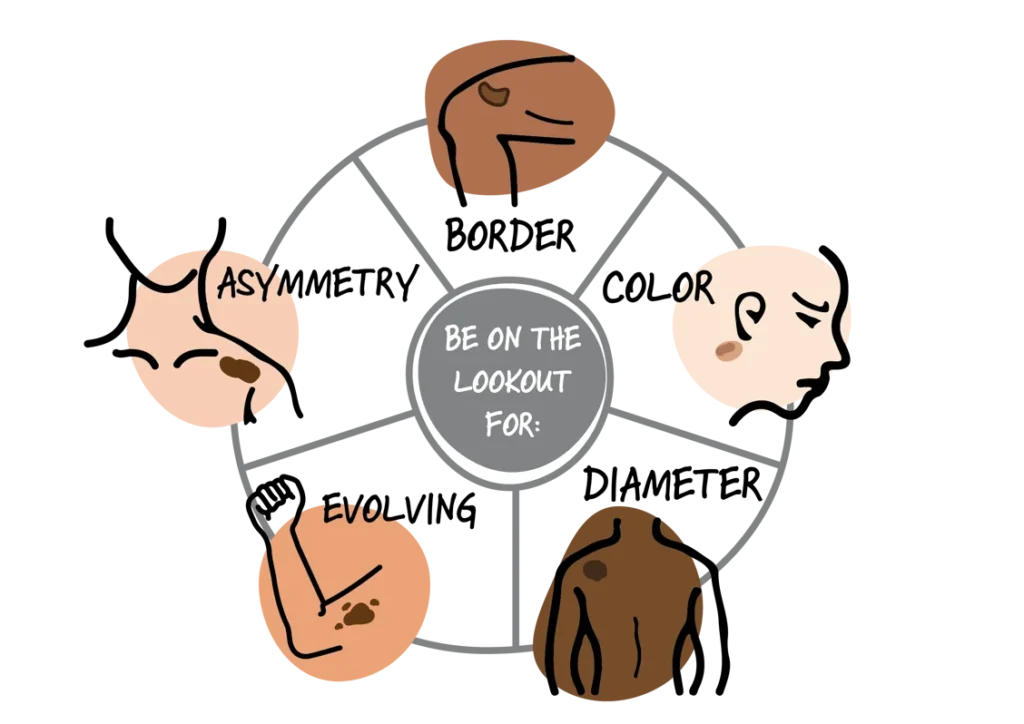
    *Please note: Members do not receive a reward for referring a group. However, when a referral is made by a member of a group, the referral credit is awarded to the group organization. The group will determine how the credit is applied—whether it is passed on to the individual member who made the referral or retained for group use. If you’re a member of a group, please contact your group administrator for details about how your organization handles Refer-a-Friend credits. The state of Maryland allows CHM members residing in Maryland to apply credits to Personal Responsibility costs; however, credits may not be applied to monthly contributions. Additionally, Maryland and Montana limit referral credits to six new members per year per state law. Other state-mandated limitations may apply.



    More Refer-a-Friend resources

    Friendship is all about relationships and bringing people closer to Christ by bearing one another’s burdens—one friend at a time!

    Share the quiz to help start the conversation about CHM.

    Hear about members’ Refer-A-Friend experiences.

    As CHM grows, your savings can too.

    Thinking about joining CHM?

    As a health cost sharing ministry, the way we operate is different—by design! Trying something new (like joining CHM) often comes with lots of questions. That’s why we’re here to help as you decide what’s best for your needs.

    To help you get started, here’s a quick look behind the scenes so you know what to expect in the first month of membership. We’re excited to share the cost-savings, flexibility, and prayerful encouragement CHM has to offer when you join!

    Getting Started

    How long will it take, and when will I receive proof of my membership?

    Once your enrollment is complete, your membership will begin as soon as you click the “submit” button on the online enrollment or on the postmark date of your mailed enrollment (unless you have a specified future start date). You’ll receive confirmation and a temporary membership number.

    When your information is processed, you’ll receive an email containing your member number and start date. After that, once you receive this information, you’ll be able to register for the Member Portal, download your digital membership cards, submit medical bills, view the CHM Guidelines, and more!

    You’ll also receive a new member Welcome Packet in the mail within a few weeks of submitting your application that will contain printed membership cards, a print copy of the CHM Guidelines, and more.

    What is the medical bill sharing process?

    CHM members are considered self-pay, uninsured* patients. When going for medical care, members inform healthcare providers that they’re a self-pay patient, asking providers to send them itemized bills directly and apply any available uninsured or self-pay discounts. Members then submit all eligible bills to CHM. This allows them to have a direct say in their healthcare. With CHM, there’s flexibility to choose your own providers with the advantage of transparent pricing.

    When the bills are submitted, the CHM staff have five tasks to complete the medical bill sharing process. For more information about what to do if you need medical care, visit this resource.

    *CHM is not insurance. As a CHM member, you’re considered uninsured if you don’t have primary health insurance.

    How do I find CHM-friendly providers?

    Because CHM doesn’t restrict you to a network, members often discover higher-quality care at lower cash-pay prices. We’re devoted to empowering members to find quality healthcare service at an affordable price. CHM has staff that specialize in building relationships with healthcare providers and pre-negotiating discounts—allowing accessible, quality care at competitive cash-pay prices. The resources section of the Member Portal also has a search feature for finding CHM-friendly providers nearby.

    There’s also the option to use our help in selecting a provider for certain medical events (maternity, non-emergency surgical procedures, or cancer). Learn more about CHM Care Solutions that are included as part of CHM membership here.

    As long as the expenses are eligible for sharing within CHM Guidelines, the healthcare provider options are countless.

    Why do you use different terminology?

    CHM is a spiritual covenant relationship with fellow Christians—not a contractual obligation. Covenants are found throughout the Bible both between God and His people, and His people in covenant with each other.

    As a health cost-sharing ministry (not insurance) we use terms that reflect our mission. These terms further demonstrate how we’re able to minister to the Body of Christ more effectively. You can find a helpful glossary of our most commonly used terms here

    While the language may feel unfamiliar at first, most members quickly find it reflects the heart of how CHM serves them.

    What else should I know about CHM membership?

    Here are some actions we highly recommend for members in the first 30 days after joining:

    • Activate your Member Portal account. You can add a person to your membership, change your contact info, download your digital membership cards, make one-time contributions, set up and manage recurring contribution payments, submit medical bills for sharing, and access tools to help you share CHM with friends and family.
    • Read Heartfelt Magazine. You’ll receive Heartfelt at the beginning of each month. Please read it carefully; it contains helpful information about being a member, ministry news, member testimonies, advice for healthy living, and more.
    • Make sure you’re on the right program and part of CHM Plus. CHM Gold with CHM Plus provides the most comprehensive sharing support, including lower Personal Responsibility and additional assistance for medical needs over $125,000. CHM SeniorShare™ is available for members age 65 and older.
    • Engage with other members on our social channels. Be encouraged through prayer, testimonies, and other helpful content on CHM’s social media channels. Look for us @iheartCHM.

    Starting your CHM Membership

    Ready to get started? If a faith-based, flexible approach to healthcare feels right for you, CHM is ready to welcome you. Enrollment is simple, and your membership can begin right away.

    • Start your CHM membership
    • Talk with a Member Enrollment Team Member

    CHM has two options for the sharing of pre-existing conditions: scheduled sharing and CHM Give (formerly known as Prayer Page). Here’s what you need to know about CHM and medical bill sharing for pre-existing conditions:

    How CHM defines a pre-existing condition

    A pre-existing condition is any medical condition for which you experience signs, symptoms, testing, or treatment before joining CHM, regardless of whether you’ve received a diagnosis (routine and/or maintenance medications are considered treatment).

    For example, if you have a stent that was inserted for a heart condition before joining CHM, the stent is considered treatment and your heart condition
    is pre-existing.

    A condition is no longer considered pre-existing if

    • you have experienced one year without signs, symptoms, or treatment;
    • you’re not on a maintenance medication regimen for that condition; and
    • it’s documented by your official medical records.

    In contrast, cancer is no longer pre-existing if, after your doctor has pronounced you cancer-free or cured, you have gone five years without any signs, symptoms, testing, or treatment (other than routine follow-up appointments).

    Active vs. maintained

    We distinguish between two types of pre-existing conditions: active and maintained.

    A condition is considered active—and medical bills are ineligible for sharing—if you have experienced any signs or symptoms either before or at the time of joining CHM (regardless of whether or not you’ve received a diagnosis) and/or your condition actively needs treatment other than with maintenance (routine) medications.

    If there is any question about whether you’re in an active incident, CHM will request your official medical records.

    Your pre-existing illness is considered maintained if

    • you have gone at least 90 days without testing or treatment;
    • your medical provider states that no further testing or treatment is needed; and
    • your medical records show that you are cured or on a maintenance treatment regimen.

    Medical expenses for conditions meeting these criteria may be considered for sharing according to CHM Guidelines as described below.

    Scheduled sharing

    CHM Gold members can receive assistance with medical bills for maintained pre-existing conditions according to the following schedule:

    • In the first year of membership, bills incurred for a pre-existing condition are eligible for sharing up to $15,000.
    • In the first two years of membership, bills incurred for a pre-existing condition are eligible for sharing up to $25,000 ($15,000 during the first year plus $10,000 during the second year).
    • In the first three years of membership, bills incurred for a pre-existing condition are eligible for sharing up to $50,000 ($15,000 during the first year plus $10,000 during the second year plus $25,000 during the third year).
    • After the third year of membership, the condition is no longer considered pre-existing.

    Eligible medical expenses incurred during the first three years of membership that exceed the schedule limits for CHM Gold members will be considered for sharing on CHM Give.

    CHM Give

    CHM Give—which is published in CHM’s monthly Heartfelt Magazine—enables sharing for CHM Silver or CHM Bronze members with eligible maintained pre-existing conditions. Also, if you are a CHM Gold member with a maintained pre-existing condition and your medical bills exceed the scheduled sharing limits, the excess amount may be eligible to appear on CHM Give. Members on CHM Give provide CHM with permission to include their names, addresses, a summary of their condition, and current donation amounts.

    All CHM members are invited and encouraged to give to medical bills listed on CHM Give (above regular monthly contributions) as they feel led. CHM Give donations sent to the CHM office qualify as tax-deductible charitable giving. One hundred percent of this extra giving goes to share CHM Give bills. Members listed on CHM Give receive donations each month proportionate to their total of eligible medical expenses until their bills are shared in full, so long as they remain CHM members.

    This portion of our ministry is an amazing testimony to the power of the Holy Spirit to change people’s hearts.

    Frequently asked questions

    Why are some bills eligible for sharing through CHM’s pre-existing condition programs and others are not?

    Any medical bills considered for the ministry’s pre-existing condition options must follow all other Guidelines for sharing eligibility. Also important is the distinction between active and maintained pre-existing conditions.

    A condition is considered active and medical bills cannot be shared if, at the time you join CHM, you have experienced any signs or symptoms either before or after joining CHM (regardless of whether or not you’ve received a diagnosis), and your conditions actively need treatment (other than with maintenance [routine] medications).

    If you have gone at least 90 days without testing or treatment and your doctor states you are cured, or on a maintenance treatment regimen, medical bills for any new incident (flare-up) related to the pre-existing illness are eligible for scheduled sharing (CHM Gold members) or CHM Give (CHM Gold, CHM Silver, or CHM Bronze members).

    Here’s an example of the difference between an active and maintained pre-existing condition: Suppose that Joe X, a CHM Gold member, had a heart attack in October and joined CHM two months later (December). During that time he had surgery and a few follow-up appointments with his cardiologist, one of which took place after Joe joined the ministry.

    According to CHM’s definition of a medical incident, Joe is in the middle of an active pre-existing incident because he hasn’t been declared cured, put on maintenance medication, or gone 90 days without treatment of his condition.

    In February, Joe had an appointment with his cardiologist, at which time his doctor said he didn’t need to be seen again for six months. Joe’s treatment plan specified that aspirin is the only medication he needs to take regularly. However, Joe suffered a second heart attack in June. Medical bills related to the second attack are eligible for sharing through CHM’s options for pre-existing condition because it’s a new medical incident—he has taken only routine medication, and it has been over 90 days since he last received treatment (doctor’s office visit in February).

    What if I didn’t go to the doctor until after joining CHM or switching to a different program?

    If you had any signs or symptoms before you joined the ministry—even if you haven’t had testing or treatment—your condition is considered pre-existing and will be evaluated according to whether it’s active or maintained (see the previous question for an explanation). Please note that CHM cannot share any bills incurred prior to joining the ministry.

    If you change to a lower program, eligible medical bills for your maintained pre-existing conditions will be shared at the lower program, regardless of when your medical bills were submitted or incurred.

    If you change to a higher program, medical bills for any current conditions will be shared at the lower program for the lifetime of your membership. Exception: If you’re switching to CHM Gold, a current condition eventually may be considered for sharing at CHM Gold once you are pronounced cured and one year free of signs, symptoms, and treatment (including medications). This applies regardless of whether medical bills have been previously submitted for sharing. Medical records may be requested.

    New illnesses with signs, symptoms, testing, and treatment beginning after the higher program start date will be considered for sharing at the higher program.

    Which programs allow my maintained pre-existing conditions to be eligible for sharing?

    If you’re a CHM Silver or CHM Bronze member, your eligible medical bills for your maintained pre-existing conditions will be shared through CHM Give (see below). CHM Gold members can be shared through the sharing schedule or via CHM Give if they exceed sharing schedule limits. Please see above for information about CHM Give and sharing schedule.

    Is a pregnancy ever considered pre-existing?

    If a member joins CHM while she is pregnant, bills for that pregnancy cannot be shared through any of the CHM sharing programs, including the sharing schedule or CHM Give. Members must have a due date for delivery at least 300 days after joining CHM Gold for maternity bills to be eligible for sharing. Additionally, any complications for an ineligible pregnancy cannot be shared through CHM.

    Christian Healthcare Ministries assists members with prescription costs as follows:

    With tools like the ones we’ve provided here, you can find the cheapest prescription costs in your area and lock in those low prices with coupons, membership cards, and more. The best part? It’s all free and easy to use.

    Save even more with these tips:

    • Ask your doctor for the generic brand of your prescription.
    • Search for your prescriptions before you even leave your house to find the cheapest prices and best locations.
    • Use more than one of the tools listed below.
    • Give the pharmacist multiple savings cards to see which one gets the best price.
    • Send the free coupons to your phone to lock in low prices.

    With these tips and resources, you can find the best savings on your prescription costs. It’s easier than ever!

    GoodRx enables you to search for your prescription by name, filter results by dosage, price, and more, and find cheaper generic brands. GoodRx may offer coupons to lock in lower prices. In addition, it has services to help you find discounts or financial assistance programs. GoodRx also has a membership card you can show your pharmacist. Learn more by visiting GoodRx.com.

    Rx101 gives you the ability to search for prescriptions in your area, enabling you to get the best bang for your buck. Rx101 also has a discount card that you can show your pharmacists when you pick up your prescriptions, often opening discounts for you right there in the store. Learn more by visiting Rx101.org.

    WellRx allows you to search for prescriptions—including generic brands—and helps find the cheapest prices in your area. If you have a prescription you’re regularly buying, you can turn on price alerts to get notification if the price changes. WellRx equips you with a membership card and coupons to lock in those low prices. Learn more by visiting WellRX.com.

    CHM Give is one of CHM’s initiatives to share medical bills for maintained pre-existing conditions. Through voluntary donations, the eligible medical needs of members are shared. It’s an amazing testimony to the power of the Holy Spirit and the generosity and love of our members. CHM Give is also published in CHM’s monthly Heartfelt Magazine.

    How does it work?

    CHM Gold members with maintained pre-existing conditions whose medical bills exceed the Gold Schedule limits–or CHM Silver and CHM Bronze members with bills from maintained pre-existing conditions–may be eligible to appear on CHM Give. Members provide CHM with permission to include their names, addresses, summary of their condition, and current donation amounts.

    All CHM members are then invited and encouraged to donate to CHM Give needs (above regular monthly contributions) as they feel led. These donations fund CHM Give and share the medical bills for maintained pre-existing conditions.

    Tangibly serve others as the hands and feet of Christ

    CHM Give is a great way to provide blessings to fellow members who have found themselves in medical situations and, quite often, in financial and spiritual stress. Sending notes of encouragement can uplift their spirits and remind them that they are not alone. Additionally, praying for fellow members makes an intangible impact on the lives of those in need.

    Here are three reasons why you should consider giving to and supporting CHM Give members:

    • 100% of extra giving goes toward members’ medical bills.
    • Donations to CHM Give are tax-deductible.
    • Many members listed on CHM Give often explain how encouraged they were by receiving cards, letters, and emails.

    How do I give?

    There are several ways that you can support your fellow Christians through CHM Give:

    • Pray as you go through the list of members with eligible maintained pre-existing conditions. We believe in the power of prayer to change hearts and lives. 
    • Donate through the Member Portal. You can easily set up recurring donations or make one-time donation through the your Member Portal account. 
    • Donate through our streamlined CHM Give webpage. This is also a great option if you don’t have a Member Portal account!
    • Send cards, letters, emails, or notes of encouragement to members as you feel led by the Holy Spirit. You never know who you might impact through your act of service and kindness.

    Together, we can show the love of Christ to those in need.

    You can make a real difference in the life of a fellow Christian through CHM Give. With extra donations, we help hundreds of members each year pay medical bills for maintained pre-existing conditions. CHM Give is a testimony to the power of the Holy Spirit and the love Christians share with each other.
    And it works: We share eligible medical bills until they’re paid in full. Each year, CHM Give shares millions of dollars for members in need.

    A story of generosity through CHM Give

    When Larry and Jamie Giglio started Ragged Coffee, they wanted to use their business to bless others, asking “how can we use a cup of coffee to reach people?” They envisioned giving a cup of coffee to a homeless person and welcoming them in. That’s how they started their business: giving away coffee, one cup at a time.

    Larry and Jamie joined CHM because it was more affordable than traditional insurance. As entrepreneurs, CHM gave them peace of mind. They could be present with their family and make their own healthcare decisions—and they could give back.

    Jamie said, “It’s easy for us to give because that’s what we’re supposed to do. It’s not ours to begin with. It’s a joy to give.”

    One way Jamie and Larry give back is by donating a portion of their coffee sales to CHM Give. Little did they know that their giving would directly impact Diane of Valrico, FL.

    A gift received

    Diane Wingate joined CHM after her hairdresser told her about the ministry.

    After joining, she learned she needed a knee replacement. Since it was a maintained pre-existing condition, her bills were eligible for sharing through CHM Give.

    Diane said, “Because of the generosity of other people and CHM Give, I don’t have to worry about how my bills are going to be paid. I can go on with my retirement.”

    The generosity Diane received financially and spiritually from strangers was a huge encouragement. Reading cards with prayers and Bible verses written out warmed her heart. Larry and Jamie likewise experienced the joy of giving and receiving. Larry says, “You may not even know the people you’re helping but your actions are going to have a lasting impact on their lives.”

    Jamie added, “Just giving a cup of coffee, having a conversation, and meeting a particular need we see—God calls us to do that.

    Hearing others’ stories, and giving to others to meet their needs, brings us together—like a cup of coffee. CHM Give allows members like Larry and Jamie to have a direct effect on the lives of others. If you want to give, here’s how you can take the next step:

    How you can be a part of CHM Give

    For CHM members

    The CHM Member Portal allows you to easily donate, knowing that your money is going to fellow members who need it most. If you have any questions, please email us at info@CHMinistries.org or call us at 800-791-6225.

    1. Log on to your Member Portal and select the “CHM Give” tab.
    2. On the “CHM Give” page, select the “DONATE NOW” button at the top. You’ll then be redirected to CHM’s secure payment portal.
    3. Once there, select either “Set Up My Recurring Donation” or “Donate One-Time”. Follow the prompts to complete your donation.

    For non-members

    If you don’t have an active membership but want to bless CHM members by donating, just follow the instructions below:

    1. Visit our CHM Give webpage and select the “DONATE NOW” button.
    2. Once there, select either “Set Up My Recurring Donation” or “Donate One-Time”. Follow the prompts to complete your donation.

    Every gift is a testimony

    From a cup of coffee to a paid medical bill, CHM Give reminds us that generosity multiplies. Consider donating today to bless a fellow believer in need. Together, we can reflect Christ’s love in action—lifting burdens one gift at a time.

    We want to hear from you, how are we doing?

    We’re always looking for ways to better serve our members and fulfill our mission of glorifying God through sharing each other’s medical bills.

    Please note that this isn’t a way to contact us or get a direct response. For that, please call our offices at 800-791-6225, email info@chministries.org, or message us on social media. Instead, this is an opportunity for you to submit your feedback on how we can serve you better!

    The original health cost sharing ministry

    As the nation’s first and longest-serving health cost sharing ministry, CHM provides a cost-effective, accountable, and faith-based framework—health cost sharing—to help fellow believers facing a health crisis. The ministry shares 100 percent of eligible medical bills and overall has satisfied over $10 billion in members’ healthcare costs.

    CHM’s concept originated 2,000 years ago with the early church who “held all things in common” and followed the Apostles as they prioritized meeting the needs of the poor, the oppressed, and their Christian family. Members are an extension of that testimony as CHM is first and foremost a ministry, reflecting the spiritual values outlined in Galatians 6:2 and Acts 2 and 4.

    The ministry, under the leadership of President and CEO J. Craig Brown II, is headquartered in Barberton, Ohio. We’re a nonprofit (501(c)(3)), Demotech accredited, and Better Business Bureau accredited Charity.

    If you have been injured in an accident, we are sorry to hear of your difficulties. Please know that all of the staff here at Christian Healthcare Ministries are praying for your recovery.

    If you incurred medical bills from an accident, here’s what you should do next:

    1. Make sure the responsible party’s insurance company is aware that CHM is a secondary source, and their resources must be exhausted first.
    2. Please complete the below forms (and submit any medical bills) on your Member Portal:
      • Sharing Request Packet
      • Accident Verification Form
      • Reimbursement Agreement
    3. Visit our step-by-step guide for submitting medical bills for further detailed instructions.

    Please note: If you are involved in an accident involving licensed motorized vehicles, bills resulting from the members’ injuries are eligible for sharing—up to $125,000 per diagnosis—after all other sources of funding are exhausted (or more if you participate in CHM Plus).

    If members are riding in a non-member’s vehicle, the amount available in the non-member’s insurance policies must be exhausted before CHM can share medical bills for the members. If the members or non-member driver are not at fault, the amount available in the offending party’s insurance policies must be exhausted first.

    CHM does not set a minimum requirement for members regarding their auto insurance medical coverage. CHM encourages members to set the highest possible limit on the medical assistance available through their auto insurance policy in order to steward members’ funds wisely and keep monthly financial contributions low.

    For more information on motor vehicle accidents please see section V.D. of the CHM Guidelines.

    Infertility is a whole lot of nothing. An awful, painful nothing.

    That it is nothing is not what makes it awful but that it exists in place of the most significant something we can ever hope for: a newborn child. Just when we are ready and inspired to begin, we face, almost immediately, the exact opposite of our hopes: nothing.

    But as painful as this “nothing” is, it is still a beginning, for indeed God created everything out of nothing. It’s just not quite the beginning we had expected for ourselves. So, hope is not lost, because infertility precedes fertility.

    While you wait, use the time wisely and in prayer. If you don’t know how to pray about this, don’t worry—there are plenty of prayers for infertility all over the internet.

    So that you can begin praying to conceive, we’ve written a few for you here. Use these prayers for pregnancy however you like. Recite them as they are or let the words inspire your own prayers for fertility. But whatever you do, make them your prayers, offering them up to God as a sweet aroma.

    Prayers for infertility while patiently waiting

    Father in Heaven, I, your daughter, am grieved by a most unwelcome interruption. I stand, stalled, before a depressing reality. The height, breadth, and depth of its wall I cannot scale, bypass, or tear down.

    I am stuck, waiting to love my child, and I don’t know what to do. Where tears of joy should be, tears of sadness now sit and fall.

    Remember me, Abba, in compassion and lovingkindness. Pick me up, as you have so many times before, and wait with me. Remind me, Lord, of your love for me, and that everything will be all right. Grant that I would not grow weary or weak during this season and that it would pass swiftly. Close my ears to the enemy’s lies, and continue to encourage me in Your truth.

    Open my soul to hope and confidence, and continue my journey toward motherhood. Until then, my Lord and my God, I will wait on you. Amen.

    Praying to conceive. CHM.

    A prayer to conceive life

    O Great Father, You are the source of all life, for You are life itself. Your heart is ever fixed on giving life and giving it abundantly. You conceive it. You deliver it. And you keep it safe in your embrace.

    You teach me continually what it means to be a source of life, what it means to give life to others, without expecting anything in return. My heart now longs for its ultimate physical expression: a child.

    Be gracious to me, Father, and listen to me, your daughter, for I have no life apart from You, and no purpose but to be Your servant. Open Your hand, and satisfy the desire of all those who wish to bring forth life.

    Allow me to conceive, deliver and embrace a child, just as You have conceived, delivered, and embraced me. In loving and knowing my child I will come to know you better, and I will love You all the more for it. Amen.

    “For this child I prayed, and the Lord has granted me my petition that I made to him.” – 1 Samuel 1:27 (ESV)

    A prayer for fulfilling potential

    O Lord, God, Creator of all, You are the beginning and the ending. You infused all of creation with possibility and divine potential. Grant me now, merciful Father, the opportunity to fulfill mine.

    In the midst of speaking all things into existence you spoke directly to Your creation, addressing it with the first command of scripture, that follows, in kind, Your creativity: “Be fruitful and multiply.”

    You didn’t have to make me, but You did. I am grateful. You didn’t have to make me a woman, but You did. I am grateful. And by making me a woman You have set me down the path to motherhood. I am grateful.

    Grant me Your favor and blessing, and hear my plea, Father. Allow my husband and I to fulfill the potential of our union, the opportunity to obey the first command of Your Word: “be fruitful and multiply.”

    Bring for us daughters and sons who will, in turn, be fruitful and multiply. And humble us by inviting us into the ongoing work of Creation. May I be worthy of the role of motherhood You have set before me. Amen.

    Grow the Fruit of the Spirit by signing up for our FruitFULL e-book!

    Created just for you, this book is full of resources to help you and your family cultivate closeness with God.

    Just like you make sure to eat a balanced diet, make sure you learn to grow the “good fruit” of the Holy Spirit. 

    “Rejoice always, pray without ceasing, give thanks in all circumstances; for this is the will of God in Christ Jesus for you.”

    [1 Thessalonians 5:16-18]

    God is doing beautiful work within you, and your unborn child is a gift. Psalm 127:3 (NLT) says, “Children are a gift from the LORD; they are a reward from him.”

    Motherhood can be intimidating, and it’s normal to be anxious about the future of your unborn child. It’s important to connect with God and bring our praises, worries, and requests to Him.

    We asked some CHM moms to share their prayers for expectant mothers, strength, peace, and protection. Here are their prayers.

    Prayers for peace

    Lauren and Stanley

    “God, I thank You for the tiny little blessing that is my child. From the very beginning, You have walked beside me, guiding every step. I ask that You equip and teach me to be the mother you designed me to be. When my heart is troubled, anxious, or scared, I pray that Your Holy Spirit guides me to Your peace. Through the valleys and the mountains, remind me that You are near. I pray that You protect this child with Your mighty hands and that they know they are loved by You. Lord, I give this child to you. I trust Your will for their life.”

    Lauren Hunter

    Prayers for wisdom

    Katlyn with Michaela

    “Heavenly Father, I praise Your name for the depth of Your wisdom. What a joyful life for the one who understands Your ways and follows Your steps. When I think about the workings of all Your creation, what awe fills my heart!

    In Your wisdom, You created a world of order and of beauty. As this little one grows each day, will You instill in their spirit a passion for learning who You are and the wisdom You display throughout Scripture? Will You stir in their hearts a ravenous hunger for Your Word, Your truth, and Your love? Help me to see the fun and creative ways of increasing their knowledge of You. Thank you for the privilege You’ve given me of being this child’s parent.

    I’m grateful for this gift, and I pray that each day we have together, we grow in our love for You. Amen.”

    Katlyn Stryker

    “Lord, each day You lovingly and faithfully craft and form this child in my womb, and You do so with purpose. Each soul has a purpose in life, and I pray that You use this child to grow my relationship with You. As we walk this journey together—You and I as Creator and creation—will You prepare my heart to be a parent worthy of the honor of knowing and raising my child? Will You help me show this little one the fullness of Your love and kindness? God, I lay in Your hands this gift You’ve given me, and I ask that You work in me today and every day forward, even as You’re working in the life of my baby, so that we may know You in a deeper way. Amen.”

    Katlyn Stryker

    Help me to foster a home and environment where my baby understands the depth and the height of Your presence in their life.

    Prayers for protection

    “Lord, protect my baby. May our child be born healthy, without complication, and in your timing. Help me to be a good mother and to know how to care for them. Protect their mind, heart, body, and soul. I pray that they would grow to know you, Jesus, and that they would grow into a person of wisdom and integrity. Thank you for the privilege of being this child’s mama. Help my husband and I to be the best parents that we can be. May our child always know that they are loved.”

    Haley Hoffman

    “Dear Lord, thank you for the life you’ve knitted together within me. We praise You for entrusting this soul to us. Give us the grace to be good parents and help us to raise this child in a way that brings glory to Your name. We humbly ask You to be a shield of protection around this baby during the remainder of the pregnancy, during labor, and throughout his or her earthly journey. Protect our family from any sickness or harm and cast out every fear that threatens to steal our joy. In Jesus’ name we pray, Amen.”

    Lisa Maruna

    Prayers for strength

    “God, thank you for the gift of life. Thank you that You give life and give it abundantly. I know that Your love in a person’s life is what gives life true meaning and joy. Help me be a vessel in sharing that love with my baby. Help me to foster a home and environment where they understand the depth and the height of Your presence in their life. Will You help my walk with You strengthen their faith and prompt a resolve in their hearts to follow You? May they experience daily an abundant life with You. Amen.”

    Katlyn Stryker

    Maternity Guide

    CHM Maternity Guide

    When you’re thinking about starting a family, considering all your options is a great first step.

    Learn more about CHM’s maternity program and make sure you’re prepared by signing up to receive the Maternity Guide.

    As a woman of God, you can look to the godly women of Scripture for inspiration. They shared human weaknesses and virtues while persevering in faith. Their stories are as old as Eve and as unique as Ruth, Sarah, Esther, and other women of the Old Testament.

    The New Testament offers insights from women who were part of Christ’s life. The stories of Elizabeth, Anna, Mary Magdalene, Mary of Nazareth, and others don’t fit predictable molds.

    They were single, married, or widowed. Some were poor, forgotten, or banished. Others were wealthy and powerful. Some lived a virtuous life, while others had lost their way. Most stepped up and answered Christ’s call to a more selfless, God-centered life.

    “Martha, Martha!” Christ’s lesson on listening.

    Many women sympathize with Martha. She opened her door to Jesus and His disciples. She whipped up a meal and waited on her guests. Mary sat at our Lord’s feet and listened to every word.

    The disciples may have talked about travels, fishing, or the weather as they enjoyed Martha’s meal. More likely, however, Christ’s authority and the power of His words commanded their attention. This was often the case whether Christ was at home, in the Temple, in a boat, at a wedding, or on a hillside. He still speaks to us through prayer, Scripture, and the Spirit. When Christ speaks, listening is always the first priority.

    “Lord, don’t you care that my sister has left me to do the work by myself? Tell her to help me! ‘Martha, Martha,’ the Lord answered, ‘you are worried and upset about many things, but only one thing is needed. Mary has chosen what is better, and it will not be taken from her.’ “ – [Luke 10:38-42, NIV]

    What does it mean to be a godly woman?

    Good qualities in a woman stem from the greatest commandment, which is love [Matthew 22:36-40]. God-fearing women of faith in the Bible remind us that a godly woman is:

    1. Prayerful

    “They all joined together constantly in prayer, along with the women and Mary the mother of Jesus, and with His brothers.” [Acts 1:14]

    Prayer puts God where He belongs in your life: first. It’s the foundation for a close, strong, and eternal relationship. It keeps thoughts, desires, and actions rooted in God’s will. If you trust Him, He’ll guide you in ways exclusive to your calling in life.

    2. Virtuous

    “But the fruit of the Spirit is love, joy, peace, forbearance, kindness, goodness, faithfulness, gentleness and self-control.” [Galatians 5:22-2]

    When you walk in the Spirit, God directs your steps. The Spirit helps you to strengthen virtues and tame vices. God’s word reminds you to witness and share Christ’s love. Your family, friends, neighbors, and strangers need that. It might be an uplifting word, a helping hand, slowness to judge, or refusal to gossip. Small acts that were done in love matter.

    3. Industrious

    “She opens her mouth with wisdom, and the teaching of kindness is on her tongue. She looks well to the ways of her household and does not eat the bread of idleness.” [Proverbs 31:26-27]

    Today, idleness can look like binge-watching dramas, following “Reality” TV, bragging on social media, or texting while ignoring people in front of you.

    You may scan social media news feeds or click on viral memes, celebrity updates, and virtue-signaling podcasts. You might envy old friends who have more fans, friends, or superficially “perfect” lives than you.

    With so many stars, bells, and whistles, you might overlook real relationships, responsibilities, and constructive actions. Rationing digital connectivity can help you tend to more important and fruitful priorities.

    4. Service-oriented

    “Whoever serves Me must follow Me; and where I am, my servant also will be. My Father will honor the one who serves me.” [John 12:26]

    Christ commanded us to love and serve one another as He modeled for us [John 13:34]. You can serve God by caring for the people in your life. That includes giving to your church and supporting faith-based community outreach. You can pray and fast. However you serve—from daily duties to volunteer time, talent, and resources—you’re serving Christ within “the least of these” [Matthew 25:35-45].

    5. Loving

    “If I speak in the tongues of men or of angels, but do not have love, I am only a resounding gong or a clanging cymbal.” [1 Corinthians 13:1]

    Orchestras use gongs or cymbals for dramatic emphasis or a grand finale. But our human ears and sensibilities can only tolerate so much drama and noise. Love doesn’t command, “Look at me!” but says, “I’m looking at – and caring about – you.” Paul’s first letter to the Corinthians offers a better way. Godly women model a type of love that:

    • Is patient and kind
    • Does not envy or boast
    • Is not arrogant or rude
    • Does not insist on its own way
    • Is not irritable or resentful

    Becoming a virtuous, godly woman is a lifelong effort made possible by the grace of God and the power of a Christ-centered life.

    Don’t be left out!

    Sign up to receive our exclusive Building a Better Marriage course, full of fun questions to ask your spouse and a special video series.

    Ideas that may increase fertility naturally

    You’ve tried to get pregnant and prayed for a baby for months or even longer. But despite big dreams of a little one, the answer is still, “Not yet.”

    If you find it hard to get pregnant, you’re not alone. According to the National Institutes of Health, about 11% of women have fertility problems during their reproductive years. In addition to preparing your body for conception, healthy steps can help you get pregnant naturally.

    Some women try natural remedies such as liver cleanses, detox formulas, or organic progesterone creams to get pregnant faster. However, the research is inconclusive. Ask your doctor before trying new remedies or making health and lifestyle changes. You’ll get customized, safe options to help you get pregnant faster.

    God’s perfect timing

    “In the morning, Lord, you hear my voice; in the morning I lay my requests before you and wait expectantly.”
    [Psalm 5:3, NIV]

    Waiting and hoping to get pregnant can be humbling and even heartbreaking. But Christ reminds us to model a child’s faith, trust and humility (Mathew 18:2-4). God loves you even more than you’ll love any children He may bring into your life. If you’re worried about getting pregnant, keep praying and trust the Lord with childlike faith. Then rest assured that He will direct your paths. (Proverbs 3:5-6)

    Bright eyes and rosy cheeks aren’t just for babies

    Good health translates to good fertility. Simple measures – from choosing prenatal vitamins to positive lifestyle changes – can help increase fertility naturally. By staying healthy and well-nourished, you’ll create a nurturing space for conception.

    Fertility is complex and highly individual. Your doctor will evaluate your personal health and medical history before discussing fertility-enhancing options.

    “In the morning, Lord, You will hear my voice; In the morning I will present my prayer to You and be on the watch.” – Psalm 5:3 (NASB)

    Vitamins and nutrients to support fertility

    Vitamins, minerals and nutrients support egg and sperm quality as well as ovulation, menstruation, thyroid and hormonal functions.

    According to the American Congress of Obstetricians and Gynecologists, a well-rounded, whole-food diet is the best source of essential proteins, carbs, vitamins, minerals and fat. A prenatal multivitamin or supplements to correct imbalances can be helpful.

    Folic acid

    Experts recommend 400 micrograms of folic acid daily for women who may become pregnant to help:

    • Manage blood flow and blood pressure
    • Enhance fertility
    • Support pregnancy
    • Prevent brain and spinal birth defects

    Iron

    Specialists at the Academy of Nutrition and Dietetics report that iron from food or supplements may lower the risk of ovulatory infertility. According to the American Pregnancy Association, liver isn’t recommended for moms-to-be. If you’re low in iron, eat these iron-rich foods.

    The sunshine vitamin might brighten pregnancy prospects

    Although some studies suggest a link between vitamin D deficiency and infertility, findings are inconclusive. However, vitamin D3–the natural type produced in your skin–supports overall health, hormone and gene-regulation, and fertility.

    Ask your doctor for a full vitamin D panel. Avoid unguided supplementation, which can cause imbalances and toxicity. Vitamin D works with vitamins A and K, potassium, magnesium and other elements. Imbalances can lead to calcium deposits and other problems.

    Your skin makes vitamin D naturally from UVB rays. However, if your skin is dark, it’s harder for your body to make vitamin D from sunshine. Dietary sources include fish, egg yolks, nuts, seeds and fortified milk and cheese.

    Fishing for fertility-boosting omega-3’s

    Omega-3 fatty acids in fish and other foods have multiple health benefits. These include taming inflammation – a potential cause of infertility. Omega-3’s contribute to egg quality and may lower the likelihood of endometriosis – a reproductive disorder.

    Fish provide protein, iron and zinc for healthy prenatal development. Omega-3 fatty acids also support a baby’s brain development. Avoid larger fish, such as shark, tuna and swordfish, which contain more mercury – a reproductive toxin that also affects prenatal brain and nervous system development.

    The FDA recommends that women trying to conceive eat smaller, well-cooked fish and other omega-3 sources weekly. This protects heart health and supports fetal development. Good choices include:

    • Fortified yogurt, milk and eggs
    • Salmon, tilapia, cod and catfish
    • Shrimp, herring and anchovies
    • Walnuts, flaxseed and sunflower seeds

    Avoid trans fats and other unhealthy choices

    Harvard researchers found that women with ovulation-related infertility tended to eat more trans fats, which are linked to heart disease and other health issues. Avoid partially or fully hydrogenated oils common in vegetable oils, non-dairy creamers and many convenience foods. Choose healthy fats such as avocado, olive and coconut oil.

    Healthy choices are important when trying to get pregnant. Women who smoke are 60% less likely to conceive than nonsmokers. Data about caffeine or alcohol aren’t conclusive, but experts generally recommend avoiding alcohol, even in moderation, when trying to conceive. Moderate alcohol can also decrease sperm counts.

    Data on coffee drinking is also inconclusive. The American Society of Reproductive Medicine considers a cup or two of coffee a day permissible while others say it’s best to limit or avoid caffeine.

    What mother in the bible are you? CHM

    What mother in the Bible would you be?

    Take our quiz to find out which mother in the Bible you relate to most.

    With a new baby comes a myriad of love and joy, but along with the good comes another side. Newborns require near-constant attention and care, and this often leads to a lack of sleep, a lack of energy, and, occasionally, some mental health decline. Many moms experience anxiety and brief “baby blues” within the first weeks after giving birth, and up to 20% can experience more intense symptoms–postpartum depression.

    Whether you’ve dealt with postpartum depression or struggled with fatigue, it can be hard to juggle newborn care along with physical and spiritual care. We asked CHM moms of young children for their tips on how to stay steadfast in their relationships with God and the care of their newborns.

    Spiritual health

    “During late-night feedings or mid-morning naps while your baby is asleep in your arms, take the moment to connect with God. Share with Him your joys and struggles–He wants to hear it all, and He wants to give you the grace and strength to bring glory to His name through your vocation of parenthood.”

    Lisa Maruna

    “There will be times when reading from a physical book–even the Bible–feels difficult, particularly when you’ve got your arms full with a hungry, crying baby. However, in today’s world, spending time in the Word can be done through many formats. Setting up a variety of tools beforehand (hard copy book, audio, app, video, etc.) is a good pre-labor project. Here are some examples:

    • Download a Bible audio app for those busy days when you can’t sleep or your hands are preoccupied, but you do have the energy and capacity to listen to God’s Word. Even if you fall asleep, hearing the Word of God as you slumber can only help.
    • In a similar fashion, perhaps find some YouTube videos of the Scripture being read aloud.

    “Lean into the body of Christ—more specifically, your local church. Ask some key friends and mentors to take turns texting you a Scripture verse along with an encouraging note or a written out prayer for the day. Establish ahead of time that late nights and little energy means your responses will be limited. Perhaps you can set up a schedule where their texts come just before bed, so you get a spiritual pick-me-up when you wake up for a midnight or early morning feeding.”

    Katlyn Stryker, CHM member

    “I remembered the Psalms and how the Psalmist’s honesty brought closeness with God. In our troubles, it can feel as if God is miles away because our pain or despair is so palpable—when in fact, God is nearer than ever. Specifically, Psalm 94:17-19 (NLT) has been near to my heart:

    Unless the Lord had helped me, I would soon have settled in the silence of the grave. I cried out, “I am slipping!” but your unfailing love, O Lord, supported me. When doubts filled my mind, your comfort gave me renewed hope and cheer.

    “I’ve met God as my sustainer as He carried me through days of physical exhaustion. I didn’t know I could survive and still be a good mom; there was a stretch of 48 hours where I didn’t get to sleep or a break from parenting when my husband was sick. God reminded me of the story of Elijah when he wished himself dead and God provided him rest and food so that he could carry on. Elijah’s hardships didn’t magically go away, but God certainly sustained and revitalized him (1 Kings 19:5-18).”

    Carasella Mancari

    “In our troubles it can feel as if God is miles away because our pain or despair is so palpable—when in fact, God is nearer than ever.”

    Newborn baby care

    “You will keep in perfect peace him whose mind is steadfast, because he trusts in you.” 
    [Isaiah 26:3 (NIV)]

    “I found that having a newborn baby involved a lot of sitting. Sitting and holding, sitting and nursing, sitting and playing, etc. It’s very easy to nurse your baby with one hand and scroll mindlessly on your phone with the other. I realized early on that I didn’t want my baby to look up at me and notice that my attention was elsewhere. In those early days, try not to miss a single opportunity to look into their eyes and bond with them. As you sit with them, intentionally choose to talk to them, pray over them, or read aloud to them. For me, it was about recognizing my priorities and acting with intention. Choosing to engage with my baby rather than my phone was a small but invaluable investment.”

    Haley Hoffman

    “You need a pile of snacks and hydrating liquids near your nursing and/or feeding station. For some, spiritual strength–and logical thinking–can deplete quickly when the body isn’t also fed physically. Women are supposed to eat and drink twice as much while breastfeeding, so taking care of yourself physically is important for cognitive and emotional functioning.”

    Katlyn Stryker, CHM member

    “Remember: God designed you to be a mother. No matter what, He has set every moment in place. Trust your instincts. You will know what is best for you and your baby’s health. There is no “right” or “wrong” way to be a mother. You are unique by God’s hand. Don’t feel burdened by needing to ask for help. If you are overwhelmed with daily tasks, recovery after birth, or even need some personal time alone, let those around you help. You aren’t any less of a mother by doing so.”

    Lauren Hunter, CHM member

    What mother in the bible are you? CHM

    What mother in the Bible would you be?

    Take our quiz to find out which mother in the Bible you relate to most.

    Fruit of the spirit: Faithfulness

    If you’ve spent any significant time in Scripture, you’ve almost certainly encountered the word “faith” (or pistis in Hebrew). As mentioned several hundred times, both our faith in Jesus and God’s faithfulness toward us are vital to our relationship and understanding of God.

    What does the Bible say about faithfulness? As one of the fruits of the Spirit, the fruit of faithfulness requires firmness in conviction and the keeping of promises. As Hebrews 11:1 [ESV] explains that faith is “the assurance of things hoped for, the conviction of things not seen.” But to understand how the Holy Spirit works faithfulness in us, we must understand how God Himself is faithful.

    The covenants

    From the very beginning of His Word, we see God’s promises in the Bible coming to fruition. Joshua 21:45 [NIV] states, “Not one of all the LORD’s good promises to Israel failed; every one was fulfilled.” Similarly, 1 Thessalonians 5:24 [ESV] says, “He who calls you is faithful; He will surely do it.”

    The covenants of God are one of the ways He shows Himself faithful. The major biblical covenants of God are the Abrahamic, Davidic, and New Covenants—the three that promise the coming of Jesus—and the Noahic and Mosaic Covenants.

    In the Abrahamic Covenant, God promises Abraham and his descendants land, children, and blessings. God showed His faithfulness by blessing his barren, 90-year-old wife, Sarah, with a son and preserving that son and his future descendants.

    He fulfilled the rest of His covenant in bringing Abraham to the Promised Land and bringing redemption through Jesus. Abraham also showed his faithfulness by trusting God’s promises—even nearly sacrificing his promised son, Isaac, on the altar. God honored his faithfulness and provided an alternative option.

    In the Davidic Covenant, God promises to bless David’s line with the Messiah. This promise was fulfilled with the coming of Jesus, a direct descendant of David.

    In the New Covenant, God promised to free His people from the Law by Jesus’ death and resurrection. This covenant would bring God’s forgiveness of sin, renewed hearts, and access to God through prayer. The fulfillment of this covenant was also the fulfillment of the Davidic and Abrahamic Covenants.

    In the Mosaic Covenant, God establishes His Law with the people of Israel after He led them out from under the slavery of the Egyptian pharaohs. This covenant promised blessings if the Israelites were obedient and curses if they were disobedient. Throughout the Old Testament, you can see how God keeps this promise through the various struggles Israel encounters whenever they stray.

    In the Noahic Covenant, God renews creation and promises never to destroy Earth again with a worldwide flood. This promise came in the form of a rainbow, the symbol of God’s covenant.

    God provides

    There’s no greater testament to God’s provision than sacrificing His own Son for our sins so we can have everlasting life. But beyond that, God is faithful in providing for us in the day-to-day. God may not always provide in the way we anticipate, but He provides nonetheless.

    In Matthew, there are several references in Scripture on faithfulness as Jesus explains how our heavenly Father cares for us:

    • Matthew 6:26 [NIV] says, “Look at the birds of the air; they do not sow or reap or store away in barns, and yet your heavenly Father feeds them. Are you not much more valuable than they?”
    • And Matthew 7:9-11 [ESV] says, “Which one of you, if his son asks him for bread, will give him a stone? Or if he asks for a fish, will give him a serpent? If you then, who are evil, know how to give good gifts to your children, how much more will your Father who is in heaven give good things to those who ask Him!”

    These verses display the abundance of love God has for us. We can step forward with confidence knowing that God was, is, and always will be faithful to us in His provision. 

    God is perfect

    We know we can trust a God who is perfect and upright. How can a God who is perfect break His promises? The simple answer—He can’t. Deuteronomy 32:4 [NLT] says, “He is the Rock; His deeds are perfect. Everything He does is just and fair. He is a faithful God who does no wrong; how just and upright He is!”

    God’s flawless nature translated to Jesus and how He lived His life. Hebrews 4:15-16 [NIV] says, “For we do not have a high priest who is unable to empathize with our weaknesses, but we have one who has been tempted in every way, just as we are—yet He did not sin. Let us then approach God’s throne of grace with confidence so that we may receive mercy and find grace to help us in our time of need.”

    If Jesus wasn’t without sin, His sacrifice would’ve been for nothing. But because Jesus, fully God and fully man, came down to Earth as a sacrifice, we have a perfect God capable of understanding our earthly struggles and who shows His faithfulness by sympathizing with our weaknesses.

    “But the Lord is faithful; He will strengthen you and guard you from the evil one.”

    – [2 Thessalonians 3:3, NLT]

    God forgives

    God’s faithfulness is never clearer than in the forgiveness of our sins. 1 John 1:9 [ESV] states, “If we confess our sins, He is faithful and just to forgive us our sins and to cleanse us from all unrighteousness.”

    We can be certain that Jesus offers full forgiveness of sin through repentance because “He who promised is faithful” [Hebrews 10:23, NIV]. God keeps His promises, and He promises the assurance of forgiveness.

    Even in our struggles with sin, God is faithful in giving us a way out. 1 Corinthians 10:13 [NIV] says, “God is faithful; He will not let you be tempted beyond what you can bear. But when you are tempted, He will also provide a way out so that you can endure it.”

    Well done good and faithful servant

    In Matthew 25, Jesus explains the parable of the talents. The master in the story gives all of his servants a certain amount of money and asks them to steward it while he’s gone. When he returns, the servants who faithfully step up to their duties and don’t shrink away are rewarded. At the end of our lives, we too want to stand before Jesus and hear Him say, “Well done, good and faithful servant” [Matthew 25:21, ESV].

    1 Samuel 12:24 [ESV] simply and beautifully explains how to be faithful to God: “Only fear the Lord and serve Him faithfully with all your heart. For consider what great things He has done for you.”

    Faithfulness of God

    In a world plagued by heartache, struggles, contention, and uncertainty, we know we can find certainty in a perfect God who keeps His promises, provides, and forgives our sins. Just think of the promises that are yet to come! 1 Corinthians 2:9 states, “No eye has seen, nor ear heard, nor the heart of man imagined, what God has prepared for those who love Him.”

    So as we faithfully step forward in a broken world, let us stand firm in confidence and look to God’s nature and His promises. For as Romans 8:18 puts it, “I consider that the sufferings of this present time are not worth comparing with the glory that is to be revealed to us.”

    Grow the Fruit of the Spirit by signing up for our FruitFULL e-book!

    Created just for you, this book is full of resources to help you and your family cultivate closeness with God.

    Just like you make sure to eat a balanced diet, make sure you learn to grow the “good fruit” of the Holy Spirit. 

    “For unto us a child is born, unto us a son is given: and the government shall be upon his shoulder: and his name shall be called Wonderful Counselor, The mighty God, The everlasting Father, The Prince of Peace.”

    God’s heart is to restore us to wholeness. When we need healing for our bodies, minds, or spirits, God’s Word provides answers for our afflictions. Scriptures on healing give us a new perspective of hope and comfort. Rest and read God’s Word, knowing that it will speak into your situation today. Let’s look at Isaiah 9:6.

    As we step into the Christmas season, we reflect on and celebrate the birth of Jesus. While it’s easy to get swept away in the beautiful lights, glittering snow, smell of fresh-baked goods, and gift-giving, we mustn’t lose sight of the celebration’s purpose.

    Jesus’ birth changed everything. He lived a perfect life, took on our sin, died in our place, rose back to life, freeing us from the curse of the law.

    Isaiah 9:6 is a prophecy, talking about the coming of Jesus. In this verse, Jesus is referred to as a wonderful counselor, the mighty God, the everlasting Father, and the Prince of Peace.

    Wonderful Counselor

    Because of Jesus’ sacrifice on the cross, we can now go before God with our praises, our sorrows, and our requests. Before Jesus, we didn’t have that sort of direct access to God. And God doesn’t just hear our prayers—He responds. He responds through His Word, through His Spirit, and through answered prayers.

    God is the best counselor because He knows us through and through, and He loves us more than we can fathom. Luke 12:7 (NIT) puts His deep knowledge and love for us into perspective: “Indeed, the very hairs of your head are all numbered. Don’t be afraid; you are worth more than many sparrows.”

    Almighty God

    There are two points in this verse where Jesus is referred to as God. For this to make sense, we need to understand that Jesus and God are one in the same–two parts of the Trinity, with the third being the Holy Spirit. Jesus is the mighty God and everlasting Father because Jesus is God.

    God is all-powerful. From the whole of creation to the wonders and miracles He’s performed throughout time, it’s all too evident. And if that’s not compelling enough, His power and majesty is repeated throughout Scripture. Revelations 1:8 (ESV) says, “‘I am the Alpha and the Omega,'” says the Lord God, ‘who is and who was and who is to come, the Almighty.'”

    Jesus “being in very nature God, did not consider equality with God something to be used to His own advantage; rather, He made himself nothing by taking the very nature of a servant, being made in human likeness” (Philippians 2:6-11 NIV).

    Can you believe it? God–almighty, omnipotent, holy, and limitless–”made Himself nothing” all for us. But He didn’t stop at lowering himself to that of a man; “He humbled himself by becoming obedient to death–even death on a cross!”

    God almighty suffered the ultimate sacrifice for us. How humbling.

    Everlasting Father

    God is eternal. It’s hard for us to grasp being that we only think in finite time, but He existed before the concept of time. Psalm 90:2 (NIV) says, “Before the mountains were born or you brought forth the whole world, from everlasting to everlasting you are God.”

    The book of Genesis speaks to how God and the Word existed before creation. Can you imagine existing for eternity in solitude? It’s no wonder God chose to create.

    The everlasting God, who created us, loves us, and died for us, will be our Father for all eternity. As believers, we’re adopted into His family as children. Being a part of the family of God, we’re able to have a deep and personal relationship with Him–able to come to Him for help, for comfort, and with our praises. Forever. This relationship isn’t possible without Jesus.

    Prince of Peace

    Prince of Peace is a lofty title. A prince is an heir to a kingdom—in this case, the kingdom of peace. Jesus is the heir of peace, and if we are “co-heirs with Christ” (Romans 8:17 NIV), we can access peace through Christ.

    Spiritual peace

    Before Jesus, we were slaves to sin, living in constant contention with God. Our sin nature makes us self-serving, disobedient, impure, and wholly unfit to stand before the presence of a holy and perfect God. By washing us clean with His sacrifice, Jesus bridged the gap between us and God.

    Jesus made reconciliation with God possible. Romans 5:1 (ESV) confirms this: “Therefore, since we have been justified by faith, we have peace with God through our Lord Jesus Christ.”

    By washing us clean with His sacrifice, Jesus bridged the gap between us and God.

    Emotional peace

    Finding peace in a world bent on conflict and turmoil feels impossible, but Jesus brings a peace separate from the world. John 16:33 says, “I have said these things to you, that in me you may have peace. In the world you will have tribulation. But take heart; I have overcome the world.”

    The key is resting in Jesus–in knowing this world is only our temporary home, and we’ll experience true peace once in our eternal home. We don’t have control over what the world does, but God does hold control–He’s overcome the world!

    Mental peace

    Perhaps the most tangible evidence of Jesus’ peace is our direct line to God. We have an almighty God we can talk to and have a personal relationship with. We’re promised peace if we come to God–with an attitude of gratitude–and share our requests and worries with Him (Philippians 4:6-7 ESV).

    Jesus also promises “rest for your soul” (Matthew 11:28-30 NIV) if you take your burdens to Him and take on the lifestyle of Christ. We’re not promised easy lives, but we do know there’s peace through Jesus, our Prince of Peace.

    Grow the Fruit of the Spirit by signing up for our FruitFULL e-book!

    Created just for you, this book is full of resources to help you and your family cultivate closeness with God.

    Just like you make sure to eat a balanced diet, make sure you learn to grow the “good fruit” of the Holy Spirit. 

    How you lead people—the way you treat them—is a direct reflection of your faith. As C.S. Lewis writes, “A man whose life has been transformed by Christ cannot help but have his worldview show through.” Leadership styles, done well, are an excellent testimony for Christ.

    In the Bible, we find different types of leadership styles, especially in the Old Testament. As you read through the kings of Judah and Israel listed in 1 and 2 Kings and Chronicles, you can easily tell through their leadership if they followed God or not.

    Following your calling as a Christian entrepreneur often means you’ll have people working underneath you. Even if you’re the only employee at your small business, you can still lead those around you through your example. As Christians, we’re all leaders. We impact and influence others by the way we live our lives.

    By developing qualities of a good leader—taking the role of a servant, supporting your employees as they work, and putting their best interest first—you can transform your workplace and display the love and unity of Christ.

    Servant leadership

    Jesus was a servant leader. The Savior of the world came down to live among us and lead us to the Father. He modeled a new type of leadership and demonstrated qualities of servant leadership that were uncommon to the people of His day. He did this by serving those who followed Him: washing their feet [John 13:1-17, NIV], comforting them, and growing them in faith. His focus was on them first and how He could equip them to fulfill their God-given purposes.

    Following in Jesus’ footsteps requires us to display that same servant leadership style and demonstrate genuine love for those working under us.

    Think about your employees or staff. How can you pray for them? Encourage them? Equip them? Ask God to provide meaningful ways for you to serve them and minister to them.

    Transformational leadership

    Transformational leaders understand the power of collaboration and a well-equipped workforce. Nehemiah, in the Bible, gives us a great example of a transformational style of leadership.

    An ordinary person—a cupbearer tasting the Persian king’s wine to guard against assassination attempts—Nehemiah followed God’s prompting and brought together the scattered Israelite people to rebuild the walls of Jerusalem. By developing leadership skills while serving the king, Nehemiah was positioned to lead this assignment.

    Despite many dangers, challenges, and direct opposition, Nehemiah created unity and did what many thought was impossible. How did he do this?

    He provided the vision of a rebuilt Jerusalem and helped the disoriented Israelites catch his passion and courage. He listened to them as they worked, making sure they had the resources they needed. When enemies came, he freed resources to protect those working on the walls. Finally, he led by doing what he asked the Israelites to do: He worked on the wall himself, donated his money to help the poor and needy, prayed before making decisions, and held fast to God’s laws.

    By being the change he wanted to see, Nehemiah’s leadership qualities helped the Israelites transform and rebuild a city that should have stayed destroyed.

    “The theme of each leadership style can be summed up in two words: Love people.”

    Benevolent leadership

    Benevolent leadership characteristics include working for the benefit of all, exemplified by Timothy, the recipient of 1 and 2 Timothy.

    Though we don’t have many details about Timothy’s life, we do know that he was highly thought of. He was young when Paul is writing to him, but as the pastor at Ephesus, he showed leadership traits by actively taking Paul’s advice to “set the believers an example” [1 Timothy 4:12, ESV].

    In his work as a pastor, Timothy had to defend his church against false teachers, standing firm in his faith and leading others according to the Scriptures. This he did by example with love, wisdom, and sound teachings.

    Leadership and transformation

    The theme of each leadership style can be summed up in two words: Love people.

    When we’ve been changed and transformed by our faith in Christ and His love, our leadership style becomes influenced by this transformation.

    We now have a desire to please God by serving others, being an agent for good and real change, and generously working for the benefit of those around us [Philippians 2:13 NLT].

    Whether your leadership style leans more towards servanthood, transformation, or benevolence, the focus remains the same. Love God and love the people He created.

    Download your free Entrepreneurial Spirit eBook.

    As a current or budding entrepreneur, you know you have a God-given dream.

    This ebook has the tools for the path ahead as you continue to step out with your startup. Plus, hear encouragement and wisdom from entrepreneurs just like you! From work-life balance and business strategy to following God’s voice and leaning into those leadership skills, it’s all inside.

    “The Lord is close to the brokenhearted and saves those who are crushed in spirit.”

    God’s heart is to restore us to wholeness. When we need healing for our bodies, minds, or spirits, God’s Word provides answers for our afflictions. Scriptures on healing give us a new perspective of hope and comfort. Rest and read God’s Word knowing that it will speak into your situation today. Let’s look at Psalm 34:18.

    Psalm 34:18

    We pick up our phones and get a notification for yet another negative headline. Instantly, fear strikes into our already weary hearts. We trudge through the day with a sense of impending danger, anxiety, or even grief. Sound familiar?

    It can seem like we’re surrounded by struggle, lack, and disappointment. Our souls feel downtrodden, our hearts crushed, and our confidence shaken. But we weren’t meant to live this way. Psalm 34:18 reminds us that even in our brokenness, God draws close to us. Not only is He with us (Joshua 1:9), but He is the divine physician who is faithful to save us and heal us from the inside out (Mark 2:17).

    When the dark shadows come to steal our joy, God wants to restore us to wholeness (Jeremiah 30:17). When just going through the motions is a trial, God wants to bring us a sense of renewed life and purpose.

    Emotional distress

    The Lord is close to the brokenhearted. Our mental anguish and emotional pain don’t cause Him to recoil or turn away. The reality is quite the opposite. In our darkest moments, God wants to draw us into His embrace. He wants to hold our hearts in perfect peace

    It doesn’t matter what we’ve seen, what’s been done to us, or what struggles we encounter. Jesus is stronger. His shalom peace involves restoration, wholeness, and well-being for every area of our souls. 

    It might not always feel that way, but we can rest knowing that even if our feelings betray us, He never changes. He is true and kind. He is for us through both the triumphs and the trials.  

    God is with us

    We can look inside ourselves and get distressed, or look at our outside circumstances and get depressed. However, when we look at Jesus, we find real rest. 

    God is so close to us, even at this moment. He is Immanuel, the Prince of Peace, and the Mighty Counselor. With just one word, He can cause our broken hearts to come to life. He is always nearby, ready to rescue us from every anxious thought. 

    In our darkest moments, God wants to draw us into His embrace.

    All depression, fear, oppression, and worry have to leave at the name of Jesus. We can bring every burden and lay it at His feet. We can rest and know His shoulders are strong enough to carry the heaviness that tries to consume our hearts. His nearness brings us to abundant life.

    If you’re ready for a breakthrough, don’t let fear keep you from letting His light in. His light is stronger than any shadow. Turn your gaze to meet His eyes, and know that He is with you.

    HealingScriptures_Psalm 34 18.jpg

    Reflection Questions

    • Does knowing that God is near you in every moment change your perspective?
    • What burdens have you been carrying that you can give over to Christ?
    • God says that He will rescue us and draw near to our broken hearts. How does reflecting on His kindness bring healing?

    Want to know more about CHM?

    Sign up to learn more about Christian Healthcare Ministries and receive our Info Pack right in your inbox.

    The long-anticipated time is here. The work of creation God’s completing within you is nearly done. 

    Prepare for your life to change forever—it’s almost time to meet your child. 

    The long-anticipated time is here. God’s work of creation within you is nearly done. The birthing process is beautiful, especially when you think of the end result of snuggling your sweet newborn baby. But it’s also scary. You might ask yourself, “Will I be strong enough? Brave enough? What if something goes wrong”? [Genesis 3:16, ESV] promises pain in childbirth, and it’s natural to feel fear walking into it with that knowledge.

    But God didn’t give you a fearful spirit [2 Timothy 1:7, NIV], and He wants you to put your confidence in Him. Easier said than done, right? So how do you let go of fear and step boldly into motherhood?

    Power of prayer

    Never underestimate the power of prayer. Through Jesus, you have a direct line to God, with whom you can develop a relationship, lift your praises, and bring your requests. He wants you to approach Him confidently because He wants to help you in your time of need [Hebrews 4:16, NIV].

    Acts 4:23-31, NIV provides an excellent example of how to pray when you’re scared. Peter and John were arrested for performing miracles and preaching the Gospel to the Jewish people. Faced with persecution, they prayed not for protection and safety but for courage and boldness to step out in faith, trusting that God would take care of the rest.

    As you prepare for delivery, you might be dealing with anxiety. Perhaps you’re nervous things will go wrong or scared it will be too painful. You’re not alone in those feelings, and you’re not stepping into that delivery room alone. God is with you, and God is in control

    Pray for courage and boldness, and trust God to take care of the rest.

    1 John 5:14, NIV says, “This is the confidence we have in approaching God: that if we ask anything according to His will, He hears us.” We are not promised everything we ask for, but we are promised God hears the prayers that align with His will.”

    While the outcome might be uncertain, God’s love and sovereignty are certain.

    Praying for others is another way to keep your mind off your fears. Pray for your husband as he steps into fatherhood. Pray that God will give him the wisdom to support you and lead your family. Pray for your child to open their heart to God and live a life that brings glory to Him.

    Fearfully and wonderfully made

    When fear of the unknown becomes too much to handle, remind yourself of these truths:

    God has a plan for you and your child. Every life, regardless of how long or short, plays a part in His grand design. While the outcome might be uncertain, God’s love and sovereignty are certain. God is good, even when things don’t go according to our plan. 

    God created women to be strong and resilient. You have more strength than you may realize. And at the end of it all, you get to meet your baby. John 16:21, NIV says, “A woman giving birth to a child has pain because her time has come, but when her baby is born, she forgets the anguish because of her joy that a child is born into the world.” Be strong, be bold, and embrace the joy that comes on the other side.

    “He replied, ‘Because you have so little faith. Truly I tell you, if you have faith as small as a mustard seed, you can say to this mountain, ‘Move from here to there,’ and it will move. Nothing will be impossible for you.’”

    Matthew 17:20 [NIV]

    Faith of a mustard seed

    Do you know the size of a mustard seed? It’s usually around 1 to 2 millimeters in diameter, comparable to the tip of a pen. Essentially, it’s very small. 

    Mustard seed faith is a bit of an odd idea, but historically, mustard seeds were used as a figure of speech to indicate something minuscule. But shouldn’t our faith be large rather than small? Why would Jesus want us to have faith the size of a mustard seed—minuscule faith?

    It’s not that Jesus wants our faith to be that small—it’s more of a comparison to draw awareness to our shortcomings. When Jesus uses a mustard seed as an example of faith, He’s telling us our faith is less than minuscule. Our faith can’t measure up to even a mustard seed. It’s a sobering reality. 

    Moving mountains

    Surely, if Jesus uses mustard seed as a figure of speech, then our ability to move mountains is a figure of speech, as well—right? Scripture suggests otherwise. 

    God performed many miracles through His chosen vessels all throughout Scripture. Moses parted the Red Sea through God’s leading. Elijah called fire down from Heaven through his faith in God. The apostles performed miracles of healing, casting out demons, and even raising the dead throughout their lifetimes.

    Knowing the way God has used His people in the past, is it outside the realm of possibility to suggest we could move mountains? No, it’s not. But we need to understand what this faith means because otherwise, you won’t be telling a mountain to move with much success.

    God’s will

    Have you ever called out to God, begging Him to change an outcome, to meet a need, or provide healing, only for the prayer to seemingly go unanswered? Most people can relate. God is faithful to provide, but His provision doesn’t always look the way we picture it. 

    We struggle with faith because we want God to fit into our own plans instead of trusting in His plan.

    God isn’t a genie in a bottle, ready to perform miracles at our whim. 1 John 5:14-15 NIV says, “This is the confidence we have in approaching God: that if we ask anything according to His will, He hears us. And if we know that He hears us—whatever we ask—we know that we have what we asked of Him.” God acts on prayers that align with His will.

    “God isn’t a genie in a bottle, ready to perform miracles at our whim.”

    Moses parting the Red Sea, Elijah calling down fire, and the apostles performing miracles all have one thing in common—God’s will. They weren’t calling on God as a source of power, using His might and majesty however they wanted. On the contrary, God used them as vessels to perform His wonders. 

    Through faith, they opened themselves up to God’s leading, and God accomplished many magnificent miracles because of this faith. It wasn’t their own power—it was God’s.

    Practical application

    How do we achieve mustard seed faith? 

    First, we need to humble ourselves. Romans 12:3 NIV says, “Do not think of yourself more highly than you ought, but think of yourself with sober judgment, according to the measure of faith God has given you.” Our faith comes from God—not our own power. As such, we need to embrace our need for Him and accept that we can’t achieve faith on our own.

    Knowing that God supplies our faith, the next step is to pray. Philippians 2:13 states, “for it is God who works in you to will and to act in order to fulfill His good purpose.” God supplies the desire to follow Him. Without His help, we can’t align with His will. If we ask God to supply us with faith and a desire to serve Him, He will hear us; 1 John 5:14-15 gives us that assurance.

    Prayer is the most important step, but we also need to live out our faith. If we’re aligned with God’s will, there will be fruit in our life.

    Galatians 5:22-23 ESV says, “But the fruit of the Spirit is lovejoypeace, patiencekindnessgoodnessfaithfulness, gentleness, self-control.”

    We also have assura nce in John9:31 that if we do His will, he hears us: “We know that God does not listen to sinners. He listens to the godly person who does His will.”

    If we acknowledge our need for God, ask for a desire to serve Him and show His fruit, we then tune in to His leading.

    It’s only when we’re attuned to His leading that we truly desire the things of God. There our prayers will also align with God’s desires. 

    That’s where mustard seed faith begins.

    Matthew 17:20

    Reflection Questions

    • When you make requests of God, do they typically align with your will or God’s will?
    • What steps could you take to build up your faith to align with God’s will?
    • What mountain are you facing in your life? Take time today to pray with faith that God will move it.

    Grow the Fruit of the Spirit by signing up for our FruitFULL e-book!

    Created just for you, this book is full of resources to help you and your family cultivate closeness with God.

    Just like you make sure to eat a balanced diet, make sure you learn to grow the “good fruit” of the Holy Spirit. 

    The miracle of new life still holds many mysteries. But we do know many things that must happen and happen just right. A mature, healthy egg must release from a woman’s ovary.

    Healthy sperm must find its way to the egg. The fertilized embryo must find its way to a healthy uterine landing place and develop a connection with a mother’s blood supply in order to continue to grow. Problems at any point along the way may keep pregnancy from happening.

    If you’re one of the many couples struggling to conceive, it can all seem like a cruel joke. One more month of timing “sex on demand.” One more negative pregnancy test. One more day of feeling like a failure and hating your body that won’t do what it’s “supposed” to.

    Mother’s Day, baby showers, friends or siblings enjoying their children — it’s not fair that you can’t have that too! You may pull away from family gatherings or time with friends. Coping with infertility is never easy.

    Stress and infertility

    There’s a complicated and hard-to-define relationship between stress, mental health symptoms, and infertility.

    No medical research has been able to document that stress itself will prevent pregnancy, though stress may affect a woman’s reproductive hormones that control ovulation. And many individuals will tell you that they feel very anxious and/or depressed because of their struggle to conceive.

    Infertility and relationships

    Infertility doesn’t just take a toll on your sense of self. It places stress on your relationship with your spouse. You may carry some personal shame over your infertility, leading you to keep part of your heart hidden from yourself, your spouse, and even others.

    If your spouse has a known medical condition affecting fertility, you may struggle with feeling bitter toward them. Scheduling sex to try to get pregnant can seriously erode your sense of real intimacy. For those couples choosing to invest in infertility treatments¹, the financial stress can become significant also.

    You and your spouse may struggle to agree on whether and how much money to invest. Treatment can drain the money you would like to have for other purposes.

    And infertility may also impact your relationship with God. You read and claim Bible verses like Psalm 127:3, “Behold, children are a heritage from the Lord, the fruit of the womb a reward” [NIV]

    You wonder why God isn’t blessing you with a child. I’ve had many women ask me if God is punishing them for past sexual indiscretion, abortion, or another sin by preventing them from having a child.

    My answer is always no—infertility is not God’s punishment. So what can you do to address the multiple stresses of infertility?

    “You can grow in your ability to trust that He is good and that He is for you regardless of whether you conceive or not. That’s a journey, and your heart will need a lot of tender loving care in the process. But He is worth trusting.”

    Caring for yourself both physically and mentally

    You are more than your ability to conceive. As important as this part of your life is, be purposeful about caring for the other parts of yourself also. The basics of regular physical exercise, healthy nutrition, and good rhythms of rest (sleep and weekly rest) lower the physical stress response in your body and lead to a clearer mind and more emotional stability.

    As a Reproductive Endocrinologist, I often told my infertility patients that it’s OK to take breaks trying to conceive. Breaks are good for you mentally and physically and also for your marriage. Find and give energy to other good things in life, such as creativity, a career, learning something new, or helping others.

    That doesn’t lessen your desire for a child, but choosing to also invest in other things helps you become a more whole person the way God intended. Know that you are not alone in your infertility struggle. You can also find much encouragement through connecting with other individuals who are also struggling in this way.

    Your marriage matters

    Hopefully, your spouse is more than “a means to have a child.” (If you do see your spouse that way, get some help!) It’s essential to invest in each other and in the love you share together.

    When your spouse is feeling down, not enough, or discouraged, don’t try to minimize their feelings or “fix” them. Choose to be with them. Listen to both their words and their heart. Come alongside as support.

    When you’re the one feeling down, not enough, or discouraged, it’s OK to ask for help. Let your spouse know you’re not asking them to “fix” you, but ask them to listen, hold you, and be there as support.

    Different people respond differently to the stress of infertility. Give each other some grace to respond in your own unique ways, and spend time doing things together that have nothing to do with trying to conceive.

    Invest in your relationship together so that if God does bless you with a child, you will have a strong marriage to bring that child into. Spend time doing things as friends. Make intimacy and sex about the two of you whenever you can, and not primarily about getting pregnant.

    God is in control

    When it comes to your relationship with God, hold on and let go.

    Hold on tightly to whom you know God to be. Keep bringing your desire for a child to Him. Spend time quietly in His presence and ask Him to show you how He sees you. Invite Him to speak about your situation.

    Let go of the outcome. You can’t control God even if you try, not that you would really want to. You can grow in your ability to trust that He is good and that He is for you regardless of whether you conceive or not. That’s a journey, and your heart will need a lot of tender loving care in the process. But He is worth trusting.

    The stress of infertility is real. Acknowledging that stress will allow you to take healthy steps in managing it along the way, regardless of what your family looks like tomorrow.

    ¹ Christian Healthcare Ministries members have chosen to not share the medical costs of treatment specifically for infertility or for pregnancies resulting from such treatment. Please see our Maternity Guide for further information.

    Wanting a child can feel lonely. Proverbs says “the barren womb” is never satisfied [Proverbs 30:15]. You may be hoping to conceive for the first time, trying for another child, or fearing your next pregnancy will end in miscarriage. Whether it’s been two months, two years, or a long season of waiting, know that God is with you.

    As your mind and body are wrestling with the physical aspects and working to cope with the stress and impact on your marriage, your soul needs nourishment too. The intellectual part of your mind needs to process the truth of God’s word, and the more emotional parts of your soul and spirit also need to soak in God’s presence to find comfort, hope, and strength.

    God cares

    God created human beings to “be fruitful and multiply” [Genesis 1:28]. Creating and carrying new life in your body is a reflection of God’s very nature as Creator. Conceiving and giving birth to a child is a beautiful example of how God has uniquely designed women and their role in procreation.

    However, throughout human history, many women have struggled to conceive—even women who knew God and were following Him. Perhaps you can identify with Sarah (Genesis 16), Rachel (Genesis 29), Hannah (1 Samuel 1), or Elizabeth (Luke 1). Like these would-be mothers of old, you may wonder why God seems to bless other women with children, but you aren’t experiencing the same.

    God eventually blessed each of the above-mentioned women with a child. Will He do the same for you? I’ve talked with women who wonder if their struggle to conceive is God’s punishment for something they’ve done or not done. Some try to find the right prayer or the right person to pray over them so they will conceive.

    It’s right to pray for a child. “Children are a gift from the Lord” [Psalm 127:3, NLT]. And for those who do have a child, it’s right to thank God for that new life. When I was delivering babies, I’d often say to new parents, “Every new life is a miracle. A new baby is God’s opinion that the world should go on.”

    And if you’re struggling to conceive, it doesn’t mean God is against you. After all, “If God is for us, who can be against us?” [Romans 8:31, NIV]. He is for you regardless of your circumstances. To paraphrase Paul’s words, “Who shall separate us from the love of Christ?” Shall infertility or pregnancy loss? [Paraphrased from Romans 8:35, KJV].

    God’s presence

    Even when your intellect knows those true Biblical statements, your emotional self may still struggle. God’s presence with you offers comfort, strength, healing, and hope for both your intellectual and emotional self. He’s not waiting for you to get it all together; He’s right with you even in the midst of your struggle. Scripture shows God being uniquely close to those who are troubled:

    • “The LORD is close to the brokenhearted and saves those who are crushed in spirit.”—[Psalm 34:18 NIV]
    • “He heals the brokenhearted and binds up their wounds.”—[Psalm 147:3 NIV]

    God invites you to bring your deepest burdens to Him. Believers in Scripture did just that; Moses, David, Jeremiah, Mary and Martha, and others. Many of the Psalms demonstrate how God invites you to share your anger, pain, loneliness, desperation, anxiety, fear, or questions. You need to hold nothing back.

    Imagine Jesus sitting with you as you struggle to conceive. God’s presence never lessens; He’s with you always, regardless of the journey’s end. Open your soul to Him. Perhaps write Him a letter expressing all that’s on your heart. Picture Him in the room with you.  What look is on His face? What do you want to tell Him? Is He saying anything to you?

    Soaking in God’s presence should become a regular practice. Don’t run away from Him—run to Him. It’s good to continue to let your requests be made known to God [Philippians 4:6]. But once you ask, don’t immediately get up and leave. Stay there a little longer and listen. As your heart becomes still, you can receive “encouragement in Christ [and] comfort from love” [Philippians 2:1]. 

    Regardless

    God will bless you, either with conceiving a child or with a blessing of a different nature. Sometimes He blesses by showing up as you are in the fire of infertility, as He did with the three Hebrews in the fiery furnace (Daniel 3). Jesus’ promise to you is, “I will never leave you nor forsake you” [Hebrews 13:5, ESV].

    Perhaps your testimony will be, “For this child I have prayed” [1 Samuel 1:27]. Or perhaps your testimony will be, “None of these things move me” [Acts 20:24].

    Embrace your feelings about not—or not yet—having a baby. Bring those emotions to Jesus. Be real with Him. And then direct your feelings instead of following them. Instead, follow Him and anything He tells you to do. Listen for His voice and soak in God’s presence.

    May you invite Jesus to walk every step of this journey of trying to conceive with you. And may you sense God’s presence guiding and comforting you today, tomorrow, and every day.

    Grow the Fruit of the Spirit by signing up for our FruitFULL e-book!

    Created just for you, this book is full of resources to help you and your family cultivate closeness with God.

    Just like you make sure to eat a balanced diet, make sure you learn to grow the “good fruit” of the Holy Spirit. 

    What were the first thoughts that ran through your mind when you received the positive pregnancy test? Did you experience excitement and joy? Resolve? Did you feel anxiety and fear? Don’t worry—all these responses are normal.

    Many pregnancies are planned and anticipated after much preparation and prayer. Other pregnancies are unexpected, and it’s normal to feel ill-prepared and nervous. Some pregnancies are the result of long periods of trying and failing to conceive, so it’s reasonable to feel a mixture of excitement and uncertainty.

    Fear is natural. Whether you hear stories of other struggling mothers or even have your own past struggles weighing on you, it’s easy to let fear take hold. But while fear is natural, you shouldn’t sit in it. God’s in control, and He’s right there with you.

    Be anxious for nothing

    Anxiety, when left unchecked, seeps into every part of your life, and it’s not easy to overcome. But worrying doesn’t solve anything and even has negative consequences on your overall health and well-being [Luke 12:25, NIV]. Here are some scriptural truths about fear and anxiety to reflect on when you find yourself overwhelmed.

    God cares

    You don’t have to carry your struggles and stress alone. 1 Peter 5:7, NIV says, “Cast all your anxiety on him because he cares for you.” Bring your worries to Him; let go of the fear surrounding your unborn baby. Let Him carry it all for you.

    God has not given us a spirit of fear

    You aren’t designed to live in fear—God calls you to something better. 2 Timothy 1:7, NIV says, “For the Spirit God gave us does not make us timid, but gives us power, love and self-discipline.” Your spirit is meant to embrace God’s power, love, and peace. Put aside the fear of the unknown and embrace the spirit of God.

    Trust in the Lord

    As you put your trust and faith in God and His plan, fear loses its hold on you. Psalm 112:7 says, “They will have no fear of bad news; their hearts are steadfast, trusting in the Lord.” There isn’t room for fear in a heart filled with faith. Put your faith in God that He will care for you and your unborn baby.

    God knows the outcome

    You have an almighty, heavenly Father who thinks about you, and He wants you to know He loves you. Jeremiah 29:11, “For I know the plans I have for you,” declares the LORD, “plans to prosper you and not to harm you, plans to give you hope and a future.” God knows the story of you and your unborn baby. He knows your past, present, and future, and regardless of the outcome, He desires peace for you—not evil.

    His grace is sufficient

    Your weakness can glorify God. 2 Corinthians 12:9, ESV says “But he said to me, ‘My grace is sufficient for you, for my power is made perfect in weakness.’ Therefore I will boast all the more gladly of my weaknesses, so that the power of Christ may rest upon me.” When you feel small and your fear takes hold, humbly confess and relinquish your desire to control and hand it all to God, and He will act for you. God is in control, and He wants you to rely on Him.

    Peace be still

    Sometimes peace feels out of reach. When you have something weighing on your heart, when you worry for your unborn child and their future—it’s hard to find peace in those moments. However, the Prince of Peace gives promises throughout Scripture about how to attain peace.

    God first

    Keeping God first in your life and fixing your heart and mind on Him produces peace. Isaiah 26:3 NIV says, “You will keep in perfect peace those whose minds are steadfast because they trust in you.” The more your mind fixates on God, the less room there is for the world to sneak in and corrupt with fear and doubt.

    Be at rest knowing that God loves you and your child, and He has a plan for you both.

    Eternal love

    When Jesus died and rose again, He left His Peace behind—a promise of eternity with Him. John 14:27, “Peace I leave with you; my peace I give you. I do not give to you as the world gives. Do not let your hearts be troubled and do not be afraid.”

    The world can do very little to harm you, because God promises eternity, and nothing can take that from you. There might be struggles in this world, but that’s nothing compared to the glory Christ will reveal in us [Romans 8:18, KJV].

    Thanksgiving prayer

    An attitude of gratitude goes a long way toward pushing aside worry, and Philippians 4:6-7, ESV substantiates that promise: “Do not be anxious about anything, but in everything by prayer and supplication with thanksgiving let your requests be made known to God. And the peace of God, which surpasses all understanding, will guard your hearts and your minds in Christ Jesus.”

    When you posture your heart towards praise as you lift your concerns to God, you open the door for God’s peace to settle within your heart. Thank God for the gift of life He’s bestowed upon you and trust Him to take care of the rest.

    Children are a gift from the Lord

    Finally, take heart knowing God loves your unborn child, and He knew the outcome of your child’s life long before you knew you were pregnant. Psalm 139:13-16, NIV expresses how the wonderful Creator is weaving your child together and knows your child through and through. Jeremiah 1:5, KJV says, “Before I formed thee in the belly I knew thee;”

    Your child is a gift and a heritage from the Lord. James 1:17-18, NIV says children are perfect gifts from above and “first fruits of all He created.” Be at rest knowing that God loves you and your child, and He has a plan for you both.

    CHM Maternity Guide

    When you’re thinking about starting a family, considering all your options is a great first step.

    Learn more about CHM’s maternity program and make sure you’re prepared by signing up to receive the Maternity Guide.

    It’s never too early to prepare for that life-changing moment when you learn there’s a baby on the way. Embracing the miracle of life begins long before you welcome a little one into your arms, your home, and the world.

    When trying to conceive, it’s important to tend to the health of your heart, soul, mind, and body. Here are some tips for getting pregnant, including steps to take and plans to make when trying to get pregnant.

    The joy of the journey

    “Though you have not seen Him, you love Him, and even though you do not see Him now, you believe in Him and are filled with inexpressible and glorious joy.”
    [1 Peter 1:8, NIV]

    God’s love for you is limitless, but His ways aren’t always so predictable. You can’t be certain about the timing, health, or the number of children, but taking proactive steps can bring unexpected blessings.

    You’re part of a caring community that’ll help you through any personal challenges such as infertility, miscarriage, marital stress, or other events that can test and ultimately strengthen your faith. Whatever the future holds, His joy will be with you throughout the ups and downs of life.

    Preparing for conception

    When trying to conceive, start preparing six months to a year before you hope to get pregnant. Making a simple plan can keep you on track. You can use fertility apps and other smart pregnancy helpers, or a paper and pen – whatever works for you.

    Financial worries can hinder family plans. Plan a baby-friendly budget to keep things manageable. Review our Maternity Guide for cost-sharing and other details as you plan.

    “Though you have not seen Him, you love Him, and even though you do not see Him now, you believe in Him and are filled with inexpressible and glorious joy.” – 1 Peter 1:8 (NIV)

    Schedule an appointment

    You may feel overwhelmed by pregnancy tips from friends and family or podcasters, bloggers, and social media. Scheduling a preconception appointment with your doctor helps keep you focused.

    Your doctor will evaluate your health and health history, discuss fertility plans and recommend specialists as needed. Ask about the best approach for you – from diet and exercise to home-and-family preparations.

    Your husband can schedule a preconception evaluation, too, to spot potential health or infertility problems and start proactive treatments.

    Keep moving!

    A healthy body prepares you for a healthy pregnancy. Experts at the Centers for Disease Control (CDC) recommend 150 minutes of activity weekly for healthy moms-to-be. To stay motivated, ask your husband or a friend to join you for regular walks or workouts. Scheduling small activities throughout the day can also help reach exercise goals.

    Eat well

    Your doctor can recommend prenatal multivitamins and what to eat or avoid when trying to conceive. A good diet limits processed foods and include a healthy, colorful variety of fruits and vegetables. Foods to choose or avoid when trying to conceive include:

    • Salty or sugary junk food
    • Certain raw, undercooked, or unwashed foods
    • Unpasteurized dairy products
    • Mercury-containing tuna, swordfish, and other large fish
    • Foods with PFOA (perfluorooctanoic acid) – a chemical used in some fast foods, microwaveable popcorn, and other pre-packaged convenience foods

    Harvard School of Public Health researchers recommend the following dietary changes to lower fertility risks associated with ovulatory disorders:

    • Fewer trans fats
    • Less low-fat dairy and more high-fat dairy
    • Less sugar from carbohydrates
    • More fiber

    Take folic acid daily

    Getting 400 mcg of folic acid daily can help prevent brain and spinal birth defects. You can also get folic acid from folate – a nutrient in certain foods, fortified cereals, and grains. According to the National Institutes of Health (NIH), dietary sources of folate include:

    • Asparagus
    • Brussels sprouts
    • Leafy green vegetables
    • Liver
    • Spinach
    • Yeast

    Avoid alcohol and excess caffeine. Ask your doctor about medications, supplements, and herbal teas to avoid when planning a pregnancy.

    Take care of yourself

    Healthy moms-to-be create a safe, nurturing place for babies to grow. The following pregnancy tips can help:

    • Take it easy – Conflicts and worries are part of life, but excess stress affects your health. Get plenty of rest, discuss expectations with your husband, and find ways to manage marriage stress.
    • Prepare your home and family – Research safe cribs, furniture, and products, and take steps to prepare siblings and even your pets for a new baby.
    • Don’t smoke – The CDC reports that smoking during pregnancy can contribute to premature delivery, low birth weight, birth defects, and other complications. If you need help, call 1-800-QUIT-NOW (1-800-784-8669).

    Relax! You’ve earned it.

    Getting pregnant is a journey to experience, not a task to complete. God will be with you every step of the way, and you can trust Him to care for you and your family – wherever the journey leads.

    Seek help and lean on others when you need it, too. And above all, remember that you were made for this miraculous and unpredictable journey of creating life.

    What mother in the bible are you? CHM

    What mother in the Bible would you be?

    Take our quiz to find out which mother in the Bible you relate to most.

    Member Story: Michael Widuck, Canton, Ohio

    • Total eligible bills: $62,006
    • Provider discounts: $22,710
    • Total bills shared: $39,296

    As an entrepreneurial family, we’ve learned the value of flexibility. My wife, Krissy, owns and manages a retro camper company, providing a photo booth and other services to weddings and events. I manage rental properties and am a realtor.

    One day, as I was listening to The Ramsey Show, I heard him mention CHM. It seemed like it had exactly what we needed with our self-employed lifestyle, and so we joined at Bronze.

    We didn’t need to use it at first, but when the worst-case scenario finally happened, we were lucky we had CHM.

    On a chilly February day, I was trying to take my garage door down. I was working on disassembling the spring when suddenly it snapped back and crashed into my hand.

    I looked down: My fingers were crooked and bleeding.

    I called 911. Krissy, my wife, pulled in with the kids as I was standing there in the driveway staring at my hand in shock. She heard the ambulance sirens coming, but I couldn’t explain to her what had happened.

    I was rushed to the hospital, and they stopped the bleeding. However, I needed surgery, but since the surgeon was already performing a cancer surgery, I had to wait for the entire day. When I woke up from my operation, he informed me I’d broken three fingers and he’d put pins in them all.

    “Your index finger, though,” he said. “The joint got pretty smashed. It will not move much. You’re going to have pain and trouble with it.”

    It was hard trying to recover from this surgery, not knowing how things would turn out. I do everything with my hands; would my hand be damaged forever? I was also thinking about my kids. They were still young, and I was thinking about how different things would be with a damaged hand.

    Additionally, I wasn’t sure what things would look like with CHM. Would they share my bills? How long would it take? Would my provider work with CHM? As bills came in, I scanned them in and submitted them to CHM. Every eligible medical expense was shared. I didn’t have to worry about any lingering bills from the surgery.

    My hand also healed up well. I even have 90% mobility in my index finger. That’s a huge blessing from God.

    CHM has given us the opportunity and the flexibility to follow our passions and dreams. Shortly after my hand incident, Krissy and I bought and restored a neglected building in downtown Canal Fulton, Ohio. In the downstairs, we were able to empower a mom to start her own business by providing her with a storefront, and the upstairs is an Airbnb suite.

    When it comes to healthcare, CHM is how it’s supposed to work. We’re so thankful for this ministry.

    Member Story: Cara Chatwin, Utah

    • Total eligible bills: $612,845
    • Provider discounts: $254,613
    • Total bills shared: $358,232

    Friends told my husband, Darik, and me about CHM. As we learned more about the ministry—and especially about the Gold maternity program—we knew it was the right decision for us. We were impressed with the thoroughness of maternity sharing and how well the Gold level fit within our budget. We also decided to join CHM Plus. It’s important to have that extra level of protection because you never know what will happen in your future, like having three babies at once!

    Several months after joining CHM we were excited to find out that I was pregnant. We had one daughter, Gemma, so we thought we knew what to expect. Imagine our shock when we learned I was carrying not one, not two, but three babies.

    I called CHM right away. I wanted to make sure that our high medical costs were eligible under the CHM Guidelines. The staff members were helpful and friendly, reminding us that because I was a Gold member with CHM Plus, our medical costs would be eligible.

    Because my pregnancy was high risk, I had to see a specialist in addition to my normal obstetrician. By the end of my pregnancy, between them I had two appointments each week.

    Reese, Royal, and Wren were born at 34 weeks, five days. They stayed in the neo-natal intensive care unit (NICU) for 20 days; then they all got to come home on the same day. This is a rare occurrence for multiple births, and we were very blessed by it.

    Before discounts, the bill total was nearly $1 million. Thankfully, we negotiated discounts and the bills were reduced to $600,000.

    Were we ever glad we joined CHM Plus! Our triplets have been a huge blessing in our lives, but they were completely unexpected. We’re deeply grateful for CHM Plus; bills were nearly $400,000 above the $125,000 per illness CHM Gold sharing limit. Enough stress comes from bringing three babies home; it’s amazing to not have to worry about a large bill on top of that.

    Instead, we sent the huge stack of bills to CHM along with the sharing request packet and they handled it from there. We had some difficulty obtaining discounts from one hospital, but CHM staff negotiated with them until we got the discount.

    Members took care of us, too. I still receive the nicest cards from CHM members who are praying for us. Though we haven’t personally met these members their letters are heartfelt and encouraging.

    We are forever thankful to CHM and all of the generous members who have taken such good care of us. We have three happy, healthy babies. We have been able to give them our love and attention without distraction from worries of giant bills. CHM has been the biggest blessing in our lives. Thank you!

    In emergency situations

    Immediately seek medical care. Getting well is your first priority. When your condition is stable, you, a friend or a family member responsible for your care can follow the steps under “General information” below.

    If your condition is not critical but requires immediate care, consider if an urgent care center will meet your needs (emergency rooms are usually more expensive than urgent care centers—and it can take longer for you to be seen).

    In non-emergency situations

    1. Get connected to CHM Care Solutions. With a collection of specialized care components to support your body, mind, and spirit, we’re here to help you feel your best. Our solutions address specific types of medical needs, such as maternity, surgery and cancer. For example, if it’s a general health issue, try using your access to CHM’s Virtual Care Solution (VCS)With VCS, you can conveniently talk to a board-certified doctors via video. The best part is that virtual visits are included as part of your membership! Commonly addressed medical conditions include respiratory infections, cold and flu symptoms, allergies, skin irritations, pink eye, and much more. 

    2. Consider shopping around for healthcare providers in your area. Many healthcare providers reduce their charges for self-pay patients. Though as a CHM member, you may go to any hospital or doctor’s office, selective “shopping” helps lower the cost of your medical care because you often can receive the same service at a lower price. The only note when choosing a provider is to make sure the care they provide falls under the CHM Guidelines.

     3. Follow the steps under “General information” below.

    General information

    Be sure to also visit our provider interaction page.

    1. CHM is not insurance, so inform your healthcare provider(s) that you’re a self-pay, uninsured patient. Tell your providers you would like to be billed directly with itemized medical bills. 

    An itemized bill contains:

    • The patient’s name;
    • The date of service;
    • The place of service;
    • The procedural (CPT) codes (or description of services rendered);
    • An itemized list of charges.

    Your CHM card is not an insurance card. However, if your provider has a prearranged discount with CHM (see the “CHM friendly-providers” lookup tool on your Member Portal), show your card to your provider to identify yourself as a CHM member to take advantage of the discounts.

    2. Ask for a discount (bill reduction). Build a relationship with your provider(s). Asking for a self-pay or uninsured discount is asking for the same consideration that insured patients receive (due to discounted rates negotiated by their insurers). Many providers will extend a discount to patients requesting a reduced rate because it usually means they receive faster payment and experience less hassle and paperwork.

    3. Prior to paying bills totaling $1,000 or more from an individual healthcare provider, please contact our Member Advocate team by calling 800-791-6225 when the following circumstances apply:

    • You’re unable to obtain a self-pay discount
    • You obtain a discount, but the provider requires payment upfront or has a deadline for payment

    4. Apply for any financial assistance available. Most hospitals are required to provide certain types of medical care for free or at a reduced cost. As self-pay, uninsured patients, CHM members may qualify for financial assistance programs that are offered by the hospital. Likewise, state and federal governments also allocate money toward healthcare for individuals whose incomes fall within a defined economic level.

    5. Set up a payment plan with your providers. Work with your provider to set up a monthly payment plan until your eligible medical costs have been processed and reimbursed in accordance with the CHM Guidelines.

    6. When you receive your itemized bills, send copies of each bill to Christian Healthcare Ministries, along with the completed Sharing Request Packet via the Member Portal. The sharing clock begins when CHM receives your itemized bills and all of the necessary forms. However, all medical bills must be submitted within 6 months of their date of service to be considered for sharing. Bills are processed in the order they are received by our office.

    Choosing a healthcare provider

    While there’s a huge advantage to choosing your own provider, there are also many options. Sometimes it can be overwhelming to find the right one for you. CHM’s Medical Director, Dr. Jacobson, offers tips for finding the right provider.

    Your treatment is a shared decision

    Another advantage of CHM is that your treatment decisions are between you and your doctor. Dr. Jacobson discusses the importance of shared decision-making in a medical situation and how to view your role and your provider’s role in the process.

    Your fellow CHM members are ready to support you financially and spiritually if you encounter an illness, injury, or other healthcare need.

    When we share each other’s burdens, we act as the hands and feet of Christ (Galatians 6:2, Acts 2 and 4). Cost-savings, excellence in healthcare, and prayerful encouragement are at your fingertips!

    Visit the resources below to learn more about sharing requests, CHM Give, and more.

    Sharing Request Packet

    CHM Give Request

    The CHM Give (formerly known as Prayer Page) Request Form is required if you have a pre-existing condition, as defined by the CHM Guidelines.

    Maternity Guide

    This guide provides a wealth of information and step-by-step info about what to do when you’re expecting a baby. Please be sure to also consult the CHM Guidelines for important maternity information. All items are available on the Member Portal.

    Medical bill log

    This sample medical bill log is a great tool that will help you keep track of your medical bills. The sample given shows maternity bills but can be adapted and used for any major medical situation.

    “The biggest blessing we received was all the cards and prayers that poured in from CHM members.”—Wahid Wahba

    “Members from all across the country began to pray for Mallory’s healing and sent her encouraging cards and letters.”—Cassie Millburn

    “The most astonishing part of my health crisis was the outpouring of prayer support in the form of cards, letters and emails from CHM members across the country. Each week our mailbox was filled with fervent, written prayers from the amazing Body of Christ.”—Alice Rouse

    Each of these CHM members have received cards from fellow members like you, who took time out of their day to spread the love of Christ and encourage them when they were feeling overwhelmed. These cards turned bad days into good ones, gave hope when they were feeling down, and became treasures long after their medical events had passed.

    But how do you write letters of encouragement or cards like this? What should you include? What should you leave out? We’ve provided some ideas you can use to make sure that your letter or card is truly encouraging, along with suggestions for what not to include.

    Do include Scripture

    The psalmist wrote, “The Lord is close to the brokenhearted; and saves those who are crushed in spirit” [Psalm 34:18, NIV]. Who is better, then, to encourage fellow members struggling through a medical incident? Including Scripture—the very Word of God—brings His unwavering comfort and encouragement right into the recipient’s hands. The Bible provides a multitude of uplifting thoughts to share.

    Do include prayer

    One of the most encouraging declarations a believer can hear is: “I’m praying for you.” Take this encouragement one step further and write out your prayer so your recipient can see the words you prayed over them and hold onto your prayer as they go through their medical event.

    Do include stories of God’s power

    As Phylicia Masonheimer so aptly said, “God’s kindness and past provision are a template for His future actions.” By sharing your encouraging stories or the ways you have seen the Lord working in your own life, you are giving this same encouragement to your fellow members.

    Do be Spirit-led and heartfelt

    A letter of encouragement doesn’t have to be lengthy, perfectly penned, or eloquently expressed—on par with Jane Austen, William Shakespeare, or the psalmist—to be impactful. Instead, listen to the Holy Spirit as He leads you and write from your heart! What makes these letters and cards so encouraging is that you took the time to write and let the recipients know you’re thinking of them.

    Don’t include advertising or promotional offers, health remedies, political materials, or information promoting various religious denominations

    It’s important to remember that the purpose of writing a letter is to encourage people as they go through a difficult situation. Sending such items as these does not accomplish this goal. Even though they may be sent with good intentions, these communication pieces typically benefit the sender more than the receiver.

    Before you send something, ask yourself, Would I find this encouraging when I’m facing a stressful event? If the answer is no, don’t send it.

    Letters of encouragement and cards are a huge blessing to your fellow members. Indeed, they often are treasured for years after the event has taken place. Thank you for supporting your brothers and sisters in Christ through your comforting and uplifting words. Happy encouraging!

    Don’t be left out!

    Sign up to receive our exclusive Building a Better Marriage course, full of fun questions to ask your spouse and a special video series.

    When you’re going through a difficult time, it may be hard to connect with your biblical community. You may feel like they don’t really understand what you’re experiencing, or that you’re an inconvenience to them when you’re not feeling or acting your best.  However, God created us to dwell in a community, and His love, compassion, strength, and comfort are evidenced through the people He puts in your life.

    If you’re going through a difficulty, medical or not, consider the ways you can draw strength from your biblical community:

    Draw strength from your community’s help

    It’s often hard to admit you need help—let alone accept it—from others who see your weakness. We want to convince ourselves and others that we can do everything that we need to do and, most certainly, take care of ourselves.

    God doesn’t ask us to carry our burdens and trials alone, though. The Gospel story is all about Someone (Christ) stepping in to care for us when we could not, and saving us when we were powerless. This concept is reenacted as your Christian community surrounds you with support: By preparing a meal for you and your family, sitting and talking with you, helping you clean, or simply sending a message to say they’re thinking of you.

    Draw strength from your community’s prayers

    When your community is praying for you, they’re taking time out of their day to lift you and your needs up to God. Know that their prayers are an extension of their love for you. Even if your fellow CHM members on the other side of the country haven’t met you, their love for God compels them to love you and lift you and your needs in prayer.

    There is great power in prayer. Throughout the Bible, we see examples of God moving powerfully through the prayers of His people. When people pray for you, God is surely at work in your life in a way that brings Him glory.

    Draw strength from God through your community

    God strengthens and encourages His people through their communities. Exodus 17:12Ecclesiastes 4:9-12Esther 4:16, and Ephesians 4:1-2 all point to that. Sometimes the Holy Spirit directly leads people to care for you in specific ways. In other instances, people act out of their God-given gifts to care for you as they see your needs arise.

    You can access God through your community in several ways:

    • Through Scripture they share with you
    • Through the biblical truth they speak into your life
    • Through their Spirit-led actions

    God is comforting and caring for you through the encouragement and Spirit-led actions of your community. He puts community around you to bear your burdens (Galatians 6:2) and encourage one another (Hebrews 10:25).

    Biblical community in action: Esther

    Esther was stuck between a rock and hard place. The king of Persia was set to destroy her people based on misinformation, but should she go into see him uninvited, she would be put to death. It was losing proposition for her either way, unless God intervened.

    She was not alone in this fight. Rather, she had her community of believers around her to carry her burdens.

    In Esther 4:16, Esther tells Mordecai, her adoptive father and the one who urged her to go to the king, “Go, gather all the Jews to be found in Susa, and hold a fast on my behalf, and do not eat or drink for three days, night or day. I and my young women will also fast as you do. Then I will go to the king, though it is against the law, and if I perish, I perish.”

    Esther gathered strength from her people as they fasted and prayed on her behalf.

    Just like Esther, we can gather strength from our community. God works through community—His hands and feet on earth—to strengthen, encourage and comfort you no matter what struggles you encounter.

    Difficult or unwanted news—especially relating to a medical diagnosis—can be challenging to process. However, you don’t have to face your trials alone. God, your CHM family and your local community are walking with you through your journey and are here to help you process the news.

    Here are some steps to embrace as you begin what may be a difficult journey:

    Enlist the support of a close friend or family member

    If you are going to a doctor or a place where you think you may receive bad news, it’s a good idea to have someone you trust along with you. Even if you feel prepared to receive the news, your support person may be able to think of key questions to ask and notes to record. After the visit, they can use their insight from the visit to help you verbally process your illness or injury and decide what the best course of action may be.

    Allow yourself space to grieve

    The grieving process may occur, even if your diagnosis isn’t terminal. You may be grieving the loss of summer plans that you are now too tired to complete. You may grieve a necessary lifestyle change, an inevitable change of pace, or the loss of an enjoyable activity in your regular schedule.

    Many people want to avoid feelings of anger, denial, or depression; we may think that these feelings are wrong because, as Christians, we are called to be joyful. Christ does give us joy, hope, and peace that passes understanding, yet sorrow, pain, or fear are understandable initial reactions. The Apostle Paul writes that Christians do grieve. However, we grieve differently from those of the world. Instead of staying in these overwhelming emotions, work your way through them; understand that these feelings are to be expected. Allow them to reveal your need for Christ and push you toward Him.

    Call upon the Lord

    Psalm 34:18 [NIV] says that “The Lord is close to the brokenhearted and saves the crushed in spirit.” He is with you in every moment of difficulty. You can turn to Him for comfort through prayer or by reading the Bible. He can help you clear your mind, find peace and comfort, and open your eyes to the blessings He has placed in your life. 

    If you are looking for reading suggestions, you may wish to begin with the Book of Psalms, verses from Isaiah 41 and 43, and this helpful list of verses.

    Know that everything has a purpose—even this pain

    In his book The Wounded Spirit, Frank Peretti writes: “God does not waste an ounce of our pain or a drop of our tears; suffering doesn’t come our way for no reason, and He seems efficient at using what we endure to mold character. If we are malleable, He takes our bumps and bruises and shapes them into something beautiful.” God confirms this through Romans 8:28, which reads, “And we know that in all things, God works for the good of those who love him, who have been called according to his purpose” [NIV]. Knowing this doesn’t take the pain away, but it does help to process your circumstances in the light of eternity.

    Tap into your community

    Seeking support within your community can give you the opportunity to discuss your symptoms or treatment with others, which can be both therapeutic and informative. Trusted individuals can often help you find new questions to ask your doctor, and talking aloud can help you work through the details of your illness or injury.

    God created us to dwell in communities, just as He is in community with Christ and the Holy Spirit. Your CHM family is here to comfort, support, encourage, and pray for you. Through your local community, God provides a support structure that can bring you meals, pray over you, watch your kids, and help you with the day-to-day tasks that might be overwhelming you.  

    We are here for you

    CHM is a ministry, first and foremost. Not only do we want to help you with the burden of your medical bills, but we want to lift you up spiritually as well. You can call the CHM offices, and we will pray for you. Your fellow brothers and sisters in Christ also want to lift you and your situation up to the Lord and send you cards, letters, and emails of encouragement.

    Remember: You are not alone. God has a plan—beyond your earthly understanding—to use this for good.

    New CHM members sometimes ask how they can know that other participants will take care of them when a medical event occurs. We enjoy answering this question because our history, present and future highlight reasons why you can be confident that CHM members will share your eligible medical expenses.

    Our upstanding history

    Founded in 1981, Christian Healthcare Ministries (CHM) is the longest-serving health cost sharing ministry. Since CHM’s inception, its members have shared 100 percent of each other’s eligible health cost burdens.

    And it works! Millions of dollars are shared each year, touching the lives of tens of thousands of people. New testimonies are uploaded monthly; you can see just how powerful your monthly contributions are. Also, a common theme within CHM members’ testimonies is the encouragement they felt when receiving cards and letters from other CHM members who are praying for them as they walk through a medical event.

    Our present

    Transparency is part of being accountable. Here are just a few of CHM’s internal policies:

    • Third-party annual audits: CHM’s annual financial statements are audited by an independent Certified Public Accounting firm. It checks all aspects of CHM from the receipt and disbursement of money to the systems and procedures that control operations. Additionally, copies of annual audits are made available to anyone upon request.

    • Our independent board of directors: Management and the Board of Directors regularly review financial statements and reports on CHM’s financial position. The Board also reviews and approves the ministry’s annual budget.
    • Maintaining strict internal controls: CHM staff members who receive money do not disburse money. CHM staff members who prepare checks for payment do not sign the checks. CHM staff members who sign the checks do not reconcile bank statements.
    • Fraud prevention measures: CHM implemented and abides by the provisions of the Sarbanes-Oxley Act of 2002, which directly addresses fraud prevention. As a non-profit organization, CHM is not required to take this action, but it does so to give members even greater confidence in CHM’s safeguards.
    • Publishing the CHM Guidelines: The CHM Guidelines are available online, so there should be few questions about what is, or isn’t, eligible for sharing. Our staff is available through multiple methods of communication, including direct social media messages, to give members answers to any Guidelines-related questions.

    CHM has been a Better Business Bureau Accredited Charity since 2013. This designation is not achieved by every charitable organization—in fact, only two percent of BBB-reviewed charities are accredited. The standards CHM meets go beyond the accountability requirements of local, state and federal laws and regulations. To view the CHM page, go to bbb.org, narrow your search results by selecting “Charities” and type “Christian Healthcare Ministries” into the search box.

    Our vision for the future

    When God’s people come together to support one another, it becomes a testimony to the watching world. Because of members’ generosity every month as they send in their monthly contributions, CHM was able to support tens of thousands of families last year alone. CHM members have shared over $12 billion in members’ healthcare costs since 1981.

    Learn more about CHM’s programs and costs here.

    Christian Healthcare Ministries (CHM) is a health cost sharing ministry that provides a cost-effective and faith-based framework to help fellow believers with health cost support. We take our calling seriously and love serving members. Here are three ways it shows:

    1. We share 100 percent of eligible medical bills.

    Our mission is to show God’s love through the sharing of medical bills, which is why sharing 100% of eligible medical bills is our top priority. It’s also why we go to such great lengths to be the best stewards possible of members’ gifts. This commendable track record has gained the notice of financial experts such as Dave Ramsey and Scott Moore, and helped CHM earn the designation as a Better Business Bureau Accredited Charity. It’s also why over 90% of all revenue go straight to medical bill sharing, and we embrace a debt-free mindset. What CHM members do for each other is an expression of God’s love, and like the God we serve, they do it in full.

    2. We celebrate how much is shared on your behalf.

    From the offices of CHM, a resounding cheer is heard. What’s the occasion? We’ve shared a record dollar amount of medical bills! We see the monthly sharing total as a tangible indication of God’s hand and members’ faithfulness toward one another.

    God is working through this ministry—through both staff and faithful, caring CHM members—to ease the burden of medical bills for Christians across the country. To us, that’s something worth cheering about.

    3. Ministry is our foundation.

    Based on the biblical principles of Galatians 6:2 and Acts 2 and 4, we apply our biblical calling to every aspect of our ministry—in the way we interact with members, encourage members to interact with each other, pray over medical bills, or talk with providers. We look at healthcare through Bible-focused glasses.

    CHM is a ministry—not a business—through which CHM members are in a covenant with each other and help one another spiritually, financially and emotionally at any age or stage. It’s our honor to enable Christians to live out their faith through in the very practical area of healthcare costs.

    Recently, a CHM member wrote:

    I’m having a hard time deciding whether to schedule my screening mammogram as two view (2D) or three view (3D). I am 40 years old and had my first mammogram last year as a two view; the results were normal. Other than never giving birth, I have no risk factors for breast cancer. I heard 3D mammograms are much better at detecting breast cancer than 2D mammograms, but also that 3D mammograms expose the patient to more radiation. Looking at the cost factor, the 3D mammogram is about $150 more because, in my area, it is only available at a hospital. Is it worth paying the extra money for the 3D mammogram?

    Dr. Jacobson’s response: Age 40 is generally considered early initiation of screening. As you had a normal mammogram (MMG) last year, the best answer probably hinges on your individual risk factors.

    Why should mammograms be considered?

    According to the American College of Obstetricians and Gynecologists (ACOG), breast cancer is the most commonly diagnosed cancer in women. Breast cancer is the second-leading cause of cancer death in American women, after lung cancer. ACOG points to modeling that concludes that the potential benefit of early, annual cancer screening with mammography outweighs by 60-fold the risk of dying from radiation-induced cancer. Estimates indicate that screening 100,000 women every year with mammography would induce 125 cases of breast cancer and cause 16 deaths, while not screening that same-size group would result in 968 breast cancer deaths.

    Shared decision-making

    ACOG’s current breast cancer screening guidance focuses on patient autonomy and shared decision-making to help women and their obstetrician-gynecologists (OB/GYN) decide on an appropriate breast cancer screening strategy from among the range of reasonable options within published major guidelines. ACOG recommends that women and their OB/GYNs engage in dialogue that includes discussion of health history, the benefits and harms of screening, and the patient’s related concerns, priorities, values and preferences surrounding screening. This patient-centered, individualized approach is designed to help women feel empowered to fully consider their breast cancer screening options, and take an active and informed role in their healthcare.

    Benefits and drawbacks of screening


    Evidence indicates that regular screening mammography starting at age 40 reduces breast cancer mortality for average-risk women. Screening, however, also exposes women to such potential harms as callbacks, anxiety, false-positive results, overdiagnosis and overtreatment. Varying judgments about the appropriate balance of benefits and harms have led to differing guidelines about what ages to start and stop having mammograms, and how frequently to recommend screening for average-risk women. These guideline variations create challenges for both patients and providers in choosing or recommending the most appropriate approach to screening.

    Screening guidelines for women at average risk

    While variations in guidelines exist, ACOG recommendations for screening mammography for women at average risk of developing breast cancer include the following:

    • Women should be offered screening mammography starting at age 40. If they bypass screening in their 40s, they should begin screening mammography no later than age 50.
    • Screening mammography should take place every one or two years based on an informed, shared decision-making process that includes a discussion of the benefits and harms of annual and biennial screening and incorporates patient values and preferences.
    • Screening mammography should continue regularly until at least age 75. Beyond 75, the decision to discontinue screening should be based on a shared decision-making process informed by the woman’s health status and longevity.

    2D or 3D mammography

    According to breastcancer.org, a recent five-year study involving 67,350 screening MMGs concluded that 3D mammograms—which create a picture using X-rays from several different angles—find more breast cancers and offer fewer false positives when compared to 2D mammograms. A false positive occurs when a mammogram shows a suspicious area that, after further testing, turns out to be normal. Since the increased number of angles in 3D mammogram allows a radiologist to better differentiate between normal, overlapping breast tissue and tumors, 3D mammograms result in approximately 20 percent fewer false positives. For this reason, 3D mammography appears to be emerging as the preferred breast screening technology.

    Resources/References

    Everyone can use a vacation, and traveling enables us to spend quality time with family and friends. While planning your upcoming vacation, take a few minutes to brush up on the CHM Guidelines regarding how CHM works while traveling.

    Important things to know as you plan your getaway:

    Traveling stateside

    CHM is fully portable within the states. With no healthcare provider network by which you must abide, you have flexibility to choose your own doctor—even on a trip. Eligibility doesn’t change state-by-state, so be sure to check the CHM Guidelines to see if your intended testing or treatment is eligible for sharing.

    Travel abroad

    International travel is a great way to experience different cultures and explore God’s creation! There are some things to consider as you prepare to travel to other countries.

    If you need medical care during a vacation abroad, medical expenses for foreign healthcare providers will be authorized in accordance with the CHM Guidelines. Eligible medical bills must be translated into English and converted into U.S. currency before CHM can process them. It’s also important to note that emergency transportation to the U.S. from a different country—or between countries—is ineligible for sharing at any time. As a safeguard, consider travel insurance prior to your trip that includes medical transportation.

    While CHM will share eligible medical bills from foreign providers for members who are traveling outside the country, “medical tourism” is ineligible for sharing. Medical tourism occurs if members choose to travel outside of the country for the purpose of undergoing medical testing or treatment.

    When you’re looking at family vacation ideas, you can explore options in your own backyard—and far beyond! No matter where your travels take you, your CHM family is there to support you along the way.

    *Editor’s note: This information was published in the July 2023 issue of Heartfelt Magazine, CHM’s monthly magazine that provides CHM membership-related tips and tricks, medical advice from doctors, testimonies from CHM members, and more. Please refer to the CHM Guidelines and applicable web pages for the most up-to-date information regarding CHM membership, sharing eligibility, and ministry news.*

    Gentleness, or as we might call it, humility and meekness, is one of the fruits of the Spirit. Looking at the Greek, Paul uses the word “prautēs,” which has the same root as the word Jesus used to describe those who will inherit the earth in Matthew 5. The word prautēs defines gentleness as mildness, humility, and meekness.

    Humility in the Bible

    There’s no better example of humility and gentleness than the life of Jesus. Jesus, fully God, became fully man, exhibiting the highest form of meekness and humility this world has ever seen.

    Philippians 2:4-8 [ESV] describes His humility: “Let each of you look not only to his own interests but also to the interests of others. Have this mind among yourselves, which is yours in Christ Jesus, who, though He was in the form of God, did not count equality with God a thing to be grasped, but emptied Himself, by taking the form of a servant, being born in the likeness of men. And being found in human form, He humbled Himself by becoming obedient to the point of death, even death on a cross.”

    Jesus showed humility by serving others [Matthew 20:28]. He also demonstrated incredible gentleness as He interacted with the people who surrounded Him. Jesus, in all His holiness, could’ve chosen to cast judgment on the sinners He encountered, but, instead, He made special efforts to be gentle towards those who needed grace and forgiveness the most.

    Some examples of this include His interactions with people of lower status in the ancient Jewish culture. Jesus challenged the societal and cultural norms in the way he treated people. He accepted outcasts, empowered women, cared for children, and even extended forgiveness to those who mistreated Him the most.  

    Accepted outcasts

    Jesus never shied away from people on the fringes of society. Even though most people hated tax collectors, Jesus embraced them—He even invited a tax collector to be His disciple! He showed ground-breaking compassion towards those with debilitating illnesses, impairments, or disabilities, and those fighting demons—people who’d been forced out of civilization.

    He didn’t just stop at outcasts among His own people. He also ministered to a centurion, a Canaanite woman, and Samaritans. Jesus demonstrated the importance of loving and ministering to those not accepted into high society—the “least of these” [Matthew 25:40]—in stark contrast to the religious leaders’ contempt for anyone of lower standing.

    Empowered women

    Seen as both socially and spiritually inferior to men, women were often looked down upon, especially if they were unmarried. Jesus was not a respecter of persons—someone who looked down on those of lower standing—but instead exhibited gentleness and compassion in how He treated women.

    • When the woman who’d been bleeding for 12 years touched His garment without consent, Jesus displayed gentleness in His response by acknowledging her  faith instead of casting her out.
    • When the prostitute poured the ointment on Jesus’ feet and washed them with her tears and hair, Jesus was gentle towards her and defended her at the Pharisees’ outcry.
    • When the Pharisees brought an adulteress before Jesus and cried for her to be stoned, Jesus didn’t condemn her.
    • When Jesus encountered the woman at the well, Jesus ministered to her instead of casting judgment on her life choices.

    Jesus also showed great compassion towards widows throughout His ministry. He taught women and let them serve when society wouldn’t entertain the idea.

    Cared for children

    Jesus embraced and cared for the children that His disciples, annoyed by their presence attempted to keep away from Him. However, Jesus was moved with love and compassion for them, and instead chose to welcome them and prayed over them. Jesus exhibited gentleness with these children, when others would not have taken the time or considered them a nuance.

    Forgiveness extended

    At the end of His earthly ministry, Jesus continued to show gentleness in how He dealt with His accusers. He was tormented, beaten, scorned, and left to die—and yet His heart remained on the souls of the people inflicting pain on Him. In Luke 23:34 [ESV], Jesus prayed, “Father, forgive them, for they know not what they do.” Jesus even extended forgiveness to the thief who repented on the cross next to Him.

    Living out the fruit of gentleness

    Jesus’ life serves as a great example of how we can live out gentleness and humility in our life. Paul also had great insights. In Ephesians 4:1-2 [NLT], he wrote, “Therefore I, a prisoner for serving the Lord, beg you to lead a life worthy of your calling, for you have been called by God. Always be humble and gentle.” While in prison, Paul noted the importance of seeking peace and unity through humility, gentleness, and patience.

    But how does that look practically? How do we put on gentleness in all situations, especially in a world that’s filled with so much wickedness and contention?

    Romans 12:14-21 commands us to:

    • bless those who persecute us
    • live in harmony
    • never repay evil for evil
    • live peaceably with all
    • don’t perform acts of vengeance
    • give generously to our enemies.

    Bible gentleness

    It sounds counterintuitive, but we’re called to respond to the wickedness around us with gentleness, regardless of how hard it is. Ephesians 4:32 [ESV] says, “Be kind to one another, tenderhearted, forgiving one another, as God in Christ forgave you.” See the word “tenderhearted” there? It means to be gentle in nature.

    In Matthew 11:29 [NLT], Jesus says, “Take my yoke upon you. Let me teach you, because I am humble and gentle at heart, and you will find rest for your souls.” Jesus’ gentle and humble nature is connected to rest. The fruit of gentleness in our lives can produce rest and peace when we choose, like Jesus, to respond to those around us with humility and gentleness.

    There’s power in gentleness. Much like Jesus, we can minister to people in ways we would’ve never imagined with this fruit of the Spirit. Today, make a conscious choice to respond with meekness, humility, and a gentle nature.

    Download your free FruitFULL Kids lesson plans!

    Little ones need fruit too!

    Learn about the Fruits of the Spirit together with our free FruitFULL Kids Lesson Plans, perfect for your family devotional time.

    The following is for informational purposes only and should not be construed as legal, tax or accounting advice.

    The U.S. Tax Cuts and Jobs Act (TCJA) removed the individual penalty for people who don’t have insurance or who can claim a qualifying exemption, such as CHM membership. Therefore, you do not have to include Form 8965 as an attachment to your Federal Form 1040.

    This applies to individuals, Medicare participants and group members. (Please note: members who are part of a group may still receive Form 1095 from their employers as part of the law’s requirement; however, these forms can be filed away with your tax records.)

    Christian Healthcare Ministries is a federally certified exemption under the Affordable Care Act, commonly known as Obamacare. Visit our Affordable Care Act page for more information, including tax reform info and the exact wording in the law.

    Extra giving

    Other than in Missouri and Indiana, which allow a state tax deduction for regular monthly financial contributions, CHM members cannot report their monthly financial contributions or CHM Plus contributions as charitable contributions. However, members who contribute to CHM Give or make an extra donation above their monthly financial contribution may claim these donations as tax deductions. Donations are credited to the year they’re received. Checks mailed in December but not arriving at CHM until January are credited to the new year. Members can use the Member Portal to make donations. 

    At the time of this writing, CHM members in 2024 gave more than $2.5 million in charitable donations to CHM Give (formerly known as the Prayer Page) participants. Members who made these donations and Missouri and Indiana members will receive a notice acknowledging their 2024 contributions. This notice is mailed out by the end of January.

    While preparing your taxes, please remember what the Bible says in Romans 13:6-7, NIV: “This is also why you pay taxes, for the authorities are God’s servants who give their full time to governing. Give to everyone what you owe them: If you owe taxes, pay taxes; if revenue, then revenue; if respect, then respect; if honor, then honor.”

    Electronic (online) filing

    If you use electronic software to file your taxes and the software asks you the questions that appear on Form 8965, remember that with the elimination of the individual mandate you no longer have to fill out Form 8965 with your tax return. You can skip this step.  

    *Members who were part of a group

    Please contact your group administrator for tax help. Group administrators with questions should speak to an attorney knowledgeable about both taxes and the Affordable Care Act.

    State taxes

    Please note that each state has different tax regulations. 

    Missouri and Indiana have provisions through their state law that allow members to enjoy a state tax deduction for the total contributions sent to CHM. Members in these states will receive a letter listing their monthly contributions for that deduction.

    The following states require all eligible residents to declare annual proof of health insurance coverage on state taxes. Please refer to your states tax resources and your tax professional for additional information about declaring a health cost sharing ministry as your form of health cost support.

    • California
    • Massachusetts
    • Rhode Island
    • New Jersey
    • Vermont
    • District of Columbia

    Important note: if you have additional questions about CHM and taxes, please contact your tax professional. Please note that each state has different tax regulations. Refer to information provided by your state for additional information regarding your taxes.

    From speech difficulty to losing the ability to move part of your body, the effects of a stroke are life-altering.  During National Stroke Awareness Month we’re sharing the warning signs of a stroke, and how you can protect your family and those you love with tips on how to prevent a stroke.

    Stroke symptoms

    The ability to recognize the stroke signs and symptoms is vital to assuring proper stroke care is administered within the right time frame for optimal recovery. According to the Center for Disease Control, the signs of stroke in women and signs of stroke in men are:

    • Numbness in the face, arm, or leg—especially on one side of the body.
    • Sudden confusion, trouble speaking, or difficulty understanding speech.
    • Sudden trouble seeing in one or both eyes.
    • Sudden trouble walking, dizziness, loss of balance, or lack of coordination.
    • Sudden severe headache with no known cause.

    The American Stroke Foundation suggests using the acronym F.A.S.T. to help identify and take action—and quickly—for optimal stroke care.

    Signs of a Stroke. CHM
    • Face Drooping 
    • Arm Weakness
    • Speech Difficulty – Is speech slurred?
    • Time to call 911

    The acronym F.A.S.T. is also used to remind those who think they or someone else may be experiencing the warning signs of a stroke to act quickly. The CDC states that stroke treatments are most effective when administered the first three hours of when symptoms first start. 

    Additional signs of stroke in women

    It’s possible that women may experience additional stroke symptoms. The American Stroke Foundation asserts that women should be aware of these additional warning signs:

    • General weakness
    • Disorientation and confusion or memory problems
    • Fatigue, nausea, or vomiting


    These signs may be more subtle but are equally important to recognize and get treatment quickly to make sure women are eligible for stroke care. 

    Signs of a mini stroke

    Mini stroke symptoms or transient ischemic attack symptoms differ from normal stroke symptoms in duration. If stroke symptoms dissipate within a few minutes, it’s possible a mini stroke occurred. If you think you experienced a transient ischemic attack, it’s still important to seek immediate medical attention as it could be one of the early signs of stroke or another serious medical condition.

    Healthy foods and lifestyle changes for stroke prevention

    As it’s true for other illnesses and diseases, diet and exercise are an important part of reducing risk factors and staying healthy.

    Eat better

    Adjusting your diet and consuming healthy foods are important lifestyle changes for stroke prevention. 

    One way to achieve this recommended lifestyle is through the Mediterranean diet, as mentioned by CHM’s Medical Director Dr. Jacobson. In a scientific study, the Mediterranean diet reduced the chances of having another significant cardiovascular event such as stroke, heart attack, or death by 70 percent. 

    According to the American Stroke Association consuming fewer calories, having cholesterol control, and increasing your intake of fruits and vegetables can also help reduce the risk of stroke.

    Get active

    Physical activity reduces the risk of heart disease, and stroke, and helps you lose weight (American Stroke Association). Aim for 150 minutes of moderate exercise a week—even a daily walk can go a long way in improving your health and reducing your stroke risks!

    Stroke recovery

    The road to stroke recovery is often long and difficult—for stroke patients and their loved ones alike. Having a care team or attending a stroke support group for patients or finding support for caregivers is an important part of the journey.

    Members of Christian Healthcare Ministries have additional ways they can get support during recovery in addition to sharing the cost of their medical bills: Through the ministry’s Prayer’s Unceasing program and through the ministry’s healing scriptures blogs.

    You can find other spiritual healing resources, biblical truths for healing, and spiritual encouragement through the ministry’s spiritual resources. 

    Through Prayers Unceasing, you can receive encouragement from hundreds of your brothers and sisters in Christ by being lifted in prayer and receiving cards, letters, or emails of encouragement as you face the challenges of stroke recovery. It’s another way CHM members are the hands and feet of Jesus in the lives of fellow Christians facing some of life’s most challenging times.

    Want to know more about CHM?

    Sign up to learn more about Christian Healthcare Ministries and receive our Info Pack right in your inbox.

    May is melanoma and skin cancer awareness month, with the first Monday in May being dubbed “Melanoma Monday.”

    This month highlights the importance of learning prevention techniques, how to recognize symptoms, and discovering support networks and treatment options if you’re diagnosed. Know that no matter what’s to come, you can rest in the healing peace of Christ and cry out to Him in any time of need.

    Melanoma cancer

    According to the American Cancer Society, skin cancer is the most common of all the possible types of cancer. However, melanoma is only a very small percentage of typically diagnosed types.

    So, what is melanoma? It’s a variation of cancer that occurs when melanocytes (cells that impact skin color), behave differently than they are supposed to. It can spread throughout the body quickly, which is why early detection, and prevention, are crucial.

    According to the Memorial Sloan Kettering Cancer Center, melanoma spots can occasionally be colorless and instead appear as pink spots or bumps. Additionally, they state that even if you stay out of the sun, up to 30% of cases can still occur. It’s important to stay aware and recognize the signs and symptoms of melanoma to be prepared.

    Melanoma symptoms

    If you experience any change in the color, size, or texture of your skin pattern, it’s a good idea to get checked out by a medical provider. If at any point a portion of the skin appears to look completely different from the surrounding area, it’s also a good idea to ask your doctor for more direction.

    The American Cancer Society has created the “ABCDE” rule  as a suggestion of how to be on the lookout for any melanoma spots:

    • A: Asymmetry: does one half of the mole or spot not match the other?
    • B: Border: are the edges irregular or abnormal?
    • C: Color: are there differences in skin shade?
    • D: Diameter: is the size growing?
    • E: Evolving: is the spot, mole, or area changing?
    melanoma symptoms. CHM

    According to the Moffitt Cancer Center , there are several other symptoms that could occur for early stage melanoma:

    • A scaly patch of skin
    • A mole that changes in size, shape, or color
    • Itchy, tender skin or nodules under the skin
    • A patch of skin, such as a sore, rash, or bump that isn’t healing

    Melanoma causes different symptoms, depending on its stage. Later stages may include symptoms such as bleeding, itching, or other types of irritation. Metastatic melanoma occurs when the melanoma spreads to other areas of the body. The signs and symptoms that correlate with this stage depend on the body part that the cancer has reached. That’s why it’s important to know the difference between regular and cancerous moles or skin areas, and to check with a doctor when any questions or signs might arise.

    Daily life: Prevention

    The American Academy of Dermatology (AAD),  asserts that skin cancer is one of the most preventable cancers. They recommend conducting regular self-exams, getting screened by a medical professional, and using safe sun-exposure practices. Additionally, the Skin Cancer Foundation  provides some quick tips to enjoy soaking up some rays—in a safe way:

    • Avoid getting sunburned and seek shade, especially in the hottest parts of the day
    • Apply 2 tablespoons of at least 15 SPF sunscreen every day, and 30 SPF sunscreen when spending extended time outdoors
    • Don’t go tanning or to a tanning bed
    • Examine your skin regularly, and get a skin exam from a medical professional

    In addition to these tips for melanoma cancer prevention, stay educated about the latest news, signs, symptoms, and treatments. It’s important to learn about different types of medical incidents so that you’re already prepared. Check out articles by Dr. Michael Jacobson, CHM’s Medical Director, for more tips and helpful information!

    Know that no matter what you’re facing—you don’t have to face it alone.

    Support

    If you, a family member, or a friend has been recently diagnosed with melanoma skin cancer, or if you’re worried about a potential diagnosis in the future, know that no matter what you’re facing—you don’t have to face it alone.

    Christ is there in the midst of every trial. He is faithful and kind to provide peace in the storms of life. He is the ultimate source of hope, peace, and healing. God knows and cares about every circumstance, even melanoma.

    Choose to intentionally seek out support. Opportunities abound to discover biblical community—just take a quick search online to see all your choices. Look for digital cancer support communities, such as our CHM General Cancer Facebook group for members. Ask your doctor or pastor if they have suggestions or know of any local support groups you could join.

    If worrying about potential medical costs for a future diagnosis is weighing heavy on your heart, know that you have options! Our Brother’s Keeper  program is a safeguard against catastrophic illness or injury. It’s important to know that you need to join before a medical incident occurs. Brother’s Keeper enables CHM members to meet medical bills that exceed the $125,000 limit per illness specified in the CHM Guidelines. It’s a low-cost way to have peace of mind if a melanoma cancer diagnosis occurs in the future.

    For melanoma and any other medical condition, the best treatment is prevention, so stay aware, go for regular skin exams, and contact your medical provider if you notice anything unusual. With these tools and tips, you’ll be ready for whatever might come your way!

    Want to know more about CHM?

    Sign up to learn more about Christian Healthcare Ministries and receive our Info Pack right in your inbox.

    There’s not a single person who is virtuous, or even valorous. Left to our own habits and desires, that’s a true statement. Outside of God’s description, virtue (or valor) doesn’t exist. But within God’s spirit, all of us can find and follow His principles, causing our lives to glow.

    Fortunately, God’s told us what He thinks about virtue. The virtuous woman of God described in Proverbs 31 provides us with a framework not to be feared, but embraced.

    It’s not a laundry list of “do’s and don’ts” we have to do to earn God’s favor. Instead, it outlines what we get to do to please God and our families. With God’s help, each of us can become a woman of valor.

    Who is the Proverbs 31 woman?

    To be a woman of integrity, according to the Bible, is to turn to God and let Him build her character. Proverbs 31:10-31, otherwise known as the “virtuous woman scripture,” explains her core attributes.

    One version describes Proverbs 31 as “The Virtuous Wife” (NKJV), while the Tree of Life version uses “A Woman of Valor”. Translated from the Hebrew (אֵֽשֶׁת-חַיִל – “eishet chayil”) we see that the woman described here is a mighty woman, not unlike the force of an army that displays valor through strength and courage.

    Either way, this passage shows that embracing our inner valor or virtue means becoming an active and powerful partner in the life of our families and communities.

    Here’s the Proverbs 31 woman in action:

    • She is wise, dependable, and trustworthy.
    • She is savvy and scrupulous.
    • She is compassionate, faithful, and prayerful.
    • She is a loving and hardworking leader, leading by example.
    • She is kind and admirable.
    • She fosters peace.
    • She loves and fears the Lord.

    Looking at the list, it’s easy to recognize the Proverbs 31 woman. She’s the ultimate “Christian girl,” the one you see at the church potluck and admire (or perhaps envy). She’s the girl staying and serving when the going gets tough. She’s the woman embracing change and adventure with well-intentioned plans (never a hair out of place, of course). Rarely is she the woman staring back at us in the mirror.

    While you might confidently identify with one (or some) of these qualities, other virtues may require more effort.

    We’re often unduly hard on ourselves, but it’s important to remember: you’re human. Because you’re human, there will be days when you will feel like you’re nowhere near being a Proverbs 31 woman. That’s okay, because these are qualities we get to grow as we’re empowered by God’s grace. As Christian women, we have the privilege of learning the patterns of valor.

    Thankfully, biblically, the “ideal” woman does not mean perfection, but rather, turning to the one who is—Jesus.

    “…a woman who fears the Lord is to be praised.” – Proverbs 31:30 (NLT)

    How to build virtue as a Proverbs 31 woman

    During those times when you feel “less than,” remember that you were created in His likeness and image. You are made for more.

    Who best to seek strength from than God, the perfecter of your faith? As you ask for God to give you the grace to be who He wants you to be, rest knowing that He’ll guide you through every storm.

    Our Christian walk is a constant process of refinement, so, fear not! You won’t necessarily have to get up before daylight, then burn the midnight oil because the “spindle” you ordered from Amazon arrived. Instead, here are some practical steps to breathe vitality into those virtue muscles:

    1. Set aside time to soak in His Word and listen to His leading. You can start with meditating on each verse in Proverbs 31:10-31, one verse at a time. Reflect on how this translates to your daily life.
    2. Next, take action when you hear from Him. What has He been gently reminding you about? Perhaps He’s been encouraging you to extend grace and generosity towards someone, or to grab coffee with a friend in need.
    3. Lean on Him. Remember that Jesus is your Redeemer. He makes all things possible for those who believe [Mark 9:23]. Being the best version of oneself is not always easy. Thankfully, you can do all things in Christ who strengthens you [Jeremiah 29:11].

    Ultimately, being a Proverbs 31 woman means exuding Christ. It means being the salt and light in this broken world, so that our lives ultimately point back to Him. In fact, even the broken places in our lives can act as vessels for His love when we give Him space to move. When we’re doing that, we’re living the Proverbs 31 life.

    As you soak in His presence, know that He will guide your every step as you journey as a woman of God.

    “And I am sure of this, that he who began a good work in you will bring it to completion at the day of Jesus Christ.”

    – Philippians 1:6.

    Don’t be left out!

    Sign up to receive our exclusive Building a Better Marriage course, full of fun questions to ask your spouse and a special video series.

    The second trimester is often considered the most pleasant stage of pregnancy, but changes that occur in this trimester affect your entire body. Heartburn, frequent urination, and round ligament pain are all common symptoms found in the second trimester. Here are some ways to reduce the common discomforts of the second trimester.

    Round ligament pain (belly, hips, and pelvis)

    As your baby grows, your uterus expands and extends out of your pelvis. Women have two round ligaments—one each on either side of the uterus—that act as suspenders to elevate and support the uterus in the body.

    The increasing size and weight of the uterus as the baby grows causes these ligaments to stretch. This stretching can cause sharp, shooting, or jabbing pain. Round ligament pain commonly occurs while walking or exercising, or at night after a day spent standing or walking.

    Here’s how to help reduce pain:

    • Resting will often relieve the pain.
    • Using a belly band or pregnancy support belt can reduce stress on these ligaments by supporting the back and the uterus.
    • Using a pregnancy pillow or placing a pillow under your belly when sleeping on your side can also provide support while you rest.

    Heartburn during pregnancy

    Pregnancy hormones relax the valve between your stomach and esophagus. This can cause acid reflux or heartburn.

    Here are some ways to prevent heartburn:

    • Eat small, frequent meals.
    • Avoid citrus fruit, chocolate, and spicy or fried food.
    • Wait at least 90 minutes before lying down after eating.
    • Use an extra pillow for your head when sleeping.
    • Drink fluids low in acid, such as water.
    • Drink between meals, not at meals.
    • When dealing with heartburn, rinse your mouth with 1 cup of water mixed with 1 teaspoon of baking soda.

    Frequent urination

    If you’re tired of getting up every couple hours with the incessant need to urinate, try these steps:

    • Drink less fluid two hours before bedtime.
    • Avoid caffeine in coffee, tea, sodas, sport drinks, and energy drinks.

    If you have a burning feeling when you urinate, call your health care provider.

    Dizziness during pregnancy

    Feeling dizzy is fairly common in the second trimester of pregnancy. This can happen because of low blood pressure, and your growing uterus can reduce proper blood flow. To help with light-headedness:

    • Eat a small meal every two to three hours to keep yourself energized throughout the day.
    • Drink 10 eight-ounce cups of fluid each day.
    • Lie down on your left side.
    • Change positions slowly, such as from lying to sitting or sitting to standing.
    • Sit down to do tasks instead of standing.
    • Avoid being in temperature extremes, such as too much sun, cold, or heat.

    Contact your healthcare provider if your light-headed symptoms don’t improve.

    Nosebleeds during pregnancy

    Nosebleeds are more common during pregnancy due to hormonal changes. To stop a nosebleed:

    • Squeeze the bridge of your nose gently between your thumb and forefinger for a few minutes.
    • Tilt your head forward to avoid swallowing the blood and breathe through your mouth until the bleeding stops.

    Contact your healthcare provider if your bleeding is severe or doesn’t improve.

    “The second trimester is often considered the most pleasant period of pregnancy, but changes that occur in the second trimester affect your entire body.”

    Discolored and itchy skin during pregnancy

    You may notice brown patches on your face, darkening of the skin around your nipples, a dark line on your abdomen, and/or stretch marks. These are all common because of hormone changes and shouldn’t be cause for alarm. Use sunscreen to protect your skin, and make sure you keep yourself moisturized.

    Itching is also more common on the hands, feet, and abdomen as skin stretches for baby’s growth. To help with itching, use gentle soaps for cleaning, hand washing, and laundry. Hot water can aggravate itching, so take cold or warm showers.

    When to call a doctor

    There are certain circumstances in which discomforts might escalate into something more serious. Call your healthcare provider if you have any of the following symptoms:

    • Abdominal pain or cramps
    • Fever
    • Vaginal bleeding
    • Burning or painful urination
    • Concerns about any of your symptoms

    Contact us

    Have any questions or concerns about the second trimester symptoms? Call CHM’s Maternity Support Team at 1-800-791-6225 for medical and program related support.

    What mother in the bible are you? CHM

    What mother in the Bible would you be?

    Take our quiz to find out which mother in the Bible you relate to most.

    Congratulations, momma! The signs of labor might be intimidating, but it means you’ll shortly meet your baby!

    Labor starts with a series of continuous, progressive contractions of the uterus that help the cervix dilate (open) and efface (thin out) so the baby can move through the birth canal. Labor ends with the delivery of the placenta.

    When does labor start?

    Labor is unique for each woman and each pregnancy. Less than 5% of women go into labor on their due date, and over 90% of women will go into labor within two weeks (before or after) their due date.

    What do contractions feel like?

    During a contraction, you’ll feel your uterine muscles tighten, which causes pain. If you put your hand on your abdomen, you’ll feel it getting harder, which causes dull pain in your lower abdomen and back and pressure in the pelvis. When the muscles relax, the pain fades. Some women describe contractions as strong menstrual cramps.

    You may have contractions during your pregnancy—particularly towards the end—that start and stop. Your provider may describe these contractions as Braxton Hicks contractions or false labor. What do Braxton Hicks feel like, and what’s the difference between Braxton Hicks vs contractions? These contractions can be uncomfortable, but they don’t typically get stronger or closer together and don’t open or thin your cervix. Unlike labor contractions, Braxton Hicks contractions often stop or slow down when you change your position or relax.

    Timing contractions

    Pay attention to the characteristics of your contractions. How often are they happening? How long do they last? How uncomfortable are the contractions?

    If you like, you can time and track your contractions on paper or within a mobile app. Timing contractions can help you tell the difference between true and false labor contractions and help you figure out when it’s time for you to head to the hospital or birthing center.

    Signs of labor. CHM

    Signs of approaching labor

    In addition to having contractions, your body will go through other changes as you get closer to delivering your baby. Remember, every pregnancy is different, so you may experience only some of the following signs.

    Nesting

    You may experience a sudden surge of energy in the days or weeks before labor. You might also have the urge to “nest” and prepare your home for the baby. Although nesting can begin any time during your pregnancy, many women experience it just before labor begins.

    Lightening

    Your baby drops lower into your pelvis in the weeks, days, or hours before labor. This is called lightening because you may feel lighter. Breathing may feel a little easier since the baby isn’t pressing on your diaphragm as much as before.

    Labor might be intimidating, but it means you’ll shortly meet your baby!

    Mucus plug

    You may pass a thick pink or blood-streaked vaginal discharge. This is a mucus plug that accumulates at the cervix during pregnancy. When the cervix begins to open, the mucus passes through the vagina.

    Labor may begin soon after the mucus plug is passed or one to two weeks later. While this may be a sign that your body is preparing for delivery, there’s no need to call your provider.

    Water breaking

    During pregnancy, your baby is surrounded by amniotic fluid. When the sack containing this amniotic fluid breaks, it’s called a rupture of membranes. It may feel either like a sudden gush of fluid or a trickle of fluid that leaks steadily. The fluid is usually odorless and may look clear or straw-colored.

    Often, a woman will go into labor soon after her water breaks if she isn’t in labor already. If your water breaks, write down the time this happens, how much fluid is released, and what the fluid looks like, then let your healthcare provider know. They’ll advise you what to do next.

    Contact us

    Have any questions or concerns about the signs of labor? Call CHM’s Maternity Support Team at 1-800-791-6225 for medical and program-related support.

    What mother in the bible are you? CHM

    What mother in the Bible would you be?

    Take our quiz to find out which mother in the Bible you relate to most.

    “How to be a good mother” has 46,000 searches on Google every month. Most mothers struggle with these thoughts—am I good enough? Am I doing it right? Even before your baby is born, you might have that nagging voice whispering in the back of your mind: What if I mess it up?

    As you prepare for a new baby, you may focus on the physical preparations: setting up a cribeating the right food, having the right checklist, etc. But emotional and spiritual preparations are just as important.

    This preparation can make pregnancy a special time of intentional prayer, growth, and reflection.

    Praying for motherhood

    Praying for your baby during pregnancy is important, but so is praying for yourself and your growing family.

    Talk to God as you would a friend. What are you worried about? Excited about? Nervous about? During this time, you can cast “all your anxieties on Him, because He cares for you” (1 Peter 5:7 ESV).

    Think about your family. Will siblings be ready for the new baby? How are you praying for your husband during this time? Take some time during your pregnancy to lift each family member up in prayer and ask God to prepare their hearts and spirits for the new baby.

    As you pray, take time to sit in silence and let the Lord speak back to you. In the quiet, let His Word wash over you with hope, encouragement, and strength.

    Building community

    Community is important. These are the people you can count on, call for baby advice, vent to when you haven’t slept a full night in weeks, and lean on for assistance when you need a break. And in turn, they know you’re equally there for them.

    The Bible is clear on the importance of community. We’re called to “bear one another’s burdens” (Galatians 6:2), to “be united in the same mind” (1 Corinthians 1:10), and to “live in harmony with one another” (Romans 12:16).

    As you build your community, make sure to include people from all stages of life.

    Be there for older people who may need company or some help around the house. They’ve already been where you are now and can provide counsel for various problems that may arise (Titus 2:3-5).

    Seek out people in the same stage as you, who know what you’re going through in the moment and can empathize with you. You can watch each other’s kids and support each other through the mutual challenges of raising children.

    Connect with people who are younger; friends who need someone to look up to and emulate, who you can mentor, encourage, and support as they grow.

    You might feel anxious wondering: Will I be a good mom? The answer is yes.

    Scripture about mothers and motherhood

    Take time to read the Bible and let God’s word refresh your heart and spirit.

    • “For You formed my inward parts; You knitted me together in my mother’s womb. I praise You for I am fearfully and wonderfully made. Wonderful are Your works; my soul knows it very well.” – Psalm 139:13-14
    • “She is clothed with strength and dignity; she can laugh at the days to come.” – Proverbs 31:25
    • “As one whom his mother comforts, so I will comfort you.” – Isaiah 66:13
    • “Behold, children are a heritage from the Lord, the fruit of the womb a reward.” – Psalm 127:3
    • “I have no greater joy than to hear that my children are walking in the truth.” – 3 John 1:4
    • “Listen, my son, to your father’s instruction and do not forsake your mother’s teaching. They are a garland to grace your head and a chain to adorn your neck.” – Proverbs 1:8-9

    How to be a good mother

    When you’re finally holding your newborn in your arms and gazing down into their face, you might feel that doubt creeping up again: Will I be a good mom?

    The answer is yes.

    You won’t be a perfect mom—no one is. But you will love your child with your entire heart, work together as a family to raise them according to God’s Word, and care for them through all the ups and downs of life.

    That makes for a good mom.

    “Her children rise up and call her blessed; her husband also, and he praises her: ‘Many women have done excellently, but you surpass them all.‘”
    [Proverbs 31:28-29]

    What mother in the bible are you? CHM

    What mother in the Bible would you be?

    Take our quiz to find out which mother in the Bible you relate to most.

    Anyone who’s experienced fatigue can attest to how debilitating it can be. Pregnancy fatigue is no exception. It’s hard to work up the willpower to accomplish the things you need to, like budgeting, preparing your house, and preparing your heart for your coming baby.

    If you can relate to this, you’re not alone—pregnancy fatigue is normal. But just because it’s normal doesn’t mean it’s welcome.

    When does pregnancy fatigue start?

    Sudden, extreme fatigue is one of the earliest indicators of pregnancy. When does fatigue start in pregnancy? Unfortunately, it can start as early as the first week after conception. Extreme tiredness in early pregnancy is most common, but pregnancy fatigue can extend to both the second trimester and third trimester as well.

    What does pregnancy fatigue feel like?

    Pregnancy fatigue may feel like lack of motivation, trouble getting up in the morning, difficulty completing tasks, going to bed earlier than usual, and trouble staying asleep. You’ll typically need to sleep for longer periods of time—between 8-10 hours.

    Causes of pregnancy fatigue

    Your exhaustion will differ depending on what stage of your pregnancy you’re in. Early pregnancy exhaustion has different causes than late pregnancy exhaustion.

    Early pregnancy exhaustion

    In early pregnancy, your body goes through a myriad of changes, and these changes naturally lead to fatigue.

    • Hormonal changes. Pregnancy causes increased estrogen and progesterone levels, which leads to drowsiness. Fortunately, the increased drowsiness progesterone provides can lead to deeper and more restful sleep.
    • Low blood pressure. Your growing baby needs extra blood, which means your blood sugar and blood pressure lower as your body supplies this additional blood.
    • Placenta. Early in pregnancy, your body is working hard to grow a placenta for your baby. This organ supplies nutrients and oxygen to your baby as they grow throughout your pregnancy.

    Third trimester fatigue

    You might experience a short period of relief after your body adjusts to the major changes that occur in early pregnancy, but fatigue often hits hard in later pregnancy for a couple reasons.

    • Extra weight. As your baby grows bigger, so do you. The extra weight you carry around easily leads to exhaustion as you go about your day.
    • Pregnancy insomnia. Sleep eludes many women due to lack of comfortable pregnancy sleeping positions. Many of the third trimester pregnancy symptoms contribute to poor sleep.

    How to fight fatigue

    While you may not be able to prevent fatigue in its entirety, here are some tips to improve it.

    Ask for help

    This is a great time to call on your support network for help. When someone says, “If you need anything, let me know,” take them up on it! People often want to help but don’t know how to assist you. It’s ok to ask family members and friends to fix a meal, help with housework, run errands, or sit with other children while you rest.

    Little wins throughout the day—like taking a shower, brushing your teeth, and putting on clean clothes—can often make you feel better.

    Self-care

    Sometimes, you may feel so tired that you don’t feel like getting dressed or cleaned up for the day. But little wins throughout the day—like taking a shower, brushing your teeth, and putting on clean clothes—can often make you feel better.

    Stay hydrated and eat well

    Make sure you’re drinking plenty of water and eating nutritious meals. Eat a variety of foods, including healthy fats, high-fiber carbohydrates, and sources of protein. Look for foods rich in vitamins and minerals.

    If you find you’re hungry more often or it takes a bit more food to satisfy your hunger, consider eating healthy, high-protein snacks between meals. You also should faithfully take your prenatal vitamins.

    When to call a doctor

    If you can’t find a coping strategy that works and your fatigue prevents you from being able to care for yourself, don’t hesitate to seek professional help. Remember: if you’re experiencing feelings of depression or anxiety for more than two weeks, it’s important to contact your doctor.

    Contact us

    Have any questions or concerns about fatigue? Call CHM’s Maternity Support Team at 1-800-791-6225 for medical and program-related support.

    What mother in the bible are you? CHM

    What mother in the Bible would you be?

    Take our quiz to find out which mother in the Bible you relate to most.

    “New baby” and “rest” aren’t the most synonymous words for a new mother, but the first few days of postpartum recovery after having your baby should be a time for rest and recuperation. While you have an infant who needs constant care, you also need to care for yourself.

    Your body will experience a number of changes following birth. Here’s an overview of the physical changes occurring after birth and guidance on how to manage postpartum recovery.

    Vaginal discharge

    Vaginal discharge—or lochia—is the tissue and blood that lined your uterus during pregnancy. It’s heavy with blood clots for the first few days but will gradually become lighter in flow and color until it goes away after a few weeks. You may notice increased lochia when you get up in the morning when you’re physically active, or while breastfeeding. A mom who has a cesarean section will also have lochia but less than a mom who has a vaginal delivery.

    Episiotomies and perineal tears

    Your vagina and your perineum (the area between your vagina and rectum) will feel very tender and sore from the strain of childbirth. If you gave birth vaginally, it’ll probably take you a few weeks to heal, especially if you had an episiotomy or a perineal tear. If you gave birth by cesarean section after attempting to push, you’re also very likely to be sore.

    To keep your perineum clean, fill a peri bottle (given to you in the hospital or purchasable online) with warm water and squirt the water over the area between your vagina and rectum in a front-to-back motion each time you use the bathroom or change your sanitary pad. Pat the area dry with toilet tissue—don’t rub. To maintain good hygiene and cleanliness, change your pad frequently. Continue to practice this perineal care for at least one week after delivery.

    Uterine contraction

    Mild contractions after birth help reduce bleeding and shrink your uterus back to its pre-baby size. You may notice these contractions more if you breastfeed. This is because breastfeeding causes your body to release oxytocin, a hormone that causes uterine contractions.

    To relieve discomfort, you can try a heating pad or take anti-inflammatory pain medication (ibuprofen) as recommended by your healthcare provider.

    Breast engorgement

    Around the third or fourth day after giving birth, your breasts may become engorged and feel firm, swollen, and sore as they start filling with milk. The initial tightness and soreness will eventually wear off whether you choose to breastfeed or not.

    • When breastfeeding, you can prevent engorgement by frequently feeding your baby. You may experience a tender, heavy feeling if a feeding is a little overdue.
    • If you are bottle-feeding your baby, you can relieve the discomfort of engorgement by applying ice packs to your breasts, wearing a supportive bra, and by taking an anti-inflammatory pain medication (ibuprofen) to reduce swelling.

    Sore nipples

    Blood flow to your nipples increases the first few days after giving birth, making them particularly sensitive. If you choose to breastfeed, it’s common to experience some pain as your baby learns how to properly latch on to your breast. A little discomfort as baby gets into a rhythm is normal but feeling constant pain throughout the feeding is not. If you experience constant pain, ask for help from a nurse or lactation consultant.

    While you have an infant that needs constant care, you also need to care for yourself.

    Night sweats

    Due to changing hormones, increased perspiration is common after delivery—especially at night. Drink plenty of water and try to stay cool. Night sweats should go away in a couple of weeks as your body adjusts to the new hormone levels.

    Constipation relief

    The first bowel movement after delivery may be delayed to the third or fourth day after delivery. Your healthcare provider may prescribe or recommend an over-the-counter stool softener to soften the stool and make bowel movements less uncomfortable.

    If you prefer natural stool softeners, there are plenty of foods that soften stool quickly. Here are some natural laxatives:

    • High-fiber foods
    • Leafy greens
    • Chia seeds
    • Flax seeds
    • Water

    Irregular menstruation

    If you’re breastfeeding, you may not get your period until after your baby weans. Please be aware that although you may not get your period while breastfeeding, you can still get pregnant. If you’re bottle-feeding, your menstruation will resume around 6 to 12 weeks after delivery. The first few periods after delivery may be irregular.

    C-section recovery

    The postpartum recovery process after a c-section tends to be a bit longer than after a vaginal birth. You’ll likely stay in the hospital for an extra day, and you’ll have certain restrictions on bending and lifting. You may also be prescribed pain medication to take for one to two weeks after delivery.

    Before you go home, you’ll get detailed instructions about how to care for your incision and promote healing. Your incision should be healed around six weeks after giving birth.

    Postpartum depression or emotional distress

    After childbirth, you may feel sad and overwhelmed for several days. Changing hormones, anxiety about caring for your baby, and lack of sleep all affect your emotions.

    Be patient with yourself. These feelings are normal and usually go away.

    If sadness lasts more than two weeks, talk to your doctor or midwife. Don’t wait until your postpartum visit to do so. You may have a serious but treatable condition called postpartum depression. Postpartum depression can happen any time within the first year after birth, and it usually lasts around 3 to 6 months, but you can lesson the affects of it with therapy and/or medication.

    Contact us

    Don’t be afraid to ask for help. While you focus on caring for your baby, remember that you provide your best care when you first care for yourself.

    If you have any question about postpartum recovery, call CHM’s Maternity Support Team at 1-800-791-6225 for medical and program-related support.

    Maternity Guide

    CHM Maternity Guide

    When you’re thinking about starting a family, considering all your options is a great first step.

    Learn more about CHM’s maternity program and make sure you’re prepared by signing up to receive the Maternity Guide.

    Your newborn baby is a blessing, a joy, and a gift from God. They’re also a huge undertaking, and it can be difficult to know whether you’re giving the best possible care to your newborn. With sleepless nights, struggles with self-care, and the need to stay steadfast in your relationship with God, it’s important to get a handle on feeding a newborn as well as their sleep schedules.

    How often to feed your newborn

    Feed your baby when they show signs of hunger rather than putting them on a newborn feeding schedule. Your baby may cue you by turning their head in search of the breast, sucking on their fingers or hands, making sucking noises, or opening and closing their mouth. Try to recognize these feeding cues and feed your baby before they start crying, which is a late sign of hunger.

    Babies often feed irregularly. Sometimes they go an hour or less between feedings and other times they might go as long as three or four hours between feedings. The length of each feed also varies. You should continue feeding as long as your baby is actively sucking and swallowing. Most babies signal that they’re finished by relaxing their face and hands, and no longer showing any feeding cues.

    Generally, a newborn baby should be fed every two to three hours, so if you don’t see feeding cues by hour three, try to feed the baby—even if it requires waking them up. If your baby seems satisfied, produces about six wet diapers and several stools a day, sleeps well, and is gaining weight regularly, then you’ll know they’re eating enough.

    Breastfeeding tips

    Breast milk is the optimal source of baby nutrition. It meets their nutritional needs for their first six months—the age when solid foods are usually added to the diet. Your baby doesn’t require any additional water or food before then.

    While breastfeeding is natural, it’s still a learning process for you and your baby, and it may take weeks before you both get the hang of it. If you’re feeling lost or confused along the way, many people can help:

    • A nurse at your delivery location
    • A lactation consultant
    • Your midwife or doctor
    • Your baby’s pediatrician

    Getting started

    It’s important to start breastfeeding within the first few hours after birth, if possible. Early and frequent breastfeeding after birth is important because this signals the breasts to produce more milk.

    It’s also important for the baby to get the colostrum that’s produced in the first few days after birth. Colostrum is a concentrated yellow liquid that’s rich in nutrition and healthy antibodies that help protect your baby from infections. If you need to be separated from your baby for medical reasons, you can still release the colostrum, either by hand or with a pump.

    How to breastfeed

    While breastfeeding is a natural process, it’s normal to feel awkward at first. It’s helpful to keep some basic principles in mind and be prepared to handle common problems.

    • Positioning: A good position is one where you and your baby are comfortable. It’s helpful to try different positions, especially if you are experiencing any discomfort or your baby is having problems feeding.
    • Helping your baby latch on: The key step in breastfeeding is making sure your baby properly “latches on,” so that their mouth forms a seal around the areola (dark area of skin around your nipple). A comfortable latch protects you from sore nipples and pain during breastfeeding and allows for good milk flow. Signs that your baby has a good latch-on include:
      • You’re comfortable during breastfeeding. You may feel some tugging, pressure, or tingling, but you shouldn’t feel pain or nipple soreness.
      • The nipple is high and deep in the baby’s mouth.
      • The baby’s top and bottom lips are wide open (like a big yawn), with the lower lip turned outward against the breast.
      • The baby’s tongue comes out over the lower lip during latch-on and stays below the areola during nursing.
    • Adjusting the latch: Any time you feel pain, it’s important to adjust the baby’s latch to protect your nipple and allow good milk flow. To adjust the latch, gently insert your finger in the side of your baby’s mouth to break the suction.
    • Sucking and swallowing: When your baby is feeding well, you can usually hear them swallow. At the beginning, they’ll suck rapidly without swallowing to get the milk flow started.

    How to increase milk supply

    Throughout breastfeeding, the amount of milk you produce depends on how often your breasts are emptied. Your body adapts to meet your baby’s needs. You can help increase milk supply by doing the following:

    • Feed your baby frequently.
    • If you need to be separated from your baby, pump at your baby’s usual feeding times.
    • Don’t give your baby formula unless your healthcare provider advises that it’s medically necessary—this may cause you to produce less milk.

    While breastfeeding is natural, it’s still a learning process for you and your baby, and it may take weeks before you both get the hang of it.

    Formula feeding

    Breastfeeding might not be a viable option for you. The good news is your baby can still get good nutrition from formula. Baby formula is designed to give babies all the calories and nutrients they need. However, please ask a lactation consultant, nurse, midwife, or other trusted resources for help before you make the switch to formula.

    Baby formula and baby bottles

    Choosing formula and equipment can be overwhelming because there are so many options. For the most part, you can make choices based on the preferences of you and your baby. Here is some basic information to keep in mind:

    • Formula: The US Food and Drug Administration (FDA) regulates commercial infant formulas to make sure they meet minimum nutritional and safety requirements. These formulas have added iron, which babies need. Varieties available include cow’s milk, lactose-free, and soy-based formulas. Don’t use homemade baby formula, such as those made with evaporated or raw milk. Homemade formulas do not contain the nutrients, vitamins, and minerals your baby needs.
    • Baby bottles: There’s no evidence that one brand of bottle is better than another. It’s ideal to have at least six to eight bottles to start since your baby will need to eat six to eight times a day.
    • Bottle nipples: Most babies will need a standard nipple. Nipples usually come with numbers on them—often referred to as “stages” or “flow rates.” These numbers reflect the size of the nipple’s hole, which affects how fast the formula or breast milk flows out of the nipple. Flows that are too fast can make younger babies gag by giving them more milk than they can handle. Slower flows may frustrate some babies and make them suck harder and gulp too much air. Try nipples with bigger or smaller holes and different shapes until you find one your baby likes. Some babies may be content to use the same kind of nipple throughout infancy.

    Follow the directions on the formula can or bottle to mix the formula with water. If you are using powdered formula, measure the water first, then add the powder.

    Infant formula should be at room temperature at feeding time. If you decide to warm the bottle, don’t use a microwave. The easiest way to warm a bottle is to place the bottle under warm running water, making sure not to get water in the bottle. Put a couple of drops of formula on the back of your hand to make sure it’s not too hot before feeding it to your baby.

    Newborn babies will likely take only 1-2 ounces of formula at a time, 8-12 times in a 24-hour period. It’s best to use it within two hours of preparation. Prepared formula that is left out at room temperature for too long will spoil.

    Bottle-feeding your newborn

    Once the formula is safely prepared, it’s time to feed your baby. Support your baby in a comfortable, semi-upright position. Most people find it easiest to cradle the baby’s head in the crook of the arm. Hold the bottle so that milk completely covers the nipple so your baby doesn’t swallow air. Don’t bottle-feed your baby while they’re on their back, because this increases the risk that they’ll choke.

    Contact us

    Don’t be afraid to ask for help. If you have any questions about newborn feeding, call CHM’s Maternity Support Team at 1-800-791-6225 for medical and program-related support.

    Maternity Guide

    CHM Maternity Guide

    When you’re thinking about starting a family, considering all your options is a great first step.

    Learn more about CHM’s maternity program and make sure you’re prepared by signing up to receive the Maternity Guide.

    You’re finally ready to begin life with your baby!

    Caring for a newborn can feel overwhelming at first. Ask experts, nurses, and trusted friends or relatives for help and advice in the first days or weeks after you get home. In the meantime, these tips can also help you feel more confident about caring for a newborn.

    Holding a baby

    If you’re a new mother and haven’t spent a lot of time around newborns, it may feel intimidating. Here are a few basics to remember:

    • Wash your hands before handling your baby. Make sure that everyone who handles your baby has clean hands. Newborns don’t have a strong immune system yet, so they can get sick easily.
    • Support your baby’s head and neck.
    • Make sure your baby is securely fastened into the carrier, stroller, or car seat.
    • Limit any activity that could be too rough or bouncy, such as rough play, being thrown in the air, or shaking.

    Bonding and soothing

    Bonding happens when parents make a deep connection with their infant within the first hours and days after birth. Physical closeness can promote an emotional connection and contribute to the baby’s emotional growth, which also affects their development in other areas.

    Begin bonding by cradling and gently stroking your baby. Both you and your partner can hold your newborn against your skin while feeding or cradling. If your little one is fussy, try singing, reciting nursery rhymes, or reading aloud as you gently sway or rock your baby.

    Newborn sleep

    Newborns can sleep 16 hours or more a day but usually only a couple of hours at a time. The digestive system of a newborn is so small that they need nourishment every few hours and should be awakened if they haven’t been fed for 2-4 hours.

    Many babies will begin sleeping through the night (between 6–8 hours) at around three months of age; however, if it takes longer for them to sleep through the night, it’s not a cause for concern.

    Babies should always be placed on their backs to sleep to reduce the risk of sudden infant death syndrome (SIDS). It’s also important to remove blankets, loose bedding, pillows, crib bumpers, toys, and stuffed animals from the sleeping area.

    Swaddling a baby

    Swaddling is a soothing technique that works well for babies for the first few weeks. Not only does swaddling keep a baby warm, but it gives newborns a sense of security and comfort.

    To swaddle a baby:

    • Spread out a blanket in a diamond shape and fold it over the top corner.
    • Lay the baby on the blanket with their head above the folded corner.
    • Wrap the left corner over the body and tuck it snuggly beneath their back, going under the right arm.
    • Bring the bottom corner up over their feet and pull it toward their head, folding the fabric down if it gets close to their face.
    • Wrap the right corner around the baby and tuck it under their back on the left side, leaving only the neck and head exposed.
    • To make sure your baby isn’t wrapped too tightly, check to see if you can slip a hand between the blanket and their chest. This allows comfortable breathing.

    Babies shouldn’t be swaddled after they’re two months old. At this age, some babies can roll over while swaddled, which increases their risk of SIDS.

    Physical closeness can promote an emotional connection and contribute to the baby’s emotional growth.

    Newborn feeding

    Only feed your baby breast milk or formula. Giving your baby water can cause a serious problem and lowers the amount of salt in your baby’s blood.

    Whether feeding your newborn by breast or bottle, it’s recommended that babies are fed whenever they seem hungry. Your baby may cue you by crying, putting fingers in his or her mouth, or making sucking noises.

    A newborn needs fed every 2-3 hours, so even if you don’t see feeding cues, go ahead and try to feed the baby by the third hour. Some newborns may need to be awakened every few hours to make sure they get enough to eat.

    If you’re breastfeeding, give your baby the chance to nurse about 10–15 minutes at each breast. If you’re formula feeding, your baby will most likely take about 2–3 ounces (60–90 milliliters) at each feeding.

    Monitoring if your baby is getting enough to eat when breastfeeding can be tricky. If your baby seems satisfied, produces about six wet diapers and several stools a day, sleeps well, and is gaining weight regularly, then he or she is probably eating enough.

    How to burp a newborn

    Babies often swallow air during feedings, which makes them fussy. To help prevent this, try burping your baby every 2–3 ounces (60–90 milliliters) if you bottle-feed, and each time you switch breasts if you breastfeed.

    To burp a baby, you should:

    • Hold your baby upright with his or her head on your shoulder. Support the head and back while gently patting the back with your other hand.
    • Sit your baby on your lap. Support the chest and head with one hand by cradling the chin in the palm of your hand and resting the heel of your hand on the chest. Use the other hand to gently pat the back.
    • Lay your baby face-down on your lap. Support the head, making sure it’s higher than the chest, and gently pat or rub the back.

    If your baby doesn’t burp after a few minutes, change the baby’s position and try burping for another few minutes before feeding again. Keep baby in an upright position for at least 10–15 minutes to avoid spitting up after burping.

    Caring for a newborn. CHM.

    Newborn diapers

    Your little one should have six or more wet diapers and three or more poopy diapers per day.

    Before diapering your baby, make sure you have all supplies within reach. If a diaper is wet or soiled, lay your baby on his or her back and remove the dirty diaper. Use wipes or a washcloth to gently wipe your baby’s genital area clean. When removing a boy’s diaper, do so carefully because exposure to the air may make him urinate. When wiping a girl, wipe her bottom from front to back to avoid a urinary tract infection (UTI). To prevent or heal a rash, apply ointment.

    When you change your baby’s diaper, carefully clean the left-over umbilical cord by gently wiping it with a clean cotton-tipped swab. If your son is circumcised, put petroleum jelly in the front of your son’s diaper to prevent his penis from sticking to it. You can stop doing this after about five days when the redness from the circumcision goes away.

    Always remember to wash your hands thoroughly after changing a diaper.

    Baby bath

    For newborns, a sponge bath one to three times a week should be sufficient. It’s recommended that you give your baby only sponge baths until the umbilical cord falls off. For circumcised baby boys, sponge baths should continue until their penis is healed.

    Have these items ready before bathing your baby so you never leave him or her unattended:

    • a soft, clean washcloth
    • mild, unscented baby soap and shampoo
    • a soft brush to stimulate the baby’s scalp
    • towels or blankets
    • a clean diaper
    • clean clothes

    Sponge bath

    Select a flat surface (such as a changing table, floor, or counter) in a warm room. Fill a sink or bowl with warm—not hot—water. Undress your baby and wrap him or her in a towel.

    Wipe your infant’s eyes with a washcloth (or a clean cotton ball) dampened with water only. Wipe from the inner corner to the outer corner. Repeat cleaning the other eye with a clean corner of the washcloth (or a fresh cotton ball).

    Clean your baby’s nose and ears with the damp washcloth. Then wet the cloth again and, using a little soap, wash his or her face gently and pat it dry. Next, using baby shampoo, create a lather and gently wash your baby’s head and rinse.

    Using a wet cloth and soap, gently wash the rest of the baby, paying special attention to creases under the arms, behind the ears, around the neck, and in the genital area. Once you have washed those areas, make sure they are dry before diapering and dressing your baby.

    Baby bathtub

    The first baths should be gentle and brief. If your baby becomes upset, go back to sponge baths for a week or two, then try the bath again.

    In addition to the supplies listed above, add an infant tub with 2 to 3 inches of warm (not hot) water.

    In a warm room, undress your baby and place him or her in the water immediately to prevent chills. Use one hand to support the head and the other hand to guide the baby into the tub.

    Use a washcloth to wash his or her face and hair. Gently massage your baby’s scalp with the pads of your fingers or a soft baby hairbrush. When you rinse the soap or shampoo from your baby’s head, cup your hand across the forehead so the suds run toward the sides and soap doesn’t get into the eyes. Gently wash the rest of your baby’s body with water and a small amount of soap.

    Throughout the bath, regularly pour water gently over your baby’s body so he or she doesn’t get cold. After the bath, wrap your baby in a towel immediately, making sure to cover his or her head.

    While bathing your infant, never leave the baby alone. If you need to leave the bathroom, wrap the baby in a towel and take him or her with you.

    Contact us

    Have any questions or concerns about newborn care? Call CHM’s Maternity Support Team at 1-800-791-6225 for medical and program-related support.

    Maternity Guide

    CHM Maternity Guide

    When you’re thinking about starting a family, considering all your options is a great first step.

    Learn more about CHM’s maternity program and make sure you’re prepared by signing up to receive the Maternity Guide.

    Let’s face it: Babies equal hard work. Behind their adorable faces and joyful smiles are dirty diapers, late nights and early mornings, and the mental strain it takes to keep going. If you’re feeling emotionally drained, here are some ways to press pause for a moment.

    Turn to Scripture

    “Come to me, all you who are weary and burdened, and I will give you rest.” Jesus said in Matthew 11:28 (NIV). If you’re feeling overwhelmed, anxious, nervous, or tired, God welcomes you to bring it all to Him.

    This season of life has so many emotions that come with it: joy, hope, anxiety, weariness, excitement and so much more. The authors of the Psalms also understood what it was like to experience these emotions. Reading through the Psalms can be a soothing balm to your soul as you hear encouragement from Christ.

    Take this time to pray or sing different Psalms to God, and let His peace and comfort surround you.

    Exercise

    If you need to clear your mind or shake the “funk” out of your body, movement is one of the best ways to do it. Movement releases endorphins and relieves stress, helps emotions move through the body, and gives you a chance to take a break.

    While you may automatically think of the gym whenever you think of exercise, it could be as simple as:

    • Exploring different walking paths near you with friends. You can even take the stroller and get the baby outside.
    • 5-15 minutes of home exercises like pushups, sit-ups, planks, etc.
    • Doing Pilates or Zumba on YouTube or through your church.
    • Biking with a child seat or trailer.

    Rest

    Rest? Is it possible? While it may seem unachievable, there are ways to work rest into a busy schedule.

    • Prioritize taking at least one nap a day when the baby does.
    • Take shifts with your husband so you each can get a nap or sleep in a little longer.
    • Hire a babysitter for a couple of hours and go for a date night.
    • Let grandmas and aunts spend time with baby while you recover or do chores.

    Set realistic expectations. Don’t pile more on yourself than you can handle. Doing so can drain your mental energy as you look at a mounting list of to-dos that you can’t accomplish.

    Mental health

    Emotional and spiritual wellbeing comes in a variety of ways—including facing and working through hurtful circumstances and situations.

    Not every childhood was good. If parenthood brings up painful memories for you or if you want to better understand how to protect your child from some of the things you may have gone through, this may be a God-given nudge to step out of your comfort zone and work through some of your past experiences.

    Postpartum depression or anxiety are after-pregnancy concerns that may be improved through counseling. If you find yourself struggling with either of these, it’s important to remember:

    • You’re doing your best.
    • You’re not a bad mother because of it.
    • Getting help will make you stronger.

    Set realistic expectations. Don’t pile more on yourself than you can handle.

    Cut back on social media

    How many times have you found yourself mindlessly scrolling through social media? While it may be a good way to get a serotonin dose from cute animal videos or funny clips, it’s not always healthy. Losing yourself in a flurry of videos or comparing yourself, your husband, your kids, your friends, or anything else in your life to those of others can suck the joy and peace out of your life.

    Try setting a timer on your phone. Limit the amount of time you spend on social media and have your app automatically shut down once you’ve spent the allotted time. If you unhealthily compare yourself to specific accounts, stop following them.

    Rather than spending your time on social media, use your available time to catch up with a friend, journal, dig into God’s Word, play with your little one, go outside, or otherwise disengage from the hectic pace of life.

    Finding inner peace

    Often, emotional health is associated with inner peace: a Zen-like state in which your feathers are never ruffled, you always have the right reactions to situations, and things that shouldn’t bother you don’t.

    This type of peace—the world’s peace—isn’t realistic.

    However, Christ promises all who follow Him have access to His peace. In John 14:27 (NLT), He said, “I am leaving you with a gift—peace of mind and heart. And the peace I give is a gift the world cannot give. So don’t be troubled or afraid.”

    The peace of God surpasses all understanding (Philippians 4:7 ESV). He gives you this peace so that “by the power of the Holy Spirit you may abound in hope” (Romans 15:13).

    Take a deep breath. Give your troubles and your worries to Christ. Ask Him to fill you with His peace and His rest.

    Maternity Guide

    CHM Maternity Guide

    When you’re thinking about starting a family, considering all your options is a great first step.

    Learn more about CHM’s maternity program and make sure you’re prepared by signing up to receive the Maternity Guide.

    The first trimester of pregnancy is your first step in motherhood. You may not look pregnant yet, but your body is going through an amazing transformation and massive hormonal changes. The rapid influx of human chorionic gonadotropin (hCG), estrogen, and progesterone can lead to various early pregnancy symptoms, including nausea, breast tenderness, and fatigue. 

    Here are some ways to reduce first-trimester discomforts, aches, and pains.

    Morning sickness

    Nausea might be the most well-known pregnancy symptom, and it hits hardest in the first trimester. Despite being commonly referred to as “morning sickness,” nausea can hit at any time of the day or night. It’s commonly caused by a hormone produced by the placenta.

    Here are some ways to counteract nausea:

    • Keep something in your stomach. Eat crackers, toast, or dry cereal before getting out of bed in the morning or whenever you feel sick.
    • Avoid smells that make nausea worse.
    • Eat small meals throughout the day.
    • Avoid eating greasy, spicy, or fried foods.
    • Try ginger tea, chews, or drops.
    • If you are vomiting, it’s important that you stay hydrated. Sip clear liquids.
    • Try the over-the-counter vitamin B6 or a combination therapy of vitamin B6 and doxylamine (Unisom SleepTabs or generic). Take 10 to 25 mg of vitamin B6 three times a day, every 6 to 8 hours. Add doxylamine 25 mg once before bed if the B6 alone doesn’t alleviate symptoms (Note: over-the-counter medications aren’t eligible for CHM sharing).
    • Consider talking to your doctor about medications to treat the symptoms of pregnancy-related nausea.

    Back and sciatic pain during pregnancy

    Back and sciatic pain during pregnancy is, unfortunately, fairly common. Here are some ways to fight back pain, sciatic pain, and cramping during early pregnancy:

    • Use a side-lying position with pillows between the knees, behind the back, and under the abdomen to give you support.
    • Rest on a supportive mattress.
    • Wear low-heeled or athletic shoes.
    • Sit up straight and avoid slouching.
    • Change positions often, whether sitting, standing, or lying down.
    • Engage in physical activity to build muscle strength.
    • Use your legs and squat to pick up objects. Do not bend over.
    • Use massage, take a warm shower, or apply ice for 15 minutes at a time (then remove) to help with low back pain.

    Avoid over-the-counter medicines until you speak with your provider. If your pain is constant and hasn’t gone away after trying these suggestions, call your provider.

    Sore nipples and breast tenderness

    Sore nipples and breast tenderness are often early signs of pregnancy, and symptoms can include tingly, sore, and swollen breasts as well as sensitive nipples. These discomforts are caused by hormonal changes. To help with the discomfort, you should:

    • Go up a bra size (or more).
    • Wear a bra to bed.
    • Wear a support bra that is not too tight.

    Pregnancy fatigue

    Early pregnancy comes with a lot of hormonal changes accompanied by many physical issues. One of these issues is fatigue, which is caused when progesterone levels spike. To help with fatigue, you should:

    • Take more rest periods or naps, if possible.
    • Make adequate sleep a top priority.
    • Try to get eight hours of sleep each night.
    • Try winding down with relaxing activities before bed.

    You may not look pregnant yet, but your body is going through an amazing transformation.

    Bleeding in the first trimester

    Light bleeding is experienced by over 20% of all pregnant women, and almost half of those pregnancies continue full term to deliver healthy babies. However, it is important to consult with your doctor if you notice consistent bleeding during your first trimester.

    Dangerous first trimester symptoms

    Sometimes pregnancy discomforts require professional medical attention. Call your healthcare provider if you have any of the following symptoms:

    • Vaginal bleeding
    • Abdominal cramps or pain
    • Vomiting three or more times per day/unable to keep liquids down for 24 hours or more
    • Painful or burning urination
    • Fever
    • Concerns about any of your symptoms

    Contact us

    Have any questions or concerns about first-trimester symptoms? Call CHM’s Maternity Support Team at 1-800-791-6225 for medical and program-related support.

    Maternity Guide

    CHM Maternity Guide

    When you’re thinking about starting a family, considering all your options is a great first step.

    Learn more about CHM’s maternity program and make sure you’re prepared by signing up to receive the Maternity Guide.

    Labor might seem like a scary concept with a lot of unknowns, but it doesn’t have to be that way. It’s good to be prepared with the knowledge of what’s to come so when it’s time to meet your baby, you can go into it with full confidence, embracing the joy and excitement that fear can rob from you during the stages of labor.

    The sequence of events is different for everyone

    Every woman’s labor is different. And your labor may be different each time you have a baby. But there are patterns to labor that are true for most women. Sometimes, labor is over in a matter of hours. Other times, labor lasts a day or more. You won’t know how labor and childbirth will unfold for you until it happens. However, you can prepare by learning about each stage of labor and the typical sequence of events. Here’s what to expect during the three stages of labor and birth.

    First stage of labor

    The first stage of labor and birth is characterized by dilation and cervical effacement. It starts when you feel consistent contractions that cause the cervix to open (dilate) and soften, shorten, and thin (efface). This allows your baby to move lower into your pelvis and into your birth canal.

    The first stage of labor is the longest stage, and it’s divided into early labor and active labor. For a first-time mom (or a primipara), it can last from 12 to 19 hours on average. It may be shorter for moms who’ve already had children. This stage of labor ends when you are 10 centimeters dilated.

    Early labor

    As your cervix begins to open, you might notice a clear pink or slightly bloody discharge from your vagina. You may feel mild contractions that come every 5 to 15 minutes and last 60 to 90 seconds.

    This is a great time for you to rely on your labor support person. For first-time moms, early labor can last from six hours to a day or more. This phase is often much shorter for moms who have already had children.

    What you can do:

    • Try to rest as much as possible. If labor starts at night, try to sleep.
    • Eat snacks or a small meal or for energy.
    • Drink water to stay hydrated.
    • Try relaxing in a bath or a shower.
    • Take slow, relaxing breaths during contractions.
    • If you can’t rest, go for a walk.

    Your healthcare provider will instruct you on when to leave for the hospital or birthing center. If you have an uncomplicated pregnancy, you may spend most of your early labor at home until your contractions start to increase in frequency and intensity.

    Active labor

    Active labor starts when your cervix has dilated to six centimeters and your contractions become stronger, longer, and more painful. Each contraction lasts about 30-60 seconds and can be as close as three minutes apart. You may feel pressure in your lower back. If your water hasn’t broken yet, it will likely break during active labor.

    Active labor often lasts 4 to 8 hours or more. On average, your cervix will dilate at approximately 1 cm per hour.

    What you can do:

    • Go to your delivery location if you aren’t there already.
    • Look to your healthcare team and labor partner for encouragement and support.
    • Continue to use breathing and relaxation techniques.
    • Move around and change positions often.
    • Try to rest between contractions, even if it’s only for a minute or two.
    • Make sure your healthcare team understands your preferences for pain management. If you’re going to take medicine to help relieve labor pain, this is the time to request it.
    • Go to the bathroom often to empty your bladder.

    The last part of active labor, often referred to as transition, can be particularly intense and painful. Transition typically lasts 15 to 60 minutes. You will experience pressure in your lower back and rectum.

    Tell your healthcare provider if you feel the urge to push. You don’t want to start pushing until your provider checks your cervix to see how dilated it is.

    If you want to push but you’re not fully dilated, your healthcare provider may ask you to try to hold back. Pushing too soon could make you tired and cause your cervix to swell, which might delay delivery.

    When it’s time to meet your baby, you can go into it with full confidence, embracing the joy and excitement that fear can rob from you.

    Giving birth

    The second stage of labor starts at complete cervical dilation and ends when your baby is born. This stage can take from a few minutes to a few hours. It is typically longer for first-time moms.

    What you can do:

    • Push during contractions and rest between them. Push when you feel the urge or when your healthcare team or support person tells you to push.
    • Experiment with different positions until you find one that feels best. You can push while squatting, sitting, kneeling—or even on your hands and knees.
    • At some point, you might be asked to push more gently—or not at all. Slowing down gives your tissues time to stretch rather than tear.

    As you are pushing, your baby’s head will begin to show. This is called crowning. Your provider will help guide your baby out of the birth canal. After your baby’s head is delivered, the rest of the baby’s body will follow. You may be asked to push one more time to get the baby’s shoulders out.

    Once your baby is born, the baby’s airway will be cleared if necessary. The baby is often placed skin-to-skin on your chest and covered with a blanket. Your healthcare provider may wait a few seconds to a few minutes before cutting the umbilical cord.

    Placenta

    During the third stage of labor, you’ll deliver the placenta. Your provider will tell you when it’s time to push gently one more time to deliver the placenta.

    You’ll continue to have contractions, but they won’t be as painful. These contractions help the placenta separate from the uterus and move into the birth canal. This stage is the shortest and usually doesn’t take more than 30 minutes.

    After you deliver the placenta, your uterus will continue to contract as it returns to its normal size. You will likely be given medication right before or after the placenta is delivered to encourage uterine contractions and minimize bleeding. Your provider will press on your belly to make sure the uterus feels right and examine your perineum to determine whether you need repair of any tears.

    Your healthcare provider will examine the placenta to make sure it’s intact. Any remaining fragments must be removed from the uterus to prevent bleeding and infection.

    Now that labor is finished, relax and enjoy this very special time with your growing family!

    Contact us

    Have any questions or concerns about the stages of labor? Call CHM’s Maternity Support Team at 1-800-791-6225 for medical and program-related support.

    Maternity Guide

    CHM Maternity Guide

    When you’re thinking about starting a family, considering all your options is a great first step.

    Learn more about CHM’s maternity program and make sure you’re prepared by signing up to receive the Maternity Guide.

    Patience in the Bible

    Having patience isn’t easy, especially in our “on demand” society. Patience might be one of the most difficult fruits of the Spirit listed in Galatians 5 to achieve.

    Scripture on patience typically revolves around the same theme—trust in the Lord in all circumstances. We often hear the phrase “patience is a virtue,” but if we’re honest, it usually doesn’t feel like a virtue. Instead, patience can seem like a long list of wants or needs that we doubt will ever be fulfilled.

    Take control

    One of our human responses to uncertainty is to force our priorities above God’s. We think that if we could just act in our own strength, we can have what we want. We want to instantly leap to the other side of the transformation, to the end goal, without going through the process.

    We might not do this intentionally, but hard circumstances or our heart’s desires can cause us to rush ahead. It’s hard to sit in discomfort.

    But maybe in those hard moments, God is working behind the scenes.

    When we force a transformation, it doesn’t end well. Transformation will happen, but it probably won’t have the result we want. It also won’t be healthy unless it’s in God’s timing, because God’s timing is perfect.

    In Scripture, perseverance or steadfastness are associated with the Hebrew and Greek words for “patience”. This means learning how to trust in the Lord , even when we face difficult circumstances.

    Resistance is the opposite of patience. When we resist God’s plan for our lives, we’re effectively stating that we don’t trust Him enough to wait. We want to have what we want when we want it. Having patience is about giving up control and trusting God’s timing . Fear and frustration enter the picture the moment we stop resting in the fact that we have a faithful God who desires the best for our lives.

    Waiting on God

    If we take a moment and think about it, we wait for little things every day. We wait for our computers to load new software at work, we wait in line for our morning coffee, we wait for our children to settle down so we can read them a bedtime story.

    When we wait for the bigger things in life, something changes. Waiting on God suddenly becomes hard work. We want our relationship restored, our hearts to be healed, our miracle baby to arrive, or our friendship to be renewed. All of these things are worthy and noble pursuits, but we want them to happen instantly and on our timetable.

    We’ve become so used to a culture of busyness that we forget to slow down and rest in the One who exists outside of time and space. His concept of time is much different from ours.

    When we’re feeling worn out, it’s an indication that our souls need to find stillness. Prioritizing patience and trusting God’s timing are ways we can find that peace.

    It’s easier said than done, but patience is accepting that some things, including timing, are out of our control. Releasing that control to Him frees our hearts to open to His plans.

    Difficult situations are uncomfortable, and we don’t want to experience the hard moments. But maybe in those hard moments, God is working.

    Trust in the Lord with all of your heart

    It’s easy to be patient when you have control. For example, you know when a movie is going to end, and if you want to see a part again, you can just rewind it. Going too slow? Push fast forward. Just not into it? That’s fine—you can turn it off and do what you want instead.

    God asks us to be patient when the remote is in His hands.

    The fruit of patience is living out our faith that God will care for us. He’s gracious and knows we will fall short. We live in a fallen world, and He understands patiently waiting on Him may not always be our first response. Scripture on patience points us back to His heart—that we would run to Him in our times of weakness.

    God knows the desires of our hearts, and He has good plans for our lives. Our cries haven’t been ignored. He is always listening, always caring, and always demonstrating His love toward us. We can prioritize patience and give Him our trust, even while we’re still waiting.

    Grow the Fruit of the Spirit by signing up for our FruitFULL e-book!

    Created just for you, this book is full of resources to help you and your family cultivate closeness with God.

    Just like you make sure to eat a balanced diet, make sure you learn to grow the “good fruit” of the Holy Spirit. 

    Peace from the Bible

    It seems like everything is out to steal your peace.

    There are little fires popping up, tasks to be completed, people needing to be cared for, and the distinct feeling you’ve forgotten something vitally important. While we’re trying to accomplish all of this, our culture is busy feeding us lies: you must do it all; you’re failing; you’re not enough.

    With this as the soundtrack to our day, it’s not surprising peace feels unattainable.

    There are many Scriptures on peace because peace is important. It’s directly connected to our relationship with God and is a visible indicator to the world of how much (or little) we trust our Savior. It’s no wonder that the enemy tries to attack it so fiercely!

    But with all we’re juggling each day, how can we develop peace of mind when it is easily squashed?

    It is well with my soul


    In 1873, Horatio Spafford, wrestling with the loss of his son to scarlet fever and the destruction of his business in the Great Chicago Fire, sent his wife and four daughters by boat ahead of him to England while he tied up loose ends. Sadly, their ship collided with another ship and sank. Only his wife was rescued.

    Horatio hurried to England to be with his wife, and as he passed over the waters where his daughters drowned, he quietly penned the words for “It is Well.” You may know the first stanza:

    When peace like a river attendeth my way,
    When sorrows like a sea billows roll,
    Whatever my lot, Thou hast taught me to say,
    It is well, it is well with my soul.

    While we may not face Horiato’s situation, the truth in his words is important. Even in pain, the secret to peace is this: the peace of God is not situational. As Isaiah promises in Isaiah 26:3 (ESV), “You keep him in perfect peace whose mind is stayed on You because he trusts in You.”

    Shalom

    When we think of inner peace , we may think of rest, self-love, confidence in ourselves, a lack of caring what other people think of us. According to the Bible, none of these things are true inner peace.

    Instead, peace is resting in the security of God, knowing you are whole in Him and He is guiding your steps. It’s trusting His ways are good, and that despite what you may go through, God is in control . It’s accepting and understanding that where you are today is part of His plan to bring glory to His name and shape you to be more like Him.

    Elle Cardel, founder of the women’s ministry Daughter of Delight, talks about the peace of God and how to be a peacemaker in your world.

    Elisabeth Elliot, a Christian missionary, author, and speaker, says it this way: “We can rest assured that the situation in which we find ourselves (and nowhere else) is the very place where God wants to meet us. It is here that we will grow into the likeness of Christ. So this means that suffering itself is not meaningless, it is not ‘for nothing.’ It is an element of God’s loving purpose.”

    This “suffering” might be a toddler sprawled on the grocery store floor throwing a tantrum. It might be a medical situation, financial stress, or a car’s check engine light. It might be the coworker testing your patience or someone at church pushing your buttons. In a broken world, there’s no lack of situations attempting to rob us of peace.

    “Peace, be still,” Jesus said to the storm in Mark 4:39 [ESV], and He says the same to our storms. Instead of fretting, worrying, and attempting to control things on our own, we can rest knowing God will meet us here.

    Mind of peace

    How do we develop this peace in our own lives? Elisabeth Elliot, in her book Be Still My Soul, lays out several next steps:

    1. Choose your attitude. Will you approach this situation remembering God’s faithfulness to you? Will you trust him? Will you rest in His control of the situation?
    2. Choose to offer your pain to God. Whatever your pain is, you don’t have to carry it on your own. We have a heavenly Father eager to carry our burdens.
    3. Choose to receive what God has given with open hands. Many times, we can’t control the thing robbing us of our peace. It simply ‘is what it is.’ Accept it and ask God to move in ways you can’t.
    4. Choose to renew your commitment to Him. Despite our emotions, our situations, our frustrations, or our struggles, we serve a God who is good. Wherever you are, remind yourself Who you follow and what He has done for you.
    5. Choose to praise Him as Habakkuk did. Though Israel was in famine, Habakkuk praised the Lord. God was faithful to Israel in the past, and Habakkuk knew He would be faithful in the future, despite what present circumstances looked like.
    6. Choose to do the next thing. We may lose our peace because we don’t have control over a situation or we can’t do something the way we planned. However, just because our plan differs from God’s doesn’t mean we can’t experience peace or move forward. God is sovereign–you don’t have to fix everything on your own. Just do the next thing.


    If peace feels a lot like a choice, it’s because it is. Jesus knows that we’ll have trials and tribulations in this world. However, He promises us in John 16:33 (ESV), “I have said these things to you, that in me you may have peace. In the world, you will have tribulation. But take heart; I have overcome the world.”

    Peace is found by willfully accepting God’s promises, resting in His faithfulness, following His footsteps, and trusting the Holy Spirit to provide peace in places where you cannot. He has overcome the world—and in this knowledge, we find peace.

    Download your free FruitFULL Kids lesson plans!

    Little ones need fruit too!

    Learn about the Fruits of the Spirit together with our free FruitFULL Kids Lesson Plans, perfect for your family devotional time.

    If you’re expecting, you might be knee deep in decisions already—baby namesbudgetingnursery ideas. But one of the most important decisions you need to make in your pregnancy is where to go for your prenatal care.

    It’s important to surround yourself with a team of people you trust to guide you through the incredible changes your body undergoes, answer all the questions you’ll have at each visit, and help create the childbirth experience you and your husband want. This guide is designed to help you make this important decision. 

    What matters most?

    Finding the right care will depend on what you need and what matters most to you. If where you give birth is important to you, you’ll need to find a doctor or midwife who can deliver your baby in your selected birthing location. If you work during the week, it may be especially important to you to have an office with convenient hours or options for weekend appointments. For some couples, having a healthcare provider who shares your cultural background or beliefs is essential.
    Once you zero in on the factors that are most important, you can narrow your options and find the right care for you and your baby.

    What do you need?

    Women have a wide range of needs for a healthy pregnancy and birth. These needs range from basic education and prenatal visits to high-risk specialty care and management of complications.

    Choose a doctor or midwife that will not only provide great care for you and your baby but also can connect you to a team that includes the people and services that fit your needs.  You’ll likely have a team of people who are experts in different areas, including providers, nurses, nurse practitioners, physician assistants, and medical assistants. 

    Different communities have various types of providers available: You may have a midwife, a family physician, an obstetrician (OB/GYNs), and/or a maternal fetal medicine specialist involved in your care.  

    To learn more about these different types of providers and their training and focus, visit:

    Ask for help

    Once you know the types of providers available, it’s time to make a choice.

    This is your decision, but you may have people you want to be part of that decision. It’s also important to involve your husband in exploring the options and finding a practice in which he feels involved, respected, and able to get answers to his questions. 

    Ask your primary care doctor, friends, and family members for provider recommendations. If you have a medical condition that will need to be managed along with your pregnancy, you should consult a trusted medical care professional for recommendations.

    It’s important to surround yourself with a team of people you trust to guide you through the incredible changes your body undergoes.

    Contact your CHM nurse navigator for help


    Do you know CHM provides a nurse navigator who can be part of your healthcare support team? Your nurse navigator has over a decade of experience as an obstetrics nurse, and she also knows how the healthcare system works and how to make it work for you. She can support your effort to make informed choices and use her expertise to help you: 


    •    Explore your options for healthcare providers and birth settings.
    •    Find a quality provider for your pregnancy and birth.
    •    Find a quality doctor for your baby’s care after he/she is born.
    •    Find a quality specialist, if needed.

    Call CHM’s Maternity Support Team at 1-800-791-6225 for more information. 

    Self-control stretches us and encourages us to grow. In the list of the fruits of the Spirit, it comes up last; however, this doesn’t mean it’s any less important. Having a spirit of self-control honors God and His creation.

    We don’t like to talk about self-control. It causes us to look inward and examine the areas of our souls that might need a bit of dust brushed off or a bit of polishing. We can either heap self-condemnation on ourselves and throw in the towel, or we can keep going and press further into our identity in Christ.

    Self-control is as much about not doing something wrong as it is about doing what is right. Unfortunately for us, it’s much easier to bear bad fruit, and bearing good fruit takes a lifetime of effort.

    In Genesis 42, Joseph came face-to-face with his brothers who sold him into slavery at a young age. Even while standing before them, he masterfully controlled his “self”—his emotions—as he sought to love, forgive, and provide for them in their time of need.

    Where did his source of “self” come from? He trusted that God is faithful —He would never fail him or leave him. While choosing to act in kindness might have been difficult, he recognized that no matter what, God was ultimately in control.

    Self-discipline

    How many times have you looked back at something you’ve done or said and wished that you hadn’t? Maybe they were harsh words spoken in a burst of anger or inner thoughts that accidentally escaped.

    When we’re in a bad mood or under stress, exercising self-discipline can be hard work. Just like our muscles need to be used in order to remain healthy, the muscles of self-control need to be used to build character.

    Learning how to control your emotions is not a one-time event. We may think that in our own willpower, we can exercise self-control. However, our strength to change comes from the grace of God. Walking in God’s grace allows us to recognize our need for Him and grow closer to Him as we rely on Him day after day.

    This doesn’t mean that we don’t try our best, but rather, we realize that our best is rooted in our identity in Christ . Lasting change doesn’t occur overnight. Our impulses, bad habits, and “to-do lists” can pile up and make us easily distracted by the pressures of everyday life. Taking stock of our strengths and weaknesses and recognizing when we’re becoming overwhelmed allows us to lean more into God’s strength.

    Just like our muscles need to be used in order to remain healthy, the muscles of self-control need to be used to build character.

    God’s grace is sufficient

    When we have a lack of self-control, it isn’t surprising to God. God knows us better than anyone else—even ourselves. This means He knows all about our pitfalls, how we struggle, and what will help us grow. He has defeated sin and death, and that same power lives in us. That power is ours as we strive to root our identity in Christ.

    Self-control in the Bible shows up throughout the lives of everyday people doing everyday tasks. It isn’t a fruit of the Spirit only accessible for those who are holy enough or good enough to exercise it. We can live life trusting and obeying as the Spirit leads.

    Using the fruit of self-control means we must give up our control. It doesn’t mean that we try to micromanage and control everything. Instead, it means we can rest in the grace of God and His definition of self-control by saying no to our impulsive side and listening for the whisper of God. He is faithful to guide us and will give us wisdom when we run to Him for guidance.

    When you’re faced with a challenge or you’re inclined to give in to temptation, ask God for His direction and discernment. He isn’t afraid of our weaknesses—in fact, He works through them! He is our defender against the thoughts that try to keep us trapped in cycles of defeat.

    Relying on His power gives Him glory and causes our lights to shine as a witness to others. When we receive our sense of “self” from Christ, exercising self-control becomes more about honoring Him than working in our own might. With God’s help, we can step out of our comfort zones and bad habits and step into a life of self-control, rest, and trust.

    Grow the Fruit of the Spirit by signing up for our FruitFULL e-book!

    Created just for you, this book is full of resources to help you and your family cultivate closeness with God.

    Just like you make sure to eat a balanced diet, make sure you learn to grow the “good fruit” of the Holy Spirit. 

    You’re almost there—baby and mother are about to meet! Your baby’s movements are more obvious in your third trimester. These exciting sensations are often accompanied by increasing discomfort and other signs and symptoms, including constipation, swelling, and backaches. Here are some ways to reduce the common discomforts of the third trimester.

    Constipation and hemorrhoids during pregnancy

    While pregnancy constipation is more common in the third trimester due to pressure on your bowel, it can happen at any point. To help with constipation and hemorrhoids, you should:

    • Drink six to eight cups of liquid each day. Choose water, juices, and milk.
    • Eat plenty of fiber-rich foods, such as raw fruits and vegetables, whole grains, high-fiber cereal, popcorn, and beans.
    • Walk or do light exercise each day as you are able.
    • Avoid using laxatives or enemas.
    • Avoid straining or pushing when having a bowel movement.
    • Drink less fluid two hours before bedtime.
    • Use the bathroom often.
    • Do Kegel exercises. Kegels are performed by squeezing the muscles around the vagina, urethra, and rectum, and holding them for three to five seconds. Slowly increase holding to 10 seconds. Repeat 10 times. Do Kegels at least three times each day.
    • Avoid caffeine in coffee, tea, sodas, sport drinks, and energy drinks.

    Leg cramps during pregnancy

    Leg cramps are most common in late pregnancy, and they often occur at night. The cause of this cramping isn’t entirely clear, but it’s suspected to be linked to low calcium levels or high phosphorus levels. Regardless of the cause, here’s how you can relieve your cramps:

    • Drink plenty of water.
    • Stretch your legs before bed.
    • If you have a leg cramp, work to straighten your leg. Alternate flexing and relaxing your foot.
    • Stretch your calf muscles during the day.
    • Do low to moderate exercise as directed by your provider.
    • Add calcium to your diet, such as dairy, leafy greens, and calcium-fortified juice.
    • Avoid crossing your legs or sitting in a position that reduces blood flow.

    What to do when you can’t sleep

    Sleeping trouble during pregnancy is most common in the third trimester, and it often stems from heartburn, congestion, hormone changes, and the need to make multiple bathroom trips throughout the night. To help combat insomnia:

    • Turn off your smart phone, TV, and tablet one or more hours before bedtime. The light from these devices can make it harder to fall asleep.
    • Exercise earlier in the day. Late day exercise can wake up your body.
    • Use relaxation, meditation, and other strategies to get ready for sleep.
    • Use pillows to cradle your body.
    • Avoid caffeine in coffee, tea, sodas, sport drinks, and energy drinks, especially after 2:00 p.m.

    Braxton Hicks contractions

    Braxton Hicks contractions (or false labor) are characterized by mild, irregular contractions or tightness in your abdomen. This is more likely to occur in the afternoon or evening after physical activity. These contractions also tend to occur more often and become stronger as you approach your due date. 

    Contact your healthcare provider if the contractions become regular and steadily increase in strength.

    Swelling in hands and feet

    Pregnancy causes your body to hold more water than usual, and this can result in swollen hands, fingers, and feet. Here’s how to reduce swelling:

    • Wear supportive shoes.
    • Prop your feet up when sitting or lying down.
    • Add protein to your diet, such as eggs, beans, tofu, meat, and yogurt.
    • Avoid standing for long periods of time.

    Varicose veins

    Varicose veins (or spider veins) look swollen, raised, or bulging. In addition to their distinctive appearances, they can also cause pain or discomfort. To help avoid varicose veins:

    • Keep feet slightly raised when sitting and avoid standing for long periods of time.
    • Avoid tight-fitting clothing.
    • Avoid crossing your legs.

    You’re almost there!

    Danger signs of pregnancy in third trimester

    Closing in on delivery, the line between common issues and an immediate trip to the hospital becomes blurred. Call your healthcare provider if you have any of the following symptoms:

    • Abdominal pain or cramping
    • Fever
    • Vaginal bleeding
    • Sudden and severe swelling or puffiness of the hands, face, and eyes
    • Vision disturbances like blurring or double vision that persists for more than a few minutes
    • A severe headache or a headache that lasts for more than two to three hours
    • A sudden release of fluid from your vagina
    • You notice that your baby has stopped moving or is moving much less than normal
    • Concerns about any of your symptoms

    Contact us

    Have any questions or concerns about third trimester symptoms? Call CHM’s Maternity Support Team at 1-800-791-6225 for medical and program related support.

    What mother in the bible are you? CHM

    What mother in the Bible would you be?

    Take our quiz to find out which mother in the Bible you relate to most.

    Joy

    Joy, the fruit of the Spirit, is a large part of our walk with Christ. Because of that, we need to look critically at our understanding of joy and the definition of joy in the Bible. Fruits of the Spirit are often misunderstood, and joy might be the most misunderstood of the bunch.

    Bible verses about joy

    What does the Bible say about joy? First, we need to step back and look at how we understand God’s joy.

    When we think of God, we view Him as many different things—a somber judge, a righteous king, a loving father—but we seldom think of Him as joyful. Yet He is! We know God found joy in His Creation when He declared it good, and we’re told of unspeakable joy in Heaven whenever a sinner comes to know Him.

    Even in moments where God exercises judgment, His joy always prevails since it’s intrinsically part of His nature. Psalm 30:5 [NLT] says, “For His anger is but for a moment, His favor is for a lifetime; Weeping may last for the night, but a shout of joy comes in the morning.”

    But more than just exhibiting joy, the mere presence of God produces joy because God Himself is our joy. Romans 15:13 [ESV] reveals the secret to receiving this joy: “May the God of hope fill you with all joy and peace in believing, so that by the power of the Holy Spirit you may abound in hope.” God is the supplier of joy, and through the power of the Holy Spirit, we have access.

    Definition of joy vs happiness

    When we think of joy, it conjures up images of celebration, jubilee, and excitement. We see joy as a synonym for happiness—an emotion brought about by circumstances—but there’s often a disconnect when we think about the definition of joy in the Bible.

    God’s joy comes through finding pleasure and contentment through Jesus rather than our circumstances. As Jesus reminds us in John 16:22 [ESV], “So also you have sorrow now, but I will see you again, and your hearts will rejoice, and no one will take your joy from you.” God is our joy, which means our joy doesn’t depend on the world. Our joy can’t be taken from us!

    Look at the apostles who suffered great persecution, even jailed for extended periods of time, yet they found joy regardless of their circumstances. 1 Peter 1:3-6 speaks of a living hope and inheritance waiting for us in heaven through the resurrection of Christ, and reminds us, “In this you rejoice, though … you have been grieved by various trials.”

    We find our joy and rest from God, even if our circumstances aren’t great. Happiness is fleeting, but God’s joy is eternal. It’s a mindset, it’s a lifestyle, and it’s a choice—a choice independent of emotions and life circumstances.

    Joyful

    In which circumstances do we need to have joy? All of them, and it’s harder than you think! However, it’s imperative to source our joy from God because life doesn’t always provide it. Regardless of what we might be facing,  commands us to “Rejoice always.”

    Bible verses about enjoying life

    This might sound obvious, but it’s easy to get so wrapped up in the blessing we forget to acknowledge God. As James 1:17 says, all blessings and gifts come from above—from God. When good things come our way, when we’re encouraged, when we’re loved, and when we’re given affection, we’re meant to worship and rejoice.

    We find our joy and rest from God, even if our circumstances aren’t great. Happiness is fleeting, but God’s joy is eternal. It’s a mindset, it’s a lifestyle, and it’s a choice—a choice independent of emotions and life circumstances.

    Finding joy

    As difficult as it can be, we’re called to rejoice even through painful circumstances. Throughout Scripture, there are many examples of choosing joy through affliction. Christians persecuted for their faith are commended for their joy amidst adversity across the New Testament. Paul, stuck in jail, wrote 2 Corinthians 7:4 [ESV]: “In all our affliction, I am overflowing with joy.”

    Even when we’re dealing with temptation and struggling with sin, we’re still called to rejoice. James 1:2-3 tell us to “count it all joy” when we hit hard times because we know God is refining us through our struggles.

    The best example of rejoicing in the midst of bad circumstances is Jesus, who took on the pain and suffering of the cross for us. Hebrews 12:2 [ESV] says, “Looking to Jesus, the founder and perfecter of our faith, who for the joy that was set before him endured the cross, despising the shame, and is seated at the right hand of the throne of God.” He knew there was joy even in the tremendous pain He endured.

    Rejoice in the Lord always

    It’s probably the most difficult to rejoice in God when we’re in need. Whether those needs are physical, emotional, or spiritual, it’s hard to feel God’s blessing when we’re lacking in one or more areas. Yet, we’re still called to rejoice.

    Though Israel was going through a famine, Habakkuk declared, “yet I will rejoice in the Lord; I will take joy in the God of my salvation” [Habakkuk 3:17-18 ESV]. Even if our basic needs aren’t met or we don’t know where our next meal is coming from, we’re still called to rejoice in the Lord.

    Though Israel was going through a famine, Habakkuk declared, “yet I will rejoice in the Lord; I will take joy in the God of my salvation” [Habakkuk 3:17-18 ESV]. Even if our basic needs aren’t met or we don’t know where our next meal is coming from, we’re still called to rejoice in the Lord.

    Rejoicing in God during times of need produces peace. Philippians 4:4 and 9 [ESV] says, “Rejoice in the Lord always; again I will say, rejoice…and the peace of God, which surpasses all understanding, will guard your heart and your mind in Christ Jesus.” If we’re in a spirit of rejoicing and giving thanks, our hearts will be at peace. God is our provider, and if we have confidence in that, we have no reason to fear.

    We may not have the answers to our various circumstances, but we can rejoice and have faith in the Lord. Rest in the Lord, let His joy fill you, and be at peace. Joy isn’t always easy, but it’s always worth the effort.

    Download your free FruitFULL Kids lesson plans!

    Little ones need fruit too!

    Learn about the Fruits of the Spirit together with our free FruitFULL Kids Lesson Plans, perfect for your family devotional time.

    Kindness matters to God. In fact, it’s listed in Galatians 5:22-23 along with the other fruits of the Spirit. However, showing goodwill in our everyday lives can be a bit of a challenge.

    After a long day at work, dirty clothes piled up high, and frustrating social media debates, we’re often left feeling depleted. Bible verses about kindness point us back toward lasting truths that refresh our hearts and give us a renewed perspective.

    Here are several examples of loving kindness from the Bible:

    Treat people with kindness

    Kindness is one of the most mentioned spiritual attributes in the Bible. The Hebrew word translated as “kindness” is חֶסֶד (chesed). It’s mentioned over 250 times in the Old Testament, and it’s so important that it’s frequently used as a major attribute of God the Father. In the book of Joel, God is described as being “slow to anger, and great in loving-kindness” [Joel 2:13]. God’s heart towards us is that we would be so full of His kindness and love that we would be kind to those around us.

    Bible verses about kindness display this unconditional care. In Luke 6:27-28 [NLT], Jesus gives His Sermon on the Mount, saying, “But to you who are willing to listen, I say, love your enemies! Do good to those who hate you. Bless those who curse you. Pray for those who hurt you.”

    This is a hard concept to demonstrate even when everything is going well, but it’s especially difficult when we’re hurting. As Jesus has shown us throughout His own life, we’re to display kindness to the people God loves—and that’s everyone. He was hurt, beaten, and rejected by mankind. He felt the sting of broken relationships, yet He still restored those around Him to wholeness.

    Likewise, He sympathizes with our pain and understands that showing compassion is hard. He isn’t afraid of our brokenness. He knows that we might be holding onto bitterness, anger, and fear. Yet He knows that acts of kindness changes hearts.

    As Christians, we’re called to have a spirit of selflessness. Responding with kind words and actions might not always be our first response, but with God’s help, we can shift our mindset. He gives us grace so that Christian kindness can be extended to anyone we meet, including those who make our lives hard.

    Choose kindness

    In Mark 6:30-34 [ESV], Jesus and His disciples had been working hard to share the Gospel with the people around them. They’d been working so hard they didn’t even have time to eat. So Jesus said to them, “Come away by yourselves to a desolate place and rest a while.”

    However, “many saw them going and recognized them, and they ran there on foot from all the towns and got there ahead of them. When [Jesus] went ashore, He saw a great crowd, and He had compassion for them because they were like sheep without a shepherd. And He began to teach them many things.”

    Jesus and the disciples were very tired. They were running on empty after pouring out their lives to others. Yet, when people who needed kindness and compassion showed up, Jesus didn’t turn away. Instead, He acted compassionately and helped them. Obviously, we’re not Jesus, so there are times when we’re at the end of our rope and we simply cannot go on. God understands that.

    But there are other times when we just don’t want to help. Choosing kindness isn’t always on our to-do list. We might not have any reason other than the inconvenient disruption it might cause, or the extra effort we’d have to make. In those times, following Jesus’ example meant helping those in need. He will give us the strength to push forward in peace and give graciously.

    Our call to kindness is meant for a greater purpose: showing the kindness of God leads to repentance.

    Kindness matters

    Kindness in the Bible gives us a new role. Romans 2:4 [NIV] says, “Don’t you see how wonderfully kind, tolerant, and patient God is with you? Does this mean nothing to you? Can’t you see that His kindness is intended to turn you from your sin?”

    Showing graciousness is meant for a greater purpose, and it’s the same reason listed here. Our kindness is to be a beacon to the world around us and to show them Christ. Even when we struggle to be kind, God is faithful to give us grace in our weaknesses and guide us towards continued responses of compassion.

    Prayers Unceasing: choose compassion as a CHM member

    In 1 Corinthians 12:26 [ESV], Paul reminds Christians that “If one member suffers, all suffer together; if one member is honored, all rejoice together.” This is also kindness, sharing each other’s struggles and joys, and it’s one way that CHM members show compassion to each other.

    Each month, members send CHM prayer requests. With their permission, we include them on the Prayers Unceasing cards which CHM members receive in their Monthly Contribution Form every month. With this card, you can encourage your brothers and sisters in Christ by lifting them in prayer and sending them cards, letters, or emails of encouragement. It’s the perfect opportunity to put compassion into practice.

    Just like our muscles, when we exercise the fruit of kindness, it starts to become a regular habit. Treating people with kindness and empathy isn’t always easy, but with God’s help, we can be one small part of a Christian kindness revolution.

    Grow the Fruit of the Spirit by signing up for our FruitFULL e-book!

    Created just for you, this book is full of resources to help you and your family cultivate closeness with God.

    Just like you make sure to eat a balanced diet, make sure you learn to grow the “good fruit” of the Holy Spirit. 

    Bible verses about love

    The first fruit of the Holy Spirit is love [Galatians 5]. We see different types of love all around us. Maybe we’ve been “in love” or felt parental love for a child. Or perhaps we’ve felt the sting of the absence of love. At the core of our beings, our inherent desire is to love and be loved in return.

    God’s love is a difficult concept for our human minds to understand, especially since the world’s definition of love is so different from God’s definition of love in the Bible. Even with the Greek (agapē) and Hebrew (ahava) definitions, we could spend the rest of our lives uncovering the meaning of Godly love. The fruit of love must be at the center of what we say and do. We are wired to pursue and give love.

    Agape

    One of the many forms of this love is agape or unconditional love. What does agape mean? Agape love is the highest form of love. It’s self-sacrificial and pours out to others, regardless of whether or not they deserve it. It believes in the best and empowers us to live a life of undaunted courage.

    Many Christians are weighed down knowing that they struggle to love people whose philosophies, lifestyles, and behaviors are opposed to God. It can feel difficult to show love towards those who believe differently than us or who have hurt us. Or perhaps we can’t forgive ourselves for what we’ve done in the past. Regardless of the reason, we must admit that—at some level—we all struggle with love.

    Jesus’ love is the only perfect example of love in action, as He is love itself. He created love, just the same as He created us. He embodies selfless giving, peace, and kindness. He is the blueprint for loving unconditionally.

    The more we draw near to Him, the more our hearts can hear the whispers of His truth. He understands the hurt in our lives. He knows and empathizes with us when we’re feeling empty. In those moments, He asks us to come to Him.

    In Mark 12, Jesus says the first commandment is to love the Lord your God with all of your heart, soul, mind, and strength. The second commandment, He said, is to “Love your neighbor as yourself.” We can’t love others without first going to Christ as our ultimate source of true love.

    Christian love in action

    When was the last time you tried loving unconditionally through your own strength? These attempts usually fall flat, and we’re left realizing the depth to which we need God’s strength.

    God is a God of love, and He is faithful to refresh our souls as we come to Him. Without drawing strength from Him, it’s nearly impossible to show love to others. Christ died for us in the name of love. If He was willing to die for you—and for your neighbor—how willing must He be to listen to your concerns and give you the strength to love in every weakness?

    Lean into the depths of His goodness and divine love, knowing that He hears your heart. We were made to love, and God loves you more than you will ever know.

    God is the only perfect example of love, as God is love itself. He created love, just the same as He created us. He embodies selfless giving, peace, and kindness. He is love without conditions.

    How to show someone you love them

    Love can be shown by speaking, doing, and acting. That’s what CHM members do when they help others pay their medical bills, send cards and letters of encouragement, and pray for those who are sick or grieving. By doing those things, they‘re demonstrating and sharing their fruit of the Spirit: love.

    “Little children, let us not love in word or talk but in deed and in truth” [1 John 3:18 ESV]. A “deed” is an action. The truth is that the way to love in the Spirit is to be constantly moving toward Someone indescribably more powerful than ourselves: The Lord Jesus Christ.

    It’s possible for Christians to love everyone, though not necessarily in the same way: We’re going to love our spouses and our families differently than we do others. It’s possible for Christians to love others because we love God. The closer we get to His nature, the more His nature and agape love—unconditional love —will shine in us, and the more we’ll be able to love, in the light of His glory and grace.

    Grow the Fruit of the Spirit by signing up for our FruitFULL e-book!

    Created just for you, this book is full of resources to help you and your family cultivate closeness with God.

    Just like you make sure to eat a balanced diet, make sure you learn to grow the “good fruit” of the Holy Spirit. 

    Planning on having a baby? Mothers have a lot to contend with. Babies are cute, loveable, and tiny forces of destruction. They pull on furniture to support themselves as they start moving around, they put any and all objects in their mouths, and they will get into just about anything if they can.

    Unless you take babyproofing measures, your little one can harm either themselves or their surroundings.

    Home safety

    You’ll want to maintain some areas of the home as being completely baby-free. Sometimes that’s to protect your sanity and have a getaway spot when a moment of quiet is needed. Sometimes keeping a baby out of a particular area is much easier than trying to babyproof the space.

    Will the baby really be in the laundry room or the garage on a regular basis? Probably not. Identify areas or “zones” within the house that you anticipate having the baby in on a frequent basis, and focus your babyproofing energy there.

    Provide a large open space—like the living room—as a space that has lots of “yeses” instead of “no” all the time and make it safe enough that you feel confident letting them roam and explore.

    In this space, you should:

    • Clear out any small items that could be dangerous.
    • Anchor furniture and large objects to the wall—especially if your baby is a climber.
    • Keep the floor clean by vacuuming or mopping often.
    • Keep any items in the room clean since it’s normal for babies and toddlers to put anything they grab into their mouth.
    • Waterproof any upholstery and pillows (and keep nice blankets or throws out of reach).
    • Provide a baby play mat and blankets specifically for the baby.

    Even in high-traffic areas of the home, you can create safe areas that specifically belong to your little one. For instance, you can clear out a cabinet or drawer in the kitchen they can put toys in and play with while you’re cooking, cleaning, etc.

    The idea is that they can imitate their parents in a healthy way that keeps them out of harm’s way. It also prevents the frustration that comes from working around child locks the whole time. Giving one or two places dedicated to “play” can be a happy compromise for all.

    Baby safety

    As babies grow, so does their sense of curiosity. They’ll likely start imitating you by interacting with parts of the house that you do. Knowing this, it’s important to use babyproofing techniques to keep them from accessing certain places and things for their safety.

    You should:

    • Keep your dishwasher pods or detergent out of reach.
    • Use a baby gate for stairs or to block off dangerous areas like the kitchen.
    • Use outlet covers.
    • Place locks on cabinets and drawers with cleaning supplies and chemicals.
    • Lock away your medications.
    • Close doors to rooms you don’t want your child to roam free in.
    • Hide wires behind furniture.
    • Keep shelves higher than they’re able to reach.

    As babies grow, so does their sense of curiosity.

    At some point, every baby needs to learn how to use the stairs. While it’s recommended to use a baby gate for stairs, some good non-traditional babyproofing advice is to teach the baby how to go down the stairs backward. If, for some reason, the baby gate was left open or knocked over during the toddler stage, you’ll want them to crawl down the stairs backward, giving them more natural control of balance and movement.

    Another good precaution is installing a mesh crib liner. Your baby can fit their limbs in between the bars, which could cut off circulation and cause injury or worse.

    Finally, be sure to install up-to-date smoke detectors and carbon monoxide detectors around your home. Keep a fire distinguisher in one or all bedrooms in case of an emergency. Even if it feels excessive, it’s better to be on the safe side.

    Maternity Guide

    CHM Maternity Guide

    When you’re thinking about starting a family, considering all your options is a great first step.

    Learn more about CHM’s maternity program and make sure you’re prepared by signing up to receive the Maternity Guide.

    Galatians 5:22-23 ESV talks about the fruits of the Spirit, with goodness being one of them. In today’s language, we use the word “good” so much that it’s almost meaningless. Goodness is the Holy Spirit’s work in us as we become more Christ-like.

    Bible verses about the goodness of God

    What does the Bible say about goodness? Each fruit of the Spirit comes from God and God alone. As Jesus said in Mark 10:18 ESV, “No one is good except God alone.” It’s written in God’s character and translates out to all God’s creation—God is good!

    Scripture makes this clear with these Bible verses on the goodness of God:

    • James 1:17 ESV, “Every good gift and every perfect gift is from above, coming down from the Father of lights…”
    • Psalm 25:8 NLT, “The LORD is good and does what is right; He shows the proper path to those who go astray.”
    • Psalm 100:4-5 ESV, “Enter His gates with thanksgiving, and His courts with praise! Give thanks to Him; bless His name! For the LORD is good; His steadfast love endures forever, and His faithfulness to all generations.”

    All good things and blessings in this life come straight from God, who is the epitome of goodness. It’s important we understand this to fully grasp how His goodness relates to us.

    Goodness in the Bible

    Since God is the author of all goodness, any goodness in us is a gift from God. In fact, He created us for goodness. Ephesians 2:10 ESV says, “For we are His workmanship, created in Christ Jesus for good works.”

    Biblical goodness can only come from the Holy Spirit. Our human “goodness” doesn’t measure up without the Holy Spirit.

    But there is renewal in Christ, and through Him, we can achieve goodness. Titus 2:11-14 ESV says, “For the grace of God has appeared, bringing salvation for all people… to redeem us from all lawlessness and to purify for Himself a people for His own possession who are zealous for good works.” The Holy Spirit is training us to be more Christ-like and to be more receptive of the good works prepared for us.

    Good works

    We can’t have faith without good works. This doesn’t mean that our salvation comes through our good works, but that good works are a natural progression of our faith. A life lived in the flesh is incompatible with the Holy Spirit and can’t glorify God.

    While our good works don’t lead to salvation or influence our salvation, they’re a clear indication of our faith and our Spirit-filled life. As James 2:26 NLT explains, “Just as the body is dead without breath, so also faith is dead without good works.”

    God is good—that’s His nature. When we’re saved, the Holy Spirit then fills us with His goodness. And as we are filled with His goodness, it naturally overflows into good works.

    There’s no shortage of needs. The more you look for ways to do good to those around you, the more opportunities you’ll find.

    Reflect on

    Titus 3:1 calls us to be “ready for every good work,” but what does that look like? There are ways we can train ourselves to reflect God and be ready for the good works prepared for us.

    Prayer time

    First—and most importantly—we need to pray, asking for the Holy Spirit to fill us. In Acts 4, when the apostles faced persecution, they came together and asked for boldness to speak out the name of Jesus. Verse 31 records that after they prayed, the place where they were gathered “was shaken, and they were all filled with the Holy Spirit and continued to speak the word of God with boldness.”

    We know when we come to God with requests that align with His will, He will grant them. 1 John 5:14-15 NIV says, “This is the confidence we have in approaching God: that if we ask anything according to His will, He hears us. And if we know that He hears us—whatever we ask—we know that we have what we asked of Him.”

    It’s certainly God’s will that we are filled with His Spirit. Ask for God to provide you with the opportunities to perform the good works He has prepared for you, and He will be faithful in providing.

    Serve others

    If you need a place to start, look to the needs of your brothers and sisters in Christ. Galatians 6:9-10 reminds us to do good to everyone—but especially to our fellow Christians—and Titus 3:14 encourages us to “learn to devote [ourselves] to good works, so as to help cases of urgent need, and not be unfruitful.”

    There’s no shortage of needs. The more you look for ways to do good to those around you, the more opportunities you’ll find. Even providing emotional support and a listening ear goes a long way. Opening up your home and fellowshipping with fellow believers can be a great encouragement and opportunity to uplift each other.

    Righteousness from God

    What “little” sin is rooted in your life? Whether that is quarreling, white lies, or something else, we’re called to devote ourselves to good works but equally to avoid “foolish controversies, genealogies, dissension, and quarrels about the law” [Titus 3:8-11, ESV].

    The message is clear—being argumentative and divisive is the opposite of goodness. We’re meant to be courteous to all people, and that’s nearly impossible to achieve if we’re in constant contention with everyone. Our hearts need to be geared towards peace and humility to be truly good to those around us.

    We should always seek to glorify God foremost through our actions. In Matthew 5, Jesus calls us the “light of the world,” and in verse 16, He says, “In the same way, let your light shine before others, so that they may see your good works and give glory to your Father who is in heaven.” Through our goodness—our good works—we point people to Christ.

    Grow the Fruit of the Spirit by signing up for our FruitFULL e-book!

    Created just for you, this book is full of resources to help you and your family cultivate closeness with God.

    Just like you make sure to eat a balanced diet, make sure you learn to grow the “good fruit” of the Holy Spirit. 

    Dog moms are women who treat their four-legged friends as “fur babies.” They’re not just pets. They’re family.

    If furry friends tug at your heart, you’re not alone. Two-thirds of Americans own at least one pet, and nearly half own a dog. Millennials top the charts with 61% dog ownership versus 37% of “Boomers,” according to recent Ameritrade research.

    Women who personify pets may wonder, ”Does my dog think I’m his mom?” However, most dog moms keep a more balanced perspective. Responsible pet ownership discussions are common among couples who plan to start a family one day, as well as those currently trying to get pregnant or are budgeting for a baby.

    There are many benefits of having a dog while pregnant. During life’s transitions, women enjoy dogs’ comforting presence, playful antics, heart-healthy stress relief, and motivation to go for w-a-l-k-s. Dogs can even prepare you for the joys, challenges, and demands of children while teaching kids about responsibility and unconditional love.

    Still, many moms prefer to ease into pregnancy challenges before pet training or introducing pets to a new baby.

    Whether you’re thinking about expanding your family or looking to start with a furry friend to dote on, you can begin your “dog mom” journey by appreciating the value of God’s creation.

    Proud dog moms value God’s creatures

    But ask the animals, and they will teach you” [Job 12:7, NIV].

    Although our pets aren’t children, animals are created and appreciated by their Creator, who saw that they were good [Genesis 1:24-25]. Dogs teach us how to love, serve, and trust. Most overlook flaws, aim to please, and appreciate their pack. Dogs model humility, loyalty, spontaneity, and heart. They teach us patience as they learn why they can’t chase cars or chew on shoes, furniture, or unattended sandwiches.

    Mom and dog: important questions

    To explore life as a dog mom, ask:

    • Can you afford a dog? Costs range from pet food and grooming to veterinarian expenses. Dogs need basics like leashes, collars, and crates. In addition to upfront costs, some experts say it costs over $2,000 yearly to keep a healthy, happy pet. Other expenses may include emergency care. Budgeting is key.
    • Does it suit your schedule and lifestyle? Dogs require time, training, exercise, pet care, pet sitters, potty breaks, play, and TLC. Some demand more activity and attention, whereas others are content to hang around the house. Research your ideal dog’s size, temperament, and traits.
    • Where will you live? It’s not easy to find pet-friendly rentals or places that accept larger dogs. If you adopt, rescue organizations may require a fenced yard. If you live in a tall building, Fido can’t use a pet door when nature calls. Do you need an apartment-friendly miniature dachshund or a big dog who’ll go running with you?
    • Do you travel a lot? Will your pup need doggy daycare? Can family or friends pet sit? Finding pet-friendly lodging and transportation complicates plans and budgets.
    • Will you have children sooner or later? If you hope to start a family, choose child-friendly breeds that will fit your lifestyle. Make sure you research to learn more about specific dogs and how they might interact with your little ones.

    “Without my dog, my wallet would be full, my house would be clean, but my heart would be empty.”

    Dog Mom quotes and insights

    Dog Moms and other fans shed light on the blessings we get from some of God’s most affectionate creatures:

    “If I had a dollar for every time my dog made me smile, I’d be a millionaire.” – Unknown

    “It’s amazing how much love and laughter pets bring into our lives and how much closer we become with each other because of them.” – John Grogan

    “Blessed is the person who has earned the love of an old dog.” – Sidney Jeanne Seward

    “Dogs like that, I guess they know how to fix you without saying a word.” – Caroline George

    “The friendship of a dog is precious.” – Dwight D. Eisenhower

    “I think having an animal in your life makes you a better human.” – Rachael Ray

    “The reason a dog has so many friends is that he wags his tail instead of his tongue.” – Unknown

    “Puppies are God’s idea of a perfect workout program.” – Stephen King

    “There is no psychiatrist in the world like a puppy licking your face.” – Ben Williams

    “Without my dog, my wallet would be full, my house would be clean, but my heart would be empty.” – Unknown

    “Pets are humanizing. They remind us we have an obligation and a responsibility to preserve and nurture and care for all life.” – James Cromwell

    “Dogs’ lives are too short. Their only fault, really.” – Agnes Turnbull

    “Be the person your dog thinks you are.” – Unknown

    Want to know more about CHM?

    Sign up to learn more about Christian Healthcare Ministries and receive our Info Pack right in your inbox.

    What is transformational leadership? Transformational leadership is a leadership style that focuses on inspiring change and collaboration among your employees. Transformational leadership style focuses on empowering collaboration within your staff, so they have the courage and initiative to make decisions, be innovative, and take pride in what they do.

    Leadership is about more than responsibility, guidance, or directing employees. Leadership is another opportunity to let your faith show as you care for, support, and—yes—lead your employees.

    Other leadership styles, such as servant leadership or benevolent leadership, have slightly different goals. Servant leadership focuses on serving your employees. Benevolent leadership focuses on creating good for your employees. Each leadership style aims to lead and empower employees well—each focuses on different skills for leadership.

    Leadership and transformation

    Researcher Bernard Bass created a leadership theory now known as “Bass’ Transformational Leadership Theory.” In this theory, he suggests that there are four effective leadership qualities for transformational leaders:

    • intellectual stimulation
    • individualized consideration
    • inspirational motivation
    • idealized influence

    What does that even mean? Let’s break it down.

    Intellectual stimulation: be creative

    Transformational leaders know they don’t have all the answers. When problems or challenges occur, they trust their employees to be creative and find new solutions.

    This is not a blind trust, hoping that something works out in the end. Before a problem or challenge occurs, transformational leaders work with their employees to make sure that:

    • They’re in a role that suits them best.
    • They have the training to be an expert at what they do.
    • They’re confident in their tasks and responsibilities.

    During the daily routine of the workplace, transformational leaders build their employees up. When the big challenges come, employees are confident, prepared, and can successfully and creatively come up with solutions.

    Individualized consideration: people first

    In Matthew 22:37-40 [ESV], as the Pharisees and Sadducees were testing Him, Jesus said, “‘Love the Lord your God with all your heart and with all your soul and with all your mind.’ This is the first and greatest commandment. And the second is like it: ‘Love your neighbor as yourself.’ All the Law and the Prophets hang on these two commandments.”

    These two commandments are cornerstones of transformational leadership as well.

    As Christians, the command is simple: Love God and love His people. As transformational leaders, it’s also simple: people first, employees second.

    Good leadership get to know the people working underneath them. They care about how their employee is doing at work and outside of work. Their employees know they can take ideas, thoughts, concerns, challenges, and more to their boss without worry or fear.

    Inspirational motivation: visionary leaders

    In any business or organization, there must be visions or goals. Without having something to work towards, employees—and even leaders—find themselves in a stalemate, struggling to figure out how to move forward.

    Transformational leaders know the vision they’re working towards. But more than that, they know how to give the vision to their employees. They don’t just want to lead someone towards a goal—rather, they want their employees to get excited about it and make it their own goal.

    An employee who catches sight of the vision will feel a sense of ownership and responsibility for achieving goals and will be more passionate about their job. When the goals are achieved, that employee will feel a sense of accomplishment.

    As Christians, the command is simple: Love God and love His people. As transformational leaders, it’s also simple: people first, employees second.

    Idealized influence: lead by example

    Transformational leaders pass on more than just the vision. They also transform into the change they want to see.

    Whether old or young, transformational leaders take this advice Paul gave Timothy seriously: “Let no one despise you for your youth, but set the believers an example in speech, in conduct, in love, in faith, in purity” (1 Timothy 4:12). They don’t expect their employees to “do as I say and not as I do.” Instead, they live out what they want to see from their employees.

    Transformational leadership example

    The examples of leaders in the Bible often give us good ideas of what is good and what is not good. Nehemiah is a biblical example of transformational leadership among the Jews.

    Nehemiah, a Jew living in Babylon during the Babylonian exile, was an ordinary person. He was a cupbearer, meaning he poured and served the drinks for the king. Following God’s prompting, he requested permission from the king to go back to the destroyed Jerusalem and rebuild the walls.

    This was not a simple task. The people of Jerusalem were divided and disorganized. Despite the king’s approval, this project had many enemies actively seeking to foil it. Nehemiah was also leading the people back into a relationship with God.

    Here’s where he brought out his transformational leadership.

    Nehemiah helped the Israelites see the vision for the rebuilt Jerusalem. As they slowly built the walls and started taking on his vision as their own, he continued supporting them and made sure they all had the resources they needed. He helped mediate fights and brought the people together in unity. When enemies tried to attack, he ensured those working on the walls were protected. Most importantly, Nehemiah lived out the standards he wanted to see in the Israelites. He worked on the wall, followed God’s law, and acted in courage and integrity.

    By being the change he wanted to see—by being transformational—Nehemiah did the impossible and rebuilt Jerusalem’s walls.

    Healthcare options for small businesses?

    It shouldn’t be overwhelming—or break the bank.

    Learn how CHM has helped entrepreneurs with excellent, budget-friendly healthcare since 1981.

    Are you ready to grow your woman-owned small business? Certification can help. When you document your business as a woman-owned small business (WOSB), you’re eligible for a wide array of advantages.

    The federal government is the largest buyer of products and services in the USA. Policymakers created the WOSB program to help level the playing field for women entrepreneurs in industries where women are underrepresented.

    WOSB certification is a nationally recognized designation. It can help your business to:

    • Access training, educational resources, and networking events
    • Bid for set-aside contracts and funding opportunities
    • Achieve increased visibility, trust, and respect for your business
    • Compete with larger businesses and corporations

    Each year, the government sets aside 5% or more of contracting dollars for WOSBs. Some contracts are reserved for economically disadvantaged WOSBs, called EDWOSBs. This certification requires extra steps to prove that you meet certain net worth, ownership, and financial guidelines.

    You’ll find WOSB opportunities in areas ranging from crop farming, food manufacturing, and commercial baking to book printing and power generation. The U.S. Small Business Administration (SBA) oversees WOSB contracting. Go to the SBA site for a current list of eligible WOSB industries.

    Women in business serve the Lord by serving others

    “Whatever you do, work heartily, as for the Lord.”
    [Colossians 3:23 (ESV)]

    Since Biblical times, women have excelled in enterprises of all shapes and sizes. They’ve spun linens (Exodus 35:25), made tents (Acts 18:2), sold garments and supply belts to tradesmen (Proverbs 31:25), planted vineyards (Proverbs 31:16), or tended sheep (Genesis 29:9). Godly women share diverse talents with their families, communities, and world.

    Whether you’re an established woman entrepreneur or a mompreneur with a new business plan, you’re familiar with the challenges women entrepreneurs face, and you’re up for the adventure. Whatever your calling, you’re most likely to succeed if you seek God’s guidance first and work diligently, as for the Lord (Proverbs 14:23).

    When grounded in faith, women at work can serve God by serving others.

    Where and how to get certified as a woman-owned business

    Is WOSB certification right for you? You might qualify if you’re a for-profit, US-based small business that’s 51% or more woman-owned and operated.

    If you want WOSB certification, brace yourself for a lot of time, energy, and paperwork to complete lengthy application and documentation steps. You’ll need to verify ownership, business size, financials, and other details.

    If approved, you’ll take additional registration steps before you can compete with other certified WOSBs for contract work:

    WOSB certification checklist

    The SBA’s interactive WOSB-qualification questionnaire guides you through qualification basics. Then you can register to create business profiles and accounts:

    • Register in the System for Award Management (SAM) – You need to start and maintain an active SAM.gov registration to participate in the WOSB program.
    • Create an SBA Account – Create a standard login.gov account before registering, using the same SAM email, plus your legal name as a business owner.
    • Claim your business – After you enter your SAM.gov ID, the majority woman business owner or other designated woman business owner must claim your business on the WOSB certification site. The system guides you through these steps once you’ve created your SBA and WOSB accounts as outlined in the steps above.

    Before you begin, take a look at the WOSB preparation checklist so you’ll have the right documents and data on hand.


    Christian businesswomen: striking a balance

    Programs like WOSB support current entrepreneurial trends. About 40% of U.S. businesses are women-owned, and women start over 1,800 new businesses daily.

    The concept of working women isn’t new. Biblical women worked in the trades, agriculture, and service arenas. They were shopkeepers, vendors, jewelry-makers, shepherds, and even builders and city planners (1 Chronicles 7:24).

    For women entrepreneurs – especially Christian women – the trick is finding work-life balance. When grounded in faith, women at work can serve God by serving others.

    Healthcare options for small businesses?

    It shouldn’t be overwhelming—or break the bank.

    Learn how CHM has helped entrepreneurs with excellent, budget-friendly healthcare since 1981.

    Finding grants to start or grow your business takes a little groundwork. Researching different opportunities is a good place to start. If your application is a good fit, awards can range in all different sizes.


    You’ll find local, state, and federal funding, including Small Business Association (SBA) grants and funding from universities, corporations, private groups, and charities. Why give away grants? Most grantors want to create jobs, stimulate growth, serve communities, or fill unmet needs.


    Applying for grants takes time, but the potential rewards can make it worth the effort. You don’t have to repay grants or give up equity in your business. However, you’re responsible for taxes, and grantors may restrict how you spend, as some require ongoing reporting and audits.

    Small business help from on high

    “Are not two sparrows sold for a penny? Yet not one will fall to the ground outside your Father’s care.
    [Matthew 10:29-31 (NIV)]

    Today’s business climate can present strong headwinds for start-ups trying to get off the ground and small businesses seeking altitude. However, winds can work in your favor when you understand aerodynamics. Most pilots take off flying against the wind. Oncoming force on a plane’s wings pushes them upward so planes become airborne faster at lower speeds using less fuel. 

    When you navigate within God’s natural laws and trust in His providence, even headwinds can give you a lift. And in any weather, He’s still in charge. After all, He created the skies, heavens, Earth, and every creature. He rules – moment by moment – over them all (Job 38:31-35). God cares about sparrows. Whether your fledgling business gets off the ground and struggles or soars, you’re worth more than many sparrows to Him (Matthew 10:31).

    Applying for grants to start a business  

    Grant applications for small businesses vary. Some funders require a letter of intent before greenlighting a grant proposal. Large grantors may have complex administrative and legal requirements, while smaller private organizations sometimes have simpler application processes.

    Make sure you meet all eligibility requirements and can complete everything before application deadlines. Grantors may ask about: 

    • Why you need a grant
    • How you’ll use the grant
    • Your business achievements, plans and goals
    • Your team and operational details
    • Budget expenses, plans and projections
    •  How you’ll measure success

    When applying for a grant, keep the funders’ interests in mind. Most just want to make sure your plans align with their priorities.

    Professional grant writers can help. They know the territory and aren’t deterred by lengthy or tedious application paperwork. Rates vary depending on expertise and grant complexity.

    Where to find small business grants

    Check out the variety of funding sources below. You can also ask business leaders for referrals. Networking events, tradeshows, and online searches specific to your business can turn up opportunities, in addition to these go-to sources:

    Federal small business grant database

    You can search the Grants.gov database listing over 1,000 federal grants, from energy and education to transportation grants. Check any requirements, get education and training, and apply for grants. The site has an app, chatbot, and support center.

    When you navigate within God’s natural laws and trust in His providence, even headwinds can give you a lift. And in any weather, He’s still in charge.

    Public and private small business grants

    In addition to the federal database, you can find public and private funding at local, state, and national levels. Government agencies, corporations, philanthropic foundations, and other organizations fund a variety of needs.

    Grantors may finance businesses that serve seniors, companies that train trade-workers, or entrepreneurs who support local farmers. Check your Secretary of State office for opportunities close to home. You can also visit the U.S. Chamber of Commerce site for private and public grant listings.

    Joining your local Chamber of Commerce or other business associations can also help you network with leaders. It’s a great way to learn about local, state, and private funding opportunities.

    Other small business grantors

    When entrepreneurs need a hand, many leaders and organizations want to help. Some grants are set aside for women, seniors, farmers, or veterans. Places to start include:

    Keep the faith while seeking funding to start a business

    If you’re ready to fund your business dreams, the sky’s the limit! Your challenge may be narrowing your focus, shortening your list, and completing applications. It takes time to hear back, and awards aren’t guaranteed, so most entrepreneurs rely on multiple sources.

    Growing a business takes leadership, hard work, and perseverance. But when you serve the Lord and others with love, zeal, and spiritual fervor (Romans 12:9-13), He’ll give you and your plans all the lift you’ll need.

    Download your free Entrepreneurial Spirit eBook.

    As a current or budding entrepreneur, you know you have a God-given dream.

    This ebook has the tools for the path ahead as you continue to step out with your startup. Plus, hear encouragement and wisdom from entrepreneurs just like you! From work-life balance and business strategy to following God’s voice and leaning into those leadership skills, it’s all inside.

    When you were young, did you ever have a dream job? Whether the dream was to be a chef, a lawyer, a doctor, or maybe even a rockstar, most of us felt a strong pull towards a specific career. What is it about growing older that throws such a wrench in our young hopes and dreams?

    As children, we tend to view the world through rose-colored glasses. At some point, the hard hammer of reality and practicality comes to knock some sense into us. And even after all the pondering and planning, many doubt their eventual career choices.

    If you’re someone who’s questioning whether you’re able to honor God with your career, whether you’re able to use your God-given gifts in your role, or whether there might be a better fit for you somewhere out there, the lack of certainty can really weigh on you. So how do you know what your calling is?

    What is a calling from God?

    We can really overcomplicate what God calls us to do. Our career isn’t our primary calling—so what is?

    Matthew 22:37-39, NIV says our main calling is to “love the Lord your God with all your heart and with all your soul and with all your mind. This is the first and greatest commandment. And the second is like it: Love your neighbor as yourself.”

    First and foremost, we’re called to love God. Second, we’re called to love the people around us. Our job should be used as an outlet to accomplish our calling from Jesus. When looking at a career, our main question should be whether we can love God and others through our work.

    If we can bring honor to God through our careers by loving Him and others, we can step out with confidence that God will take care of the rest. Romans 8:28, KJV assures, “All things work together for good to them that love God, to them who are the called according to His purpose.” 

    God’s gift

    Our God-given gifts are one way we can accomplish loving God and others. 1 Corinthians 12 (NIV) speaks on how we’re established with unique gifts that we’re meant to exercise.

    Verses 4-7 say, “There are different kinds of gifts, but the same Spirit. There are different kinds of service, but the same Lord. There are different kinds of working, but the same God works all of them in all men. Now to each one the manifestation of the Spirit is given for the common good.”

    The “common good” refers to the Body of Christ—or the church. This doesn’t mean we need to quit our current jobs and start working at the church. Whether or not our careers are in ministry, we can still participate in ministry. Volunteering at the church, opening our homes to others, teaching the younger generations, being a listening ear, and even organization are all gifts that can serve our fellow believers.

    Every gift provides value to the body of Christ, regardless of how small and insignificant it might seem. “If the whole body were an eye, where would the sense of hearing be? If the whole body were an ear, where would the sense of smell be? But in fact, God has arranged the parts in the body, every one of them, just as He wanted them to be” [1 Cor. 12:17-18].

    “When looking at a career, our main questions should be whether we can love God and others through our work.”

    Leap of faith

    It’s easy to feel you don’t know what God wants for you. Sometimes it can seem like your prayers for clarity and guidance are falling on deaf ears. It feels murky and uncertain—and that’s never a great feeling—but having full clarity would negate the need for faith.

    Maybe you’re not able to properly fulfill God’s calling to love Him and others through your job, maybe your gifts aren’t being utilized, and maybe you’re feeling a pull towards something different. Sometimes you’re stuck between one or more options, and you can’t quite figure out what the right move is. This is where faith comes in.

    Sometimes you need to take a leap of faith.

    Most importantly, you need to go to God in prayer. Lay down your doubts and uncertainty before His feet. Dive deep into His Word. And if the answer isn’t clear after you’ve taken these steps, sometimes you need to step out with boldness, trusting God can and will work everything together for good if you do it to honor Him. Don’t let your fears and doubts keep you from experiencing His blessings.

    “Trust in the Lord with all your heart and lean not on your own understanding; in all your ways submit to Him, and He will make your paths straight.” –[Proverbs 3:5-6]

    Keep the faith

    As believers, we often get in the habit of condemning ourselves and others once things stop going according to plan. As soon as we hit roadblocks of any sort, it’s easy to want to hit the brakes and shut down. Here’s the thing: We’re not promised smooth sailing while serving God. In fact, we’re almost certain to encounter suffering.

    1 Peter 5:8-10 ESV refers to the devil as a lion, prowling around and looking for easy prey. We’re called to resist him and stay firm in our faith, knowing we’re promised restoration and strength after enduring suffering.

    If we encounter issues and hiccups while trying to honor God through our work, that isn’t an automatic sign we’re in the wrong field. If there are moments when we’re struggling to fulfill God’s calling, it doesn’t necessarily mean we need to find a new job.

    Ecclesiastes 9:10a NIV says, “Whatever your hand finds to do, do it with all your might.” It doesn’t say we should stop trying, and it doesn’t say we should look for something else to do—it says we need to try our hardest. Struggles aren’t indicative of failure, and we still need to show up ready to honor God through our work, even when it gets hard.

    Healthcare options for small businesses?

    It shouldn’t be overwhelming—or break the bank.

    Learn how CHM has helped entrepreneurs with excellent, budget-friendly healthcare since 1981.

    God will take care of you

    Healing Scriptures restore our faith and provide us with insight into God’s heart. When we need healing for our bodies, minds, or spirits, God’s word provides answers for our afflictions. Reflecting on what God says refocuses our perspective and allows our healing to take place. Rest and read God’s word knowing that it will speak into your situation today.

    Jeremiah 30:17 is a reminder that God will never leave you. His word is alive and active to address our need for physical healing. This verse gives us insight into the biblical meaning of restoration, healing, and wholeness.

    Who was Jeremiah?

    Jeremiah was a prophet called to speak God’s truth to Judah. At the time this passage was written, Israel and Judah were in destitution and headed for destruction. As a result, God stepped in and promised that He would restore health to his people. He assured them that they would not only gain freedom from bondage but that they would also regain their fortunes and possess the land He gave to them. Additionally, while the surrounding verses state that the sins and guilt of His people were numerous, God declares that He will still restore their health and wellbeing as He guides them into redemption.

    Jeremiah 30:17 meaning

    But what does Jeremiah 30:17 mean for us today? When we search for healing Scriptures in the Bible it can be tempting to forget that God’s people went through many of the same difficulties that we face today. Distressing reports, a technologically-distracted society, a broken spirit, and a hurting body can nag at the edges of our hearts. It is easy to be pulled away from the truth that exists in this verse.

    CHM member Amanda Burton discovered that even when we feel broken, God’s incredible healing perseveres, as she found out when He ensured the safe delivery of her daughter.

    God restores health

    The first part of Jeremiah 30:17 states that God uses restoration to bring back health. He is not only able to restore us, but He makes a strong affirmative statement that he is willing to do so. The Hebrew word for restore is arukah, which means “to recover, to heal, and to restore to health.” The Bible demonstrates that God’s restorative power is different from our natural human concept of how to heal wounds or illnesses. When God restores an aspect of our lives, it is better than it was before.

    For example, when we confess Christ as our savior from sin, He not only restores us by entering into a relationship with us, but He also cleanses us and makes us a new creation (2 Corinthians 5:17). As believers who are cleansed by Christ’s sacrifice on the cross, we can come to God with our prayers for healing and recovery knowing that God’s grace will be there to meet us in our sickness.

    “But I will restore you to health and heal your wounds, declares the Lord.” – Jeremiah 30:17 (NIV)

    God heals all wounds

    The second part of this verse states that God declares He will heal our wounds. Our physical condition is important to Him. Keeping our hope centered upon God and the healing Scriptures found in the Bible will guide us along the right path. His words are life-giving and as a result they are a type of good medicine for our afflictions (Proverbs 15:4).

    In Jeremiah, the people of God experienced bondage, sickness and difficulty. Yet God promised a life of restoration and wholeness despite their current circumstances. Even when our afflictions and sicknesses seem overwhelming and we do not see a way out, He is standing with us in the midst of our difficulties. We are not alone in our struggles. He is always present and willing to heal, comfort and love us back to freedom.

    God will fight for you

    Focusing on Jeremiah 30:17 imparts hope and freedom back to our weary hearts and bodies. When God restores health it is more beautiful than our human minds can comprehend. We can put our faith in the willingness of our Savior to redeem us and lead us back to him. As we keep our eyes on Christ, our physical conditions encounter the one who can truly heal and restore us.

    Jeremiah-30-17.png

    Reflection Questions

    1. When God restores you, He makes your condition better than it was before. How have you witnessed God’s restoration in different areas of your life?
    2. Jeremiah 30:17 demonstrates that even when our circumstances seem challenging, God will provide. Changing our perspective to concentrate on healing scriptures can restore our faith in God. Where can you find moments during your day to consciously focus on Jeremiah 30:17?
    3. Jesus heals the sick and has compassion for our physical needs. Make a list of all your challenges and cross each one out by writing “God will restore” over each affliction. How has God imparted peace and biblical restoration to your heart today?

    Grow the Fruit of the Spirit by signing up for our FruitFULL e-book!

    Created just for you, this book is full of resources to help you and your family cultivate closeness with God.

    Just like you make sure to eat a balanced diet, make sure you learn to grow the “good fruit” of the Holy Spirit. 

    The steps to register your business include choosing a name, structure, and other basics before you’re officially in business. Most small businesses must register with local and state officials. Many also get a federal tax ID, trademark protection, and tax-exempt status.

    Requirements vary, but smart choices can offer liability protection and other legal, tax, and personal incentives. Small Business Administration (SBA)  counselors can guide you. When you learn the basics, and follow the steps below, you’ll be closer to a real or virtual ribbon-cutting celebration for your new business!

    How to register a business: 4 steps to success

    Acknowledge Him in all your ways, and He will make your paths straight.
    [Proverbs 3:5-6 (NET)]

    It’s often said that God writes straight with crooked lines. Business registration is the beginning of an exciting journey. Even the best plans can veer off-course – that’s part of the adventure! At times, your paths may look more like the zigzags of a toddler’s drawing than the tidy trajectory you envisioned. 

    When you turn to the Lord in prayer for every decision, you’re never alone. He’ll guide you toward the right people, places, and paths. Expect interesting detours along the way! All entrepreneurs experience successes and setbacks. Great leaders consider it an opportunity to learn and grow while serving the Lord and His people. 

    Step 1: Check and protect your business name  

    Is your business name available? If it’s trademarked or in use by others in your area or industry, you may need a different name. However, trademarked names might still be available if they aren’t in a competing industry. Ask an attorney about trademarks and business name protections, including:

    • Domain name registration – Search online and check with domain-name registrars to see if the website you want is available. If so, they’ll register it for nominal, renewable fees. Web addresses needn’t match business names, but both should be simple and descriptive. Names that are easy to say, spell, type, and remember help build your brand and traffic.
      •    Business name registration – Check with the SBA for federal and state registration steps and other details. Your state’s Secretary of State office can help.
      •    Trademark business name registration – Learn trademark basics, including how to search and apply for trademarks to get protection for names, products, and services.
      •    Doing Business As (DBA) – If you use a DBA (trade, fictitious, or assumed name), there may be municipality, county, and/or state DBA registration requirements.

    Step 2: Choose your location and business structure

    When you register your business, select a physical address for tax, banking, government-agency communications, and other mail and business purposes. Before registering, select a legal business structure. This affects operations, tax obligations, your level of personal liability, and more.

    Common business structures include:

    • Sole proprietorship – If you don’t select a structure, your business is a sole proprietorship. You’ll file taxes under your Social Security or Employer Identification Number (EIN). Personal and business revenues and liabilities aren’t separate.
    • Partnership – One or more partners can share ownership. Liability protection depends on the type, such as limited partnership (LP) or limited liability partnership (LLP). Partnerships can offer tax incentives, a chance to pool resources, and other advantages.
    • Corporations – A corporation is independent and legally separate from its owners. It can provide strong personal liability protection, but regulatory and tax requirements are complex. If you want shareholders and have business expansion plans, consider a corporate structure.
    • Limited Liability Company (LLC) – This combines partnership and corporation features. It helps protect personal assets from business liabilities. LLCs distribute profits and losses to shareholders.

    Laws and processes can change, with differences from state to state. Consult an attorney and learn about business structures.

    “Trust in the Lord with all your heart and lean not on your own understanding; in all your ways submit to him, and he will make your paths straight.” Proverbs 3:5-6 (NIV)

    Step 3: Register your business with the IRS

    Most businesses need an EIN for taxes. This nine-digit business ID also helps with business registration, business bank accounts, building credit, and more.

    Even if your business structure doesn’t require an EIN, it can help separate personal and business finances. An EIN differentiates businesses from hobbies. It can simplify accounting, limit legal liabilities, and help prevent identity theft.

    Step 4: Get licensing and permits

    From food sales, childcare, and personal services to landscaping and construction, industry licensing and permit requirements vary widely. If you have payroll, you may also need to register with local and state revenue offices. Learn more about license and permit applications.

    Questions? Ask the business start-up pros!

    You’ll have a few hurdles to clear before opening day draws near. For support, consider one-to-one business counseling, free business classes, and more from start-up specialists such as: 

    Download your free Entrepreneurial Spirit eBook.

    As a current or budding entrepreneur, you know you have a God-given dream.

    This ebook has the tools for the path ahead as you continue to step out with your startup. Plus, hear encouragement and wisdom from entrepreneurs just like you! From work-life balance and business strategy to following God’s voice and leaning into those leadership skills, it’s all inside.

    There’s wisdom in finding work-life balance and putting aside time for rest and recreation. However, a strong work ethic shouldn’t be seen as a roadblock to happiness and fulfillment.

    We don’t often think of work as a good thing. Many of us long for retirement or wish for a world where we can work less and play more. We think of Matthew 11:28, longing for the rest Jesus promised when He said, “Come to me, all who labor and are heavy laden, and I will give you rest.”

    In fact, work was even part of the Garden of Eden before Adam and Eve were cast out. We derive fulfillment from our work, but it’s easy to overlook this in the face of discontentment. How can we affirm the truths of work? Let’s look to Scripture.

    Working world

    Work is a massive part of our lives on Earth. The average person will spend one-third of their entire life at work. That number might seem daunting—and maybe even a little depressing—but it doesn’t need to be. Work wasn’t intended to be a negative factor in life—God intended us to work from the onset of creation, even before the fall.

    Genesis 2:15 [NIV] says, “The LORD God took the man and put him in the Garden of Eden to work it and take care of it.” Before Satan tempted humankind and the curse of sin entered the world, we were called to work.

    This was all a part of God’s perfect plan for us. It makes sense, too, since work provides fulfillment for most people. We weren’t created to sit around and do nothing; we were created to enrich God’s world through our unique gifts and talents.

    Bible verses about hard work

    Imagine how fulfilling a life dedicated to God’s service would be. Now, make your imagination your reality—our work ethic should always point back to Christ. Here are some verses that explain this concept:

    •  “So whether you eat or drink or whatever you do, do it all for the glory of God.” – 1 Corinthians 10:31 [NIV]
    • “Whatever you do, work at it with all your heart, as working for the Lord, not for human masters.” – Colossians 3:23 [NIV]
    • “Commit to the Lord whatever you do, and He will establish your plans.” – Proverbs 16:3 [NIV]

    With every word you speak, every action you take, and every success you experience, always glorify God. This holds true whether you work in ministry, a secular workplace, or if you’re self-employed—everything you do can and should be God-honoring.

    Even if the people around you aren’t receptive, you should still glorify God. Besides, our focus should be on eternal things—not worldly gain [John 6:27 NIV].

    Understanding this mindset automatically builds in the motivation for good work ethic to our everyday living. If you’re working for God—and you are—why wouldn’t you give Him your best?

    Go to work—even if you don’t want to

    This isn’t a recommendation. Scripture’s clear that this life requires work. 2 Thessalonians 3:10 [NIV] says, “For even when we were with you, we gave you this rule: The one who is unwilling to work shall not eat.” And Galatians 6:4-5 [KJV] shares a similar sentiment: “For every man shall bear his own burden.”

    Essentially, if you don’t carry your load and don’t put in the work to eat, someone else is. While the Body of Christ is encouraged to help carry the loads and burdens of our brothers and sisters in Christ [Galatians 6:2 ESV], it’s not an excuse for inaction. Your heart should focus on how to help and serve others, not on how to get the most out of others to benefit yourself.

    The Bible and work

    We’re all given gifts for which to glorify God. Romans 12:6 [ESV] says, “Having gifts that differ according to the grace given to us, let us use them.” We’re called to use them—not hide them away.

    Perhaps the best example of this is the Parable of the Talents [Matthew 25:14-30 ESV]. A master gives his servants different amounts of wealth (talents) to manage and take care of while he journeys. Two of the servants stewarded their talents well and generated more. The third hid away his talent for fear of misusing it. When the master returned, he rebuked the servant who didn’t steward the talent well.

    Work wasn’t intended to be a negative factor in life—God intended us to work from the onset of creation, even before the fall.

    Similarly, we have God-given gifts and talents, and we’re supposed to use those gifts to bring glory to God. We’re supposed to cultivate our talents, make them better, and serve others with them. We can’t achieve this without putting in effort.

    Proverbs 18:9 [ESV] says, “Whoever is slack in his work is a brother to him who destroys.” Essentially, if we don’t put effort into our work, we’re compared to those who actively try to destroy. With every project or task we touch, we should give our all for the glory of God.

    Good work ethic

    While stewarding our time and effort seems daunting, we have a God who loves us and cares for us. We don’t have to be a one-man island. When we pursue God’s glory and will, His favor rests on us, and He will establish the work we do [Psalm 90:17 NIV]. God’s blessings extend to those who faithfully and resiliently pursue Him in all they do.

    And in moments where your work becomes stress filled and overwhelming, God wants to help us through it bringing us full circle, back to Matthew 11:28 [NIV]. Rather than a verse to get us out of work, we can trust that as we follow God, we can bring our difficulties to Him and He will give us rest.

    Whatever you do, to God give all the glory, and trust Him to take care of the rest.

    Healthcare options for small businesses?

    It shouldn’t be overwhelming—or break the bank.

    Learn how CHM has helped entrepreneurs with excellent, budget-friendly healthcare since 1981.

    Setting up a business bank account makes it official: You’re in business! Keeping your personal and business transactions separate is essential to tracking and managing your finances. It makes tax preparation easier, too.

    Whether you’re a sole proprietor, an LLC, or a small business with big dreams, you’ll need a business checking account and other services. From choosing the right bank to selecting and opening accounts, it’s an important step toward success.

    Why business bank accounts matter

    “Dishonest money dwindles away, but whoever gathers money little by little makes it grow.
    [Proverbs 13:11 (NIV)]

    The Bible has over 2,000 verses about money—twice as many as verses about prayer and faith combined! Scripture emphasizes the importance of money and the dangers of misusing or idolizing money.

    Christians can’t serve both God and money (Matthew 6:24). We’re stewards of all God’s gifts, including money. Faithful Christian-led enterprises aren’t about get-rich-quick schemes or dishonest business practices. Most faith-based businesses will grow – little by little – to reach business goals while serving and glorifying God.

    A business account is just one of many practical and valuable business tools. Clear and accurate records will help you keep your business on the right track.

    Advantages of a business banking account

    When you launch your business, a business bank account establishes a professional presence. Customers can pay your business instead of you. This helps enhance your brand while building relationships and trust. Other business account advantages include:

    • Personal protection. Business banking accounts offer limited liability protection.
    • Purchasing potential. You can put large purchases on your business credit card. This provides a record of transactions for accounting and tax needs. It also establishes a credit history for future financing options.
    • Credit line flexibility. Many business banking accounts include an optional line of credit. You can use this for emergency or big-ticket expenses.

    How many bank accounts should you have?

    Your business account choices depend on your preferences and financial goals. Most entrepreneurs start with a checking account. Account options include:

    • Business checking account
    • Business savings account
    • Business credit card
    • Merchant services account – allows you to accept credit and debit card payments
    • Payment processing account – an alternative to merchant services that sometimes includes credit card payment through your phone when it’s linked to a business checking account

    How to choose a bank

    To set up a business bank account, shop around for banks that offer business accounts with related services and support. Most small business owners select full-service banks for convenience, services, and advantages such as multiple-account discounts.

    However, you may choose to work with more than one bank if you find additional deals, such as a low-rate credit card or high-rate savings.

    If you’re happy with your personal bank, ask about their business account offerings. Compare rates, fees, special offers, and other options to those of other banks. Then choose the account that best suits your needs and business goals.

    “Dishonest money dwindles away, but whoever gathers money little by little makes it grow.” – Proverbs 13:11 (NIV)

    How to set up a business bank account

    To open a business bank account, you can go online or visit a local banking office. Take time to gather the documents you’ll need. Application processes and requirements vary. These will depend on the financial institution, the size and nature of your business, the type of account or accounts, your state, and other factors.

    Documents needed to open a business bank account typically include:

    • Personal identification – Most banks require one or more forms of personal ID, which may include two or sometimes three government-issued IDs. These commonly include:
      • Birth certificate
      • Driver’s license
      • Legal residency card
      • Military ID Passport or passport card
      • Social Security card
    • Personal information – This includes your date of birth, phone, and mailing address. Any additional business owners will need to provide IDs and personal information.
    • Business tax Identification number – You’ll need an Employer Identification Number (EIN). Learn more about EINs and how to get an EIN. If you’re a sole proprietor or have a single-member LLC, your Social Security number may be all you need.
    • Business documents – Provide your business name, address, and “doing business as” (DBA) information if applicable. Other details needed include the type of industry and business structure (sole proprietorship, LLC, partnership, or corporation). Provide business-formation documents, a business license, a partnership agreement, and articles of incorporation documents if applicable.
    • Opening deposit – For business checking and savings accounts, most banks require an opening deposit ranging from $25 to $1,000 or more.

    Your small business account: the start of something big!

    Opening a business bank account is easy once you do your homework and gather your documents. Don’t wait to get started. From day one, having a professional business account ensures that you’re ready to “gather money little by little and make it grow.” (Proverbs 13:11).

    Healthcare options for small businesses?

    It shouldn’t be overwhelming—or break the bank.

    Learn how CHM has helped entrepreneurs with excellent, budget-friendly healthcare since 1981.

    As believers, we’re called to hold ourselves to biblical standards in all areas of life. Many of these standards aren’t upheld by the secular work world, and it can be difficult staying steadfast when peer pressure and ridicule come our way.

    Ideally, we’d be able to separate ourselves from anything that might challenge or distract from our convictions, but avoidance isn’t always possible or recommended.

    We’re called to spread the truth of the Gospel to unbelievers; interaction with the world is unavoidable. Additionally, many believers don’t work in a Christian workplace. So how can Christians in the workplace keep biblical convictions in a secular world?

    Not of this world

    As Christians, we’re different—or we should be. We need to set ourselves apart from the world through how we think, how we speak, and how we act. In Ephesians 4:17-19 (NIV), Paul explains this, urging the Ephesian church to separate themselves from how the world lives.

    And because of these differences, there’s every likelihood we’ll experience judgement from the world. 1 Peter 4:3-4 (NIV) talks about how unbelievers live in debauchery, and that they’ll heap abuse on us because they can’t understand why we live differently.

    But even if we encounter abuse, ridicule, and judgement, we can keep a positive attitude knowing God’s in control. As John 16:33 says, “I have told you these things, so that in me you may have peace. In this world you will have trouble. But take heart! I have overcome the world.”

    We should experience conviction whenever faced with sin. We should erect boundaries when dealing with secular environments and nonbelievers. These boundaries aren’t barriers to developing working relationships with nonbelievers, but they should be barriers to engaging in sinful behavior our colleagues might engage in.

    As we accumulate success and wealth, let us look for opportunities to give back to God what He has first given to us.

    The love of money is the root of all evil

    There can seem like there’s dissonance between Scripture and basic survival; in our world, we need money in every part of our life, but money remains one of our greatest pitfalls. Can it be evil if it’s needed to survive? As a matter of fact, Scripture explains that money isn’t evil.

    Pay close attention to 1 Timothy 6:10 (KJV): “For the love of money is the root of all evil: which while some coveted after, they have erred from the faith, and pierced themselves through with many sorrows.”

    Money might not be evil, but the love of it is. There’s good reason we’re warned to avoid coveting after wealth in Scripture—it leads to temptation, hurt, and destruction (1 Timothy 6:9 KJV).

    Having a good work ethic, being successful, and avoiding the pitfall of greed is a tricky tightrope to walk, especially for hardworking entrepreneurs and business owners. We’re supposed to work our hardest at whatever we choose to do (Ecclesiastes 9:10), and that often results in career success.

    To avoid greed, we need to remember where our wealth comes from. 1 Chronicles 29:14 (NIV) says, “But who am I, and who are my people, that we should be able to give as generously as this? Everything comes from you, and we have given you only what comes from your hand.” All blessings in life come from God. Even the ability to work and succeed in our gifts comes from God.

    It’s also important to remember Who we’re working for. Our goal should always be to bring glory to God in whatever we do, including our work. Proverbs 3:9 (NLT) says, “Honor the Lord with your wealth and with the best part of everything you produce.”

    As we accumulate success and wealth, let us look for opportunities to give back to God what He has first given to us.

    Accountability

    There’s a reason we’re encouraged—or commanded—to engage in the Christian community. Our brothers and sisters in Christ can and should help in keeping us accountable to God.

    James 5:16 (ESV) says, “Confess your sins to each other and pray for each other so that you may be healed. The prayer of a righteous person is powerful and effective.”

    Having someone to speak and pray with about the sins with which we’re struggling helps in keeping our convictions, especially as we struggle to navigate a secular world.

    As we progress as new creations in a sinful world, let’s keep our hearts and minds focused on the One true King, lest we give in to temptation. And let’s work our hardest for the glory of God.

    Healthcare options for small businesses?

    It shouldn’t be overwhelming—or break the bank.

    Learn how CHM has helped entrepreneurs with excellent, budget-friendly healthcare since 1981.

    God will deliver you

    God’s heart is to restore us to wholeness. When we need healing for our bodies, minds, or spirits, God’s word provides answers for our afflictions. Scriptures on healing give us a new perspective of hope and comfort. Rest and read God’s word knowing that it will speak to your situation today. Let’s look at Exodus 15:26.

    How quickly we forget God’s deliverance. That’s not so great if you’re a follower of Jesus. Even worse, I suppose, if you saw first-hand the mighty deliverance of Israel from Egypt. Regardless, we forget. We always have, and we probably always will.

    Remember your deliverance

    Of course, being a Christian, a follower of Jesus, is no fix-it-and-forget-it decision. It’s not like paying to have your car repaired, or your gutters cleaned. Joining the redeemed community—the household of faith—is an active choice we make every day, in every circumstance. And every deliverance we experience must be remembered so that we do not repeat our mistakes, necessitating another deliverance from slavery. We must remember.

    The Israelites forgot and risked being treated like God treated the Egyptians. At the end of Exodus 15, the Israelites had just arrived at the first encampment after being delivered from Egypt and Pharaoh’s army. Just three days prior, they had witnessed God’s great power, feared God, and trusted in Him and Moses. They sang the “Song of the Sea” (Exodus 15:1-18) in praise to God, including these lines, among many others:

    “The Lord is my strength and my song, and he has become my salvation.”

    “Who is like you, O Lord, among the gods? Who is like you, majestic in holiness, awesome in glorious deeds, doing wonders?”

    “You have led in your steadfast love the people whom you have redeemed; you have guided them by your strength to your holy abode.”

    Listen, do, give ear, and preserve

    Only three days had passed since the miracle of the parting of the Red Sea, and yet they grew dissatisfied. They forgot. In Exodus 15:24, the Israelites grumbled against Moses because of the bitterness of the water. God instructed Moses on how to make the water sweet, which he did. Then we read:

    There the Lord made for them a statute and a rule, and there he tested them, saying, “If you will diligently listen to the voice of the Lord your God, and do that which is right in his eyes, and give ear to his commandments and preserve all his statutes, I will put none of the diseases on you that I put on the Egyptians, for I am the Lord, your healer.
    [Exodus 15:25b-26]

    So, if we “listen” to His voice, “do” what is right, “give ear” to His commandments, and “preserve” His statutes, God will not put on us the diseases He put on Egypt. But if we obey his commandments and don’t experience those diseases, why does He go on to say He is our healer?

    “If you listen carefully to the Lord your God and do what is right in his eyes…for I am the Lord, who heals you.” [Exodus 15:26, NIV]

    I am the Lord, your healer

    Like the Israelites who were slaves to Egypt, we were slaves to sin. And sin leaves scars. God has healed us by surgically removing us from our slavery to sin, and He is healing the wounds caused by those sins.

    Wounds we’ve inflicted on ourselves and others, and wounds others have inflicted on us.

    How God heals is stated in the first part of the verse. A life lived listening to the voice of the Lord is a healed life. A life lived doing what is right in God’s eyes is a healed life.

    A life lived giving ear to His commandments and keeping His statutes is a healed life. In other words, God ends the statement of what He will do if we obey—refrain from putting the disease of Egypt on us—by reminding us what He has already done and is doing.

    Enter into the healed life

    Here’s more great news: Even if we forget and don’t obey; even if we don’t listen to His voice, He is still our healer. So the question is, why not enter into and stay in the healed life right now? Why ever return to the diseased life? What could it possibly give us that is better than total, complete, and forever healing?

    Listen, do, give ear, and preserve, and in remembering God’s deliverance, your healing will be complete.

    Come to the altar with us every week!

    Together, we can turn our gaze upon heaven and give praise to the Lord.

    Click here to sign up to receive worship videos from the CHM staff.

    Experiencing a strong, vibrant, and healthy marriage doesn’t stop with your marriage vows. The commitment you made to each other on your wedding day goes further than a one-time promise. Continuing to learn about the other person while discovering new ways to love and appreciate them adds joy and excitement.

    Even when things are going well, it’s important to continue working on your relationship.

    Marriage is an opportunity to minister to your spouse. When you focus on walking out your role to love, respect, and care for them, you’re better equipped to parent your children and minister to others. When we prioritize and take care of our marriage relationship, other areas and relationships can grow.

    Marriage is ministry

    Strong marriages are a reflection of God’s love for the world. It identifies us as disciples of Jesus. John 13:34-35, NIV says, “A new command I give you: Love one another. As I have loved you, so you must love one another. By this everyone will know that you are my disciples, if you love one another.”

    Jesus demonstrated how to love others by humbly serving them. True love stems from a servant’s heart.

    Happy couples share their gifts and offer selfless, sacrificial love to one another. They stay close to each other and close to God – through good times and bad. It’s not easy, but following these marriage fundamentals will help.

    “Therefore be imitators of God as dear children. 2 And walk in love, as Christ also has loved us and given Himself for us, an offering and a sacrifice to God for a sweet-smelling aroma.”

    – Ephesians 5:1-2 [NKJV]

    What makes a strong marriage

    Certain relationship principles help support lasting marriages. Here are some keys for a healthy marriage:

    1. Start with yourself. When differences and disagreements persist, it’s easy to focus on what your spouse is doing to contribute to the problem. However, it’s important to remember that every marriage consists of two flawed humans. It takes courage to assess your own weaknesses first.

      Taking responsibility for what you can change—yourself—is essential for a growing, healthy marriage. If there’s an uncomfortable grain of truth in your spouse’s complaints, being willing to make a change can encourage your spouse and build trust.

    2. Pray together. Prayer is powerful. Regardless of whether you’re feeling happy and joyful, or angry and resentful, praying together connects you and your spouse while changing your hearts.

      If you haven’t already started, talk to your spouse about making prayer a habit. Life gets busy, priorities shift, and prayer will keep God at the helm of your life and your marriage. His guidance and love will bring stability and comfort.

    3. Communicate often, clearly, and respectfully. Open communication allows you and your spouse to share needs, desires, and concerns. Assumptions or unspoken expectations can lead to hurt, disappointment, offense, and resentment. Speak up often and quickly, even if it makes you uncomfortable. Clearing the air can help you find a way forward.

      Additionally, how you communicate can be more important than what you say. Be respectful and clear. When your spouse understands that you care about communicating with integrity, what you have to share will be easier to hear.

    4. Forgive easilyAs with any relationship, forgiveness in marriage is vital. When you feel hurt, slighted, or angry, talk it out before resentment builds.

      If it’s a small annoyance, perhaps it’s something to let go. If it’s a bigger offense, try to learn more about the context, calmly state your concern, and listen closely to their response. Allow your spouse to share their perspective without interrupting or getting defensive. Avoid drama, finger-pointing, or accusation. Keep an open mind, listen to understand, resolve to improve, apologize sincerely, and communicate honestly to ease tension and build connection.

    5. Be patient. Building strong marriages takes time as you get to know each other. Be patient with your spouse and yourself. If one approach doesn’t work, talk with your spouse about exploring another. Take the time needed to really listen to your spouse and allow them to process and share thoughts without quick judgements.

      Give and receive grace for each other’s faults and shortcomings. Despite setbacks, if you’re both giving it your best, God sees your heart and will bless your dedication.

    6. Practice thankfulness. Focus on what’s right with your spouse and thank them for it. By noticing and appreciating the little things they do, it will help improve your attitude and outlook, including the overall atmosphere of your relationship and home.

      Begin small and pay attention to the difference of practicing gratitude. Rather than entertaining gossip or chronic complaining, criticism, and nitpicking, try prioritizing thankfulness.

    7. Remember, it’s not always personal. Everyone has bad days, vulnerable spots, and times when words are carelessly spoken. Give your spouse space to unwind.

      Providing your spouse with the ability to express frustrations without being personally offended by emotions can strengthen your relationship. Oftentimes, the challenges of everyday life don’t have anything to do with you. When your spouse has had a bad day, it’s an opportunity to minister to them by being a safe place for them to land.

    8. Stay active in a Christian community. Participating in regularChristian fellowship with friends, family, and church members strengthens your faith and provides support. During seasons of change, growth, or challenge, God-fearing friendships are those we can rely on.

      Biblical community can offer prayer, help, and encouragement just when we need it most. It also provides us with a sense of belonging and the knowledge that we’re not alone in the difficulties of life.

    9. Enjoy each other and have fun! In theday-to-day responsibilities and stresses, don’t forget to have fun and laugh together. Prioritize just spending time with each other.  

      Suggest ideas for a date night—like trying a new restaurant, taking a class, or participating in an activity—and take the initiative to make a plan. Create memories. Share inside jokes. Watch comedies. Laughter relieves stress and strengthens bonds!

    When marriage stress gets out of hand, ask for help

    Despite good intentions, chronic or escalating conflict may require compassionate and objective Christian marriage counseling. Don’t bury unresolved resentments or try to “white-knuckle it.” A professional counselor can offer an outside perspective, personalized support, guidance, and tools.

    If you’re in an abusive relationship or have serious problems – such as addiction or affairs – it’s especially important to seek professional help right away.

    Living healthily ever after

    Marriage is and can be a beautiful reflection of God’s unfailing love for us, His church. Start by applying 1-2 of the keys in areas where you’re seeking growth, and commit to working on your relationship with your spouse.

    Begin viewing your relationship with your spouse as ministry—one that allows you to share and reflect God’s love while empowering you to be better equipped to minister to others around you.

    Christian Healthcare Ministries

    One stressor in marriage can be finances and financial decisions. Medical bill costs can be an unexpected stressor and a significant source of debt.

    Christian Healthcare Ministries (CHM) is the original health cost sharing ministry designed to come alongside you to help lift the burden of eligible medical expenses. It’s Christians helping Christians with each other’s healthcare costs!

    Don’t be left out!

    Sign up to receive our exclusive Building a Better Marriage course, full of fun questions to ask your spouse and a special video series.

    Dogs and cats can have a special place in the hearts and lives of families. Some are protective and territorial. Others love just about everyone but mail carriers. Pets can be aloof and independent or prone to stealing unattended food and ruining perfectly good shoes and furniture.

    Whatever their disposition, most pets are eager to please. They can learn to “Sit! Stay!” and “Be a good dog or kitty!” when there’s a new baby around. However, preparing pets for a newborn requires careful consideration. Before introducing pets to your baby, you’ll need new barriers, boundaries, and ground rules.

    Stewardship of all creatures, great and small

    “The righteous care for the needs of their animals.”

    – Proverbs 12:10, NIV

    The kindness we’re called to as Christians extend to the animals in our lives. As some of God’s most sociable creatures, pets are worthy companions. Beyond species and breed names, pets humbly accept their given names, whether it’s Boots, Bowser, or something more biblical.

    Pets can model unconditional love. They’re quick to forgive, whether you step on a paw, scold them or leave them home alone. They coax smiles, entertain with antics and nudge you to get out of bed or go for a walk. The health benefits of pets range from protecting hearts and comforting special-needs children to heroic rescues. It’s not easy, but merging pets and babies is usually worth the effort.

    Caring for cats and dogs, while protecting babies’ safety

    Are you starting a family or expecting? Prepare pets and toddlers for the baby, too, so everyone’s ready.

    Most pets resist change. They may feel sad, stressed, or confused and act out by shredding pillows or leaving smelly surprises on the rug. Ask your vet about preparing your dog or cat for the new baby. Follow these tips, for starters:

    • Avoid strays. Outdoor cats and babies-to-be don’t mix. If you’re pregnant, avoid roaming kitty cats. Their “catch of the day” dining habits can create health risks, including infections, which endanger unborn babies.
    • Ease into things. Several weeks before baby’s arrival, arrange nursery furniture, play baby videos and start using baby powder, detergent and soaps. New sights, scents, and sounds will become familiar. Teach your pet to avoid baby furniture and surfaces. Foil, sticky tape, and certain scents may help. If relocating a litterbox or doggie bed, move it slowly – a little each day – or pets may return to “mark” their spot.
    • Teach new routines. Two months before birth, begin new pet routines, from feeding and grooming to exercise, playtime and sleep. Invest in big, comfy pet crates where pets can sleep at night or take timeouts. They’ll feel safe and secure.
    • Pet training. Teach essential commands, such as “sit,” “stay,” “heel” and “crate.” Enhance pets and babies’ safety by hiring a trainer or trying obedience school, videos, or online dog training courses. Ask your vet for referrals.

    “The righteous care for the needs of their animals.” – Proverbs 12:10 (NIV)

    Introducing cats, dogs, and babies

    After you’ve welcomed your newborn into the world and you’re headed home, have someone safely crate or corral dogs or cats. When you’re ready, greet pets alone in a quiet room. Leave baby-scented tees behind for curious pets to investigate until you’re ready to introduce your dog or cat to the baby.

    When it’s time for introductions, have an adult keep your pet seated near the baby, safely restrained on a short leash. Give a reward if your pet stays patient and gentle. If the pet isn’t fearful or agitated, let them move a bit closer, using caution. Gentle pets can even give a baby a careful nudge or sniff. Keep early encounters short, slow and gradual.

    Signs your dog or cat is jealous of baby

    Pets can feel lonely or neglected when babies are around. Watch for signs your cat or dog is jealous of the newborn, such as:

    • Changes in behavior
    • Misbehaving
    • Excessive meowing or barking
    • Sulking, hiding, or shyness
    • Excessive grooming
    • Changes in eating patterns or digestion

    Give TLC and reward good behavior as you gently but firmly teach. Talk with vets and trainers for tips and training help.

    Babies’ safety comes first when pets are around

    Little hands and paws can co-exist safely if everyone knows and follows the new rules. Teach children about pet safety, and never leave pets and children alone. Have a responsible adult supervise dogs, cats, and children. If pets are aggressive or misbehave around children, ask your vet about other options.

    Keep doors closed while baby sleeps, and install protective gates around your home. Don’t let pets sleep or cuddle with babies. Pets love warmth, but fur and soft obstructions can hinder a baby’s breathing and safe sleep.

    At feeding or dinnertime, teach pets not to beg for table scraps or wait for high-chair windfalls. Learn more about staying healthy around pets and pets and babies’ safety.

    What mother in the bible are you? CHM

    What mother in the Bible would you be?

    Take our quiz to find out which mother in the Bible you relate to most.

    “When anxiety was great within me, your consolation brought me joy.” – Psalm 94:19

    What does the Bible say about anxiety?

    Chains often pull us down and sting at our ankles as we walk through this life. Chains of bondage to fear, anxiety, stress, heartache, tension, disappointment, hopelessness, and indifference suffocate our peace and steal our joy.

    Regardless of the type of bondage, they all have the same root. The Bible says that the devil comes with the intention to steal, kill, and destroy us. However, Jesus came so that we could reign in abundant life (John 10:10).

    There’s a name that rules supreme above every name – and that name is the name of Jesus Christ, our Savior. When bondage tirelessly wears on our hearts and the weight of our chains seems too much to bear, He’s our conqueror who imparts strength and peace. Bible verses for anxiety speak life and light into our exhausted hearts. His name is stronger than any addiction, any pain, or any fear.

    When we come under attack, we can still our souls and know that we can call on Him with the assurance that He will fight for us.

    God heals our stressful hearts

    The second part of Psalm 94:19 demonstrates that God reaches out His hand to us even when our fears are increasing. His well-being not only dissipates our fear, but it passes beyond the point of comfort to impart delight and joy.

    When we feel overwhelmed and fearful, the last emotion we tend to experience is joy. Yet God promises that His shalom or peace is all-encompassing in our lives. His joy and delight will overflow out of His comforting arms and into our saddened hearts when we allow Him to touch our brokenness.

    The world’s statements are no match for God’s divine word. Regardless of our circumstances or the accusations that fly into our minds, know that God is ready to steady our wavering hearts and impart peace and wholeness.

    Whether your source of stress is caused by internal anxiety or external circumstances, lean into Psalm 94:19 and hear God’s healing voice speak to you today.

    Reflection Questions

    • Christ is our light in the darkness. What does light bring to your life? Look for moments of God’s light and write them down throughout your day.
    • Psalm 94:19 demonstrates that we are not alone. When we face anxiety, depression and all forms of hopelessness, God goes before us and prepares a way forward. Where has God been faithful to deliver you in different areas of your life?
    • God’s peace is different than the world’s version of peace. Which do you find yourself focusing on today? Find moments to be still and listen to worship songs that emphasize His beauty, kindness, and saving grace.

    Want to know more about CHM?

    Sign up to learn more about Christian Healthcare Ministries and receive our Info Pack right in your inbox.

    Budgeting for a new baby and related family expenses needn’t be difficult.

    Whether it’s a simple chart, a detailed spreadsheet, or an interactive, cross-platform budgeting tool, a family budget worksheet is an essential planning guide. Finances are a leading cause of marital stress.

    A household budget helps you manage your money, reach your goals and keep baby-budget worries at bay.

    Budgeting for baby with confidence in God

    When you’re ready to start a family, don’t be discouraged by baby calculators and online reports about the prohibitive costs of raising a child. While savvy stewardship is essential for healthy and happy families, sticker-shock formulas seldom factor in the richness and joys of family life.

    When you pray, work and walk in faith, there’s no measure for the generosity of God [2 Corinthians 9:6] and the riches of giving freely [Proverbs 11:24-25]. Smart family budgets factor in things like sound stewardship, hard work, community support, and learning to live within your means.

    The bottom line? Every child is a gift from the Lord [Psalm 127:3]. There are added expenses to be sure, but also shared joys, answered prayers, and blessings. Best of all, the greatest riches are measured in hugs, giggles, and assurance that the best is yet to come.

    Family budget worksheets and planners

    Family budgets, budget worksheets, and planners come in all shapes and sizes. Choose formats that work for you. The most important step is to track expenses, income, and debts, and plan accordingly.

    Some people prefer no-frills household budget worksheets with paper and pen. Others use free family budget planners and spreadsheets or other interactive budget tools and apps. Some are free, like the ones you’d find in our Preparing for Baby Kit, while others have convenient add-ons for a nominal fee.

    Making monthly family budgets go further

    When you’re starting a family, a little planning goes a long way. In addition to tracking family expenses on a household budget sheet, you can take other cost-trimming or income-boosting steps. Review the latest CHM guidelines for cost-sharing and other details as you plan.

    Whatever your style, there are ways to make it work. You can:

    • Bulk-purchase necessities. These can range from baby food and diapers to wipes, tissues, and laundry detergent.
    • Earn more. Ask for a raise and extra hours at work, or find a new job. Consider short-term side hustles such as ride-sharing, pet sitting, or dog walking. Look for close-to-home jobs or work at home as a virtual assistant or freelancer.
    • Plan meals carefully. Buy on sale, stock up, and use what’s on hand, including freezer-friendly options. Find like-minded friends to double casserole or cookie recipes, and exchange the extras.
    • Share gently used baby basics. Babies quickly out-grow booties, blankets, and teddy bears or comfy tees and jumpers. Curate the cutest hand-me-down clothes and toys, or explore consignment shops.
    • Share talents and resources. Maybe you enjoy canning seasonal produce while your neighbor has a garden surplus to share. Whatever your gifts, sharing is a win-win blessing.

    “Now faith is confidence in what we hope for and assurance about what we do not see.”– [Hebrews 11:1, NIV]

    Creating a family budget

    Family budget planning requires clear communication and patience. A well-planned budget is a work in progress. Use our budgeting sheets found in our Preparing for Baby Kit to help you get started on the following:

    Download our Preparing for Baby Checklist

    Sign up to receive our helpful preparing for baby kit! Budgeting sheets, diet and exercise tips, and much more are right at your fingertips.

    God will prevail

    Healing Scriptures restore our faith and provide us with insight into God’s heart. When we need healing for our bodies, minds, or spirits, God’s word provides answers for our afflictions. Reflecting on what God says refocuses our perspective and allows our healing to take place. Rest and read God’s word knowing that it will speak to your situation today.

    Mark 2:17 is a reminder that God is the ultimate healer. His word can prevail over any situation and touch even the darkest part of our souls. This verse gives us insight into the biblical answers for hope, repentance, and healing.

    The physician

    When you find yourself sick, what’s your first reaction?

    Do you search for your symptoms online, make appointments, or try a natural remedy? Doctors, nurses, and other medical professionals experience extensive training to diagnose, treat, and assist you.

    However, there’s also a divine physician who can treat and heal any disease, no matter how incurable or unimaginable. Mark 2:17 is a healing Scripture that shows us God’s desire to touch our lives.

    Just prior to this verse, Jesus asked Levi, a tax collector, to come and become His disciple. After Levi joined Jesus, they ate a meal together along with other tax collectors and sinners. These groups are specifically mentioned in this passage as they were of the same social status.

    Tax collectors were viewed as having betrayed their fellow Jews by taking their income from them and working for the Roman government. However, Jesus chose not just to talk to these groups, but to sit and eat with them.

    Jesus broke down all barriers to reach even the most outcast souls.

    He’s the ultimate physician of your spirit and body. It’s not the healthy who need the immediate help of a doctor, but the sick. If you’re sick, make time in your schedule for an “appointment” with the God who cares deeply for you.

    Repentance in the Bible

    As we dig into this verse, we uncover interesting questions. Jesus said that He didn’t come to call the righteous but to call sinners to repentance. But what does repentance look like and how does it relate to healing?

    We all have received an apology that wasn’t backed up by actions or authenticity. Perhaps we have even witnessed the same behavior occurring repeatedly. These untruthful actions can sting and cause us not to trust our friends, family, and neighbors.

    However, when God calls us to repentance and we approach Him for His saving grace, He’s faithful and just to forgive us and completely transform us into new beings.

    The Hebrew word for repentance is teshuva, which means “to return.” When God calls us to repentance, He’s calling us to leave our ways and return to His ways. Jesus took all our sins on His own body so that we could live a life of freedom.

    It’s not the healthy who need the immediate help of a doctor, but the sick.

    When we seek healing, we can run to God’s loving arms to find hope. Just as He is faithful to return us to a life of wholeness when we turn from our sins, He’s faithful to return us to healing when our bodies are sick.

    In this verse, Jesus is saying that our own self-righteousness can never clean out our souls and restore our health. Yet with one touch, the divine physician can reach the innermost part of our lives and bodies. 

    The idea of the divine physician was in full view when Emily Stieger was diagnosed with leukemia…then had to have an emergency C-section to safely deliver their child.

    Jesus came for the sick

    Jesus is willing to touch you when you struggle with pain, sickness, and disease. He didn’t come for those who believed that they could reach God’s perfect standards, but for those who recognized that they needed a Savior to rescue them from the stormy seas in this life. He is the ultimate doctor of our souls and bodies. When we know who we are in Christ, we can stand strong and walk through life with confidence.

    The ultimate outpouring of love washed our souls clean when He died to save us from the most terrible sickness of sin. Your past, present, and future needs are seen by God. He’s with you in this moment as you cry out to Him. Rest knowing that He’s faithful to meet you where you are as you leave your sickness and return to His health and grace.

    Mark 2

    Reflection Questions

    • We can never save or redeem ourselves from sin by trying to perform perfectly in our human state. Only Christ’s finished work on the cross was able to free us from sin. Are there any areas of your life where you are striving and focusing only on your performance? Pray and ask God to show you how to turn those areas over to Him and His restorative grace.
    • Mark 2:17 shows us that God is the ultimate physician. He can not only heal our bodies, but He can also reach inside our hearts and heal our souls. Where can you take time out of your day to sit with Him? Focus on His ability to restore every area and meet your physical needs.
    • Even when we fall short and don’t feel worthy to spend time with Jesus, He still calls us to return to a life of freedom and joy as we walk as his disciples. Write Mark 2:17 on a note and put it where you can read it as a reminder to focus on Him throughout the day. How have you witnessed God’s grace and healing in different areas of your life?

    Want to know more about CHM?

    Sign up to learn more about Christian Healthcare Ministries and receive our Info Pack right in your inbox.

    Be strong and courageous

    God’s heart is to restore us to wholeness. When we need healing for our bodies, minds, or spirits, God’s word provides answers for our afflictions. Scriptures on healing give us a new perspective of hope and comfort. Rest and read God’s word knowing that it will speak into your situation today.

    Joshua 1:9 demonstrates that God is our strength even when we face difficult challenges. His word offers us peace and a new perspective when our hearts are full of fear. This verse gives us insight into the biblical answers for worry, anxiety, and undaunted courage.

    Moses, the leader of the Israelites, had just died. Joshua was put in charge of leading God’s people into the land He had promised them. His people had been wandering in the wilderness for 40 years and they were finally ready to face their giants and claim their land.

    Joshua 1:9 is a reminder that God is with us, even when we face fear or discouraging circumstances. At this pivotal point in Joshua’s life, God said this: “Have I not commanded you? Be strong and courageous. Do not be frightened, and do not be dismayed, for the LORD your God is with you wherever you go.”

    Joshua, like anyone, needed the reminder that God would be with him, even as he faced unprecedented circumstances. When we face giants in our lives or wander in our own wilderness, it can begin to feel as if God is far away. Joshua must have felt the same way. He had an enormous task and leading a whole nation would come with numerous challenges.

    Yet God encouraged Him to be strong, not in his own might, but in the Lord’s strength. He promised that He would be with Joshua no matter what might come his way.

    This wasn’t the first time that God commanded Joshua to “be strong and courageous.” The first chapter of Joshua shows God speaking those words over him a total of three times. Even when we feel alone and afraid, God is ready and willing to speak those same words over us today.

    Do not be discouraged

    God told Joshua not to be afraid or discouraged as he faced his overwhelming circumstances. When we face our mountains, it’s hard to remember that God is still in control. Yet He graciously states that He is still with us, and He is willing to restore us (Jeremiah 30:17).

    Our loneliness, fear, depression, heartache, and pain are no match for God. He’s not surprised by anything that happens in our lives. He’s not shaken by our doubt, discouragement, or fear. He’s not worried about how He will get us back on track when we make mistakes or face challenges. Instead, He whispers words of hope, love, and restoration over our lives.

    Even when the report doesn’t look good, the neighbors start a new fight, or the anxiety sets in during the night, God is there. He knows our struggles and He looks on us with tenderness and compassion.

    Depression speaks lies of oppression and despair, but God speaks truths of hope and freedom. The arrows of the enemy can pierce our minds, but they will never win the war on our souls. Christ won that war through His finished work on the cross. Just as God was with Joshua as he marched into his battle, God is with us today as we march fiercely into our battles.

    “Have I not commanded you? Be strong and courageous! Do not be terrified nor dismayed, for the LORD your God is with you wherever you go.” – Joshua 1:9 (NASB)

    Undaunted courage

    Having a heart of courage isn’t possible on our own. Facing emotional, spiritual, or mental struggles is hard to face alone. Yet God does not leave us in our despair. God promised Joshua that He would be with him, not just in one part of his journey, but wherever he went. God is the same yesterday, today and forever and He speaks the same promises over us today.

    CHM members Jake and Charity McEntire discovered how to step out bravely and trust God’s goodness with their dreams and growing family.

    We can keep choosing the brave path, knowing that God meets us as we walk towards Him. God’s perfect love challenges every fear and gives us joy in our weakest moments (Psalm 94:19). Perfect love takes on even the fiercest of giants and dares to believe that hope will win the fight. Be still in His presence and know that God is with you, He loves you and He’s for you. He’s still writing your story today.

    CHM Healing Scriptures - Joshua 1:9

    Reflection Questions

    • Facing wilderness moments is always a struggle. Yet we do not walk by sight, but by faith. God is with us even when it feels like we’re alone. Where can you find intentional moments in your day to pray and spend time in His presence?
    • When we encounter incredible challenges, God calls us to take courage and walk unafraid. He’s not surprised by your giants and His light can shine through your struggles. Take a journal and write down your giants. Next cross out each problem and write “God is with me.” How big do your circumstances look compared to the power of God?
    • Having a heart of courage doesn’t mean that we won’t ever face fear or discouragement. Rather, it means that we’ll walk forward even when we’re afraid. God’s perfect love is bigger than our circumstances. When does God’s love tend to shine through in your day?

    Want to know more about CHM?

    Sign up to learn more about Christian Healthcare Ministries and receive our Info Pack right in your inbox.

    Whether you’re starting a family, having a second baby, or adding more children to the mix, a new arrival is a big change for small siblings. Their responses can vary widely, whether you have a happy-go-lucky child, a clingy toddler, or a bossy older sibling who’s feeling a bit territorial.

    It’s normal for siblings to feel left out when a new baby is on the way. With a little preparation and patience, you can ease their concerns as they begin to form a healthy, lifelong family bond.

    Helping toddlers and newborns to get along

    “And He took the children in His arms, placed His hands on them and blessed them.”
    [Mark 10:16, / NIV]

    Your children are blessings and blessed to be part of a faithful and loving family. God recognizes their innocence, as well as their need for older and wiser parents to guide them in the way that they should go [Proverbs 22:6].

    Preparing toddlers for a new baby takes time, but it’s worth the effort. Soon, they’ll adjust to having a little less attention from mommy and daddy and learn – faster than you can say, “First steps!” – they’ll have a new friend to play with.

    You can expect some sibling rivalry – it’s part of family life. There’ll be days when children with even the rosiest of dispositions turn green with envy when one sibling seems to have more. As they learn to get along, it’s a good time to teach them how to share everything, from their time and their toys to their love.

    “And He took the children in His arms, placed His hands on them and blessed them.”– Mark 10:16, NIV

    Preparing for baby two, three, or more

    By the time you’re having a second baby, you’re probably a parenting pro. You’ve mastered the basics, from late-night feedings to daytime naps, diaper duty, bassinets, and baths. Whether you’re having a second child or your family has grown bigger, kids of all ages benefit from knowing what to expect. Remind them they’re still unique, special, and loved.

    The following steps can help make new-baby transitions easier:

    • Pray together for the new baby. Innocent children pray from the heart. Their presence is precious in the eyes of the Lord [Matthew 19:14]. Short but heartfelt daily prayers can help teach children how to pray as they get to know Jesus. Praying for their new brother or sister before and after birth can also strengthen faith and family bonds.
    • Plan ahead for delivery day. Make advance arrangements for child care with trusted family or friends. Let your children know what to expect and do. If it’s a birthing center or hospital, take pictures in advance so they can see where you’ll be when the baby’s on the way.
    • Talk to your children. Share age-appropriate explanations about everything from pregnancy to expected arrival dates and lifestyle changes. Invite questions and ask them to share how they’re feeling.
    • Keep them in the loop. Children like to be part of the plan. Do they have thoughts on baby names? Can an older child help watch toddlers, paint “Welcome Baby” banners or choose nursery-room colors? Does a younger child need time to adjust to sharing a bedroom? Feeling like they’ve graduated to the role of responsible big sister or brother can keep siblings from feeling left out.
    • Plan a baby-photo party. Select baby photos of your toddler and other siblings. Explain how you cared for them as a baby and will care for the new baby in the same way. Kids can help create a bulletin-board family baby tree and attach baby photos with names, leaving a blank space in anticipation of the new arrival.
    • Educate toddlers about newborns. Remind them they’ll need to be very gentle with the baby. Let them practice a gentle touch with a doll or teddy bear. Explain to toddlers that the newborn will spend a lot of time sleeping, eating, and crying, or expressing bright-eyed fascination with new faces and places.
    • Make introductions special. After your baby is born, keep the toddler’s first visit short and sweet as they adjust. While everyone’s oohing and ahhing over the newborn, give siblings a little extra TLC. You can prepare surprise gift bags in advance with Big Brother or Big Sister T-shirts, baby-themed cookies, or a toy. Or have someone take the little ones out for ice cream to celebrate.

    Preparing for a new baby is just the beginning

    Having a second baby with a toddler in tow is a challenging but exciting time for everyone. Keep lines of communication open as the baby grows and your family bonds.

    Communicating with your spouse is important, too. With each new child, rework your family budget together, and nurture your marriage too.

    Last but not least, don’t forget about Fido, Fluffy, or other furry friends. Getting siblings ready and preparing pets for a new baby helps everyone adjust to a delightfully unpredictable new normal.

    God will provide

    Healing scriptures restore our faith and provide us with insight into God’s heart. When we need healing for our bodies, minds, or spirits, God’s word provides answers for our afflictions. Reflecting on what God says refocuses our perspective and allows our healing to take place. Rest and read God’s word knowing that it will speak into your situation today.

    Isaiah 53:5 demonstrates that God keeps his promises and provides healing when we face sicknesses. His word offers us peace and hope when our bodies need restoration. This verse gives us insight into the biblical answers for healing, trust, and redemption.

    Trust in the Lord

    Trusting God isn’t always easy—especially in times of struggle and pain. When our bodies are sick, our focus usually rests on our diagnosis, our options, and our road to recovery. We worry and wonder what we can do to make our situation better.

    Yet when our focus is solely on ourselves, we lose sight of what Christ has already accomplished on our behalf. Isaiah 53:5 reminds us that Christ has endured our sicknesses and sins on His own body. God has provided a way through our circumstances. By the stripes of Jesus, we’re healed not by our own goodness, but by His goodness.

    The Olchesky family discovered this restoration when their daughter made a miraculous recovery after falling into a pool.

    The book of Isaiah

    700 years before the birth of Jesus, Isaiah wrote prophecy after prophecy about the life, work, death, and resurrection of Jesus Christ.

    The Jewish scribes and Pharisees poured over these texts as the community eagerly awaited their deliverance from bondage and suffering. While the full meaning of the text was hidden at the time, it came to fruition when Jesus fulfilled these prophecies at the cross.

    Jesus heals us today because He satisfied our punishment. When the curse of sickness and sin entered the world after Adam and Eve’s disobedience, we lost our God-given shalom. Shalom is a Hebrew word that encapsulates every aspect of our wellbeing. While it’s typical definition is “peace,” it means so much more.

    Shalom is a concept that touches every broken place and imparts life to our bodies, hearts, souls, and relationships. It includes overall restoration of each area of our lives. When we have God’s shalom, we have healing, wholeness, and renewal.

    Even when the reports don’t look good or the odds are against us, know that God hears our cries and provides a path forward.

    He was wounded for our transgressions

    The first part of this passage uses violent language to describe what Jesus underwent for our deliverance. He was crushed, pierced, and bruised under incredible stress and pain. Through it all, His suffering was not in vain. He restored us from our transgressions.

    But what are transgressions? This is a word that we don’t often hear in today’s language. The definition of transgressions in the Bible has to do with the idea of a covenant. Covenants are contracts made between people, or between God and His people, and there are several examples in scripture.

    Transgression occurs when someone breaks a covenant, breaching trust. The Hebrew word for transgressions is pesha (rebellion; to trespass). In rebelling against each other or against God, a void is formed that can only be bridged by redemption or restoration.

    As flawed human beings, we had deep transgressions with God as our covenant was broken with Him. We could not save ourselves from the power of sin and death. Separation from God is a breach no human can heal. However, God provided a way for our restoration.

    Christ chose to undergo the terrible pain that we deserved to restore our relationship with God. He faced our trespasses to take them down with the fierceness of His love and the fullness of His redemption.

    By His stripes, we are healed

    The second part of this verse addresses our healing from sin and sickness. God calls us to redemption through the finished work of Jesus Christ. Where our human capabilities fall short, Christ meets us in our weakness and gives us His overcoming strength. Even when the reports don’t look good or the odds are against us, know that God hears our cries and provides a path forward.

    Jesus was whipped and tortured for our healing. Rather than looking at our physical conditions, cares, and circumstances, look to Jesus’ finished work at the cross. His body took all our sins so that our bodies could be healed, whole and redeemed. His physical form endured incredible pain so that we can live free today.

    By His stripes, we’re healed from every sin. By His stripes, we’re healed from every disease. By His stripes, he demonstrated His overwhelming love towards us. With each stroke, He took the curse upon His perfect being to save our spirits, bodies, and hearts both now and forever. He broke the power of sickness, sin, and death over our lives.

    Look to him today, and know that He has already provided a way for your peace, strength, and healing.

    Isaiah 53:5. CHM

    Reflection Questions

    • Jesus fulfilled the prophecies that were written about His life 700 years earlier. When God redeems us, he redeems us in full. How have you witnessed His redemptive work in your life? Read all of Isaiah 53 to focus on everything Jesus has done for you.
    • Isaiah 53:5 demonstrates the fullness of God’s love. Jesus made the ultimate trade so that His scars would bring healing and restoration to our body, mind, and spirit. How does focusing on God’s love and healing impact your situation?
    • God gave us scriptures on healing to provide a way to understand the fullness of His heart. How does it change your perspective knowing that Jesus bore all your diseases?

    Want to know more about CHM?

    Sign up to learn more about Christian Healthcare Ministries and receive our Info Pack right in your inbox.

    There’s a difference between a job, a vocation, and a calling. While a job is just that—a means of work—a vocation is so much more.

    Whether we’re considering the move to entrepreneurship, we’re in the midst of making our God-given dreams or career a reality, or we’re serving in our current corporate workplace, God has a plan and purpose for our lives. That includes our work, too!

    Vocation

    Vocation is more than an occupation. What does that mean?

    Vocation combines the gifts and talents God’s given us with a divine purpose, calling, and sense of meaning. Each of us has a unique purpose in this life only we can fulfill. Vocation is just one way we live out part of the calling God has placed on our lives.

    Vocation is the culmination of God’s calling specifically in our work. While we can work simply to obtain a paycheck, God desires so much more. From the very beginning, God tasked us to be good stewards of the work He’s given us to do.

    Genesis 2:15 (NIV) states, “The Lord God took the man and put him in the Garden of Eden to work it and take care of it.” This means that work was God’s design. Interesting, isn’t it? We aren’t meant to work simply to work—we’re called to take care in our work. Our work inherently has purpose and meaning.

    What are vocations?

    God equipped us with passions and gifts for a reason: to serve Him and His kingdom.

    Rather than working aimlessly, vocation operates with the gifts we’ve been given and the skill sets we’ve developed. They can include everything from entrepreneurship, welding, and marketing, to homemaking, financial advising, and pet-sitting. It combines practical knowledge and training with God-given wisdom and peace.

    Vocations don’t need to be in a religious or church setting, although they can be. We can serve wherever we are, just as we are, with our particular skills and knowledge.

    Above all, our identity must be rooted in Christ and His finished work on the cross. It is important to remember that our work cannot be where we derive our sense of ultimate meaning.

    Vocation combines the gifts and talents God’s given us with a divine purpose, calling, and sense of meaning.

    Entrepreneurship: finding a job you love

    So what does this look like in our lives? How do we know if we’ve found the right vocation?

    The first step is to ask:

    How do the gifts and passions God has given me align with a particular line of work, workplace, or task?

    Entrepreneurship in and of itself is a vocation. It’s an adventure—with purpose.

    For example: Perhaps you’ve always had a gift for baking. Maybe your chocolate cake has always sold first at the church bake sale, and neighbors request special cookies for their children’s birthday parties.

    You feel a sense of fulfillment each time you bake, knowing that in some small way you’ve brought joy and light into someone’s day. In this case, your gifts (baking) combined with your passions (bringing joy) can lead to a vocation (running a bakery).

    Sometimes it’s hard to recognize, and sometimes it isn’t always financially possible to chase our vocation at a particular moment. However, that doesn’t mean that it won’t ever be in our future. Sometimes our dreams come to fruition a bit differently than we imagined.

    However, when God is in charge of our stories, we can rest knowing He has our best in mind. We can dream big and give our vocations to Him.

    Create meaning

    When we start to lean into our passions we often ask: “Is this even practical? Can I really find part of my meaning in my work?”

    Yes and no.

    Our identity is so much more than our work. Our identity comes from God alone. We can easily make work an idol just like anything else, so it’s important to be mindful of the choices we make. We should always seek guidance from God and note if our options would take us closer to Him or further from His heart.

    With that in mind, God has given us desires and talents that uniquely show up in each one of our lives. We can intentionally choose to pursue more of those things that make our hearts soar. If our work is draining our souls, wearing on our family, or causing a sense of dread, that might mean it’s time for a change.

    Part of the purpose God has for our lives can be fulfilled through our vocations. If we’re looking at our work simply through the eyes of a “job,” perhaps we need either a perspective transformation or a purposeful work change.

    We are called to “take care” in our work. If we wake up each day with drudgery beyond the normal tiredness from a task well-fulfilled, it might mean God is asking us to move to a new position, place, or role. If we sense that God is leading us in a new direction, He might be calling us to take a leap of faith. Starting a business can be a challenge, but God’s plan isn’t thwarted by our circumstances.

    One person’s journey through entrepreneurship or the workforce will look different from another, even if those two individuals have the same role. Thus, it’s important to keep our eyes on Christ and run the race that He has set before us. Exploring vocations is exciting—so take on the adventure with an open heart and concentration on God.

    Healthcare options for small businesses?

    It shouldn’t be overwhelming—or break the bank.

    Learn how CHM has helped entrepreneurs with excellent, budget-friendly healthcare since 1981.

    The importance of prayer in marriage

    Do you pray for your spouse every day?

    One of the greatest ways we can serve and love our husbands is by praying for them.

    Not just sometimes, but all the time.

    Likewise, one of the greatest ways our husbands can love and serve their wives is by doing the same.

    Fulfillment in all the wrong places

    We live in a world that looks for fulfillment in all the wrong places. As Christians, we know the only way we can be fulfilled is when we look to the Lord as the One who sustains and provides our every need.

    But this does not exclude us from the temptation to fill our hearts and fix our eyes on the things that call out to our flesh. The temptation will always be present until Christ’s return.

    Two are better than one

    Ecclesiastes 4:9 tells us, “Two are better than one” (ESV). But, if we’re honest with ourselves, it doesn’t always feel this way. Marriage takes work—a lot of work. Not just as newlyweds when you’re still in the honeymoon phase, but every step of the way.

    Can I be completely transparent with you for a moment? If marriage has taught me anything, it’s just how selfish I am.

    As much as it stings to say, it’s true. The pastor that married my husband and me over six years ago now told us in one of our pre-marital counseling sessions to prepare for this truth to be revealed in some really uncomfortable ways.

    He was right.

    This truth has served as a very humbling reality within the heart of my marriage many times.

    Why do we pray for one another?

    When we take the time to pray for and with our spouse, things start to change.

    We find that our marriage is strengthened, our desire to love each other in ways that reflect Christ’s love grows and our hearts soften toward one another.

    When Christ isn’t at the center of our marriage, it’s obvious. The fruit simply isn’t there. We argue more with our spouse, we find ourselves more frustrated, and we don’t enjoy each other’s company as much.

    When we humble ourselves before God and embrace the powerful, essential, and beautiful gift of prayer, blessings flow! A marriage rooted in Christ and covered in prayer can’t help but improve. What a precious truth this is. Let us savor and enjoy it!

    Marriage takes work—a lot of work. Not just as newlyweds when you’re still in the honeymoon phase, but every step of the way.

    Ways to pray for your spouse

    As a wife, something I will never regret is taking the time to pray for my husband. Now, am I the best at it? No. But I’m trying.

    I want to love my husband to the best of my ability, and I recognize prayer is a huge part of helping me do just that. Why? Because I know what happens when I partake in its gift. It completely changes my attitude toward my husband and enables me to love him better.

    When we take time to pray for and with our husbands, change happens. Not just in our marriages, but in our individual walks with God, too.

    Prayer is one of the most effective and meaningful things that you can do for the heart of your marriage. And wives, my prayer for you is that you would do so each day.

    I want to encourage and challenge you to pray for your husband every day starting right now. If you’re not sure where to start, I would love to help you out.

    Here are powerful ways to pray for your husband:

    Spiritual growth

    Pray for his spiritual growth.

    The number one spot in our hearts must belong to the One who first breathed life into our beings and brought us together. Pray that your husband would be captivated by the Father. Pray that he would “walk in a manner worthy of the Lord, to please Him in all respects, bearing fruit in every good work and increasing in the knowledge of God” (Colossians 1:10).

    Protection

    Pray for your husband’s protection from physical, mental, emotional, and spiritual temptations.

    Spiritual warfare is real and around us all the time. The enemy would love nothing more than to drag him down, but as he looks to God to sustain, strengthen, and supply, He will keep him from stumbling. (Jude 1:24)

    Leadership

    Pray for his leadership.

    Leadership is quite an undertaking—and a biblical one at that. Our husbands need God’s supernatural insight to know how to lead and love well. Pray that the Word would be your husband’s helpful guide as he seeks to lead with gentleness, dignity, courage, and confidence. Pray that his leadership would be marked by love and his desire to please God in all he does. (Ephesians 5:25)

    Wisdom

    Pray for his wisdom.

    True wisdom is only found in the Father’s heart. Pray that this is the wisdom your husband would seek. (James 1:5)

    Spiritual encouragement

    Pray for his ability to encourage you and your family spiritually.

    I’m going to be honest with you: it doesn’t feel too good when my husband sheds light on the ways I’m falling short in my walk with the Lord, but I’m so very glad he does. He holds me accountable and helps me see when my actions and/or words don’t line up with my beliefs. He speaks truth over me because he loves me. Because we’re on the same team. (Ecclesiastes 4:9)

    As we make it a point to pray for our husbands, may our marriages flourish in Christ as a result.

    Don’t be left out!

    Sign up to receive our exclusive Building a Better Marriage course, full of fun questions to ask your spouse and a special video series.

    Every day is a good day to ask yourself how to be a good husband. You’re a man of God striving to be a godly husband. But how do you define the duties of a Christian husband by Biblical standards?

    A godly household reflects a higher order under Christ’s authority. Paul reminds Christians to submit to one another [Ephesians 5:21, NIV]. and wives to submit to husbands as to the Lord [Ephesians 22]. The verses that follow provide important context for Ephesians 5:21-33. For husbands, it’s a high bar! But when you step up as a servant-leader in the footsteps of Christ, you’re worthy of your wife’s submission and respect.

    In the game of life and within the boundaries of marriage, there are scriptural guidelines to be sure. The 10 Commandments [Exodus 20: 1-26], Sermon on the Mount [Matthew 5:1-11], and bottom-line basics [John 3:16] are fundamental. As a Christian husband and leader of your household, stay close to your wife and follow God’s playbook – the Bible.

    Your wife is your life’s partner, beloved friend, and helpmate [Genesis 2:18]. Talk and pray together often [Matthew 18:20]. Trust God at every turn. After all, you have a direct line to His wisdom [James 1:5]! Be steadfast and abound in the Lord’s work, but remember that victory comes through Christ [1 Corinthians 15:57-58].

    What is the role of a Christian husband? Love your wife … a lot!

    “However, each one of you also must love his wife as he loves himself, and the wife must respect her husband.” – [Ephesians 5:33, NIV]

    Christian marriage is more than legal documents and storybook ideals. It’s a lifelong covenant witnessed by the Lord [Malachi 2:14-16]. You’re no longer two, but one flesh, joined together by God [Matthew 19:6]. He wants you to love each other wholeheartedly, as you’re called to love Him. A faith-based marriage welcomes God’s gift of children [Psalm 127:3] and family. It enriches you individually and together for your salvation and the greater glory of God.

    Just as being a godly husband isn’t about being perfect, a godly wife struggles with her own sinful tendencies. Be kind, and remember that you’re in this together! “Be completely humble and gentle; be patient, bearing with one another in love” [Ephesians 4:2-5].

    Guideposts for godly husbands

    As you work out the finer points of married life with your bride of a few or many years, these reminders may help keep you on track.

    1. Do everything in His name

    Marriage is rewarding, demanding, and often painstakingly “ordinary.” From small chores to big repairs, it’s easy to forget why it all matters. You’re called to love one another [John 13:34], act justly, love mercy, and walk humbly with your God [Micah 6:8]. You’re asked to pray for all people [1 Timothy 2:1] and do all things in life – in word and deed – in the name of the Lord Jesus, giving thanks to God and the Father through Him [Colossians 3:17].

    2. Play to win

    Scripture reminds you to follow the rules, train your body and bring it under control if you want to win the crown that lasts forever [1 Corinthians 9:24-27]. The win is salvation – for you, your wife, and others. As a godly man, a Christian husband, and the leader of your household, you’re playing for keeps – an eternal crown that’s better than any earthbound trophy, prize, or bragging rights.

    “However, each one of you also must love his wife as he loves himself, and the wife must respect her husband.” –[Ephesians 5:33, NIV]

    3. Expect turbulence

    As a Christian husband, expect many blessings but also sacrifices and setbacks. There’ll be shared joys as well as thankless chores and painful thorns. Don’t be deterred! You needn’t “white-knuckle it” when times are hard, or you’re dealing with marriage stress. That’s the time – more than ever – to get on your knees before the Father.

    4. Take out the garbage

    When you need perspective, Paul doesn’t mince words: “I consider everything a loss because of the surpassing worth of knowing Christ Jesus my Lord, for whose sake I have lost all things. I consider them garbage, that I may gain Christ” [Philippians 3:8].

    You may focus on the duties of a husband, such as protecting and providing for your family or fixing what’s broken. Sometimes, it’s easier to fix leaky faucets, flat tires, or squeaky furniture than to heal emotional wounds, patch up conflicts, restore lost faith or mend broken hearts. If you find yourself short-tempered, slow to forgive, or distracted by earthly vs. heavenly goals [Matthew 6:19-21], step aside, take a deep breath, and regroup.

    Are your goals motivated by greed or pride? Do you resort to substance abuse, angry tirades, or other vices versus positive, proactive actions? Do your critical words discourage others? Toss the ungodly trash in your life. Strive to focus instead on whatever is true, noble, right, pure, lovely, admirable, excellent, or praiseworthy [Philippians 4:8].

    Furthermore, your wife will appreciate it if you literally take out the garbage, too – whether or not that’s on your list of things to do!

    5. Let the Spirit empower you

    Christ’s disciples often fell short. Peter witnessed Christ’s dazzling transfiguration [Mark 9:2] yet later disowned Jesus [Matthew 26:70]. Thomas doubted Christ’s resurrection [John 20:24]. James and John joined Peter and were caught napping while Christ prayed alone, suffering overwhelming grief in the garden of Gethsemane [Matthew 26:38].

    Christ knows that the spirit is willing, but the flesh is weak [Matthew 26:41]. He loves you anyway! After Christ’s resurrection, the Holy Spirit’s power [Acts 2:4] emboldened the disciples. Seek His guidance, and He’ll do the same for you.

    Don’t be left out!

    Sign up to receive our exclusive Building a Better Marriage course, full of fun questions to ask your spouse and a special video series.

    Whatever your line of work or calling in life, its purpose is all for the glory of God (1 Corinthians 10:31). Work-life balance that glorifies God and protects you and your family from neglect or burnout is doable when we trust in Jesus. He assures us that all things are possible with God (Matthew 19:26) – even when it doesn’t feel that way.

    What is quality time? Your loved ones will know it when they see it! It’s that undistracted, unhurried time spent fully appreciating and supporting each other. It’s time spent on shared activities, good conversation, or just paying attention, listening, and really being there for the people you love. 

    Quality time and work-life balance won’t look the same for every person or season. Take time to consider your calling, the people who matter to you, your personal definition of work-life balance, and why work-life balance matters.

    What does the Bible say about rest?

    “For anyone who enters God’s rest also rests from their works, just as God did from His.”
    [Hebrews 4:10 (NIV)]

    God spent six days creating the world and rested on the seventh day. He made the land, sea, sun, moon, and stars. He separated night from day. He created everything on the Earth, from plants and animals to people (Genesis 2:20) made in His image. Then He took a break, stepped back, and appreciated the fruits of His labor.

    God didn’t rest because He needed to recharge after a supernaturally productive workweek. After all, the Almighty One does not faint or grow weary (Isaiah 40:28). After six days of work, He blessed the seventh day, and made it holy. (Exodus 20:8-11).

    As noted in Mark 2:27, the Sabbath was made for man, not man for the Sabbath. He set aside a day for us to rest and come together for fellowship and worship. 

    Pursuing worthy goals at work or after hours can leave us with little time or energy left for what really matters in life. The greatest commandment is to love God and each other (Matthew 22:37-40). Although their work mattered, Christ gently reminded His weary disciples to come away to a quiet place and rest awhile (Mark 6:31).

    Why quality time matters: 10 advantages

    Why is family important, and what is the meaning of quality time? It isn’t about the quantity of time you spend with others. What matters is that you care enough to take the time and how you spend that time with them. Quality family time can offer these and other priceless advantages: 

    1. Builds durable individual and family bonds
    2. Develops trust by sharing needs, hopes, dreams, and struggles
    3. Provides strong role models for your family and others
    4. Demonstrates mutual affection, appreciation, and care
    5. Creates memories and traditions that maintain connections for years
    6. Fosters extended family relationships and community
    7. Reduces stress, anxiety, and loneliness
    8. Lightens burdens and shares responsibilities
    9. Adds a sense of security
    10. Helps kids build confidence, get better grades, and make smart choices

    In addition to quality time with others, spend quality time with Him.

    Science-supported quality time goals for Christians

    The National Institutes of Health (NIH) describes work-life balance as attaining a reasonable level of control over occupational and family life. It’s the ability to maintain stability in your work and personal life while managing: 

    • Self
    • Time
    • Stress
    • Change
    • Technology
    • Leisure


    Achieving work-life balance can be challenging during times of change and stress. Christian counselors have had success with cognitive (thought-based) approaches such as Rational Emotive Behavior Therapy (REBT). It’s based on the premise that we make problems worse by the way we interpret events. Emotions can stem from our beliefs, evaluations, and reactions to situations. In other words, you feel the way you think.

    Effective therapies can involve identifying and replacing or reframing irrational beliefs. For example: 

    • I don’t need everyone’s approval be worthwhile in the eyes of God.
    • I can succeed even if I don’t perform every task to perfection.
    • I can try, and if I don’t succeed, I’ll learn and resolve to do better next time.

    Other effective, evidence-based cognitive therapies can include:

    • Exposure to positive, faith-based imagery
    • Relaxation training
    • Review of Scriptures that dispute dysfunctional views of work and family life

    Quality time with God: Leave room for the Spirit!

    Seek first the kingdom of God, and His righteousness; and all these things shall be given to you as well. – Matthew 6:33 (NIV)

    When phones ring, babies cry, customers complain, bosses demand, plans change, schedules conflict, and messages multiply exponentially, it’s tempting to react in decidedly unvirtuous ways! Instead, take a deep breath, say a prayer, do what you can, and move on.

    You’re never alone. Ask for help, and delegate or redirect your goals as needed. God will guide you. He understands our human limitations. He doesn’t expect anyone to do it all, know it all, or have it all. In addition to quality time with others, spend quality time with Him. Call on Him in times of trouble, and He will rescue you (Psalm 50:15).

    Editor’s note: psychiatric counseling is ineligible for sharing per the CHM Guidelines. Members have access to HealthiestYou, which provides mental health services at fair marketing pricing to the member.

    Healthcare options for small businesses?

    It shouldn’t be overwhelming—or break the bank.

    Learn how CHM has helped entrepreneurs with excellent, budget-friendly healthcare since 1981.

    What is Christian love? On good days and bad, you may wonder how to be a good Christian wife. Being a godly woman who nurtures a strong and lasting relationship with her husband is a work in progress. You and your husband have unique personalities, preferences, strengths, and weaknesses. When two become one, communicating, compromising, and balancing acts are part of your marriage journey.

    No person or marriage is perfect. Don’t be deterred by relationship setbacks or marital stress. Reading about and modeling the characteristics of a Christian woman is a good place to begin practicing Christian love. In time, you’ll build on your strengths and manage your weaknesses.

    You can pray and strive daily to do everything in love (1 Corinthians 16:14) for the greater good of marriage goals that glorify God.

    Character counts: the million-dollar woman

    A wife of noble character who can find? She is worth far more than rubies.
    – Proverbs 31:10

    Did you know that fine rubies are rarer than diamonds and among the most expensive gemstones? They’ve weighed in at prices of over $1 million per carat. Being a godly woman in a ruby-like relationship with your husband sets a high bar! But Scripture tells us that some things in life are of inestimable value. Some aspects of love, life, and eternally focused relationships are priceless.

    How to be a gem of a wife

    True beauty comes from within. Just as rubies are multi-faceted gems, a good Christian wife loves her husband in her own unique ways. It’s not about being Martha Stewart, Florence Nightingale, Mother Teresa, or even Joan of Arc. It’s practicing virtues that show – in your smile, your work, and your love. To be noble is to be honorable, righteous, dignified, trustworthy, gracious, and good.

    Proverbs 31: 10-31 describes a noble wife in great detail. When you read the chapter in its entirety, you’ll find countless spiritually inspired but highly practical virtues. Striving for these can make you a real gem in the eyes and heart of your husband, and God. Proverbs 31 lists the following among many examples of things a godly wife does for her husband:

    …she works hard

    Today’s women may or may not spin wool, make linen garments, or have “strong arms for her tasks.” You may have nimble texting thumbs, a willingness to replace missing buttons, and a tendency to run to the nearest grocery store rather than “bring food from afar” (Proverbs 31: 14). If you work hard at whatever you do and take an active, caring role in a genuine partnership, you’re on the right track.

    …she feeds and clothes her family

    Love is the most important ingredient in the meals you prepare (Proverbs 31: 15) and the warmth you bring to your household (Proverbs 31: 21). Nourishment and warmth may come in the form of oven-fresh cookies, brown-bag sandwiches, a hot casserole, or your husband’s favorite five-star meal. It may look like a warm comforter, a hand-knit scarf, or a colorful and perfectly placed rug. It matters. You’re contributing to the comforts of home and the happiness, security, and well-being of your loved ones. You’re encouraging camaraderie, good conversations, enjoyable treats, and lifelong memories for family or guests. That’s a worthy endeavor!

    …she speaks with wisdom

    Communicating is essential in any relationship, and it’s a two-way street. A godly wife listens well, keeps a pleasant disposition, speaks without malice, and treats her husband with respect. When you’re kind, patient, and positive toward your husband rather than being critical and argumentative, everyone is more likely to be heard, understood, and respected in return. Never mock, ridicule, or speak poorly of your husband in person or when he’s not around.

    …she brings her husband good, not harm

    Be kind and affectionate toward your husband. He needs your support and encouragement support as he brings honor to your household at the city gates (Proverbs 31:23) among the elders of our day. It’s a team effort. Since people’s temperaments and desires vary, it’s important to keep lines of communication open. When you and your husband are pulling in the same direction, you’ll reach individual and shared goals more easily. Support your husband in all his endeavors and work to lift him up, not bring him down.

    “A wife of noble character who can find? She is worth far more than rubies.” – Proverbs 31:10 (NIV)

    Partnership and prayers with your husband

    A Christian wife who loves her husband follows his lead and serves as a partner and friend, rather than pushing, pulling, micromanaging or nagging. Does he need more space or less? Is there something bothering him that you’ve overlooked? Don’t assume things are okay. Touch base often to be sure you’re both on the same page.

    Christian love includes scheduled and spontaneous prayer time with your husband. It keeps you connected to each other and God. When to-do lists, expectations and gems-in-the-making get to be too much, remember the bottom line: Love each other deeply, because love covers over a multitude of sins (1 Peter 4:8).

    Don’t be left out!

    Sign up to receive our exclusive Building a Better Marriage course, full of fun questions to ask your spouse and a special video series.

    “For God so loved the world that he gave his one and only Son, that whoever believes in him shall not perish but have eternal life. For God did not send his Son into the world to condemn the world, but to save the world through him.”

    God’s heart is to restore us to wholeness. When we need healing for our bodies, minds, or spirits, God’s Word provides answers for our afflictions. Scriptures on healing give us a new perspective of hope and comfort. Rest and read God’s Word knowing that it will speak into your situation today.

    John 3:16-17

    Each of us craves love. We want to be in meaningful relationships that encourage us to pursue the best versions of ourselves. We want to be fully known—and completely loved.

    However, our flawed human nature has warped our sense of true love. We pursue passions and relationships that will never satisfy our hearts. We grasp for meaning and seek satisfaction in our careers, our spouses, our children, and even ourselves. During the Christmas season, we seek to give gifts that will reflect and perhaps even impart feelings of love. But God has already given us the ultimate gift of love—Jesus Christ.

    We’ve likely heard John 3:16 a million times, especially if we’ve grown up in church. It’s considered the “for God so loved the world” verse that explains the message of salvation. This verse condenses the entire message of the gospel into one clear sentence. However, we often stop there. If we continue reading through verse 17, the message becomes even more meaningful.

    Jesus didn’t come to condemn the world, but to save it.

    What radical love. God loved us while we were still sinners, and by believing in Christ’s finished work at the cross we can have eternal life in heaven with Him. But the message doesn’t end there. He came to bring light, life, and restoration. He came in a manger, lowly and small. He came so that we can live a full life on this side of heaven, too.

    Redeeming love

    On that night so long ago, God imparted the greatest gift to the greatest sinners. With the baby’s cry, love spoke into the world. He came in the midst of turmoil and darkness to bring light and grace. He is love itself, and His love transforms our world.

    When the world says we’re worthless, God’s love says we’re worthy.

    When the world says we’re broken beyond repair, God’s love says we’re redeemable.

    When the world says we need more to be fulfilled, God’s love says we can be satisfied in His goodness.

    When the world says our failures define us, God’s love rewrites the story of our lives.

    When the world says our failures define us, God’s love rewrites the story of our lives.

    No matter what comes against us, God’s divine love is stronger. Bible verses about love show us the true character of God’s heart. It’s a heart that came down in human flesh. It’s a heart that caused heavenly hosts to cry “glory to God in the highest.” It’s a heart that knows every intricacy of our lives, and still intentionally chose to be our Savior anyway. This is the Lord who heals us, restores us, and trades our anxiety for joy.

    Breath of heaven

    Love has come to bring everlasting life, hope, and redemption. Love is the very breath of heaven.

    We can give and receive love because we know the one who first created love. Love never gives up, never gives in, and never seeks for itself (1 Corinthians 13). While we’ll never reach God’s standards of love, we can rest in knowing that the more we accept His love, the more we can give to those around us.

    Love came with fragile fingers and left with nail-scarred hands.

    No matter what this season has thrown your way, no matter what pain or trauma has scarred your heart, no matter what has caused you to believe that you’re unlovable, know that God loves you fully and completely. He will never revoke His love from you. This is real love. This is our Jesus.

    Pets and mental health

    Pets and mental health go together like a sunny day and a walk in the park. Scientific studies confirm that pets improve your health. In addition to the physical health benefits of owning a dog or other active animals, pets are good for the mind, heart, and soul.

    Taking care of pets can help you forget your troubles for a while. An affectionate pet can be there for you when family and friends are physically or emotionally distant. Pets don’t judge or hold grudges and they’ll jump for joy at your return, even if you’ve only been gone a little while.

    The Human-Animal Bond Research Institute (HABRI) cites studies showing that interacting with animals improves mental health. Pets keep us active and involved in life.

    They can also teach children about responsible routines, service, and empathy. They get kids and adults off the couch and out of their comfort zones. An American Kennel Club (AKC) survey of 2,000 dog owners found that nearly half made new friends while walking their dogs.

    God’s creatures, great and small

    “So don’t be afraid. You are worth more than many sparrows.”
    [Matthew 10:31, NIV]

    Pets can be as slow as turtles, as fast as ferrets, as curious as cats, and as loyal as dogs. God cares for all His creatures (Matthew 10:29-31) – even the tiniest sparrow – and we know we should cast our anxieties on Him (1 Peter 5:7). But when life brings hardships and trials (2 Timothy 4:5), adversity, and discipline (Hebrews 12:11), it’s often difficult to trust.

    Whatever the trial, God strengthens and upholds us through it all with His victorious hand (Isaiah 41:10). We’re also called to look out for each other’s interests (Philippians 2:4). Christian fellowship, service, and prayer support help us throughout life’s journey.

    As part of God’s richly diverse creation, pets can play a part in lightening emotional, psychological, and spiritual burdens. Pets offer spontaneity and love that make life’s journey a little easier.

    Scientific proof that pets support your mental health

    The benefits of dogs and mental health as well as other animals are well established. Studies funded by the National Institutes of Health (NIH) support the mental health benefits of pet ownership and animal interaction, including service dogs.

    NIH researchers have studied pets ranging from fish to dogs and other animals, including horses. They evaluated the effects of human-animal interaction using standardized measures of mental health, including the American Psychological Association’s Beck Depression Inventory.

    Results for children and adults showed:

    • Improvement in discipline, responsibility, and coping skills
    • Reduced symptoms of post-traumatic stress disorder (PTSD)
    • Increased feelings of social connection
    • Less stress and anxiety
    • Reduced feelings of loneliness, sadness, or depression

    Mental Health Foundation researchers found similar results. Pet owners are less likely to suffer depression, have lower blood pressure and other symptoms of stress, and live longer. Playing with pets increases serotonin and dopamine, which help you feel calm.

    Researchers also noted that pets fulfill a basic human need for touch. This is especially important for people who are isolated or lonely and for abused children who have never experienced mutual affection. Just petting an animal relieves stress and anxiety. Pets can also add purpose and structure to your day.

    Pets don’t judge or hold grudges and they’ll jump for joy at your return, even if you’ve only been gone a little while.

    Signs your dog imprinted on you

    Being a dog mom and other “pet parent” trends can lead some people to wonder if their furry friend is too close. Some dogs attach to just one person while avoiding other humans and pets.

    Experts at the American Kennel Club (AKC) say that puppies can “imprint” like an invisible stamp on a human. This can happen from birth up to six months of age.

    Imprinting can be part of healthy bonding if you keep things in balance. Pets and pet owners shouldn’t be so inseparable that there’s little room for other people, interests, and activities.

    Vets encourage early socialization of pets so they’re not fearful or aggressive around other pets and people. Signs of healthy bonding include pets that:

    • Are comfortable with eye contact
    • Seek physical contact
    • Are instantly attentive to your voice
    • Attach themselves to something that’s yours like a blanket
    • Feel at ease when you’re around
    • Show excitement when you return home

    After reading the research, you might be eager to bring a furry friend into your home. But what are the best pets for mental health? Almost any pet can bring companionship and comfort.

    Popular choices range from fish, turtles, ferrets, and hamsters to birds, cats, and dogs. To ensure a healthy relationship with any pet, research and talk with experts so you know what to expect.

    If you can’t afford or accommodate a pet, you have other options. You can spend time with other people’s pets, volunteer at a shelter, walk dogs, pet sit, or even visit a petting zoo for a lift.

    Ask rescue organizations, veterinarians, pet retailers, and others for information. With just a bit of effort, you can receive the advantages of owning a pet in no time!

    Come to the altar with us every week!

    Together, we can turn our gaze upon heaven and give praise to the Lord.

    Click here to sign up to receive worship videos from the CHM staff.

    What does work-life balance mean?

    Work-life balance is a popular concept with highly personal definitions. Defining work-life balance varies with the seasons of your life, the nature of your work, and the shared goals of individuals, families, and organizations. Generally, you have a healthy balance if you can work hard and enthusiastically but still have time and energy for the rest of your life.

    What does work-life balance mean for you? It’s a balancing act. You may have a growing family. You may earn good money or have financial setbacks. You may manage a household, pursue a degree, take up hobbies, or volunteer. You may launch a start-up, manage a business, or try new work-from-home ideas for Mompreneurs.

    It’s important to consider why work-life balance matters to you. To achieve and maintain a work-life balance, you’ll need to set clear priorities, make hard decisions, and give up or delay some of your favorite things.

    A servant’s heart: essential to balance

    “Whatever you do, work heartily, as for the Lord and not for men, knowing that from the Lord you will receive the inheritance as your reward. You are serving the Lord Christ.”

    Colossians 3:23, ESV

    Work is a blessing, a burden, and a calling, no matter how humble the task. Whether you’re folding laundry, driving a forklift, fielding calls, closing sales, or leading corporate teams, you’re helping people who matter. If you have an entrepreneur’s spirit, you’ll wear many hats. You crunch numbers, pitch ideas, and pinch-hit as needed.

    what is work life balance

    At work and after hours, balancing roles requires a servant’s heart. When work seems thankless or overwhelming, remember who’s really “the boss of you.” Does your work glorify God? Ask Him to keep your goals in line with His will for your life and the greater good of others.

    Wise work-life priorities pursue lasting treasures

    Sometimes, work-life balance is a mindset. During difficult times, consider your motives for working. You may dream of flashier cars, designer labels, and show-homes, but their beauty is fleeting. Chasing “the next big thing” can breed personal frustration and neglect of your family and others who matter to you.

    Worthy priorities include earning enough to care for your family, pay off debts, save for a rainy day, stay healthy, help others, enjoy life, and guard family time. It’s not easy, but it’s doable with focus, discipline, and flexibility. As you set goals, be mindful that work-life balance keeps God in the driver’s seat.

    No task or role is insignificant – especially in God’s eyes.

    Managing e-connectivity

    In today’s digitized world, boundaries blur and technologies distract. Achieving work-life balance means deciding not to check your devices randomly or be “on-call” for work or frivolous pursuits 24/7.

    Unless you’re responding to emergencies, balancing work and life means narrowing attention and availability. To maintain work-life balance, take a cue from Elijah. Ignore the media’s metaphorical earthquakes, windstorms, and fire. Quiet your mind and listen for the still, small voice of God in the gentle breeze (1 Kings 19:11-13, NASB).

    Don’t “white-knuckle it”

    If you’re chronically stressed, you’re working too hard. Clenched fists and white knuckles are literal and metaphorical signs of internal tension. “White-knuckling it” can happen when you grip the steering wheel of an out-of-control car or cling to a roller-coaster’s protective bar.

    During extreme stress, you may grasp an object so tightly it breaks. It’s tempting to ignore work-related stress and push forward. This may get you through a crisis, but chronic stress drains energy reserves. It leads to burnout, poor productivity, strained relationships, and other problems. Work hard and do all you can, not more. Draw on the strength that God supplies for His glory through Christ (1 Peter 4:11, NIV).

    Pencils can teach us about work-life balance

    As you work, remember that you’re part of something bigger. In his iconic book, “I, Pencil,” Leonard Read cleverly demonstrated the tremendous financial potential and mutual benefits of cooperative effort.

    Thousands of people come together to create something as simple and useful as a pencil. The graphite lead, cedar wood, brass trim, yellow paint, black letters, eraser, and even the glue that holds everything together require contributions from near and far.

    No task or role is insignificant – especially in God’s eyes. He chose a carpenter as Christ’s earthly father. Jesus chose fishermen as His disciples. Faithful work contributes to and reflects a higher purpose. Whether your business is hauling logs, designing furniture, building homes or painting, decorating, and selling them, it matters. You may catch, package, distribute, cook, or serve fish. Whatever your calling, do it for the Lord.

    Mother Teresa of Calcutta worked with a servant’s heart. She didn’t seek honor or riches. She said, “I am a little pencil in God’s hands. He does the thinking. He does the writing. He does everything, and sometimes it is really hard because it is a broken pencil, and He has to sharpen it a little more.”

    To achieve true work-life balance, let God be the CEO of your plans, the author of your work, and the One you can trust – especially when your pencil is broken.

    Healthcare options for small businesses?

    It shouldn’t be overwhelming—or break the bank.

    Learn how CHM has helped entrepreneurs with excellent, budget-friendly healthcare since 1981.

    If you’re a mom, you know that motherhood and entrepreneurship can go hand in hand. It takes hard work, creativity, and skills to raise good children, manage a household, and keep everyone happy – most of the time. It’s no surprise that so many women start businesses and run them well.

    What is a mompreneur? This trendy term describes women who balance parenting and entrepreneurship. Moms represent about one in three women-owned businesses.

    Definitions vary, but most mompreneurs are women who start a business and seek work-life balance. Mompreneurs set their own schedules, pace, and goals. Christian mompreneurs may also want to answer a call, support household budgets, and find success without sacrificing faith and family.

    Mom’s business, God’s plans

    “Commit to the Lord whatever you do, and He will establish your plans.” – Proverbs 16:3, NIV

    Christian business moms start with ideas, prayers, and plans dedicated to the Lord’s work and will. They apply unique talents, experience, and expertise. Mompreneurs may sell art, balance ledgers, photograph kids, manage PR, blog, podcast, teach or invent the next big thing. Work-from-home ideas for mompreneurs are endless. Start small, think big, and find what works for you.

    Pray for discernment , but don’t wait for perfection. Start-ups aren’t easy, fast, or guaranteed. You’ll have some long hours, wins, losses, setbacks, and successes. Ask God to guide you and your spouse.

    What is a mompreneur? This trendy term describes women who balance parenting and entrepreneurship.

    Inspiring tips for mompreneurs

    Mompreneurs juggle everything from groceries, schoolwork, sports, and sick days to sales calls, logistics, and spreadsheets. These mompreneur quotes and tips may inspire you:

    Mom-minutes matter

    “Mompreneurs, more than other entrepreneurs, need to be disciplined with their time.”
    – Sherry Colbourne, Business Development Mentor

    Here are some ideas to consider that can help you make the most of your limited time:

    • Begin big and small jobs with prayer. Commit work and its outcome to God.
    • Have a start and finish times. Stick to routine work hours and days.
    • Set clear boundaries. Enforce schedules and workspaces.
    • Rise earlier. Get up before others to prepare, pray, and plan. Do a chore or two if you can.
    • Screen contacts. Answer non-urgent messages at preset times, not as they come in.
    • Time-block it. Group similar projects and types of work. Examples include writing, calls, project management, errands, meetings, or shopping.
    • Schedule the unscheduled. Set aside 30-60 minutes for unplanned—but important—interruptions. If nothing happens, redirect the time.
    • Use small windows of time. Still on hold? Stack papers, review notes, scan emails, or chop veggies. Stuck in traffic? Return calls, pray, or listen to business podcasts.
    • Delegate. Involve your kids when you can for learning, fun, and mom time. Hire virtual assistants and outsource what you can.
    • Wear blinders. Tune out distractions, including social media and surfing.

    mompreneur

    Successful mom entrepreneurs laugh … a lot!

    “Your best weapon is a sense of humor.”
    – Karla Campos, Tech Entrepreneur

    When things go wrong, it’s okay to laugh. Great plans can fail, sometimes spectacularly. The delivery is late, you lose your keys, toddlers spill grape juice on your white paper, sirens blare, and your otherwise docile dog howls through a meeting. Whatever it is, try to laugh it off and move on.

    A cheerful heart is good medicine (Proverbs 17:22, ASV). To defuse stress:

    • Appreciate friends with the gift of laughter. Spend time with the class clown who’s still around or the friend who can always make you laugh.
    • Watch funny shows. Add comedies to family movie or TV night rotations. Start a smile file for incoming viral videos of precocious pets and kids. Download your favorite comedians.
    • Stay playful. Share contagious giggles and antics with children of all ages.
    • Let God share His joy. Staying faithful can put joy in your heart (Psalm 4:7, NASB).

    Believe in yourself and your idea

    “All mom entrepreneurs started with an idea they believed in, and the courage to take risks to bring the idea to fruition.”
    – Pamela Webber, E-commerce Entrepreneur

    Mompreneurs dare to go from brainstorming and blueprints to open-for-business. Successful entrepreneurs set goals, gather teams, and put plans into action. Don’t let fear stop you. You’ll have naysayers and cheerleaders. Even so, ultimately, it’s up to you.

    Entrepreneurship offers freedoms and blessings, burdens and responsibilities – just like parenting. You have what it takes! Believe in yourself and work your plan:

    • Mind your mission. What makes you and your offerings unique? Why does it matter? Write it down. Post it for big-picture focus.
    • Count the cost. Include your mission, goals, marketing plan, and realistic estimates of costs and likely earnings in your business plan. If you’re leaving a job with employee benefits, you’ll need to consider self-employment taxes, overhead, paid time off, and insurance costs. Health-share ministries can help by offering budget-friendly alternatives to traditional health insurance.
    • Consult experts. What will you need? Ask legal and financial experts about laws and funding. Ask business advisors to review your plans.
    • Get started. Create a prototype. Build a website. Make a marketing plan. Action builds momentum and motivation.
    • Learn as you go. You don’t need all the answers right away. Take classes or attend tradeshows and conferences to learn, network, and grow.

    Healthcare options for small businesses?

    It shouldn’t be overwhelming—or break the bank.

    Learn how CHM has helped entrepreneurs with excellent, budget-friendly healthcare since 1981.

    If you run a woman-owned business or you’re an aspiring female entrepreneur, you’re part of a growing trend. For years, woman-owned businesses were relatively rare compared to those with men at the helm. Today, all that’s changed. Female entrepreneurs are commonplace, managing successful businesses of all sizes and types.

    Women in business may run small-business start-ups, serve as CEOs in Fortune 500 corporations, or find a work-life balance by working from home as mompreneurs.

    In the U.S. alone, the number of women entrepreneurs increased by 114% over just two decades. Female entrepreneurs employ over 9 million people, generating a healthy $1.9 trillion yearly for the nation’s economy.

    If you’re a Christian woman, you may want to combine your entrepreneurial talents with service to others and love for God. In today’s business climate, there are opportunities to share your skills in ways that work for you and your family.

    Female entrepreneurs share talents to glorify God

    “To one he gave five talents, to another two, to another one to each according to his ability.”

    – Matthew 25:15, ESV

    Many Christian women feel called to start and run businesses. Their reasons vary, from paying bills and generating wealth to following a dream. Most want to share and develop talents that support their own and others’ needs. Some tire of working for corporate managers who minimize the importance of work-life balance.

    Christian women in business can take different paths to success. They may choose to be sole proprietors, chief executives, or partners in a family business. Possibilities include:

    • Christian or religious focus – Female entrepreneurs may choose to offer spiritually focused products or services. They may open Christian bookstores, counsel families, sell religious cards and crafts, publish Christian books, manufacture religious products, or design family-friendly apps.
    • Secular industries – Christian women in business can also share their faith by the way they live and work – whatever their title, industry, or market niche. They bring Christ-centered integrity (Colossians 3:23, NLT) to their work. They offer high-quality products and services. They respect customers, employees, and associates. They pay a just wage (Romans 4:4, ESV). They support the personal and economic needs of others, including their household family and other relatives (1 Timothy 5:8, NIV).
    • Mompreneurship – In today’s virtual work world with efficient supply chains, it’s easier to plan the ultimate corporate merger: parenting and entrepreneurship. You don’t have to look far to see examples of mompreneurs who start and run successful businesses from home while raising children and managing a household.

    Women-owned businesses begin with discernment

    Starting and managing a business isn’t for everyone, of course. Women in business, like all entrepreneurs, require certain skills, qualities, and resources to succeed. Entrepreneur magazine identifies the following traits shared by successful entrepreneurs:

    • Self-discipline
    • Integrity
    • Persistence
    • A clear sense of direction
    • Action-oriented decisiveness

    Exciting doors are open to you if you have what it takes. Christian women entrepreneurs must be willing to work hard and aim high while maintaining a healthy work-life balance. This is especially important when it comes to raising a family and living a Christ-centered life.

    In the U.S. alone, the number of women entrepreneurs increased by 114% over just two decades. Female entrepreneurs employ over 9 million people, generating a healthy $1.9 trillion yearly for the nation’s economy.

    Staying open to the spirit

    Before you hang out your shingle, you’ll want to weigh the pros and cons, including the unique challenges women entrepreneurs face. Before making big decisions, savvy business leaders consider the opportunity costs – a business term for the opportunities missed when you choose one investment option over another.

    Starting and growing a business holds many opportunity costs for already-busy parents, especially moms. You’ll still have to direct everything from the morning rush to making time for family dinner, evening prayer, and family time.

    There’ll be unpredictable days when toddlers or teens need extra TLC, time, or crisis care, from bandaging wounds, wiping tears, and helping with homework to emergency room trips.

    Whatever path you take, trust your instincts and let God be your guide. Scripture reminds us that every individual is fearfully and wonderfully made (Psalm 139:14, NIV). In God’s eyes, there are no unimportant roles or people.

    Whether you apply your talents in business or other arenas, your plans needn’t be perfect or permanent. Seek His will in all you do, and He will show you what path to take (Proverbs 3:6, NLT).

    Download your free Entrepreneurial Spirit eBook.

    As a current or budding entrepreneur, you know you have a God-given dream.

    This ebook has the tools for the path ahead as you continue to step out with your startup. Plus, hear encouragement and wisdom from entrepreneurs just like you! From work-life balance and business strategy to following God’s voice and leaning into those leadership skills, it’s all inside.

    Learning how to balance work and life isn’t easy. You may manage a business, work from home, or commute. Your entrepreneurial spirit may motivate you to start a new venture. Whatever the goals, it’s essential for Christians to “get” the importance of work-life balance.

    Definitions of work-life balance change as your life changes. When you’re out of work, you work hard to get back in the game. When business thrives, you adjust to new demands. When you’re short-staffed or a crisis comes along, you meet pressing needs.

    If you have a growing family, you’ll have expected and unexpected responsibilities to manage. Mompreneurs and other women entrepreneurs face special challenges and opportunities.

    Achieving Christ-centered work-life balance requires faith, flexibility, and frequent reality checks. There are only so many hours, days, and years in your life. What really matters to you? Do your goals and schedules reflect that? If roles conflict, you can’t care for yourself or those around you. It can drain your energy, rob your peace of mind, steal your joy, and crowd out more godly goals.

    Your work-life balance matters to God

    “Seek first the kingdom of God and His righteousness, and all these things will be added to you.”
    [Matthew 6:33, ESV]

    How can you achieve, maintain, or improve work-life balance ? God understands that we’re only human. He blesses our efforts while warning slackers. There are over 35 Biblical references to sluggards – the habitually idle or lazy.

    Paul warns, “If anyone is unwilling to work, let him not eat (2 Thessalonians 3:10, NKJV).” God sets a high bar. Still, Christ also reminds His disciples to step aside and rest awhile when crowds press in, and there’s literally no time to eat (Mark 6:31, NKJV).

    God wants us to work diligently, while also taking time to enjoy the fruits of our labor. He calls us to worship and rest on Sundays (Geneses 2:2-3, ESV). Work matters, but relaxation and relationships matter, too (Matthew 22:36-40, NIV). Whatever life brings, Christ assures us we can always turn to Him:

    “Come to Me all you who are weary, and I will give you rest.”
    [Matthew 11:28, NIV]

    The high costs of work-related stress

    U.S. Department of Labor studies confirm that demanding schedules and work expectations add to worker fatigue and other serious problems. Top stressors include:

    • Long hours
    • Low pay
    • Lack of job security
    • Extended, irregular, or random “on-call” shifts

    Related costs include:

    • Decreased alertness
    • Lower work quality
    • More errors
    • Productivity and income losses
    • Increased illness and injury risk
    • Sleep, eating, and health disorders

    Relentless pressure causes problems ranging from headaches, back pain, depression, and anxiety to high blood pressure and heart disease. For some, it can lead to anger, abuse, violence, or even suicide. Harvard research shows that suicides are often impulsive.

    Most survivors who got help didn’t attempt suicide again. The takeaway? Humans aren’t invincible, but – whatever the heartbreak – life gets better if you get help, make changes, and stay hopeful through hard times.

    There are only so many hours, days, and years in your life. What really matters to you? Do your goals and schedules reflect that?

    Biblical work-life balance tips from an insect

    The tiny and unassuming ant masters the art of work-life balance. Proverbs reminds us to “consider her ways and be wise” (Proverbs 6:6, ASV). What do we know about ants? They’re smart, social creatures who love the light. They’re organized, focused, and disciplined. They operate elaborate farming systems with clear job descriptions for ants of varied talents, skills, and callings.

    Specialized scout-ants find new food sources. They teach others where and how to find the food. Colonies of ants gather, carry, and compost leaves. They sow, fertilize, weed, and prune crops. They harvest and eat their produce. They set aside seeds in underground storehouses.

    You might see a neat line of ants carrying one leaf per ant, on a mission. Leaders and followers pace themselves. If a follower lags, the leader slows down. If a follower closes in, the leader speeds up. Other followers watch and adjust their speed as they go.

    Ants share talents, divide labor, work hard, and stay together. They respect and help others. They save for a rainy day and enjoy the fruits of their labor – a worthy example of work-life balance.

    Healthcare options for small businesses?

    It shouldn’t be overwhelming—or break the bank.

    Learn how CHM has helped entrepreneurs with excellent, budget-friendly healthcare since 1981.

    Do you remember the first time you struggled to forgive someone?

    The earliest memory I have involves my grandmother. I was probably eight or nine at the time, and my grandparents had just taken my brother and me to the mountains for some good ‘ol Dollywood fun! (If you know, you know!)

    The unforgettable bubble

    While getting ready in the hotel one day, I was chewing a piece of Double Bubble Bubblegum. My grandmother and I were standing in front of the bathroom mirror and, as she was doing my hair, I blew the largest bubble I thought I had ever blown in my life! 

    As the bubble continued to grow, I started to see less and less of my reflection in the mirror.

    Now, this was the kind of bubble that bubblegum dreams are made of for a child! Unfortunately, however, it ended all too soon, because my grandmother decided it would be funny to pop it. 

    And when it popped, it ended up all over my face and my hair! 

    I was so angry at my grandmother that I cried. As I grieved the sudden loss of the bubble of my dreams, she couldn’t stop laughing! 

    When she finally apologized, I found it very, very hard to forgive her. 

    Now, my bubblegum story might be a little dramatic, but it taught me a timeless truth:

    Our sin nature makes it incredibly difficult to forgive those who hurt or offend us…even over something as simple as a bubble.

    Forgiveness in marriage

    I was especially reminded of this when I got married six years ago. If marriage has taught me one thing, it’s just how selfish to the core I truly am. 

    Even when things are my fault, I find myself expecting my husband to apologize first. Perhaps you can relate.

    I don’t know about you, but I don’t want to be like this. I want to die to myself and pick up my cross daily so that I can view my spouse–and everything for that matter–through the lens of Christ and eternity.

    Because when we do so, our pride takes a backseat and things like forgiveness become easier to extend. Because when we do so, our marriages become healthier and more Christ-centered.

    The beauty and power of forgiveness in marriage

    If you often find yourself struggling to apologize or forgive, specifically in your marriage, here are three biblical truths to remember and rejoice in:

    • Forgiveness is biblical. In Matthew 18, we see Peter ask Jesus how many times he should forgive someone who sinned against him. Jesus responds, “I do not say to you seven times, but seventy-seven times” (Matt. 18:22, ESV). Have you ever done the math on that? It’s a whopping 490 times! But the point here is that we should never stop forgiving. In fact, Jesus makes it quite clear that unless we forgive others, our Father in heaven will not forgive us. (Matt. 6:14-15Mk. 11:25)
        
    • Forgiveness is freedom. It’s true! When we don’t choose the path to forgiveness, resentment builds toward our spouse. When we choose to forgive, we surrender the pride, hurt, and offense to God and invite Him into the change we desire to see take place. We choose refinement over resentment–holiness over hardness of heart–and what a beautiful thing that is.
    • Christ provides the power to forgive. Christ paid the ultimate price for the penalty of sin by dying so we wouldn’t have to. He, quite literally, took His last breath on the cross with us in mind. His very death is what paved the way for our forgiveness, an opportunity for a relationship with Him, and the gift to dwell with Him in eternity. Praise God!

    Will forgiveness always be easy? No. It will hurt, and it will take work. But this I can promise you: it will always be worth it. 

    May our marriages be a reflection of this holy and sanctifying truth. May our marriages be a living display of Ephesians 4:32: “Be kind to one another, tenderhearted, forgiving one another, as God in Christ forgave you” (ESV). May our marriages grow us closer together and, most importantly, closer to the One who first forgave us.

    Don’t be left out!

    Sign up to receive our exclusive Building a Better Marriage course, full of fun questions to ask your spouse and a special video series.

    The benefits of owning a dog range from lifting moods to lowering disease risks. The Harvard Medical School report, “Get Healthy, Get a Dog,” shares evidence that dogs aren’t just loyal companions, they’re also good for your health.

    Compared to non-owners, dog owners have lower blood pressure, healthier cholesterol levels, and a lower risk of heart disease. Mental health benefits of owning a dog include being less likely to feel lonely, anxious, or depressed.

    Other experts, including the American Heart Association (AHA) and the American Kennel Club (AKC), also cite the science-based health benefits of having a dog. Dogs help keep you active, healthy, social and engaged in life. They balance contagious enthusiasm with deep empathy and a desire to love and serve others unconditionally.

    Dogs nudge you – sometimes literally – to get up and move. They want to tag along to pet-friendly places. They urge you to go outside to walk, run, or play. They motivate you to meet and greet others you might otherwise overlook. Pet-friendly “dog moms” and other fans know that dogs earn their frequent “Good dog!” praise.

    Spiritual health benefits of owning a dog

    “But the fruit of the Spirit is love, joy, peace, patience, kindness, goodness, faithfulness, gentleness and self-control.” Galatians 5:22, NET

    Dogs are far from perfect! They sometimes steal food, chew on rugs, bark at visitors, and covet their neighbor’s chew toys. Like humans, they often fall short of their master’s expectations.

    Still, most keep trying, and routinely exhibit qualities that inspire us. Although they’re not human, these faithful four-legged friends show us that some of life’s best virtues stem from love (1 Corinthians 13:13).

    Dogs are among God’s most caring, joyful, and gentle creatures. They can help you find the self-discipline to work hard, stay active, love others, and forgive often. They can teach you how to forget your worries for a while. Dogs model traits that inspire God’s children through changing seasons of life. That’s good for the body, mind, heart, and soul.

    Dogs are far from perfect! They sometimes steal food, chew on rugs, bark at visitors, and covet their neighbor’s chew toys. Like humans, they often fall short of their master’s expectations (Romans 3:23).

    Physical health benefits of owning a dog

    The physical health benefits of having a dog are confirmed by the AHA and other health leaders. The AHA reports that in addition to lowering cholesterol, blood pressure, and heart-harming stress, dogs can improve recovery after illness. The AKC cites studies showing a clear correlation between dog ownership and longer life expectancy.

    Dogs help with weight-management, too. One NIH study of public housing residents found that those who walked “loaner” dogs lost an average of 14.4 pounds over a year. They saw it as their responsibility to the dog, not just an exercise chore, and felt a sense of being needed.

    According to the Human-Animal Bond Research Institute (HABRI), people are happier and healthier when animals are around. Their research review found that interacting with animals results in:

    • Healthier breathing rate, heart rate, and blood pressure
    • Improved recovery after a heart attack or stroke
    • Increase in hormones associated with well-being, including cortisol, oxytocin, b-endorphin, dopamine and others
    • Increased time spent exercising by up to 30 more minutes a day
    • Reduced muscle tension

    Dogs bond with humans and become like family. Some dogs have heroically rescued children and adults from intruders, traffic, fires, drowning, and other dangers. Other dogs have alerted owners and others to medical conditions ranging from pending seizures to undiagnosed tumors.

    Do dogs think humans are dogs?

    Curious pet owners have wondered, “How does my dog see me?” Research is limited. One French study, reported in Scientific American, tested canine participants with names like Cusco, Bahia, Babel, and Sweet. The dogs looked at a series of digital pictures of dogs and non-dogs. The images included pictures of human faces as well as facial photos of domestic and wild animals.

    Researchers concluded that dogs can identify and differentiate other dogs, breeds, and humans by sight alone. They seemed to understand who falls into the category of dog and who does not.

    Other scientists note that dogs use both sight and smell to size up their surroundings. With over 100 million sensory receptors in the nose, dogs can easily distinguish canine scents from human scents. As domesticated wolf descendants, dogs still love to be part of a pack but are unlikely to think you’re one of their own species.

    Responsibilities and rewards of owning a dog

    While dogs offer healthy rewards, pet ownership is a big responsibility. Before bringing a pup home, ask trusted shelters, veterinarians, and pet experts about what to expect.

    Dogs require attention, care, and commitment. They’re also a sizable part of any household budget, especially if you have children or are budgeting for a baby.

    Affordable alternatives may include pet-sitting, dog-walking, training dogs or therapy pets, or caring for the pets of neighbors, family, and friends while they’re away. Doing a little homework in advance helps to ensure mutually beneficial relationships with pets for years to come.

    Grow the Fruit of the Spirit by signing up for our FruitFULL e-book!

    Created just for you, this book is full of resources to help you and your family cultivate closeness with God.

    Just like you make sure to eat a balanced diet, make sure you learn to grow the “good fruit” of the Holy Spirit. 

    Editor’s note: Doulas are ineligible for sharing. Please refer to the CHM Guidelines and applicable web pages for the most up-to-date information regarding sharing eligibility, CHM membership, and ministry news.

    Whether you’re trying to get pregnant or expecting, you have plans to make! You’ll need a helping hand, from pre-pregnancy and pregnancy, through delivery and after the birth.

    As you budget for a baby and think about home birth vs. hospital birth, you’ll want to explore the benefits of birthing helpers, birthing coaches, and the differences between a doula and a midwife.

    Pregnancy, birthing, and motherhood: it’s all a labor of love

    Fearfully and wonderfully made [Psalm 139:14, NIV], newborns show off God’s amazing handiwork [Ephesians 2:10]. Newborns remind us of life’s big and small miracles.

    But before newborns leave the womb, there are months of pregnancy and hours of labor. Throughout pregnancy and motherhood, there’ll be happy times and times when you may “cry by day and have no rest by night” [Psalm 22:2].

    Still, with trust in God and perseverance, joy returns to the weary soul [Psalm 30:5]. A newborn’s first cry reminds families why the mothering adventure is a labor of love. It’s sacrificial. It’s rewarding. And it’s totally worth it!

    What is the difference between a doula and a midwife?

    Doulas and midwives are trained to be “Mom’s helpers.” Both are involved in the birthing process, but their qualifications, training, and duties differ. Professional requirements for doulas and midwives vary with individuals, training or certification, and changing laws or standards of care. Ask local health officials for current regulations.

    What does a doula do?

    Doulas “mother the mother.” They nurture, support, and offer expert guidance at every step. They give personalized, non-medical support. They also support fathers, family, and friends. Most doulas have extensive training and experience. Some are certified or professionally licensed. However, they’re not a substitute for a medically trained midwife or doctor.

    Types of doulas include:

    • Doulas that assist throughout pregnancy, childbirth, and recovery
    • Birth doulas that assist from pregnancy through childbirth
    • Postpartum doulas who assist after childbirth and at home

    Whether you give birth with or without medication or have a complex delivery (including surgical C-section), doulas can help. Research shows that mothers benefit from nurturing, connection, and labor support from someone outside a woman’s immediate network.

    Birth doulas may offer:

    • Emotional and practical support – Doulas discuss birthing options, talk about what to expect, address concerns, and ease anxiety. They guide you through preparations, labor, childbirth, and postpartum care. Most birth doulas also include one postpartum home visit.
    • Physical support – A doula keeps the mom comfortably positioned as labor progresses. Doulas may offer breathing techniques, a soothing touch for an aching back, and complementary therapies such as aromatherapy or acupressure. They may use massage and strategic counterpressure to assist with birthing.
    • Birth partner support – Whether your birth partner is your husband, mom, or someone else, your supporters need support too! Doulas can answer questions and meet personal needs, from serving herbal tea to running errands.
    • Information and advocacy – Doulas can connect you with research-supported resources for well-informed decisions. They’ll help communicate your needs to medical staff and advocate for your best care.
    • Postpartum doula care – Doulas ease your transition from birthing to motherhood. They may assist with:
      • Physical and emotional recovery after childbirth
      • New routines at home
      • Ways to comfort and bond with your newborn
      • Learning basics, such as breastfeeding, feeding, and sleeping routines
      • Teaching nutrition, wellness, and self-care for you and your family
      • Other infant care needs, from assembling cribs to safe sleep practices

    “Yet you brought me safely from my mother’s womb and led me to trust you at my mother’s breast.” – [Psalm 22:9, NLT]

    What does a midwife do?

    A midwife is a certified, clinically-trained medical professional. Midwives offer evaluation, support, and care for a safe, healthy pregnancy and childbirth. Most midwives are either registered nurses (certified nurse midwives or CNMs) or certified midwives (CMs) with post-graduate training and certification. Research from the National Institutes of Health (NIH) shows that midwife-led deliveries offer medical benefits and may lower the chance of needing a C-section delivery.

    Services vary, but most certified midwives can offer comprehensive healthcare services such as:

    • Preventive care
    • Making a birth plan
    • Hospital admission and discharge
    • Gynecological exams, prenatal care, and fetal monitoring
    • Assessing and managing risks for baby and mother
    • Writing prescriptions
    • Giving labor-inducing drugs and pain medications
    • Ordering and interpreting lab tests
    • Delivering a baby vaginally
    • Detecting and managing birthing complications, taking emergency measures if needed
    • Caring for mother and baby after birth
    • Ordering home healthcare and medical devices
    • Newborn care, including nutrition, bonding, and breastfeeding
    • Postpartum guidance for mothers, encouraging healthy sleep, diet, and exercise
    • Referring to medical specialists if needed

    If you plan to give birth at home, experts recommend having a midwife or doctor on hand for safe medical monitoring and care of the mother and baby.

    What mother in the bible are you? CHM

    What mother in the Bible would you be?

    Take our quiz to find out which mother in the Bible you relate to most.

    “May the God of hope fill you with all joy and peace as you trust in him, so that you may overflow with hope by the power of the Holy Spirit.”

    God’s heart is to restore us to wholeness. When we need healing for our bodies, minds, or spirits, God’s Word provides answers for our afflictions. Scriptures on healing give us a new perspective of hope and comfort. Rest and read God’s Word knowing that it will speak into your situation today. Let’s look at Romans 15:13.

    Romans 15:13

    How often do we say “I hope”? We hope our family likes the Christmas gifts we bought them. We hope our gingerbread cookies turn out just like Grandma’s. We hope, next year, we’ll find that special someone. We hope we’ll have enough strength to get through the holiday season.

    Hope is powerful, but it’s not all the same. The world is searching for hope in the face of despair. As human beings, hope is what we crave, and all creation groans along with us for the coming hope of redemption. Romans 15:13 asserts that true hope is found in God. The world’s version of hope cannot compare to the ultimate source of hope we have in Christ.

    Hopeful

    When we see a nativity scene, we likely notice little crafted figures shaped like shepherds, wise men, Mary, Joseph, and the baby Jesus. These scenes depict a moment of hope coming true.

    For thousands of years, God’s people waited for redemption. They waited on whispers of a promise not yet realized. They spoke the words of the prophets by the fireside, near their flocks, and under starry skies. They hoped in a God who parted the Red Sea, healed their afflictions, and led them out of bondage.

    When hope arrived, it didn’t arrive packaged with ribbons, bows, or a trumpeted announcement. Hope arrived with a baby’s cry. Hope arrived in a manger, meek and small.

    In a world that is hopeless, we can be hopeful. He will do what He promised.

    Silent night

    On that silent night so long ago, a glimmer of light broke through the darkness. Even in the waiting, the silence, the stillness, God was working.

    Darkness knows no fear and has no enemy except for the source of all light itself—Jesus Christ. Amid heaviness, grief, panic attacks, and everyday pressure, God delivers hope.

    He knows the burdens we carry. He knows sometimes it’s hard to believe in better days, especially when we stare down the face of darkness. But we don’t fight the darkness on our own.

    In a world that is hopeless, we can be hopeful. He will do what He promised.

    Jesus took on the face of darkness and overwhelmed it with His light. The divine exchange that took place at the cross gives us a bigger hope—the hope for redemption and restoration. He has defeated hopelessness once and for all.

    Hope is a confident expectation of good. Why can we have a confident expectation? Because we can put our trust in Him. He is faithful and full of love toward us. Hope is knowing His plans will come to fruition in our lives.

    Hope isn’t a fleeting moment of belief, it’s a sustained positive posture of grace. It knows there’s strength to be found in both the joy and the silence. Hope knows that with every fluttering snowflake comes a glimmer of God’s beauty.

    Dare to hope again, dear one. He is still moving in every moment.

    Grow the Fruit of the Spirit by signing up for our FruitFULL e-book!

    Created just for you, this book is full of resources to help you and your family cultivate closeness with God.

    Just like you make sure to eat a balanced diet, make sure you learn to grow the “good fruit” of the Holy Spirit. 

    A mother’s love: scripture, praise, and pearls of wisdom for moms

    If you tune in when someone says, “Mom,” these encouraging words and Bible verses are for you. The best scriptures for women offer rich insights, strength, and timeless truths about mothers and motherhood.

    After all, it’s one of life’s most revered and challenging roles. Whether you’re wearing running shoes, sandals, boots, flats, or heels, you have big shoes to fill if you’re a mom.

    You carry on the wisdom of the faithful, including mothers and grandmothers, before you [2 Timothy 1:5, NIV]. You teach, guide, encourage, cheer, and pray for your children through happy and troubling times. You share and instill lifelong knowledge, virtues, character, and love.

    Those who love you don’t always think to say, “Thanks, Mom!” for all you do. Even so, you can rest assured their love for you is in their heart and in God’s heart too.

    Scriptures for moms through sleepless nights

    God never sleeps. When you’re nodding off, He still has His eye on the smallest sparrow, the sleepiest or most restless child, and the weariest mom.

    While you take care of everyone else, God will take care of you. Unlike His children—especially busy parents—God does not grow faint [Isaiah 42:4, ESV]. You can call on Him at any hour. Pray, trust, follow the light of His word [Psalm 119:105, NIV], and leave the rest to God. He loves you and your family even more than you do.

    Bible verses for mothers to lean on

     bible verses for moms. CHM

    God has hope-filled plans for you and your family [Jeremiah 29:11, NIV]. His ways are often mysterious, but you can trust in His providence, love, and timing. Those the world may see as weak or less significant can be powerful servants [Luke 22:26, NIV] and spiritual warriors [Ephesians 6:10-11, NIV].

    “I can do all things through Christ who strengthens me.” [Philippians 4:13, NKJV]

    “My flesh and my heart may fail, but God is the strength of my heart.” [Psalm 73:26, NIV]

    As a mother comforts her child, so will I comfort you.” [Isaiah 66:13, NIV]

    “The Lord, your God, is with you wherever you go.” [Joshua 1:9, NLT]

    “The Lord will fight for you, and you have only to be silent.” [Exodus 14:14, ESV]

    “You will keep in perfect peace those whose minds are steadfast because they trust in you.” [Isaiah 26:3, NIV]

    “For you formed my inward parts; you knitted me together in my mother’s womb.” [Psalm 139:13, ESV]

    Bible verses about mothers and other encouraging quotes

    Children of all ages have a special place in their hearts for their mothers. You’ll see it in small toddlers who say, “Hey, Mom! Watch this!” and big athletes who say, “Hi, Mom!” during nationally televised events.

    Kids of all ages appreciate a thumbs-up from Mom. A mother’s work might seem unfruitful at times, and outcomes aren’t evident right away. However, with persistent prayer, God’s blessings can prevail in time:

    “Give all your worries and cares to God, for He cares about you.” [1 Peter 5:7, NLT]

    “Strength and dignity are her clothing.” [Proverbs 31:25, ESV]

    “Love covers a multitude of sins.” [1 Peter 4:8, NLT]

    “Only God Himself fully appreciates the influence of a Christian mother in the molding of character in her children.” – Billy Graham

    “It is around the family and the home that all the greatest virtues, the most dominating virtues of human society, are created, strengthened, and maintained.” –Winston Churchill

    “I remember my mother’s prayers, and they have always followed me.” –Abraham Lincoln

    “During all those years of struggle and heartache, my mother never worried. She took all her troubles to God in prayer.” –Dale Carnegie

    “The impression that a praying mother leaves upon her children is life-long. Perhaps when you are dead and gone your prayer will be answered.” – Dwight L. Moody

    “All I am I owe to my mother.” – George Washington

    A mother’s love endures

    “You don’t really understand human nature unless you know why a child on a merry-go-round will wave at his parents every time around and why his parents will always wave back.”– William D. Tammeus

    Most moms experience mixed emotions during life’s milestone moments: a baby’s first steps, a child’s first day at school, a boy’s first bike ride, a teen’s first time behind the wheel, a graduate’s first apartment, the newlyweds’ first home.

    Every independent step involves a little more “letting go.” You may feel pride, joy, worry, and a little sadness sometimes all at once. A special mother-child bond remains through any age or season. It models your love for your family and God’s tender love for His children:

    “For you formed my inward parts; you knitted me together in my mother’s womb.” [Psalm 139:13, ESV]

    “He gathers the lambs in his arms and carries them close to his heart.” [Isaiah 40:11, NIV]

    “How often I have longed to gather your children together as a hen gathers her chicks under her wings.” [Luke 13:34, NIV]

    “Every day of my life was recorded in your book. Every moment was laid out before a single day had passed.” [Psalm 139:16. NLT]

    “A mother’s hug lasts long after she lets go.” – Author unknown

    “Do not forsake your mother’s teaching.” [Proverbs 1:8, NIV]

    “Love always protects, always trusts, always hopes, always perseveres.” [1 Corinthians 13:7, NIV]

    If I asked you to define the word “patient,” what would you say? Merriam-Webster defines being patient as “bearing pains or trials calmly or without complaint.”

    When I consider the word “patient” through a Gospel lens, I consider the need for us to trust in God’s perfect plan and timing. The need for us to wait patiently on the Lord and rely on Him to sustain us.

    There’s something about the saying, “God’s timing is perfect,” that comes across as a cheesy cliche, perhaps because it seems overused. Perhaps because our flesh nature is tempted to believe this isn’t true.

    All things considered, I would argue we can’t hear this timeless truth enough.

    The temptation to do things our own way

    Oftentimes, we’re tempted to take the pen in our hands and write our own story. We get tired of the waiting and feel as if we’re ready—or ready “enough”—to speed things along. Learning how to be patient is a process filled with some necessary pruning, but the outcome–the sanctification–is always worth it.

    Learning how to be patient is one thing. Actively being patient within the heart of your marriage, however, can be quite the challenge.

    My husband, Michael, does a great job of this. He’s quite possibly the most laid-back person I know. Me, on the other hand? Not so much.

    The need for patience in marriage

    Patience is required of us in many ways. Whether it’s how we communicate with our spouse or whether we’re waiting alongside our spouse for something to take place, we must always first look to God. As God is patient with us, we must seek to point one another to Him as we seek to be patient ourselves. If we rush into things, we’re sure to become blinded by our sins and miss out on the blessings at hand.

    Truths to help you be patient in your marriage

    With that in mind, I would love to share bible verses about patience that contain truth and encouragement regarding patience that I have learned throughout the course of my marriage.

    A patience that honors God is impossible without first looking to Him.

    God’s plan can’t be thwarted.

    We’re tempted to believe that we can “hurry God along” to bring about what He has set in motion. We believe we know better than God, but that’s simply not true. Don’t just take my word for it—look at His Word:

    View your spouse through the lens of Christ.

    The nature of our flesh doesn’t like this. It craves instant gratification, no matter what it takes to receive it. I don’t know about you, but there have been many–too many–moments where I have snapped at my husband for this reason.

    When we begin to surrender our restless, selfish ways into the arms of our steadfast, sufficient Savior, something beautiful takes place; the scales are removed from our eyes, and we start to view ourselves and our spouses through His lens. This is a lens that yields patience.

    Finally, consider how the Father looks at us!

    God looks at us through the lens of Christ’s imputed righteousness–that is, through the lens of what Christ accomplished on the cross.

    My dear sister, don’t forget that God is working in both you and your spouse. In Christ, we’re all in the process of being sanctified. For all who are in Christ are equally in need of and dependent on Him.

    A prayer for patience

    Don’t be left out!

    Sign up to receive our exclusive Building a Better Marriage course, full of fun questions to ask your spouse and a special video series.

    Business ideas for stay-at-home moms are more plentiful and varied than an Instagram candy buffet. Smart technologies, virtual networks, and other changes offer new possibilities for aspiring entrepreneurs. Many are mompreneurs who balance parenting with businesses they start from home.

    Some business moms test the waters with easy businesses to start from home. They make money tutoring students, reselling products, or offering services where they see a need. Others seek financing for larger enterprises.

    Business or no business, every mom is a working mom. If you’re a mother, you balance home and family demands through changing seasons of life. Most Christian moms want to serve the Lord, support home budgets and share their gifts while maintaining a work-life balance.

    Mompreneurs in the Lord’s vineyard

    “She considers a field and buys it; out of her earnings she plants a vineyard.” – Proverbs 31:16, NIV

    Scripture offers many examples of women entrepreneurs. The Proverbs 31 woman (Proverbs 31:10) is a familiar and industrious business mom. She finds wool and flax, works with her hands, brings food from afar, buys property, plants seeds, and makes deals. She provides for her workers, helps the needy, and is undeterred by bad weather. Her children call her blessed. She rejoices in what the future holds, knowing God is trustworthy.

    To weary moms, the Proverbs 31 woman can seem like the Martha Stewart of Biblical times – a little too perfect. However, she’s just someone who worked with what she had and bloomed where she was planted.

    She invested her time, talent, and resources. She kept God first, had a faithful heart, and served her husband, family and others, for a greater good. Everyone’s gifts and goals differ according to our calling and the grace God gives us (Romans 12:6, NASB).

    Easy businesses to start from home

    Your entrepreneurial path depends on your reasons for working. You may take temp jobs or freelance gigs to pay off bills or start college funds for the kids. You may plan to start and grow a business.

    After you and your husband pray about and discuss it, consider what works for you and your family. Opportunities are endless. These business ideas for stay-at-home moms may help:

    Solve parent problems

    Moms are problem-solvers. When babies yank, chew on, or mistake necklaces for toys, mompreneurs design sturdy and pretty baby-proof jewelry. When babies drop pacifiers or food, mompreneurs develop anchored plates and tethered pacifiers.

    Moms have designed colorful, kid-friendly medical ID bracelets as fun, potentially lifesaving solutions for children with peanut allergies, bee allergies, and other conditions. Whatever worries you or tries your parent-patience could be your next business idea.

    work from home jobs for moms. CHM

    Share your gifts

    What’s your superpower? Do you have the patience of a saint, the heart of a minister, the energy of a hummingbird, or the gift of gab? It could be a springboard for a podcast, book, blog, or networking club. You can coach, teach, lead, inspire, and build community among individuals and families.

    There are ways to monetize your writing, speaking or organizing talents. You can give talks, sell related e-books, add affiliate links to a website, or guest blog on trending sites. You can host webinars, sell creative T-shirts and hats, charge membership fees, offer real-life or online training, or sell lesson plans to home-school families.

    Everyone’s gifts and goals differ according to our calling and the grace God gives us.

    Lift a burden

    In an era of look-at-me social media, do you have a heart for the less perfect things in life? Look for home-based business opportunities to serve forgotten brethren close to home: bullied teens, homebound seniors, grieving widows and widowers, families with hospitalized children, the homeless, prisoners, battered women, the poor, unemployed, or other needs.

    Provide affordable daycare, respite care, and ride services. Offer pet care or train and place companion pets. Deliver or share meals, flowers, or care packages. Wash or fix cars, clean houses, or care for lawns.

    Aspiring entrepreneurs can develop both nonprofit and for-profit organizations. Fundraising options range from donations and grants to corporate sponsorships and product sales.

    Sell, organize, or pitch

    Some people feel overwhelmed by too much “stuff.” Clutter-management businesses are booming: Rented storage, professional organizers, movers, junk-to-trash haulers, and recyclers. Help others ­­­– or yourself – to downsize.

    Ditch the dusty collectibles, sell like-new clothes, and remember that one mom’s junk is another mom’s treasure. Maybe you have an eye for antiques, hard-to-find replacements, or furniture that just needs TLC and fresh paint.

    Frequent flea markets, auctions, estate and garage sales, and resell things at a profit. Consignment shops and online marketplaces resell everything from books, music, and clothes to hard-to-find replacements, hardware, and auto parts. If you offer services, such as cleaning, moving, organizing, storing, or hauling, check legal, security, and insurance requirements.

    Ask the number-crunchers

    If you envision a start-up, make plans and schedule appointments. You’ll need a business plan and funding. Talk to business experts, lawyers, accountants, bankers, and investors. Most start-ups don’t turn a profit right away. Can you afford to wait? Do your homework, and pivot as needed. You’ll learn as you grow.

    Healthcare options for small businesses?

    It shouldn’t be overwhelming—or break the bank.

    Learn how CHM has helped entrepreneurs with excellent, budget-friendly healthcare since 1981.

    Women entrepreneurs are taking the work world by storm. According to the Women Business Enterprise National Council, female entrepreneurs represent 42% of businesses in the U.S. In recent years, the number of women-owned businesses has grown by 114%. Growing trends include:

    • Aspiring women entrepreneurs
    • Woman-owned business leaders
    • Mompreneurs 

    Among the top issues women face is work-life balance. This is especially true for Christian moms managing their homes, families, faith, and life.

    Being a woman entrepreneur requires an honest assessment of yourself, your life, and your priorities. Recognizing potential pitfalls as you pursue your dreams can help guide your Christ-centered plans.

    Entrepreneurial challenges and wisdom for women

    “Getting wisdom is the wisest thing you can do. And whatever else you do, develop good judgment” [Proverbs 4:7, NLT].

    Discernment is among the top challenges female entrepreneurs face. So many choices, so little time! How do you get wisdom? Experience helps. You’ll learn from every effort, win, and loss. Above all, wisdom comes from above, “The Lord gives wisdom; from His mouth come knowledge and understanding” [Proverbs 2:6, NIV].

    Modern economies have blurred the boundaries of family, work, and faith – the bedrock of godly societies. Men and women entrepreneurs and their families must seek wisdom and judge well. God’s wisdom is available by asking [James 1:5, NLT] and far surpasses ours [Romans 11:33, NIV]. Pray about your plans with family and faithful Christians. Entrust everything – from launch to leadership – to God.

    Motives matter, as illustrated by the failed Tower of Babel business plan. Babylonians wanted to build a great city “for ourselves,” including a Heaven-directed tower that “will make us famous” [Genesis 11:4, NLT]. God recognized the potential of a unified people [Genesis 11:6, NIV] and their defiance and prideful hearts. Their rebellious spirit and desire for earthly fame became a stumbling block, not a cornerstone [Isaiah 28:16].

    Successful entrepreneurship in a Spirit-starved world

    Gallup and the National Opinion Research Center polling confirms that support for spiritual values makes good business sense too.

    • 78% of Americans want to experience spiritual growth. Half say they’re too busy with their careers to appreciate God or develop their spiritual lives.
    • Christian businesses that encouraged spiritual values had less fearful, happier, and more productive employees. Employees were more committed to workplace goals and less likely to compromise their values.
    • Employees of secular businesses that offered spiritually minded programs were more productive. They reported feeling calm and relaxed.

    Christ-centered values pave the way in this world and the next [John 14:6, NIV]. Prioritizing spirituality in business can prevent burnout and keep you open to the Spirit. It may even give your business a competitive edge.

    Challenges women entrepreneurs face: work-life balance

    U.S. Department of Labor studies underscore the importance of work-life balance. Without it, quality and productivity decrease, while health risks and other problems increase.

    Balancing it all is challenging for Christian entrepreneurial women. You need to mind daily business, earn healthy profits, invest wisely, and keep God first.

    When starting a business, it helps to systemize and record your processes and procedures. Make sure others know the drill. This improves efficiency, offers economies of scale, and makes it easier to delegate operations. When you’re away, you’ll worry less.

    Use trusted, smart apps. Attend trade shows and networking events. Learn from mentors who’ve succeeded with similar business models. As you plan, allow time for everyone to worship, rest, and relax on Sunday. Leave unscheduled time during the week too. Find Christian business mentors, prayer partners, and support [Colossians 1:9, ESV].

    “Recognizing potential pitfalls as you pursue your dreams can help guide your Christ-centered plans.”

    Other challenges businesswomen face  

    Owning a business offers freedom and flexibility. Still, it demands tough choices. Businesswomen face challenges like these:

    • Opportunity cost – Consider potential benefits, but also what’s lost when you choose one investment over another. When starting a business, you may lose steady paychecks and perks from an employer. You may incur new costs ranging from taxes and consultant fees to inventory and travel expenses. You’ll have less time and energy for personal and family plans. Your financial and emotional balance sheet should reflect tangible and intangible priorities.
    • Funding – Some work-from-home business ideas for mompreneurs are low-cost start-ups. Women reinvest profits as business improves. Other businesses require business loans, credit lines, venture capital, or other funding. Networking helps. Try varied options. Ask for advice, referrals, and business. You never know who can help and in what way unless you ask.
    • Expectations – PEW Research Center leadership surveys found that women are held to higher standards than men. This can affect everything from work expectations to sales, support, and financing. Some successful businesswomen find it challenging to join established networks. Others face resistance and disrespect in traditionally male-dominated fields.
    • Confidence – Self-doubt and second-guessing decisions keep some women from navigating new territory. If you’ve done your homework and believe what you’re doing is worthwhile, it’s worth your best effort. Your style, vision, and callings are unique by design. Savvy CEOs chart their own course.

    Healthcare options for small businesses?

    It shouldn’t be overwhelming—or break the bank.

    Learn how CHM has helped entrepreneurs with excellent, budget-friendly healthcare since 1981.

    “When they saw the star, they rejoiced with exceeding great joy. And when they were come into the house, they saw the young child with Mary his mother, and fell down, and worshipped him: and when they had opened their treasures, they presented unto him gifts; gold, and frankincense, and myrrh.”

    God’s heart is to restore us to wholeness. When we need healing for our bodies, minds, or spirits, God’s Word provides answers for our afflictions. Scriptures on healing give us a new perspective of hope and comfort. Rest and read God’s Word knowing that it will speak to your situation today.

    The “they” referenced in Matthew 2:10-11 are the Magi—aka the wise men. The wise men would have traveled hundreds of miles to get to Jesus. What motivated them to put the time, resources, and energy into making that trip? The answer is joy.

    The joy of the Lord

    If you’ve ever had a trip or event you were extremely excited about, you might relate to the obsessive energy you can get. Depending on how involved the event is, you might spend months—maybe even years—planning, researching, and daydreaming about it. No amount of work or stress will deter your enthusiasm.

    In Matthew 2:10, the Magi were described as rejoicing with an “exceeding great joy.” They made the long and tedious trek to see Jesus because they had an abundance of excitement and joy surrounding the birth of their heavenly King. The Magi were filled with divine guidance in their journey, and upon reaching the young Jesus, they fell to the ground in worship.

    Expressing their praise and gratitude was more important than the pain, effort, and time it took.

    Like the Magi, we should also rejoice with exceeding great joy at the birth of Christ. By humbling Himself and becoming man, living a perfect life, dying for our sins, and rising again, He gave us the most precious gift we’ll ever receive—the gift of salvation. We should be filled with an excessive and overwhelming joy, and that joy should lead to action and good works (Ephesians 2:10 ESV).

    Joy produces energy, and the joy of the Lord is even more potent. Nehemiah 8:10 (NIV) says “…the joy of the LORD is my strength.” In Nehemiah, this joy pulled them through the grief they felt at their own sin. It provided them with strength, and we can also draw strength and energy from the joy of the Lord to accomplish great things, regardless of our own shortcomings.

    Gold, frankincense, and myrrh

    Along with their praises, the Magi presented Jesus with three gifts—gold, frankincense, and myrrh. These gifts were not only useful and valuable, but they’re thought to have significance, potentially even prophetic significance.

    Jesus is King

    The first gift, gold, is thought to represent the deity and kingship of Christ. Gold is valued for its shine, beautiful color, resistance to depreciation, and malleability. These factors contribute to the association with royalty in ancient kingdoms and civilizations.

    By presenting Jesus with gold, the Magi recognized Christ as royalty—and He is. In the Last Supper, Jesus says “Truly, I say to you, I will not drink again of the fruit of the vine until that day when I drink it new in the kingdom of God” (Mark 14:25 ESV). In Jesus’ second coming, He’s coming back as King, establishing the kingdom of God.

    We can also draw strength and energy from the joy of the Lord to accomplish great things, regardless of our own shortcomings.

    High Priest

    The second gift, frankincense, was historically used as incense and perfume. It was highly valued for these reasons, but it was likely gifted to represent Jesus’ perfection and priesthood. Jesus became the mediator between us and God, fulfilling the role of high priest for now and always.

    Jesus lived a sinless life and sacrificed himself to cleanse and sanctify us. Hebrews 4:14-16 (NIV) refers to Jesus as a “great high priest” who was “tempted in every way, just as we are—yet He did not sin.” And because of His ability to emphasize with our weaknesses and temptations, we can boldly approach the throne of God and receive mercy.

    The Lamb of God

    The third gift, myrrh, is a dried resin historically used as incense and medicine. It’s well known for its bitter aroma and likely represents the suffering and death of Christ on the cross.

    The term “Lamb of God” is mentioned in John 1:29 (NIV) when John sees Jesus approaching and says, “Look, the Lamb of God, who takes away the sin of the world!” The significance of this term comes from the Old Testament practice of yearly sacrificing lambs to atone for Israel’s sins. Jesus became the sacrificial lamb  for us, taking on the bitter pain that we deserved to take away the sin of the world.

    Cultivate joy

    Knowing the lengths the Magi took to show Jesus their praise and gratitude, we should feel convicted. Jesus gave up everything for us—we’re asked to give so little in comparison. This Christmas, let’s reflect the precious gift we’ve been given, lift our praises to God, and think on how we can cultivate joy to further Christ’s work in us.

    Come to the altar with us every week!

    Together, we can turn our gaze upon heaven and give praise to the Lord.

    Click here to sign up to receive worship videos from the CHM staff.

    “Thanks be to God for His indescribable gift!”

    God’s heart is to restore us to wholeness. When we need healing for our bodies, minds, or spirits, God’s Word provides answers for our afflictions. Scriptures on healing give us a new perspective of hope and comfort. Rest and read God’s Word knowing that it will speak into your situation today.

    There are many gifts and blessings God gives us, but the “indescribable” gift mentioned here is the gift of salvation. Why is salvation indescribable? In short, it’s such a deep and all-encompassing display of God’s love for us that we can’t begin to fathom it. Yet to properly express our gratitude, we need to try.

    The gift of God’s forgiveness

    We’re a sinful people; our nature leans toward self-gratification and selfishness. God sent the 10 Commandments (the law) to hold us accountable, and we perpetually fall short. Even in our attempts to follow God, often our righteousness “is as filthy rags” (Isaiah 64:6 NIV).

    The New Testament echoes this sentiment. Romans 3:23 (KJV) says, “For all have sinned, and come short of the glory of God…” But what does verse 24 say? “…being justified freely by His grace through the redemption that is in Christ Jesus.” In the words of Isaiah: “by His stripes, we are healed.

    We’re filthy, but we’re redeemed through Jesus Christ. Jesus offered himself as the ultimate sacrifice for our sins, and now, because of that sacrifice, “There is therefore now no condemnation to them which are in Christ Jesus” (Romans 8:1a).

    We’d have no future without forgiveness. We’re not worthy of the gift of God’s forgiveness. The forgiveness we’re given is entirely out of the abundance of love God has for us—not because of anything we’ve done to earn it.

    The gift of eternal life

    Forgiveness of sin leads to eternal life. Our sin keeps up separated from a perfect and holy God, but the sacrifice of Jesus cleanses us, making us able to live with Him in eternity. Jesus says in John 5:24 (NIV), “Very truly I tell you, whoever hears My word and believes Him who sent me has eternal life and will not be judged but has crossed over from death to life.”

    Without salvation, we’re promised death—separation from God. But we don’t have to face that reality because Jesus offers life.

    “For the wages of sin is death; but the gift of God is eternal life through Jesus Christ our Lord” (Romans 6:23 KJV).

    Why is salvation indescribable? In short, it’s such a deep and all-encompassing display of love we can’t begin to fathom it.

    The gift of relationship with God

    Our relationship with God is by far the most important gift of salvation. Before Jesus came and liberated us from the law, we were unable to go before God.

    High Priests were appointed to act as intermediaries between God and the common people. They were held to a higher standard of holiness because only they could cross the veil and come into the presence of God and seek atonement for the sins of the Israelites by offering a blood sacrifice.

    When Jesus, fully God and fully man, took on the punishment for sin and became a living sacrifice for us, this veil was torn. Jesus became the mediator between us and God, and now, through Jesus, we can go directly to God through prayer. God’s presence now lives in His believers through the Holy Spirit, not behind a veil.

    Our ability to talk to God is a beautiful gift. We can bring our joy, our sorrow, and our requests to Him in a way we never could before. We can call on God as our Holy Father, knowing we’re adopted into His family—all thanks to the gift of salvation through Jesus.

    Thanks be to God.

    Healing Scriptures - 2 Corinthians 9-15

    Reflection Questions

    • When was the last time you thanked God for the gift of salvation? Take a few minutes to go before Him, bringing your praises to Him with reverence.
    • Jesus died for all who come to Him in faith. Have you shared the gift of salvation with those in your life?
    • Is there a sin in your life that’s keeping you from growing in your relationship with God? Take a few minutes to reflect and bring any sins in your life before God.

    Well done, good and faithful servant.

    Each of us wants to hear the words “well done” or “good job.” We want to affirm our biblical values and Christian beliefs while also doing good work. We want to feel accomplished in our careers and finish our tasks knowing we’ve contributed or served meaningfully.

    Matthew 25:21, ESV, states, “His master said to him, ‘Well done, good and faithful servant. You have been faithful over a little; I will set you over much. Enter into the joy of your master.’”

    In this parable, Jesus explains how we’re called to be faithful and demonstrate a strong work ethic, even in the smallest of tasks. We’re to shine bright as lights of God’s goodness and love in the world.

    But being a faithful servant isn’t always easy. Amidst the busyness, stressful situations, team dynamics, and mounting pressure, it can be a challenge to stay strong.

    Perhaps you have difficulty striking a good work-life balance, have an important presentation to give, or be managing financial dynamics requiring transparency and tact.

    No matter our circumstances, we can incorporate our faith into our business practices. We can interact with others from a perspective of conviction, kindness, and understanding, but it’s only possible with God.

    Ethics

    Ethical behavior goes beyond just “doing the right thing.”

    As Christians, we make a difference by living out our faith. The Bible defines our moral principles and belief system, but it includes so much more than that. Reading Scripture leads us to the source of all truth—God.

    Treating others with respect, acting with integrity, and choosing to form intentional relationships are just the start. Redemption, reconciliation, grace, and forgiveness are more than values—it’s how to live out our faith. When the going gets tough, when our plans for our new small business aren’t taking off, and when our hope for a breakthrough looks more like a breakdown, we must lean even closer to Christ.

    Proverbs 1:7, NIV says, “The fear of the Lord is the beginning of knowledge, but fools despise wisdom and instruction.” James 1:5, NLT also states, “If you need wisdom, ask our generous God, and He will give it to you. He will not rebuke you for asking.”

    God is our great defender. He is the source of all knowledge and truth. He’s more than willing to impart wisdom to us—all we need to do is ask.

    We can act as faithful servants because we have a flawless, faithful God.

    While we can’t always choose our circumstances, we can choose how to respond. Even if we’re in a workplace where we can’t explicitly talk about our faith, we can still make a conscious decision to live out our beliefs and follow God.

    If we take on even the smallest responsibilities with ethics and integrity, we’ll grow. Making intentional choices with our words and actions creates a lasting difference.

    Faith-driven entrepreneur

    Christian business leaders and entrepreneurs know that it’s important to keep our hands—and hearts—open to God’s plans. Being a faithful servant of God doesn’t mean that we’ll always have the right answers or make the right choices. However, it means we act with consistency, love graciously, and ask for forgiveness when we fail.

    Taking the leap of faith to become an entrepreneur can be a scary time. Business management is tricky. If we’ve expanded to start a full organization or ministry, it’s hard to know how to lead employees well. Trust isn’t earned easily, and wisdom is an absolute necessity.

    However, we can live with confidence as believers in Christ. Why? Because God is with us.

    Consider the story of Joseph. Genesis 39:2-3, NLT says, “The Lord was with Joseph, so he succeeded in everything he did as he served in the home of his Egyptian master. Potiphar noticed this and realized that the Lord was with Joseph, giving him success in everything he did.

    Joseph was noticed not because he did great things on his own but because the Lord was the one who caused his success. Potiphar wasn’t a Christian. He didn’t follow God; however, there was something different about Joseph that caused him to recognize that God was in charge of Joseph’s life.

    Despite his terrible circumstances, Joseph rose to a prominent position—second in command of Egypt. This should encourage our hearts. Despite our socioeconomic status, skill set, background, or even what others have done to us, God can weave it into a beautiful tapestry for His glory.

    When we, like Joseph, recognize God is with us, there isn’t anything we can’t do. Our plans may not always work out like we expect them to, but when we put our trust in God, we know He has our best interests at heart.

    He’s got this.

    His will for our lives is good and will come to fruition. We can act as faithful servants because we have a flawless, faithful God.

    Download your free Entrepreneurial Spirit eBook.

    As a current or budding entrepreneur, you know you have a God-given dream.

    This ebook has the tools for the path ahead as you continue to step out with your startup. Plus, hear encouragement and wisdom from entrepreneurs just like you! From work-life balance and business strategy to following God’s voice and leaning into those leadership skills, it’s all inside.

    Thinking about childbirth settings? What to consider for home vs. hospital birth

    When you’re expecting, each day brings you closer to the moment you see your newborn face-to-face. You’re sure to have countless questions about childbirth and adding to your family. How much does it cost to give birth? What labor and delivery bills can I expect? How does home birth compare to hospital birth? What does a midwife do?

    Before labor pains tell you, “It’s go time!” investigate home birth versus hospital birth to see what might be best for you and how to budget for a new baby.

    Joyful noise

    “A woman giving birth to a child has pain because her time has come; but when her baby is born she forgets the anguish because of her joy that a child is born into the world.”

    – John 16:21, NIV

    The joys and pains of pregnancy foreshadow the adventures of Christian family life. As prudent parents, you’ll plan your course and pray about your choices, but it’s good to know that the Lord directs your steps (Proverb 16:9). His hand guides expected and unexpected details.

    Just ask Joseph! His best-laid plans to give Mary a safe place to give birth were continually – like a GPS after a wrong turn – “recalculating.”

    Christ wasn’t born in a home, a castle, or even a room at the Inn, but in a stable and placed in a feed trough – that would symbolize faithful humility and spiritual food. Angelic lights and a traveling star, not any human’s “perfect” plan, showed Joseph, Mary, lowborn shepherds, and highborn wise men the way.

    You can trust the One who knits your child in the womb (Psalm 139:13) to do the same for you.

    Home Birth vs. Hospital Birth. CHM.

    How much does it cost to give birth?

    Faith-based parenthood starts with prayerful planning, stewardship, and counsel. (Proverbs 15:22) You’ll need to investigate local labor and delivery costs and whether a home birth, hospital birth, or other options are best. Prenatal costs can range from $1,700 to $3,000, and facilities can charge from $1,189 to $11,986. The median cost is $4,215, which varies depending on:

    • Your state
    • Location (home, hospital, or birthing center)
    • Type of hospital (public, private-nonprofit, urban or rural)
    • Hospital’s practices, policies, and volume of high-risk deliveries
    • C-section or vaginal birth
    • Anticipated medical expenses and complication risks

    In addition to room and board costs for hospital stays, labor and delivery bills itemize:

    • Services of obstetrician/gynecologist, anesthesiologist, pediatrician, and others
    • Epidural, if used
    • Nursery
    • Laboratory
    • Medications and medical supplies

    Call nearby hospitals and birthing centers for details. Most provide tours, information, pricing, and referrals to financial counselors or other professionals. You can also ask other parents about their experiences.

    “A woman giving birth to a child has pain because her time has come; but when her baby is born she forgets the anguish because of her joy that a child is born into the world.” – John 16:21 (NIV)

    Home and home-away-from-home options

    Childbirth settings may include a home, hospital, or birth center — a healthcare facility focused on pregnancy and childbirth. Birth centers are usually in or near a hospital for access to medical interventions or emergency care if needed. Most welcome family involvement.

    Wherever you give birth, board-certified midwives may assist. They may be certified nurse-midwives or certified midwives with special training and a bachelor’s degree or higher.

    What does a midwife do?

    Midwives deliver babies and guide you throughout pregnancy, labor and delivery, and after birth. Services may include prenatal exams and testing, education about childbirth, breastfeeding, diet, exercise, medications, and health. Midwives refer to doctors or other specialists as needed. They may be appropriate if you’re in good health with no known risk of complications.

    Home Birth vs Hospital Birth | Christian Healthcare Ministries

    Home birth

    According to the ACOG, about 35,000 home births occur yearly. About 25% are unplanned. ACOG experts consider home births unsafe if a midwife or obstetrician isn’t present.

    Reasons for choosing home birth include:

    • Relaxed setting with the comforts of home
    • Choice of birthing positions and other preferences
    • No established time limits for labor
    • Privacy and control over pregnancy and childbirth experiences
    • Lower likelihood of interventions that may not be necessary, such as induced labor, C-section, or excessive fetal monitoring
    • May cost less

    Home birth may not be appropriate if you have:

    • Pre-existing conditions
    • Past pregnancy complications
    • Carrying multiple babies
    • Baby is not in a head-down position
    • Unlikely to go into labor spontaneously at term
    • Obesity, age, or a past C-section

    If you give birth at home and an emergency arises, you’ll need an ambulance to take you to a hospital.

    Hospital birth

    Benefits of hospital birth include:

    • A specialized team of nurses, OB/GYN, pediatricians, and other specialists are on hand, 24/7
    • Advanced neonatal care
    • Fast access to many specialized services for baby or mom

    Potential drawbacks of hospital birth include:

    • Need to travel to the hospital
    • Limited choice for preferences, such as birthing positions
    • Standard hospital bed and ambiance may be less comforting
    • Some hospitals encourage medical interventions sooner than you’d like
    • The requirement to stay overnight or longer
    • Less personal choices about treatment options
    • Medical costs may be higher, even for an uncomplicated birth
    What mother in the bible are you? CHM

    What mother in the Bible would you be?

    Take our quiz to find out which mother in the Bible you relate to most.